CDFA Fails to Regulate Movement of Firewood
Many of California’s hardwood trees are threatened by two introduced insects – the goldspotted oak borer (or here) and the polyphagous shot hole borer or here. Both are established in southern California, but threaten trees throughout the state.
 One of the most likely pathways by which these insects can be moved to vulnerable areas is by the transport of firewood. Yet the California Department of Food & Agriculture (CDFA) has not regulated firewood movement.
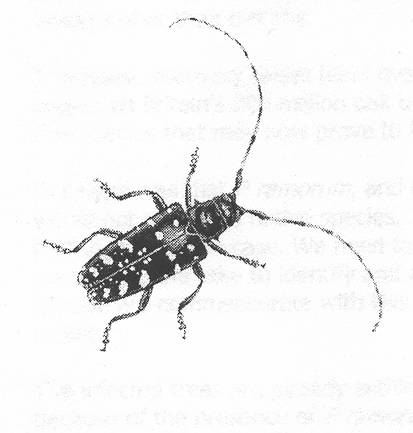
goldspotted oak borer
Two Tree-Killers
California’s oaks – including California black oak, canyon live oak, coast live oak, Engelmann oak, Shreve’s oak, and valley oak – are threatened by one of both of these insects. The goldspotted oak borer (GSOB) is established in San Diego County with additional outbreaks in Riverside and Orange counties. In less than 20 years, GSOB has killed nearly 100,000 black oaks in these counties. GSOB also kills coast live and canyon oaks. These oaks growing throughout the state are at risk to GSOB.
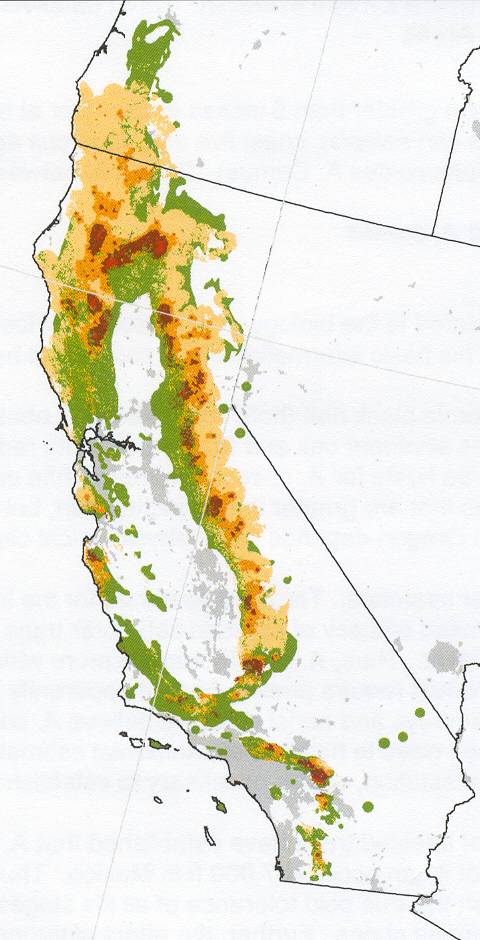 areas of California at risk to goldspotted oak borer
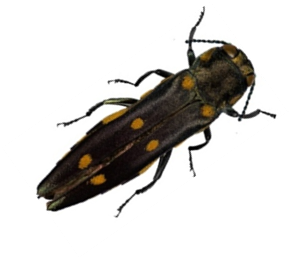
The polyphagous shot hole borer (PSHB) carries a fungus. The beetle-disease complex has been found in areas of Los Angeles, Orange, San Bernardino, Riverside, and San Diego counties. The insect attacks more than 300 species of trees, shrubs, and vines; the fungus survives in more than 100 of these.
Trees attacked by PSHB include: 11 species native to southern California; 13 agriculturally important trees, such as avocado; and 53 species that, cumulatively, constitute more than half of all trees planted in urban areas of southern California. While PSHB might not be able to reproduce in all these hosts, it is known to reproduce in five types of maples, five types of oaks, a couple of willows, as well as a poplar, a sycamore, and an alder.
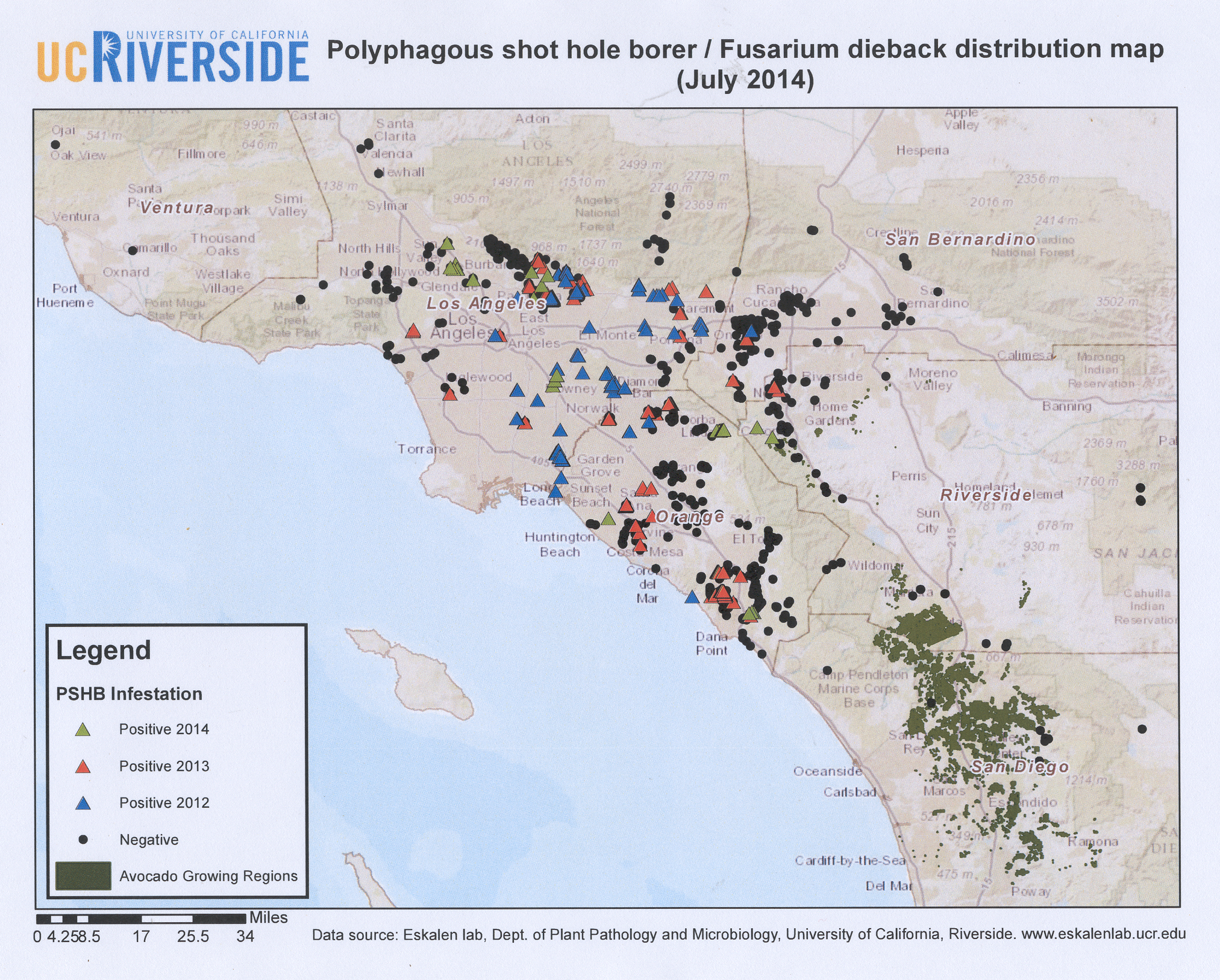
areas of southern California where polyphagous shot hole borer is established
Many of the vulnerable tree species are important components of riparian communities in southern California. PSHB apparently attacks only trees that receive enough water to support the fungus – hence the threat to riparian areas. Since PSHB comes from tropical Southeast Asia, its spread to the north and upslope would probably be limited by winter cold. Nevertheless, a wide variety of trees in large parts of the state appear to be at risk.
Among the natural areas at risk to one or both of these pests is Yosemite National Park. The oak trees growing in Yosemite Valley are black oaks, vulnerable to GSOB.
Both State & National Park Service have Failed to Act
Despite the threat to natural and even agricultural resources throughout the state, CDFA has not adopted regulations governing the movement of firewood – the pathway most likely to spread these pests. CDFA has funded outreach efforts, including flyers, posters at campgrounds, and highway billboards. Broad coalitions – made up of academics; county agriculture and parks officials; federal forestry and public lands staff; and others –are educating the public and firewood vendors about the risk and asking them not to move firewood. But when people ask whether there is a law against moving firewood, these volunteers must answer, “no”. This undermines their message!
Yosemite and the other National parks in the region also have not adopted regulations prohibiting visitors from bringing in firewood obtained outside the park. While the National Park Service discourages people from bringing firewood into the Park from farther than 50 miles away, this request is buried in the detailed description of camping regulations or here.
The other National parks in California also do not regulate visitors’ movement of firewood.
It is past time for state and federal agencies to accept their responsibility to protect priceless natural and agricultural resources by adopting regulations to control the movement of firewood.