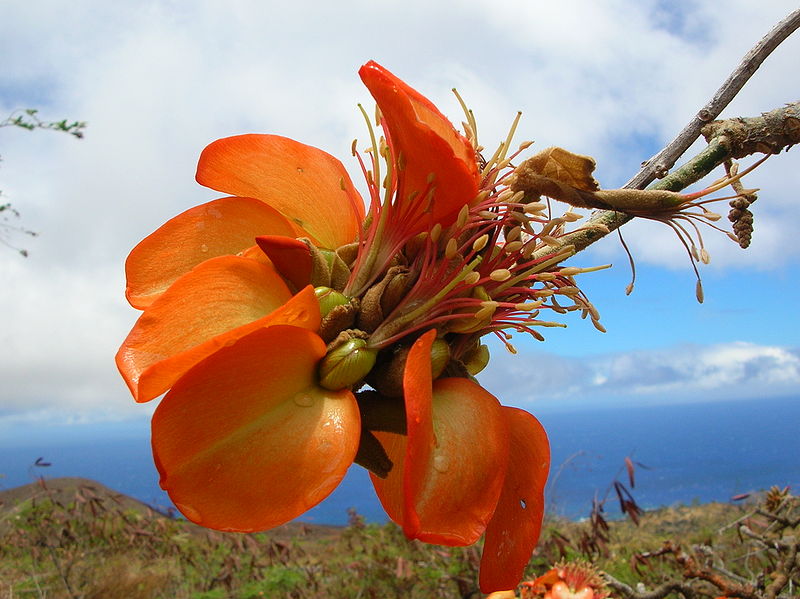
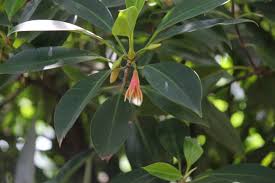
wiliwili flower photo by Forrest and Kim Starr, courtesy of creative commons
Hawaii’s
dryland forest is a highly endangered ecosystem. More than 90% of dry forests
are already lost due to habitat destruction and the spread of invasive plant
and animal species. However, a new publication documents some recovery of
wiliwili trees from one major pest. At the same time, a new pest is spreading
and killing naio, a critical dryland shrub. Both pests originated in countries that have rarely
if ever been a source of U.S. pests. This is worrying because phytosanitary
agencies have their hands full with imports from the usual sources. The role of
California as a source of invasive species in Hawai`i has long deserved federal
attention – but as far as I know has not received it.
Hope for Wiliwili Trees
The
Hawaiian endemic wiliwili tree, Erythrina
sandwicensis, occurs in lowland dry forests on all the major islands from
sea level to 600 m. Wililwili is a dominant overstory tree in these habitats.
(Unless otherwise noted, the principal source is Kaufman et al. in press – full
citation at end of blog.)
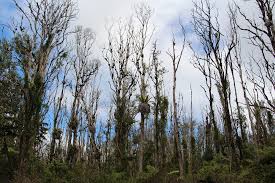
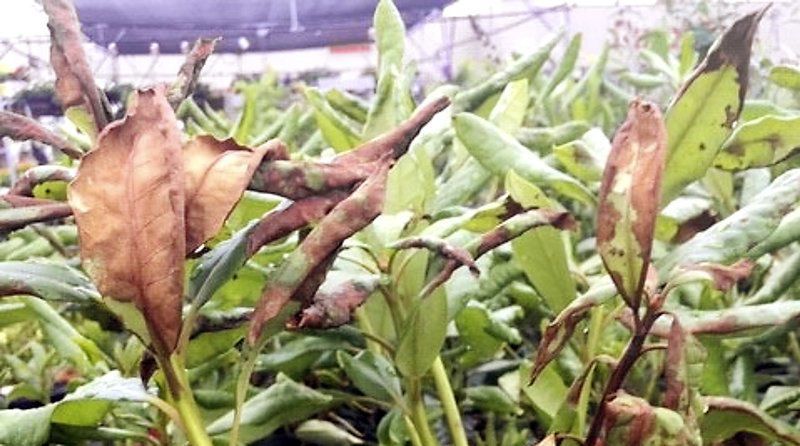
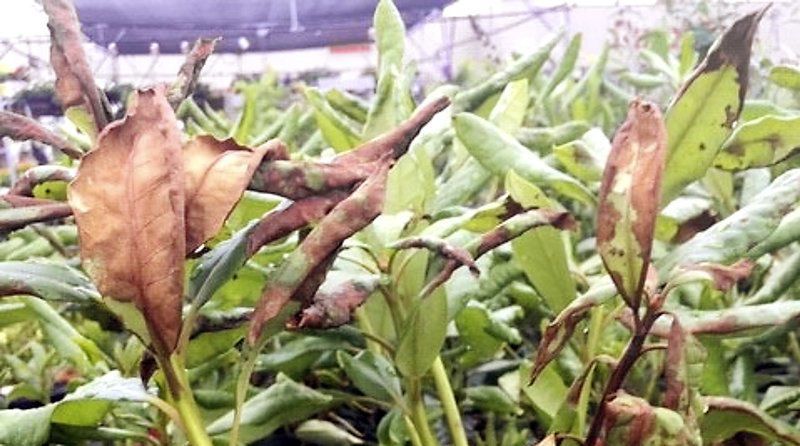
The tree has been severely affected by the introduced Erythrina gall wasp, Quadrastichus erythrinae (EGW). The gall wasp was detected on Oahu in 2005 and quickly spread to the other Hawaiian islands.
Arrival
of the EGW on Oahu was part of the insect’s rapid global range expansion. Originally from East Africa, it was first
detected in the Mascarene Islands and Singapore in 2003. At the time, it was unknown
to science. Within a few years it had spread across Asia, many Pacific islands
(including Hawai`i), and to the Americas, including Florida in 2006, Brazil in 2014
(Culik 2014), and Mexico in 2017 (Palacios-Torres 2017). Although apparently restricted
to the Erythrina genus as host, it
has lots of opportunities. This genus has 116 species distributed across
tropical and subtropical regions: 72 species in the Americas, 31 in Africa, and
12 in Asia.
The
severe damage to wiliwili (and to non-native Erythrina trees planted in urban areas and as windbreaks) prompted Hawaiian
officials to immediately initiate efforts to find a classical biological
control agent. The process moved rapidly. A candidate – a parasitic wasp
species new to science, Eurytoma
erythrinae – was found in East Africa in 2006. Host specificity testing was
carried out. Scientists quickly learned to rear the parasitic wasp in laboratories.
Release of the biocontrol agent was approved in November 2008 – only three and
a half years after the EGW was detected on Oahu.
The
biocontrol agent’s impact was quickly apparent. Establishment was confirmed
within 1–4 months at all release locations throughout Hawai`i. Reduced pest impacts
to trees were detected within two years. By 2018, only 33% of the foliage was
damaged on the majority of wiliwili trees. Damage to non-native Erythrina had also declined.
Results of Biocontrol
Agent’s Release
The
biocontrol agent’s efficacy in reducing EGW’s impacts on trees has been
evaluated for 10 years after the agent’s release. Monitoring was conducted at
sites on four of the six main islands. (The monitoring program and its findings
are described in Kaufman et al. in press).
I wonder how
many other biocontrol agents have been monitored so closely for such a long
time? Shouldn’t they all be?
Given
the uniqueness and importance of such long-term assessment, it is worth looking
at the data in detail.
1) Foliar Damage
and Tree Health
In
2008, before release of the biocontrol agent, more than 70% of young shoots in
wiliwili trees that were inspected were severely infested. The damage rating of
“severe” fell from about 80% of trees in 2008 to about 40% in 2011. About 20%
of trees surveyed – at sites on all islands – had no gall damage.
By
three years after release of the biocontrol agent (2011), mortality rates
attributed to stress from the EGW infestation for trees in natural areas fell
to 21%. Mortality rates for trees in botanical gardens was somewhat higher –
34%. Kaufman et al. proposed several
possible reasons: a) lingering presence of systemic insecticides that might
have harmed the biocontrol agents early in the releases; b) year-round sustenance
for the EGW as a result of the i) presence of alternative hosts and ii) supplemental
irrigation which maintained fresh foliage on the trees.
Less
intensive monitoring occurred during 2013 – 2018. It showed continuing substantial
suppression of EGW damage on Erythrina
foliage, although levels varied among locations. Sites with the lowest
precipitation and higher temperatures throughout the year had the slowest
recovery of wiliwili. Still, trees are now producing vegetative flushes and
healthier canopies during non-dormant periods.
2) Flower and Seed
Damage
Successful
reduction of infestations in flowers and seedpods was less immediate. Still, by
2011, seed-set had increased from less than 3% of trees setting and maturing
seed, to almost 30% with mature seed. The proportion of trees bearing
inflorescences also increased, with more than 60% of trees blooming three years
after introduction of the biocontrol agent. There was also a slow but steady
increase in seed production.
However,
in 2019, it remains unclear how infestation of seedpods will affect germination
and therefore future plant recruitment.
More
worrying, little recruitment was observed over the 10 years. Hawaiian
authorities have completed tests on, and are preparing a petition for release of,
a second biocontrol agent, Aprostocitus
nites. It is hoped that it will further suppress EGW in flowers and
seedpods.
Still, poor recruitment is likely due to the combined impacts of multiple invasive species in native environments. A significant factor is a second insect pest – a bruchid, Specularius impressithorax – which can cause loss of more than 75% of the seed crop. I hope authorities are seeking methods to reduce this insect’s impacts.
The Hawaiian species group of the IUCN has given the wiliwili tree the Reed Book designation of “vulnerable”.
Worries for Naio
naio in bloom photo by Forrest and Kim Starr, courtesy of creative commons
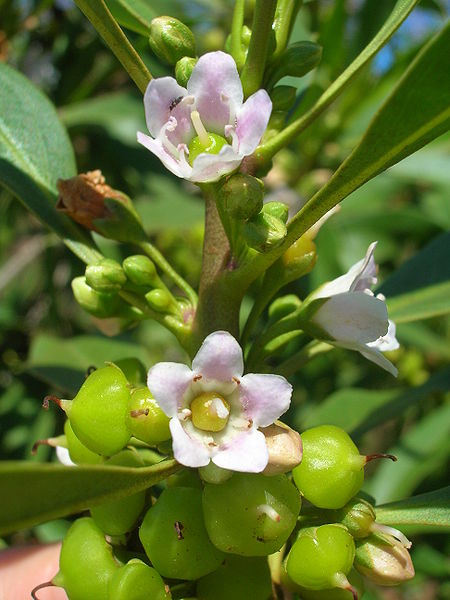
Naio
(Myoporum sandwicense)is an integral component of native Hawaiian
ecosystems, especially in dry forests, lowlands, and upland shrublands.
However, it is also found in mesic and wet forest habitats. Naio is found on all
of the main Hawaiian Islands at elevations ranging from sea level to 3000 m.
The loss of this species would be not only a significant loss of native biological
diversity but also a structural loss to native forest habitats.
The
invasive non-native Myoporum thrips, Klambothrips
myopori, was detected on the Big Island (Hawai‘i Island) in 2009 – four
years after it was first detected on ornamental Myoporum species in California. At the time of the California
detection, the species was unknown to science. It is now known that this
species is native to Tasmania.
The
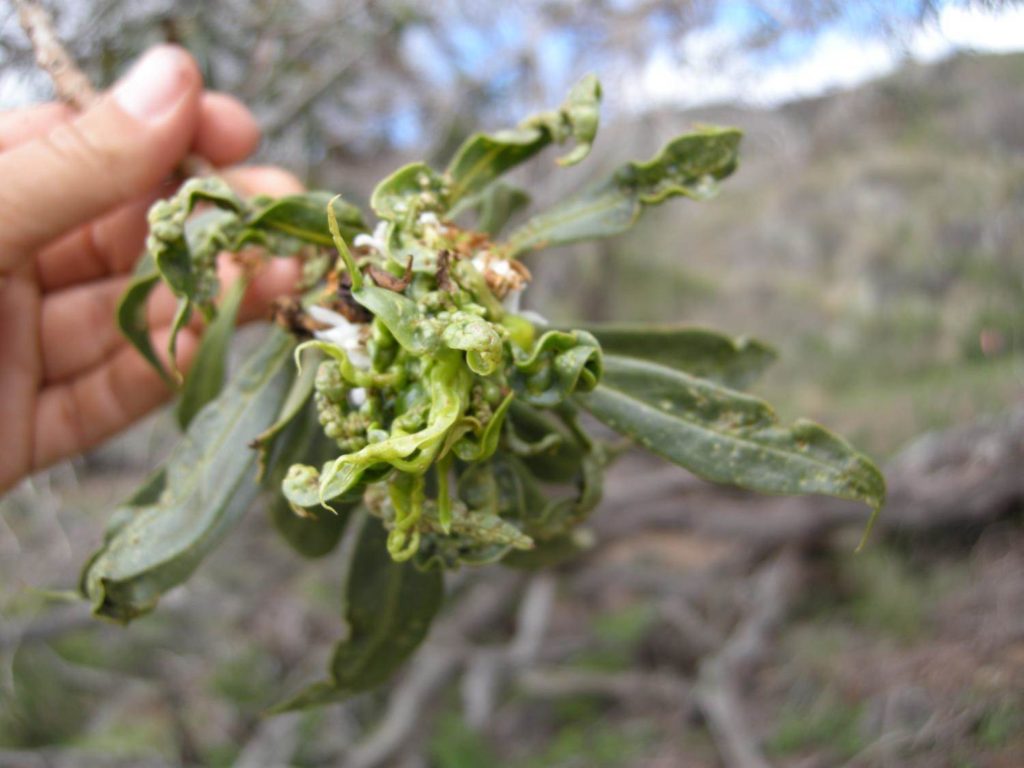
thrips feeds on and causes galls on plants’ terminal growth and can eventually
lead to death of the plant.
For close to a decade, the Myoporum thrips was restricted to the Big Island. It has now been found on Oahu (Wright pers. comm.) Alarmed by the high mortality of plants in California, in September 2010, the Hawaii Department of Lands and Natural Resources Division of Forestry and Wildlife and the University of Hawai‘i initiated efforts to determine spatial distribution, infestation rates, and overall tree health of naio populations on the Big Island. Monitoring took place at nine protected natural habitats for four years. This monitoring program was supported by the USFS Forest Health Protection program. (See also the chapter on naio by Kaufman et al. 2019 in Potter et al. 2019 – full citation at the end of this blog.)
naio damaged by thrips photo by Leyla Kaufman, University of Hawaii
The monitoring confirmed that the myoporum thrips has spread and colonized natural habitats on the leeward side of Hawai`i Island. Infestation rates increased considerably at all sites over the duration of the four-year sampling period. Trees experiencing high infestation levels also showed branch dieback.
Medium-elevation sites (between 500–999 m) had the highest infestations and dieback: over 70% of the shoots had the worst damage.. At two sites, over 70% of the monitored trees have died.
Even
though flowers and fruits were still seen at all sites, little to no plant
recruitment was observed at these sites. Thus another plant species important
in this endangered plant community is in decline.
Few
management strategies are available for this pest. They include preventing
spread to other islands and early detection followed by rapid application of pesticides.
Implications
and Conclusions
The Erythrina gall wasp and myoporum thrips are only two of the thousands of invasive species established in Hawai`i. Island ecosystems, especially Hawai`i, are well recognized as especially vulnerable to invasive species. It has been estimated that on average 20 new arthropod species become established in Hawai`i every year.
East Africa and Tasmania are new sources for invasive species. Phytosanitary agencies need to adjust their targetting of high-risk imports to recognize this reality. Regarding the Hawaiian introduction of the thrips, there was probably made an intermediary stop in California – which is not unusual. (See also ohia rust.)
I
applaud Hawaiian officials’ quick action to counter these pests. I wish their
counterparts in other states did the same.
There
are multiple threats to Hawaii’s dry forests, including habitat modification
and fragmentation; wild fires; seed predation by rodents; predation on seeds, seedling,
and saplings by introduced ungulates (e.g.
feral goats, pigs and deer); competition with invasive weeds; and damage by
invasive insect pests and diseases.
With
so much of Hawaii’s dry forests already lost, the release of biocontrol agents
targetting specific pests is only one element of a much-needed effort. Long-term protection of wiliwili and naio
depends on greater efforts to reduce all threats and to stimulate natural
regeneration of this ecosystem. These programs could include predator-proof
fencing to keep out ungulates; baiting rodents and snails; and active
collection. Breeding, and planting of threatened plant species in an effort to
protect both the individual species and the habitat.
Kaufman,
L.V., J. Yalemar, M.G. Wright. In press. Classical biological control
of the erythrina gall wasp, Quadrastichus erythrinae, in Hawaii.: Conserving an
endangered habitat. Biological Control. Vol. 142,
March 2020
Potter,
K.M. B.L. Conkling. 2019. Forest Health Monitoring: National Status, Trends,
and Analysis 2018. Forest Service Research & Development Southern Research
Station General Technical Report SRS-239
Kaufman,
L.V, E. Parsons, D. Zarders, C. King, and R. Hauff. 2019. CHAPTER 9. Monitoring
Myoporum thrips, Klambothrips myopori (Thysanoptera: Phlaeothripidae), in
Hawaii
Wright, Mark. 2005. Assistant
Professor and Extension Specialist, University of Hawaii. Personal
communication.
APHIS proposes to place numerous plant taxa on its list of plants for planting whose
importation is “not authorized pending pest risk analysis” (NAPPRA). Unfortunately, the proposal comes too late for some
pests; doesn’t apply to at least one significant pathway of entry; excludes some
highly damaging newly detected pathogens; and too often applies only to
agricultural pests. Nevertheless, the proposal is worth supporting – while
mentioning those caveats.
APHIS is accepting comments on the data sheets justifying the proposed listings until 24 January. The Data sheets can be obtained here. We encourage you to comment.
APHIS’
Regulatory Framework
Under
APHIS’ regulations in ‘‘Subpart— P4P’’ (7 CFR 319.37 through 319.37–14 …),
APHIS prohibits or restricts the importation of “plants for planting” – living plants,
plant parts, seeds, and plant cuttings – to prevent the introduction of “quarantine
pests” into the US. A “quarantine pest” is defined in § 319.37–1 as a plant
pest or noxious weed that is of potential economic importance to the United States
and not yet present in the country, or is present but not widely distributed
and is being officially controlled.
§
319.37–2a authorizes APHIS to identify those plant taxa whose importation is
not authorized pending pest risk analysis (NAPPRA) in order to prevent their introduction
into the United States. If the plant taxon has been determined to be a probable
invasive species, its importation is restricted from all countries and regions.
If the taxon has been determined to be a host of a plant pest, the list
includes (1) names of affected taxa, (2) the foreign places from which these
taxa’s importation is not authorized, and (3) the quarantine pests of concern.
APHIS finalized a rule giving itself the authority to place plant taxa in the NAPPRA program in 2011; it has previously used this process twice to restrict imports of plant taxa – most recently in 2017.
Plant Taxa that Host a Damaging Pest
or Pathogen
The proposed restrictions would apply to two plant families —
Myrtaceae taxa (when destined to Hawai`i), and the subfamily Bambusoideae
(bamboo); plus 43 other taxa that are likely to transport damaging insects,
pathogens, or viruses.
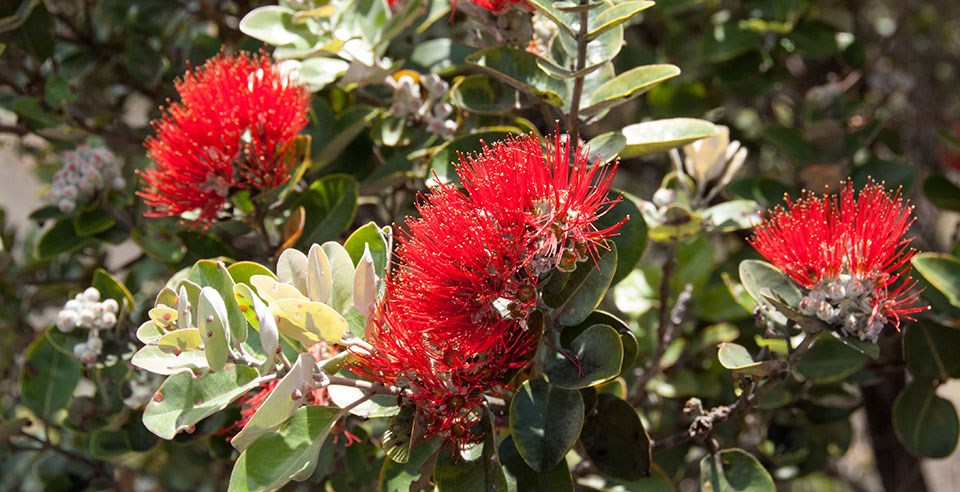
ohia in bloom; National Park Service photo
1)
All plants in the family Myrtaceae that are destined for Hawai`i.
The proposed restriction is intended to counter the risk that additional strains of the `ohi`a rust pathogen Austropuccinia psidii might be introduced and prove more damaging to native Hawaiian vegetation than the strain already present on the islands. (See description of `ohi`a rust here.
`Ohi`a
rust was detected in Hawai`i in 2005. Detection was followed by scientific
studies to determine whether different strains exist and, if so, whether they
posed a threat to Hawaiian vegetation. Under the circumstances, the proposed
action is disturbingly tardy.
Worse,
the pathogen was probably introduced to Hawai`i on imports of flower and
foliage cuttings, rather than entire plants or propagules. Unfortunately, the
section of APHIS’ regulations that governs imports of plants that can be grown
(“plants for planting”) does not apply to imports of cuttings (including
flowers). In the Federal Register notice, APHIS says it will issue a separate
proposal to tighten regulations on imports of cuttings and flowers. I hope they
move expeditiously on this rulemaking –
which will be more cumbersome in even the best case because it requires
a full rulemaking, not the expedited notice and comment process allowed under
the NAPPRA program.
It is disturbing that the proposal does not include the two Ceratocystis species that are killing millions of `ohi`a trees in Hawai`i link to DMF writeup. It is true that these were identified relatively recently – in 2017. However, other plant taxa proposed for inclusion in the NAPPRA category were also detected or determined to be the cause of a disease as recently as 2017.
ohia trees killed by Ceratocystis; Island of Hawaii; photo by J.B. Friday, University of Hawaii
2) APHIS proposes to include another
pest that might attack a native Hawaiian plant, Phyllanthus distichus. Another species in the genus, P. saffordii is endemic to Guam; it is
listed as endangered under the federal Endangered Species Act. Other Asian
gooseberries in the Phyllanthus genus
are grown in backyards in Hawai`i and other semitropical areas and there is
some interest in expanding commercial uses.
3)
APHIS proposes to include several plant taxa important in tropical agriculture
because of the threat that imports of those plants will transport diseases or
pests. These include two pathogens that threaten production of macadamia nuts (Neopestalotiopsis macadamiae and Pestalotiopsis macadamiae); and pests of
breadfruit, lychee, and durian.
4)
Some of the plant taxa that APHIS hopes to protect from new pests or pathogens
by placing hosts in the NAPPRA category are invasive. These include – in
Hawai`i – Syzygium jambos (rose
apple). It is named as a host of two
pests targetted by the proposed action – the `ohi`a rust pathogen Austropuccinia psidii and armored scale
insect Myrtaspis syzygii.
Euonymus bungeanus (winterberry euonymus) is in the same genus as
several plant species invasive across the continent. APHIS proposes to restrict its importation in
order to prevent introduction of the Euonymus yellow mottle associated virus
(EuYMaV), which has only that plant species as a known host.
5)
APHIS also proposes to add to the NAPPRA category several plant taxa that could
transport the Elm mottle virus (EMoV) because of the threat the virus poses to
several European elm species – and presumably also to North American elms. The
virus also attacks hydrangea and lilac.
In
several cases, some of the primary hosts of the target pest or pathogen are already
in NAPPRA for other reasons from some origins. Nearly all the woody hosts are
already required to undergo post-entry quarantine – which presumably APHIS now
considers to provide inadequate protection.
6) Also proposed are diseases or pests
that threaten grapevines and tomatoes.
Several of the proposed taxa are already
present in the US (including `ohi`a rust). Other proposed listings appear to be
precautionary actions to protect plant taxa that USDA expects to be
increasingly important economically in the future.
Plant
Taxa Proposed Because They Appear Likely to be Invasive
APHIS has proposed 26 plant taxa for inclusion in the NAPPRA category because they might themselves be invasive. Of greatest ecological concern are two taxa of mangroves which had been introduced by early 20th century plant explorer David Fairchild and have since been detected to be spreading in South Florida. These are Bruguiera gymnorhiza and Lumnitzera racemose. Also of concern is a vine that grows in Asian and Indian Ocean mangrove forests, Derris trifoliate.
Bruguiera gymnorhiza; Wikimedia Commons
Several proposed species are aquatic
plants that can form dense mats.
Other taxa proposed appear to possibly
threaten pastures or other agricultural uses.
Posted
by Faith Campbell
We
welcome comments that supplement or correct factual information, suggest new
approaches, or promote thoughtful consideration. We post comments that disagree
with us — but not those we judge to be not civil or inflammatory.
P. ramorum-infected rhododendron plants Indiana Department of Natural Resources
As you may remember, in June and July I blogged about a troubling outbreak of sudden oak death pathogen Phytophtora ramorum in the nursery trade. The discovery was made by Indiana authorities, who carefully inspected plants being sold in the state. They discovered that rhododendron plants imported from an Oklahoma wholesaler included infected plants.
By the end of May, Indiana state inspectors had destroyed more than 1,500 rhododendrons and prohibited sale of another 1,500 plants pending determination of their health. [source: Indianapolis Star 29 May, 2019] Over the next months, APHIS determined that more than 50 rhododendron plants found in Indiana nurseries had been infected [California Oak Mortality Task Force Newsletter August 2019 ].
In the spring and summer, APHIS and state authorities alerted 28 states that they might have received plants from the suspect sources – the suppliers of the Oklahoma wholesaler — one nursery in Washington State and two nurseries from Canada. In the end, APHIS determined that plants exposed to the pathogen had been sent to 18 states – Alabama, Arkansas, Iowa, Illinois, Indiana, Kansas, Kentucky, Michigan, Missouri, Nebraska, North Carolina, Ohio, Oklahoma, Pennsylvania, Tennessee, Texas, Virginia, and West Virginia. As of late July, P. ramorum-positive nursery stock had been detected in nurseries in seven of these (Iowa, Illinois. Indiana, Kansas, Missouri, Nebraska, Oklahoma) plus Washington [California Oak Mortality Task Force Newsletter August 2019].
As I pointed out in the earlier blog, this is just the latest of several occasions since 2004 in which infected plants have been widely distributed by the nursery trade, despite federal and state regulations. Also, at the time of this outbreak, APHIS had just formalized several steps relaxing the regulations that had been implemented through Federal Orders adopted in recent years. (See the earlier blog for details.)
APHIS actions
I wonder at APHIS’ delay in explaining to stakeholders the situation– and what it is doing about it! APHIS provided minimal information to me – by email rather than a public announcement; this email came a month after Indiana announced detection of the pathogen to the public (as reported in my blog). APHIS issued an official notice even later, in mid-July [California Oak Mortality Task Force (COMTF) Newsletter August 2019]. Neither notice was timely, given the serious risks to both nursery and naturally growing plants from the pathogen.
It
is now November and principal questions have not yet been answered. How did the
inspection systems in Washington and British Columbia fail to detect the
outbreaks before the plants were shipped? This lapse is especially worrisome
because APHIS requires testing of soil and standing water, not just visual
inspection of plants. Furthermore, rhododendrons are well known to be
vulnerable to the pathogen and therefore are a specified focus of detection
efforts!
The October COMTF newsletter includes a report by the Washington State Department of Agriculture that a nursery found positive in May will carry out a Critical Control Points (CCP) assessment. An “extensive fall certification survey” will also be conducted. Presumably, these efforts are aimed at determining how the outbreak occurred.
The Canadian Food Inspection Service (CFIA) described – briefly – its nationwide survey program. CFIA reported that one nursery was determined to be P. ramorum-positive in 2018, three in 2019. CFIA says that trace-forwards and trace-backs demonstrate that no Canadian nursery shipped infected plants to the U.S. in 2018 or 2019. So, apparently, none of the infected plants came from the Canadian nurseries.
I hope that Washington State and APHIS will soon determine the probable causes of the outbreak. APHIS should then promptly inform all stakeholders and engage them in developing improved programs and policies to minimize the likelihood that similar problems will occur again.
Phytosanitary officials from the states are apparently also seeking additional information from APHIS about what went wrong and how the agency plans to fix the problems. See the resolution adopted by the National Plant Board here
California
Action
A much more positive development is that the California Department of Food and Agriculture (CDFA) has introduced a Voluntary P. ramorum Pre-Quarantine Program. This is a voluntary inspection program specifically for nurseries in California counties that are not currently regulated for the pathogen – but that might be put under regulation in the future. Inspections and sampling will be administered by county regulatory officials and samples will be processed by the CDFA Plant Pest Diagnostics Center. If P. ramorum is detected at a participating nursery, the PQP nursery may become a federally regulated establishment.
Broader Implications
As I pointed out in Fading Forests III, APHIS and the states have struggled to prevent spread of tree-killing pests once they have established in the country. Even regulated pests – such as Phytophthora ramorum and the emerald ash borer — have escaped the regulations. APHIS and/or the states have chosen not to engage on other pests, such as redbay ambrosia beetle and laurel wilt disease and the polyphagous and Kuroshio shot hole borers and associated Fusarium fungus. In other cases, some states have acted – and asked APHIS to not get involved – e.g., thousand cankers disease of walnut. This situation heightens the risk to our urban, rural, and wildland forests. Americans need a hard-nosed discussion of how we can improve coordinated efforts to prevent pests’ spread.
Posted
by Faith Campbell
We
welcome comments that supplement or correct factual information, suggest new
approaches, or promote thoughtful consideration. We post comments that disagree
with us — but not those we judge to be not civil or inflammatory.
It
is widely recognized that invasions of non-native species occur as a
consequence of international trade (see Seebens et. al. 2017 – full citations at the end of this blog). This is as
true for non-native forest pests as for any other bioinvader – see Aukema et al. 2010; Liebhold et al. 2012, Lovett et al. 2016. In fact, gross domestic product – as an indicator of levels
of trade — is a better predictor of the number of forest pest invasions in a
given country than the country’s amount of forested land (Roy et al. 2014).
shipping containers at port of Long Beach, California
As I noted in my previous blog, I began studying and writing about the threat to North America’s forests from non-native insects and pathogens in the early 1990s. I reported my analyses of the evolving threat in the three “Fading Forests” reports – coauthored by Scott Schlarbaum – in 1994, 2003, and 2014. These reports are available here.
I document here that both introduction
and spread of pests within the country have continued apace. While significant
efforts have been made to prevent introductions (described briefly under the
“Invasives 101” tab of the CISP website), they have fallen short. As I noted in
Fading Forests III, programs aimed at preventing spread of pests within the
country remain fragmented and often are unsuccessful.
The Challenge: Huge Volumes of goods are moving, providing
opportunities for pests
Since 1990, volumes of imported goods more than quintupled. Within the U.S., a total of 17,978 million tons of goods were transported in 2015; 10,776 million tons of this total by truck. About one-third of this total – 5,800 million tons – was moved farther than 250 miles. These vehicles moved on a public roads network of 4,154,727 miles (US DOT FFA). Consequently, once a pest enters the U.S., it can be moved quickly into every corner of the country.
Introductions
By and large,
establishment of tree-killing pests has occurred at a fairly steady rate of
about 2.5 per year, with “high-impact” insects and pathogens accumulating at
0.43 per year (Aukema et al. 2010). Since
introductions did not rise commensurately with rising import volumes, Lovett et al. (2016) concluded that the
recently adopted policies for preventing introductions referenced above are
having positive effects but are insufficient to reduce the influx of pests in
the face of ever-growing global trade volumes. The study’s authors went on to
say that absent more effective policies, they expect the continued increase in
trade will bring many new establishments of non-native forest pests.
One group of forest
pests did not enter at a steady rate, but rather entered at a higher rate since
1985 – wood-boring insects. Experts concluded that the increase probably
reflected increases in containerized shipping (Lovett et al. 2016). At the global level, the rate of fungal invasions has
also recently been reported to be increasing rapidly (Roy et al. 2014).
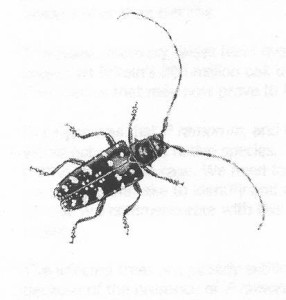
Asian longhorned beetle
Geography of trade
patterns also matters. Opening of trade with China (in 1979) offered
opportunities for pests from a new source country which has a similar climate
and biology. Roy et al. describe the importance of phylogenetic
relatedness of pests and of tree hosts in explaining tree species’ vulnerability
to introduced pests. The most vulnerable forests are those made up of species
similar to those growing in the source of the traded goods – i.e., the temperate forests of the
northeastern U.S. – when goods are imported from similar forested areas of
Europe and Asia. Chinese-origin wood-boring pests began to be detected around
1990. This already short interval probably underestimates how quickly pests
began arriving; detection methods were poor in those years, so a pest was often
present for close to a decade before detection.
Between 1980 and 2016, at least 30 non-native species of wood- or bark-boring insects in the Scolytinae / Scolytidae were newly detected in the United States (Haack and Rabaglia 2013; Rabaglia et al. 2019). Over the same period, approximately 20 additional tree pests were introduced to the continental states (Wu et al. 2017; Digirolomo et al. 2019; R. Haack, pers. comm.) plus about seven to America’s Pacific islands. Not all of the new species are highly damaging, but enough are. See my previous blog here.
Many of the tree-killing
pests were probably associated with pathways other than wood packaging. These
include 6 of the 7 Agrilus species, sudden oak death pathogen, three pests of palm trees, the
spotted lanternfly, beech leaf disease; and the pests introduced to America’s
Pacific Islands.
HIGH-RISK
PATHWAYS OF INTRODUCTION
Already
in the 1990’s it was evident that better preventing pest introductions would
depend on shutting down the variety of pathways by which they move around the
world. At that time, attention focused on imports of
logs and nursery stock (nursery stock makes up one component of a broader
category called by phytosanitary agencies “plants for planting”). Both logs and
“plants for planting” had well-established histories of transporting pests and
import volumes were expected to grow. We have since learned that there are many
more pathways!
Plants for Planting
Imports of “plants for planting” (phytosanitary agencies’ term, which encompasses nursery stock, roots, bulbs, seeds, and other plant parts that can be planted) have long been recognized as a dangerous pathway for introduction of forest pests. For example, this risk was the rationale for adopting the 1912 Plant Quarantine Act. Charles Marlatt, Chairman of USDA’s Federal Horticultural Board (see “Then and Now” in Fading Forests III here), wrote about the risk in National Geographic in April 1911 (urging adoption of the 1912 law) and again in August 1921. See also Brasier (2008), Roy et al. (2014), Liebhold et al. (2012), Jung et al. (2016).
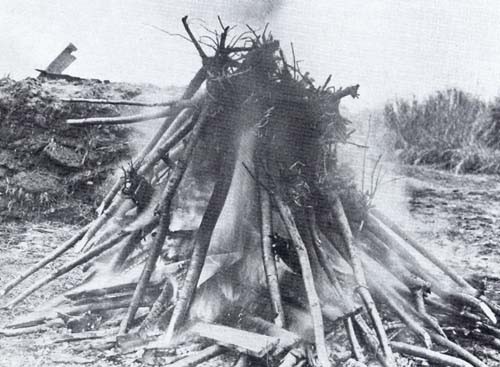
Japanese cherry trees being burned because of scale infestation January 28, 1910; Agriculture Research Service
Of the 91 most
damaging non-native forest pest species in the U.S. (Guo et al. 2019), about 62% are thought to have entered North America
with imports of live plants. These include nearly all the sap-feeding insects,
almost 90% of the foliage-feeding insects, and approximately half of the
pathogens introduced during the period 1860-2006 (Liebhold et al. 2012). Specific examples include chestnut blight, white pine
blister rust, Port-Orford-cedar root disease, balsam woolly adelgid, hemlock
woolly adelgid, beech scale, butternut canker, dogwood anthracnose, and sudden
oak death. In more recent years, introductions via this pathway possibly
include ‘ōhi‘a
rust, rapid ‘ōhi‘a death pathogens, and beech leaf disease. The gypsy
moth, while a foliage feeder, was not introduced via imports of live plants.
The
APHIS annual report for 2018 reported that in that year we imported 18,502
shipments containing more than 1.7 billion
plant units (plants, bulbs, in vitro materials, etc.).
Liebhold et al. 2012, relying on 2009 data, found that about 12 percent of incoming plant shipments had symptoms of pests – a rate more than 100 times greater than that for wood packaging. Worse, a high percentage of the pests associated with a shipment of plants is not detected by the federal inspectors. The meaning of this finding is unclear because the study did not include any plant genera native to temperate North America and APHIS points out that infestation rates varied considerably among genera in the study. However, APHIS has not conducted its own analysis to document the “slippage rate” on imports of greatest concern to forest conservationists, i.e., imports of woody plants. I provide details on pests detected on imports of woody plants in recent in my blog here.
Clearly the risk of pest introductions continued at least until recently. I reviewed an APHIS database listing pests newly detected in the country during the period 2009-2013. I concluded that approximately 37 of the 90 “new” pests listed in the database (viruses, fungi, aphids and scales, whiteflies, mites) were probably introduced via imports of plants, cuttings, or cut foliage or flowers. I discussed these matters in greater detail here.
Adoption of a new regulatory regime governing imported plants for planting (Q-37 regulation) in 2018 is too recent to for us to see its impact. But the new regulation sets up a process under which APHIS can impose more protective regulations on specific types of plants or plants from certain countries of origin to counter a perceived concerning level of risk. Until APHIS begins activating its new powers by negotiating more protective regulations governing plant imports from high-risk sources, it seems unlikely there will be any meaningful change in the introduction rates.
Crates, Pallets,
and Other Forms of wood packaging (solid wood packaging, or SWPM)
Recognition
of the risk associated with wood packaging is much more recent. In 1982, a USDA
risk assessment concluded that the wood boring insects found in crates and
pallets were not of great concern (USDA APHIS and Forest Service, 2000).
However, contradictory indications were quickly documented – including from
APHIS’ own port interception data – which the agency began collecting in 1985. Over
the 16-year period 1985-2000, 72%
of
the 6,825 bark beetles (Scolytidae)
intercepted by APHIS were found on SWPM (Haack 2002). Cerambycids (longhorned
beetles) and buprestids (jewel beetles) make up nearly 30% of insects detected
in wood packaging over the last 30 years (Haack et al. 2014).
Detection
of outbreaks of the Asian longhorned beetle and other woodborers in the
mid-1990s made it clear that wood packaging was, indeed, a high-risk pathway.
Of
the 91 most damaging non-native pest species in the US, 30% probably arrived
with wood packaging material or other wood products (Liebhold et al. 2012). This group includes many
of the most damaging pests, the deadly woodborers – Asian longhorned beetle,
emerald ash borer, redbay ambrosia beetle,
possibly the polyphagous and Kuroshio shot hole borers.
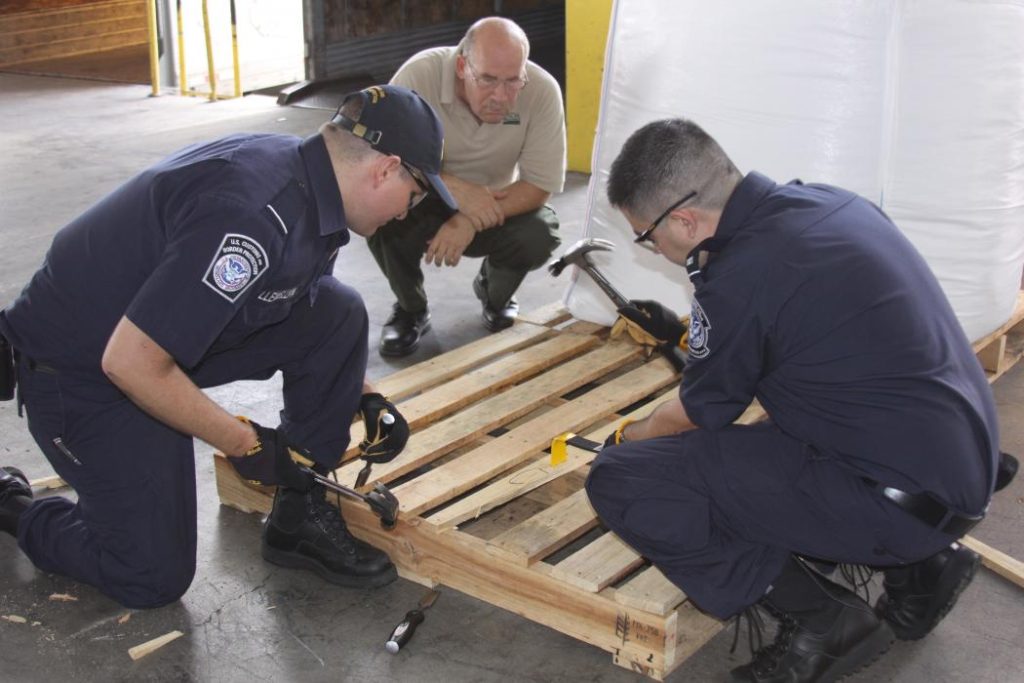
CBP agents inspecting a pallet
As noted above, introductions of wood borers have risen in recent decades, widely accepted as associated with the rapid increase in containerized shipping after 1980. In 2009 it was estimated that 75% of maritime shipments were packaged in crates or pallets made of wood (Meissner et al. 2009). A good history of the global adoption of containerized shipping is Levinson, M. The Box: How the Shipping Container Made the World Smaller and the World Economy Bigger (Princeton University Press 2008)
The simultaneous
opening of trade with China (in 1979) offered opportunities for pests from a
new source country which has a similar climate and biology. Chinese-origin wood-boring
pests began to be detected around 1990. This already short interval probably underestimates
how quickly pests began arriving; detection methods were poor in those years,
so a pest was often present for close to a decade before detection.
I have already documented numerous times that, despite the U.S.’ implementation of the International Standard of Phytosanitary Measures (ISPM) #15 in 2006, live quarantine pest woodborers continue to enter the U.S. in wood packaging. The best estimate is that 0.1% of wood packaging entering the United States is infested with wood-borers considered to be quarantine pests (Haack et al. 2014). More than 22 million shipping containers entered the U.S. via maritime trade in 2017 (US DoT). As noted, an estimated 75% of sea-borne containers include wood packaging. Applying the 0.1% estimate to these figures results in an estimate that as many as 17,650 containers per year (or 48 per day) transporting tree-killing insects enter the U.S.
Over a period of
nine years – Fiscal Years 2010 through 2018 – U.S. Customs and Border
Protection (CBP) detected more than 28,600 shipments with wood packaging that
did not comply with ISPM#15 (Harriger presentations to the annual meetings of
the Continental Dialogue on Non-Native Forest Insects and Diseases). While most
of the non-compliant shipments were wood packaging that lacked the required
mark showing treatment per ISPM#15,
in 9,500 cases the wood packaging actually harbored a pest in a regulated
taxonomic group.
Disturbingly, 97%
of the shipments that U.S. CBP found with infested wood packaging bear the
ISPM#15 mark certifying that wood had been fumigated or heat-treated (Harriger
2017). CBP inspectors tend to blame this on widespread fraud in use of the mark.
On the other hand, one study found that larvae can survive both treatments –
although the frequency of survival was not determined. It was documented that twice
as many larvae reared from wood treated by methyl bromide fumigation survived
to adulthood than larvae reared from heat-treated wood; the reason is unclear
(Nadel et al. 2016).
The APHIS’ record
of interceptions for the period FYs 2011 – 2016 contained 2,547 records for
insect detections on wood packaging. The insects belonged to more than 20
families. Families with the highest numbers of detections were Cerambycids –
25% of total; Curculionidae – 23% (includes Dendroctonus,
Ips, Orthotomicus, Scolytinae, Xyleborus, Euwallacea); Scolytidae – 17% (includes
true weevils such as elm bark beetles); Buprestids – 11%; and Bostrichidae –
3%. Not all of the insects in these groups pose a threat to North American
plant species.
One encouraging data point is that since 2010, there have been no detections of species of bark and ambrosia beetles new to North America in the traps deployed by the USDA Forest Service Early Detection and Rapid Response program (Rabaglia 2019). The 2014 recognition of the Kuroshio shothole borer apparently did not result from this trapping program.
There have been several changes in the wood packaging standard and its implementation by CBP since 2009, the year Haack et al. 2014 analyzed the “pest approach rate”. APHIS has not carried out a study to determine whether these recent changes have reduced the approach rate below Haack’s estimate of 0.01%. Consequently, we do not know whether these changes have reduced the risk of pest introductions.
Other Pathways That
Transport Fewer Pests – Some of Which Have High Impacts
Insects
that attach egg masses to hard surfaces can be transported by ship
superstructures, containers, and hardsided cargoes such as cars, steel beams,
and stone. While relatively few species have been moved in this way, some have
serious impacts. The principal examples are the gypsy moths from Asia, which
feed on 500 species of plants (Gibbon 1992).
The United States and Canada have a joint program – under the auspices of the North American Plant Protection Organization (see RSPM #33) aimed at preventing introduction of species of Asian gypsy moths. The NAPPO standard originally went into force in March 2012. Under its terms, ships leaving ports in those countries during gypsy moth flight season must be inspected and cleaned before starting their voyage.
Gypsy moth populations rise and fall periodically; it is much more likely that egg masses will be attached to ships during years of high moth population densities. These variations are seen in U.S. and Canadian detection reports – as reported here.
While most AGM detections are at West Coast ports, [here; and here] the risk is not limited to that region. AGM have been detected at Wilmington, NC; Baltimore, MD; Charleston, SC; Savanna and Brunswick, GA; Jacksonville, FL; New Orleans, LA; Houston and Corpus Christi, TX; and even McAlester, OK.
Nor is the risk limited to the ships themselves. In 2014, more than 500 Asian gypsy moth egg masses were found on four shipments of imported steel slabs arriving at ports on the Columbia River in Washington.
Between 1991 and 2014, AGM was detected and eradicated
on at least 20 occasions in locations across the United States (USDA AGM pest
alert). Additional outbreaks have been discovered and eradication efforts
undertaken in more recent years.
A second example is
the spotted lanternfly (SLF) (Lycorma delicatula), which was first
detected in southeast Pennsylvania in autumn 2014. It is native to Asia; it is
believed to have entered the country as egg masses on imported stone.
While SLF is
clearly a pest of agriculture – especially grapes and tree fruits – its
importance as a forest pest is still unclear. Many native forest trees appear
to be hosts during the insect’s early stages, including maples, birches,
hickories, dogwoods, beech, ash, walnuts, tulip tree, tupelo, sycamore, poplar,
oaks, willows, sassafras, basswood, and elms. Adult lanternflies strongly
prefer the widespread invasive species tree of heaven (Ailanthus altissima).
As of August 2019, SLF was established in parts of five states: Delaware, Maryland, New Jersey, Pennsylvania, and Virginia. It was detected as having spread to a 14th county in Pennsylvania; five new counties in New Jersey. APHIS is working with state departments of Agriculture in these states, as well as supporting surveys in New York, North Carolina, and West Virginia (USDA APHIS DA-2019-20, August 7, 2019). Apparently the detections of a few adults – alive or dead – in Connecticut and New York had not evolved into an outbreak. See description and map here.
Imports of logs – roundwood – seem inherently risky. Certainly Dutch elm disease was introduced via this pathway. However, there have been few pest introductions linked to this pathway in recent years, probably because we import most of our unprocessed lumber from Canada. (I provide considerable data on U.S. roundwood imports in Fading Forests III here.)
Decorative items and furniture made of unprocessed wood certainly have the potential to transport significant pests (USDA APHIS 2007). Examples include boxes and baskets; wood carvings; birdhouses; artificial Christmas trees or other plants; trellises; lawn furniture. To date, apparently, no high-impact pest has been introduced via this pathway, although pests intercepted on shipments have included Cerambycids from Asia, e.g., velvet longhorned beetle and here.
Alarmed by high numbers of infested shipments from China, APHIS first suspended imports of such items temporarily; then adopted a regulation (finalized in March 2012 – USDA APHIS 2012).
APHIS
has not taken action to prevent introductions on such items imported from other
countries – although the North American Plant Protection Action adopted a
regional standard making the case for such action and outlining a risk-based
approach (NAPPO RSPM#38).
Snails on Shipping
Containers
Snails have been
detected on shipping containers and wood packaging for decades. In 2015, APHIS
stepped up its efforts to address this risk through bilateral negotiations with
Italy and launching regional and international efforts to develop guidance for
ensuring pest-free status of shipping containers (Wendy Beltz, APHIS, presentation
to National Plant Board, 2018 annual meeting).
SPREAD
WITHIN THE UNITED STATES
Major pathways for human-assisted spread of pests within the country are sales of plants for planting, movement of unprocessed wood – especially firewood, and hitchhiking on transport vehicles. Since most forest pests are not subject to federal quarantine, any regulatory programs aimed at preventing spread depend on cooperation among the 50 states. None of these pathways is regulated adequately to prevent pests’ spread. See Chapter 5 of Fading Forests III here.
And since neither
federal nor state agencies do significant enforcement of existing regulations,
preventing spread often depends upon pest awareness of, and voluntary
compliance by, individuals and companies.
Even pests subject to a federal quarantine are not prevented from spreading. Plants exposed to the sudden oak death pathogen were shipped to 18 states in spring 2019.
SOD-infected rhododendron plant; Indiana Department of Natural Resources
A collaborative effort by the nursery industry, APHIS, and states (Systems Approach to Nursery Certification, or SANC) is striving to close gaps linked to the standard practice of inspecting plants at the time of shipping, but full implementation of this voluntary program is still years away.
Transport of firewood has been responsible for movement of pests both short distances, e.g., goldspotted oak borer in southern California; and long distances – e.g., emerald ash borer to Colorado. APHIS attempted to develop a certification program but the industry was unable to put one together (see Chapter 5 of Fading Forests III). Current federal and state regulations of firewood are tied to the emerald ash borer quarantine, which APHIS has proposed to terminate. Wood for turning and woodworking has also been linked to movement of pests, e.g., walnut twig beetle/thousand cankers disease from the west to Pennsylvania.
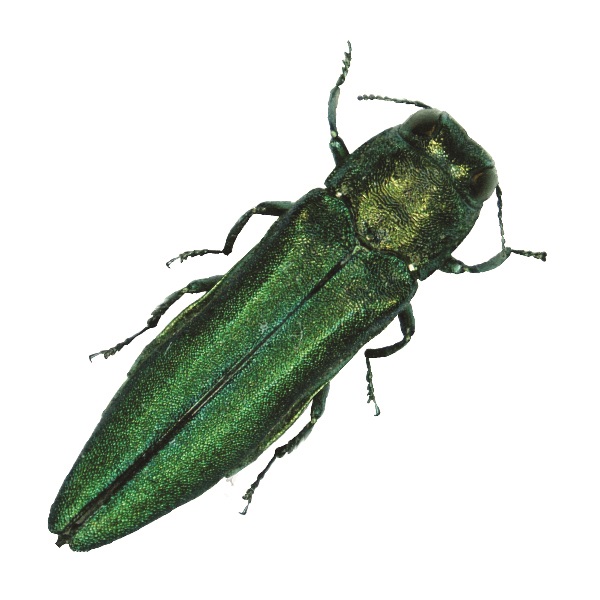
emerald ash borer
Truck transport of a
variety of goods has transported European gypsy moths from the infested areas
in the east to the west coast. Transport of stone probably moved spotted
lanternfly from southeastern Pennsylvania to Winchester, Virginia.
SOURCES
Aukema, J.E., D.G. McCullough, B. Von
Holle, A.M. Liebhold, K. Britton, & S.J. Frankel. 2010. Historical
Accumulation of Nonindigenous Forest Pests in the Continental United States.
Bioscience. December 2010 / Vol. 60
No. 11
Brasier, C.M. 2008. The biosecurity
threat to the UK and global environment from international trade in plants. Plant Pathology (2008) 57, 792-808
Bray, A.M., L.S. Bauer, T.M. Poland,
R.A. Haack, A.I. Cognato, J.J. Smith. 2011. Genetic analysis of emerald ash
borer (Agrilus planipennis Fairmaire)
populations in Asia and North America. Biol. Invasions (2011) 13:2869-2887
Gibbon,
A. 1992. “Asian Gypsy Moth Jumps Ship to United States.” Science.
Vol. 235. January 31, 1992.
Haack R. A. and J.F. Cavey. 1997.
Insects Intercepted on Wood Articles at United States Ports-of-Entry and Two
Recent Introductions: Anoplophora
glabripennis and Tomicus piniperda.
In press in International forest insect workshop proceedings, 18 – 21
August 1997, Pucon, Chile. Corporacion National Forestal, Santiago, Chile.
Haack, R.A., F. Herard, J. Sun, J.J.
Turgeon. 2010. Managing Invasive Populations of Asian Longhorned Beetle and
Citrus Longhorned Beetle:A Worldwide Perspective. Annu. Rev. Entomol. 2010.
55:521-46.
Haack,
R.A. and R.J. Rabaglia. 2013. Exotic Bark and Ambrosia Beetles in the USA:
Potential and Current Invaders. CAB International 2013. Potential Invasive
Pests of Agricultural Crops (ed. J. Peña)
Haack R.A., Britton K.O., Brockerhoff, E.G., Cavey, J.F.,
Garrett., L.J., 2014. Effectiveness of the International Phytosanitary Standard
ISPM No. 15 on Reducing Wood Borer Infestation Rates in Wood Packaging Material
Entering the United States. PLoS ONE 9(5): e96611.
doi:10.1371/journal.pone.0096611
Haack,
R.A., F. H´erard, J. Sun, and J.J. Turgeon. 2010. Managing Invasive Populations
of Asian Longhorned Beetle and Citrus Longhorned Beetle: A Worldwide
Perspective. Annu. Rev. Entomol. 2010. 55:521–46
Harriger, K. Department of Homeland Security Bureau of
Customs and Border Protection, presentation to the Continental Dialogue on
Non-Native Forest Insects and Diseases, November 2017.
Jung T, Orlikowski L, Henricot B, et al. 2016. Widespread
Phytophthora infestations in European nurseries put forest, semi-natural and
horticultural ecosystems at high risk of Phytophthora diseases. Forest
Pathology 46: 134–163.
Liebhold, A.M., E.G. Brockerhoff, L.J. Garrett, J.L.Parke, and K.O Britton.
2012. Live plant inports: the major pathway for forest insect and pathogen invasions of the US. Frontiers in
Ecology.
Lovett, G.M., M. Weiss, A.M. Liebhold, T.P. Holmes, B.
Leung, K.F. Lambert, D.A. Orwig, F.T.
Campbell, J. Rosenthal, D.G. McCullough, R. Wildova, M.P. Ayers, C.D. Canham,
D.R. Foster, S.L. LaDeau, and T. Weldy. 2016.
Non-native forest insects and pathogens in the United States: Impacts
and policy options. Eological
Applications, 26(5) pp. 1437-1455.
Meissner, H., A. Lemay, C. Bertone, K. Schwartzburg, L.
Ferguson, and L. Newton. 2009. EVALUATION OF PATHWAYS FOR EXOTIC PLANT PEST
MOVEMENT INTO AND WITHIN THE GREATER CARIBBEAN REGION. Caribbean Invasive
Species Working Group (CISWG) and Plant Epidemiology and Risk Analysis
Laboratory (PERAL) / CPHST. June 4, 2009
Morin, R. presentation at Northeastern Forest Pest Council 81st Annual
Meeting, March 12 – 14, 2019, West
Chester, Pennsylvania
Nadel, N., S. Myers, J. Molongoski, Y.
Wu, S. Linafelter, A. Ray S. Krishnankutty, and A. Taylor. 2016.
Identificantion of Port Interceptions in Wood Packaging Material: Cumulative
Progress Report, April 2012 – August 2016
Rabaglia,
R.J., A.I. Cognato, E. R. Hoebeke, C.W. Johnson, J.R. LaBonte, M.E. Carter, and
J.J. Vlach. 2019. Early Detection and Rapid Response. A Ten-Year Summary of the
USDA Forest Service Program of Surveillance for Non-Native Bark and Ambrosia
Beetles. American Entomologist Volume 65, Number 1
Roy, B.A., H.M. Alexander, J. Davidson,
F.T. Campbell, J.J. Burdon, R. Sniezko, and C. Brasier. 2014. Frontiers in Ecology 12(8): 457-465
U.N. Food and Agriculture Organization International
Plant Protection Convention. 2012. International Standards for Phytosanitary Meaures
No. 36 Integrated Measures for Plants for planting. Rome. Online at
https://www.ippc.int/ Accessed December
7, 2012.
United States Department of Agriculture
Animal and Plant Health Inspection Service and Forest Service, 2000. Pest Risk
Assessment for Importation of Solid Wood Packing Materials into the United
States.
United States Department of Agriculture Animal and
Plant Health Inspection Service 2009. Proposed Rule Importation of plants for
planting: establishing a category of plants for planting not authorized for
importation pending pest risk assessment. Federal
Register 74(140): 36403-36414 July 23, 2009.
United
States Department of Agriculture Animal and Plant Health Inspection Service 7
CFR Parts 318, 319, 330, 340, 360, and 361. Federal Register Rules and
Regulations Vol. 83, No. 53. Monday, March 19, 2018
United States Department of Agriculture Animal and
Plant Health Inspection Service 2007. Pests and
mitigations for manufactured wood décor and craft products from China for
importation into the United States. Revision 6. July.
United States Department of Agriculture Animal and
Plant Health Inspection Service. 2012. Importation of wooden handicrafts from
China. Final rule. Federal Register 77(41):
12437-12444. March 1. Online at http://www.gpo.gov/fdsys/pkg/FR-2012-03-01/pdf/2012-4962.pdf.
Accessed August 2, 2013.
United
States Department of Transportation Bureau of Transportation Statistics Freight
Facts and Figures
United States Department of Transportation, Maritime
Administration, U.S. Waterborne Foreign Container Trade by U.S. Customs Ports
(2000 – 2017) Imports in Twenty-Foot Equivalent Units (TEUs) – Loaded
Containers Only
Williams, L.H. and J.P. La Fage. 1979.
Quarantine of Insects Infesting Wood in International Commerce. in J.A.
Rudinksy, ed. Forest Insect Survey and Control Fourth Edition 1979
Wu,Y.,
N.F. Trepanowski, J.J. Molongoski, P.F. Reagel, S.W. Lingafelter, H. Nadel1,
S.W. Myers & A.M. Ray. 2017. Identification of wood-boring beetles
(Cerambycidae and Buprestidae) intercepted in trade-associated solid wood
packaging material using DNA barcoding and morphology Scientific Reports 7:40316
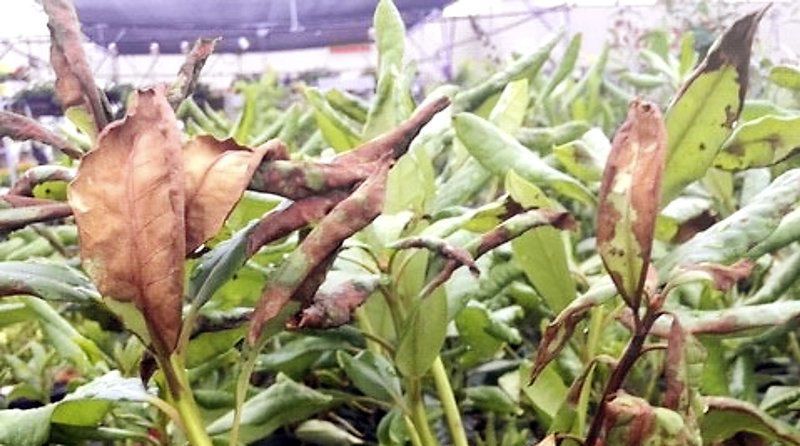
rhododendron infected by P. ramorum; photo by Indiana Department of Natural Resources
Sudden
oak death (SOD) (Phytophthora ramorum)
As I reported in June, Indiana officials had detected the pathogen that attacks more than 100 plant species and that causes sudden oak death in shipments of rhododendron plants from two nurseries in Washington State and British Columbia.
After an unexplained delay, USDA APHIS finally issued an official statement (reported on here) on the situation. Shipments of potentially infected plants already had been sent to 18 states — Alabama, Arkansas, Iowa, Illinois, Indiana, Kansas, Kentucky, Michigan, Missouri, Nebraska, North Carolina, Ohio, Oklahoma, Pennsylvania, Tennessee, Texas, Virginia, and West Virginia. Through “trace forward” inspections, eight of those states have confirmed that their plant retailers received infected plants — Iowa, Illinois, Indiana, Kansas, Missouri, Nebraska, Oklahoma, and Washington.
Plants that test positive for P.
ramorum are being destroyed. All plants that have been kept within a
two meter radius of an infected plant are also being destroyed. Host plants
outside the two meter radius will be sampled intensively.
In addition, several major retailers have agreed
to initiate a voluntary recall of plants from their stores.
APHIS advises
people in these eighteen states who have bought a
rhododendron from a retail outlet to monitor the plant for signs of disease,
including leaf spots and shoot dieback. (APHIS provides no reference to a
reliable on-line source of information on symptoms.) If people suspect their
plant(s) might have the disease, they are advised to contact their local state
department of agriculture or a county extension office.
Meanwhile, states are taking steps to inform their citizens. I described the rapid and extensive effort in Indiana in my earlier blog. In Kansas, the Department of Agriculture announced the presence of the pathogen on rhododendron containerized plants on June 7. As in Indiana, most of the plants were being sold by Walmart stores; also one by Home Depot.
In Illinois, state officials announced the pathogen’s presence on July 2nd. Infected plants were detected at ten Walmarts and at one Hy Vee. Walmart and Rural King are participating in voluntary recalls.
It
is unlikely that all the infected plants have been or will be detected and destroyed
according to protocols. First, some plants had undoubtedly been sold to people
who remain unaware of the issue. Second,
other plants were destroyed before they could be inspected by authorities. For
example, Virginia authorities told me that the “original suspect plants” at a
retail store had been destroyed before they arrived. As a result, authorities
cannot know whether infected plants entered the state.
So, is this response adequate? Who will continue outreach to possible purchasers of the plants? Who will enhance monitoring of native vegetation in vulnerable areas, e.g., the Ozarks of Missouri (see the risk maps on pages 86-88 of Fading Forests III, available here.
The Washington State nursery was operating under the program adopted by Federal Order in 2014 and formalized by the regulatory change last year. Because the Washington state nursery had not previously been detected to have infested plants, it was subject only to the standard state phytosanitary inspections with no special attention to possible sources of Phytophthora ramorum inoculum (on plants, in soil or water, in pots that have been used previously, …). Clearly this system was insufficient in this case – as it had been 15 years ago. I do not know what regulations governed the British Columbia nursery or whether plants from BC are inspected more closely by APHIS when they are imported.
I repeat – what lessons
will APHIS learn from this disturbing event, and how will it adjust its
program? Will the states – 18 of which had to carry out expensive trace-forward
programs – demand a more rigorous program?
Beech leaf disease (BLD)
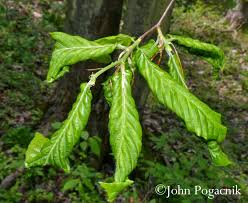
beech leaves with symptoms; photo by John Pogacnik, Cleveland Metroparks
In January I posted a blog about beech leaf disease. In May and June, two people commented, raising the question of whether BLD was killing trees on their properties in Connecticut. Connecticut’s authorities have visited at least one of these sites, but I have heard nothing about their findings. Photographs from the first site, however, greatly worried Ohio’s experts.
More
recently, a person in Westchester County, NY (which borders Connecticut) also
raised the alarm. I don’t know whether New York authorities (some of whom have
viewed symptomatic trees in western New York and Ohio) have checked this site.
Although
these reports have not yet been verified by authorities, I think it would be
wise for people throughout the range of American beech – or who have bought
European beech trees in recent years from Ohio nurseries – to closely monitor their
trees and report any suspicious findings to state authorities.
Posted
by Faith Campbell
We
welcome comments that supplement or correct factual information, suggest new
approaches, or promote thoughtful consideration. We post comments that disagree
with us — but not those we judge to be not civil or inflammatory.
Rhodendron infected by P. ramorum photo by Jennifer Parke, Oregon State University
It
might be déjà vu all over again.
Fifteen
years ago, in the spring of 2004, officials discovered that the disease called
“sudden oak death” or “ramorum blight” was present on camellias at a large
California nursery that shipped $30 million worth of plants interstate on an
annual basis. The nursery was in southern California, far from the wetter areas
of northern California where the disease is established in the wild and where
regulatory efforts were focused. By the end of 2004, 176 nurseries in 21 states
had received infected plants, 125 of which were linked to the California
supplier. APHIS and the affected states and
nurseries had to spend millions to find and destroy infected plants and conduct
intensive surveys to try to ensure this situation was not repeated.
APHIS had begun regulating P. ramorum in nurseries in northern California and Oregon in February 2002. These regulations went through several rounds of change after the 2004 outbreak – discussed in Chapter 5 of Fading Forests III, available here.
Beginning in 2014, APHIS issued two Federal orders that relaxed some of the regulatory requirements for nurseries.
Just this past May, APHIS completed the process of integrating these changes into its formal regulations. (See my blog from May and the text of the new regulations here.) APHIS stated in replying to comments on the rulemaking that it was confident that the new regime provided sufficient protection.
Even
as APHIS was finalizing this rule change, Indiana officials discovered that
rhododendron plants imported into the state were infected with Phytophthora ramorum!!
Indiana authorities reported that potentially infested plants were received at more than 70 WalMart stores and 18 Rural King stores. By the end of May, state inspectors have destroyed more than 1,500 rhododendrons and have put another 1,500 other plants on hold [source: Indianapolis Star website 29 May, 2019]
Indiana
authorities also said that the same source nurseries had shipped plants to nine
other states – unnamed.
In mid-June – more than a month after Indiana’s initial detection [Indianapolis Star website 23 May] – APHIS issued a statement. In an email to me, Evelia Sosa, Assistant Director of Pest Management, reported that potentially infested plants from the original suppliers were sent to 18 states! These states are Alabama, Arkansas, Iowa, Illinois, Indiana, Kansas, Kentucky, Michigan, Missouri, Nebraska, North Carolina, Ohio, Oklahoma, Pennsylvania, Tennessee, Texas, Virginia, and West Virginia. State officials Agriculture officials in these States are currently visiting nursery locations to sample plants received from the originating nurseries. Plants that test positive for P. ramorum will be destroyed. All plants that are within a 2 meter radius of an infected plant will also be destroyed. Host plants outside the 2 meter radius will be sampled intensively. Other hosts in the impacted facilities will be monitored for signs of the disease.
Homeowners who might have purchased infected plants are advised by APHIS to monitor them carefully for symptoms; a website is provided — ironically (see below), it is the website of the California Oak Mortality Task Force!
Several of the states which received potentially infected plants have already been through this routine because infected plants were shipped to their nurseries in the 2004 – 2008 period. These include Alabama, North Carolina, and Texas. P. ramorum has been found multiple times in streams or ponds associated with the receiving nurseries (see my blog from May here)
There
are several reasons for particular concern. First, the source nurseries were in
Washington State and British Columbia. How did the inspection system fail to
detect the outbreaks before the plants were shipped? Inspections now include
testing of soil and standing water, not just visual inspection of plants. Second,
at least some of the infected plants are rhododendrons – which are taxa well
known to be vulnerable to the pathogen and the specified focus of detection
efforts!
This
would seem to verify concerns raised in its comments on the proposal (see the
above website) by the California Oak Mortality Task Force, whose members have
been studying and managing the outbreak for close to twenty years. COMTF said:
“The revised framework, in many ways, matches
the rule structure present in 2004, when the pathogen was inadvertently,
potentially shipped to over 1,200 nurseries in 39 states from a few nurseries in
Southern California, Oregon and Washington. At that time, the APHIS P. ramorum regulation restricted
shipments in the quarantine area, defined as the known infested counties in California
and part of Curry Co., Oregon; however, the source nurseries were located in
counties where P. ramorum was not
present in wildlands. This revised framework does not adequately protect
against the reality, that any nursery with host plants, anywhere, is a
potential source for infested plants
How is APHIS going to respond – not just in leading efforts to detect and destroy infected plants but also to review its regulatory program? Why did APHIS wait so long to inform me – and presumably others in the public – about this most recent outbreak. (Although as of the time of posting, APHIS had not issued an announcement to the people registered on its stakeholder registry.)
It is not a surprise that APHIS is backing away from regulations. As I document in my blog here, the agency began some years ago to stress collaborative approaches rather than regulations. But there are risks and costs associated with these decisions.
There
are troubling situations applying to other forest pests that I hope to blog
about soon.
Posted
by Faith Campbell
We
welcome comments that supplement or correct factual information, suggest new
approaches, or promote thoughtful consideration. We post comments that disagree
with us — but not those we judge to be not civil or inflammatory.
In
recent months there have been several developments affecting efforts to manage
the sudden oak death infestation in West Coast states and to prevent its spread
to other parts of the country.
1) APHIS
regulations
Most notably, APHIS has formalized revisions to its regulations governing nursery stock. This revision was proposed last June (see my blog about this here). The revisions largely implement changes to practices that APHIS had adopted in 4014 and 1015 through Federal Orders. The final regulation is posted here. The new regulation goes into effect on May 20th.
APHIS received only 10 comments (posted here) on the proposal – from researchers, State agriculture and conservation agencies, environmental advocacy groups, research foundations, and private citizens. I summarized points raised in their comments by CISP and others in an earlier blog.
APHIS
responded to most of these comments by reiterating that it has been operating
under the current program since 2014 and believes the existing testing
protocols and conditions are sufficient to mitigate the risk. The measures to monitor
nurseries for infections include testing soil and water, that is, they do not
rely exclusively on visual inspection of the plants. This is a step forward. In
response to comments by CISP and California Oak Mortality Task Force that all
nurseries that grow host plants are a potential source of contamination, APHIS points
out that it is not authorized to regulate nurseries that don’t ship plants
interstate. This limitation is a serious problem arising from the underlying
statute – the Plant Protection Act. APHIS said it would continue to monitor
detection of the pathogen, and would reevaluate program protocols “should the
need arise” – but it made no promise on how frequently it would reevaluate the program.
APHIS
did make some adjustments, based on comments. It agreed to one state’s request
that it clarify the minimum
number of samples that must be taken during annual inspection of nurseries that
had not previously tested positive for the pathogen when those nurseries are
located in counties that have SOD infestations in the environment. (Such
counties are found only in California and Oregon.)
The
agency also said it plans to restructure the list of host species so that it
can be updated more quickly. APHIS plans to remove the lists from formal regulations
(which require public notice and comment to amend) and post them on the APHIS
website. APHIS also expects to merge the lists of proven and associated hosts
into a single host list. However, these plans would, themselves, constitute
rulemaking and require another public comment period.
APHIS
also agreed to reinstate its quarterly program updates, beginning in April of
2019. I have not yet seen an alert telling me how to find the first such update,
though.
2) P. ramorum in California and Washington
According to the most recent (April 2019) newsletter of the California Oak Mortality Task Force, tanoak (Notholithocarpus densiflorus) mortality in California attributed to Phytophthora ramorum increased by more than 1.6 million trees across 106,000 acres in 2018. The dead trees are concentrated west of the coastal range.
In
the meantime, P. ramorum continues to
be detected in nurseries shipping plants from West Coast nurseries. As of
April, the California Department of Food and Agriculture had detected P. ramorum in nine nurseries – six from
previous years, three new in 2019. (Sixty-four additional infected plants were
found in one nursery that had been confirmed positive in an earlier year –
raising questions in my mind about the efficacy of the Confirmed Nursery
Protocol for eliminating the pathogen.)
As I noted in a previous blog, Washington is finding it difficult to eliminate P. ramorum from the soil of a botanical garden in Kitsap County. For the third time in less than a year, a pond that is downhill from previously “mitigated” sites has tested positive for P. ramorum.
I remind you that scientists do not believe that P. ramorum persists in water – it must be surviving on some plant tissue in both Washington and the Eastern states (see below).
3) P. ramorum in Oregon
The Oregon Department of Forestry (ODF) commissioned a study of the economic impact of Phytophthora ramorum in the state. The study found that to date, sudden oak death has caused minor impacts on the regional economy. There was no impact on timber harvest, export or log prices or recreation or tourism revenues and only anecdotal reports of losses to real estate transaction values in some areas. Meantime, the state and several federal agencies are spending $1.5 million per year to try to contain the outbreak.
However, sudden oak death has the potential to cause harm to core values that elude economic quantification, particularly to tribal cultural values and the “existence value” of tanoak-dominated forests. SOD may be an existential threat to tanoak and associated obligate species (e.g., dusky-footed woodrats, Northern flying squirrels, and Allen’s chipmunks – which are important prey items for northern spotted owl, cougar, coyote, and Pacific fisher. More widespread wildlife — e.g., deer, elk, bear, Coho salmon, and a variety of bird species – might also be harmed.)
Immediate
termination of the ODF treatment regime might lead to serious impacts due to
more rapid expansion of sudden oak death into Coos County, Oregon. These could
include Asian governments restricting timber and fiber exports from southwest
Oregon and resulting loss of 1,200 jobs and forest products harvest tax. There
might also be a collapse of residential property value and real estate
transaction revenues. Finally, there might be a decline in recreation and
tourism in affected areas. Maintaining the current treatment regime was
expected to delay the spread of SOD north of the Rogue River until 2028, and
prevent infestation of Coos County beyond 2038. Continued funding SOD
treatments for a total cost of $30 million over the next 20 years could offset
loss of 1,200 jobs by 2028 and $580 million in wages from 2028 to 2038.
The study
authors note that other factors – such as major wildfires or trade wars – could
render these impacts moot.
4) P. ramorum in the East
According to the most recent newsletter of the California Oak Mortality Task Force, over the nine years since 2010, the pathogen has been detected from 11 streams in six eastern states – four in Alabama; one in Florida; two in Georgia; one in Mississippi; one in North Carolina; and two in Texas. P. ramorum has been found multiple times in eight of these streams; it is consistently present in two steams in Alabama, one each in Mississippi and North Carolina.
In
2018, seven states participated in the stream survey (which is operated by the
USDA Forest Service): (AL, GA, MS, NC,
PA, SC, and TX). This was the smallest number of participating states, which
has fallen from14 in 2010 to seven in 2018.
The
number of streams surveyed annually has ranged from 45 to 95. The number of
streams sampled in 2018 was also close to the smallest number: 47. P. ramorum was detected from six streams
– four in Alabama, one each in Mississippi and North Carolina. All positive
streams were associated with previously P.
ramorum-positive nurseries.
Remember
that P. ramorum continues to be detected in West Coast nurseries that ship
plants interstate (see the second section of this blog).
Posted
by Faith Campbell
We
welcome comments that supplement or correct factual information, suggest new
approaches, or promote thoughtful consideration. We post comments that disagree
with us — but not those we judge to be not civil or inflammatory.
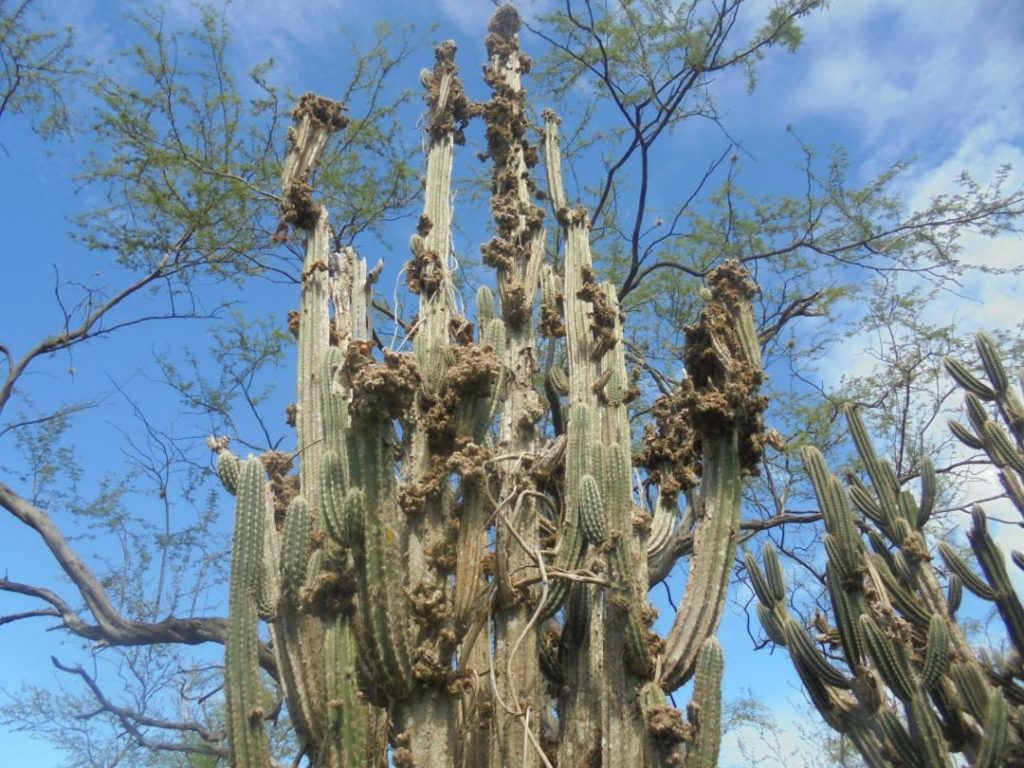
Photo of infested cactus at Cabo Rojo National Wildlife Refuge, Puerto Rico. Taken August 20, 2018 by Yorelyz Rodríguez-Reyes
Three and a half years ago, I blogged about the threat to columnar cacti in Puerto Rico from the Harrisia cactus mealybug. The mealybug clearly threatens the endemic cacti of the Caribbean islands, and possibly some of the hundreds of other columnar cacti growing across two million square miles of desert ecosystems that straddle the U.S.-Mexico border region.
I am pleased to report that scientists continue efforts to find biocontrol agents to reduce this insect’s damage on Caribbean islands. Much of this work is being done by the Center for Excellence in Quarantine and Invasive Species at University of Puerto Rico. The team consists of Michael West Ortiz, Yorelys Rodrígues Reyes, Ferdinand Correa and Jose Carlos Verle Rodrigues.
As of February 2019, the Center is conducting host specificity tests on a primary parasitoid of the Harrisia Cactus mealybug — Anagyrus cachamai. This wasp was found as a result of almost a decade of searching in South America and other locations. It is native to Argentina and Paraguay (Triapitsyn et al. 2018; sources listed at the end of the blog).The Center also continues surveys and studies of other primary and secondary parasitoids of the mealybug.
The work to develop a biocontrol agent for the
mealybug continues despite continuing uncertainty about the true species of the mealybug. At the time
of its discovery on Puerto Rico, the mealybug was believed to belong to a
species used as a biocontrol agent for invasive cacti in Australia and South
Africa, designated as Hypogeococcus
pungens.
However, H. pungens is now thought to
be a species complex, and the species in Puerto Rico differs from the earlier
designation (Triapitsyn et al.
2018).
Apparently
the mealybug was introduced in Puerto Rico around 2000 — probably on the ornamental common
purslane (Portulaca olerácea), an
annual succulent. (Note: the
introduction was on a host different from the vulnerable cacti.) Within five
years of the first detection in San Juan, the mealybug was sighted on cacti on
the other side of the island in the Guánica State Forest and Biosphere Reserve.
By 2010, the mealybug was widely distributed in most dry districts. Surveys
found it in all 11 municipalities surveyed in southern Puerto Rico. At some
locations, infestation levels were extremely high – e.g., 86% of stems surveyed were infested at Guánica. Infestation
rates were lower in other municipalities. As of 2010, infestations were
estimated to be present on about 1,400 km2 on the southern coast;
the rate of new infestations suggests that the mealybug was spreading rapidly
(Segarra-Carmona et al. 2010). I have been unable to obtain more recent
estimates.
The
mealybug impacts seven of 14 native cactus species occurring in dry forests of
the island, including three endemic and two endangered species in the subfamily
Cactoideae. The two endangered species are Harrisia
portoricensis and Leptocereus grantianus (USDA ARS). The tissue
damage caused by the mealybug interferes with sexual reproduction and can cause
direct mortality of the plant (Triapitsyn et
al. 2018). These
cacti provide food or shelter for endemic bats, birds, moths and other
pollinators (Segarra & Ramirez; USDA ARS). The mealybug is also now killing
native cacti on the U.S. Virgin Islands (H. Diaz-Soltero pers. comm. August
2015).
USDA Funds Conservation Efforts Despite
Apparent Absence of a Constituency Calling for Such Action
Efforts
to identify and test possible biocontrol agents targetting the Harrisia cactus
mealybug received significant funds from the Plant
Pest and Disease Management and Disaster Prevention Program. This is a
competitive grant program managed by APHIS. It is permanently funded and thus
not subject to the vagaries of annual appropriations. Until last year, this
program operated under Section
10007 of the 2014 Farm Bill. With passage of a new Farm Bill, it is now
designated as Section 7721 of the Plant Protection Act.
Since Fiscal Year 2018, APHIS has had authority to spend more than $60 million per year on this program. In Fiscal Year 2017, , the program provided $120,000 to an unspecified federal agency, $70,000 to an academic institution in Puerto Rico (presumably the Center), $15,000 to another academic institution in California, and $3,000 divided among two APHIS facilities – for a total of $208,000. The next round of funds came in FY19, when the program provided $277,267 to an unspecified federal agency to continue work on biocontrol. In addition, the program provided $78,507 to an unspecified federal agency to “safeguard[e] genetic diversity of native and listed cacti threatened by Harrisia cactus mealybug in Puerto Rico”.
No Apparent Action on
Threats to Opuntia Cacti
In my earlier blog, I also described the threat to flat-padded Opuntia (prickly pear) cacti from the cactus moth Cactoblastis cactorum. Various federal, state, and academic entities received $463,000 from the permanent fund in Fiscal Year 2016 and another $100,000 in FY2017. No cactus moth programs have received funds in more recent years.
SOURCES
Segarra-Carmona, A.E., A.
Ramirez-Lluch. No date. Hypogeococcus pungens (Hemiptera: Pseudococcidae): A
new threat to biodiversity in fragile dry tropical forests.
Segarra-Carmona,
A.E., A. Ramírez-Lluch, I. Cabrera-Asencio and A.N. Jiménez-López. 2010. FIRST REPORT OF A NEW INVASIVE MEALYBUG, THE
HARRISIA CACTUS MEALYBUG HYPOGEOCOCCUS PUNGENS (HEMIPTERA: PSEUDOCOCCIDAE). J.
Agrie. Univ. RR. 94(1-2):183-187 (2010)
Triapitsyn,
Aguirre, Logarzo, Hight, Ciomperlik, Rugman-Jones, Rodriguez. 2018. Complex of
primary and secondary parasitoids (Hymenoptera: Encyrtidae and Signiphoridae)
of Hypogeococcus spp. mealybugs (Hemiptera: Pseudococcidae) in the New World. Florida
Entomologist Volume 101, No. 3 411
USDA Agriculture Research Service, Research Project:
Biological Control of the Harrisia Cactus Mealybug, Hypogeococcus pungens
(Hemiptera:pseudococcidae) in Puerto Rico Project Number: 0211-22000-006-10
Project Type: Reimbursable
West Ortiz, M. pers. comm. February 2019
Posted
by Faith Campbell
We
welcome comments that supplement or correct factual information, suggest new
approaches, or promote thoughtful consideration. We post comments that disagree
with us — but not those we judge to be not civil or inflammatory.
A year ago, I alerted you to a new threat to American beech (Fagus grandifolia). In that blog I reported that conservation and park managers in northeastern Ohio had begun noticing troubling decline and mortality of beech saplings beginning in 2012. The problem was spreading: we now know that over the four years between 2012 and 2016, the apparent disease spread from an estimated 84 ha to 2,525 ha within Lake County, Ohio (Ewing et al. 2018; full citation provided at end of the blog).
By
2018, trees with symptoms had been detected in 24 counties across three states
and one province: 10 counties in Ohio, 8 counties in Pennsylvania, 1 county in
New York, and 5 counties in Ontario). A map is
provided in Ewing et al.
The
rate of decline within beech stands varies, suggesting that trees differ in
susceptibility. This is a promising for breeding resistance (Ewing et al.).
Symptoms
A number of organizations have produced fact sheets and related material. I recommend the fact sheet available here.
Disease Progression
In
Northeast Ohio, Cleveland Metroparks’ intensive monitoring program revealed a
4% mortality rate from 2015 to 2017. More than half of the plots now have dead trees
that had previously been only symptomatic.
Most of the dead trees are small – less than 4.9 cm dbh. However, some larger
trees have died and others bore only a few leaves this past summer. Leaves with
light, medium, or heavy symptoms of infection – as well as asymptomatic leaves
– can occur on the same branch of an individual tree.
The
disease seems to spread faster between the stems of trees growing in beech clone
clusters by spreading along the interlocking roots.
Serious science
effort finally initiated – and funded!
The
cause of beech dieback and mortality has still not been definitively
determined. Most scientists agree that the cause is some kind of disease agent,
not abiotic factors. A growing number of scientists from USDA’s Agriculture
Research Service and Forest Service; Ohio’s Division of Forestry and Department
of Agriculture; the Holden Arboretum; Ohio State University; and groups in Canada
are researching possibilities.
The
most promising candidate is a previously undescribed nematode detected by David
McCann of the Ohio Department of Agriculture. That nematode has since been
described by Japanese researchers on Japanese beech F. crenata (Kanzakiet al.) and given the name Litylenchus crenatae. Thousands of live Litylenchus nematodes (at least 10,000)
can swim out from a single leaf. Scientists at the USDA Agriculture Research Service
and Holden Arboretum are waiting for bud break this spring to see whether plant
material inoculated with the nematode develops disease symptoms.
Still, other
possible disease agents could also play a role.
An
international working group has been formed to continue studies of both disease
agents and disease progression in seedlings, saplings, and mature trees.
Still, no regulation
to counter long-range spread via nurseries!
Long range spread of the disease is probably assisted by anthropogenic transport, especially of nursery stock. As I reported in May, an Ontario retailer received – and rejected – a shipment of diseased beech from an Ohio nursery.
Despite
the evident risk, no official agency has adopted regulations to prevent spread
on nursery stock. None of the states or provinces in which the disease is
present has adopted regulations. None of the neighboring states or provinces
has acted to protect its nursery industry or forests. Neither USDA APHIS nor the
Canadian Food Inspection Agency (CFIA) has adopted regulations. The disease was
not mentioned during the annual meeting of the National Plant Board – which
took place in Cleveland in August! Connie Hausman of Cleveland MetroParks did
include the issue during her presentation on the extensive park complex to the
group during the group’s field trip.
The
absence of regulation is a puzzling omission because Lake County, Ohio, has
many nurseries that grow and ship European beech — which can also be infected
by beech leaf disease.
The Importance of American Beech – and Protecting
range of American beech
Our American beech is not a major timber species – in fact, the species is actively disliked by managers focused on timber production because beech bark disease kills trees before they reach commercial size. Beech trees also often have cavities which reduce their timber value – but which are valuable to wildlife.
However,
American beech is extremely important ecologically in northern parts of the
United States and in Canada east of the Great Plains. Beech is co-dominant
(with sugar maple) in the Northern Hardwood Forest. A summary of the species’ ecological
importance can be found in Lovett et al.
2006. Beech nuts are a primary source of food for many woodland birds and
mammals. In the central part of the northern hardwood forest – including in
southern Canada – beech trees are the only
source of hard mast. Furthermore, beech trees create a dense canopy; drastic defoliation
modifies light levels at ground level, thereby affecting understory competition
and other forest ecosystem services. Beech leaf litter decays more slowly than
maple’s, which affects nutrient cycling. While beech leaf disease is unlikely
to eradicate American beech, it could cause functional eradication of the species.
Ohio alone has more than 17 million American beech trees, according to Tom Macy
of the Ohio Department of Natural Resources (Ewing et al. 2018).
The
threat appears to be widespread because both European (F. sylvatica) and Asian (F.
orientalis) beech have shown symptoms. Ewing et al. 2018 call for detection efforts across Northern Hemisphere.
Of course, the species is already under threat from beech bark disease. Promising efforts to breed beech trees resistant to BBD now face the complication of having to incorporate resistance to this new disease (Ewing et al. 2018).
European Beech Weevil
I
will remind you that last year I noted a third threat to beech trees – the
European leaf weevil. Originally detected in Nova Scotia, it continues to
spread. About 95% of beech trees in forest plots near Halifax are dead. In the
city, half the beech trees have died and the rest are in severe decline. While
neither the province nor CFIA has imposed a quarantine or other regulations to govern
the movement of beech material, Canadian officials are exploring possible
chemical treatments. They are working with European colleagues to explore
biocontrol agents (Jon Sweeney, Natural Resources Canada, pers. comm.).
Conclusion
These
new threats are getting far too little attention! Some can be blamed on the
difficulty of regulating an unknown disease agent (e.g., beech leaf disease). Attempting this would stretch
traditional policy practice and, possibly, legal authorities. And it has not
yet been demonstrated that this disease can kill mature beech. However, neither
of these caveats applies to the weevil, which is an identified species, documented to kill mature trees, and a problem
still not addressed.
Sources
Ewing,
C.J., C.E. Hausman, J. Pogacnik, J. Slot, P. Bonello. 2018. Beech leaf disease: An emerging forest
epidemic. Short Communication. Forest Pathology 2018;e12488
Lovett
et al. 2006. Forest Ecosystem
Responses to Exotic Pests and Pathogens in Eastern North America. BioScience
Vol. 56 No. 5.
Sharon
Reed’s presentation on YouTube https://www.youtube.com/watch?v=tDBbik7cUrI
Posted
by Faith Campbell
We
welcome comments that supplement or correct factual information, suggest new
approaches, or promote thoughtful consideration. We post comments that disagree
with us — but not those we judge to be not civil or inflammatory.
Tanoak mortality at Big Sur photo by Matteo Garbelotto
Outbreaks intensified in western
North America and Western Europe (UK, France).
Outbreaks are increasingly
genetically diverse – raising the possibility of sexual reproduction and
evolution.
Evidence accumulated that
eradicating Phytophthora ramorum from the environment once it is present is extremely difficult,
if not impossible.
Meanwhile, APHIS proposed revisions that would weaken its regulation of nursery stock. See my earlier blog. Copies of all comments can be viewed here.
1)
Intensifying Outbreaks
North
America
According to the California Oak Mortality Task Force’s (COMTF) November 2018 newsletter, about 50 million trees have been killed by P. ramorum in California and Oregon. This breaks down to:
29
– 44 million tanoaks (Notholithocarpus
densiflorus) (1.6 – 2.5% of the species’ total population in California and
Oregon);
1.9
– 3.3 million coast live oaks (Quercus
agrifolia) and Shreve oaks (Q.
parvula var. shrevei), combined (0.4 – 0.7% of their populations); and
up
to 1.1 million California black oaks (Q.
kelloggii) (less than 0.17% of their population).
Of course, the oaks face additional threats from goldspotted oak borer and polyphagous and Kuroshio shot hole borershin more southern parts of California.
California
bay laurel (Umbellularia californica)
is not killed by P. ramorum but
instead drives the spread of the outbreak in California. The state has an
estimated 91.4 million infected California bay laurel trees.
These
estimates are considered to be conservative. They are based only on trees that
have been confirmed to be infected by direct, cultural isolation during the
period up to 2014 — more than four years ago! And before a sharp
intensification of infection (see below).
Data from a USDA Forest Service aerial detection survey – reported in COMTF’s September 2018 newsletter— detected a large increase in tanoak mortality in counties California counties reaching from Mendocino south to Monterey. This intensification in tree mortality was expected because the pattern is already well established: two seasons after a wet winter seasons, trees die. Such a wet and extended winter occurred in 2016-2017.
United
Kingdom
Outbreaks of the EU1 strain of P. ramorum on larch (Larix kaempferi) in Scotland have also intensified. The infection is now found throughout much of Scotland, not just in the heavily infested zone in the the southwest part of the country. See updated map of outbreaks on Larch sites in woodland settings at https://scotland.forestry.gov.uk/supporting/forest-industries/tree-health/phytophthora- ramorum?highlight=WyJyYW1vcnVtIiwiJ3JhbW9ydW0iLCIncmFtb3J1bSciXQ
There is more on the status of P. ramorum in the the UK (England, Wales, Scotland and Northern Ireland) in a situation report posted by Forestry Commission England in 2018. Find it here: https://www.forestry.gov.uk/pdf/PRamorumSituationReport30June2018.pdf/$FILE/PRamorumSituationReport30June2018.pdfh
As in North America, the large number of outbreaks is attributed to favorable, wet conditions in the summer and fall of 2017. (This situation was summarized in COMTF’s September 2018 newsletter.
France
The
outbreak on larch in France, first reported in 2015, is also spreading. This is
particularly significant because, first, it is the first report of P.
ramorum outside of nurseries and ornamental settings in mainland Europe
and, second, because it is a new genotype not tied to any other outbreak. By
May 2018, about 80% of the trees in the Saint-Cadou larch plantations in
Brittany (Northwest France) were symptomatic or dead in the more infected
plots. A second outbreak has been detected a few kilometers away in a mixed
forest stand of larch, oak, and sweet chestnut (Castanea sativa). There,
disease prevalence was much lower. Both stands have been removed.
(This was also summarized in COMTF’s September newsletter.
2)
Increasing Genetic Diversity
EU1
Strain in Oregon
As I have reported in the past, Oregon now has a second strain of Phytophthora ramorum – the “EU1” strain. This opens the possibility of sexual reproduction between it and the NA1 strain already established in forests in Oregon’s Curry County.
According to a
presentation by Chris Benemann of
the Oregon Department of Agriculture to the Continental Dialogue on Non-Native
Forest Insects and Diseases, in 2018 – three years after the initial detection
of one tree in 2015 – the number of trees infected by the EU1 strain has risen
to 73. Oregon has prioritized removing these trees and treating (burning) the
immediate area – now more than 355 acres. The legislature has provided $2.3
million for SOD treatments for 2017-2019. ODA believes that eradication of the
EU1 outbreak is still possible.
3) But Is Eradication Possible?
According to the COMTF September newsletter, P. ramorum was detected by a water bait in a small pond downstream from a previously-infected botanical garden in Kitsap County, Washington. The garden undertook extensive mitigation efforts – including soil steaming – and the pathogen had not been detected in this managed landscape for about 2 ½ years. Hundreds of samples of host plants were collected in September, with only one warranting further analysis to determine whether it was positive. Surveys will continue in 2019.
In the East, USDA has baited streams to detect P. ramorum for several years. Seven states participated in the 2018 Spring National P. ramorum Early Detection Survey of Forests: Alabama, Georgia, Mississippi, North Carolina, Pennsylvania, South Carolina, and Texas. As reported in the COMTF’s September newsletter, h292
samples were collected from 48 sites. As in past years, positive samples were
collected from streams associated with previously positive nurseries. These
included three samples from two locations in Alabama; two samples from one
location in Mississippi; and one sample from North Carolina. The Alabama and
Mississippi sites have tested positive for approximately a decade.
So,
the pathogen is persisting in water – but how? I have been told that P. ramorum requires plant material on
which to survive – so how is it persisting without detectable infested plants? Also,
does the presence of zoospores pose a threat of infesting streamside plant
material? What studies are examining this issue?
Awareness
through Art
Artists have transformed a SOD-infected tanoak tree into 7,000 pencils as part of their thoughtful “7,000 Marks” project. They explore issues around global industrial trade, quarantine boundaries as a conservation tools, and the opposing concern that restricting trade can echo a rising tide of xenophobia. You can learn more (and buy pencils) here.
SOURCES
Cobb,
R.; Ross, N.; Hayden, K.J.; Eyre, C.A.; Dodd, R.S.; Frankel, S.; Garbelotto, M.
and Rizzo, D.M. 2018. Promise and pitfalls of endemic resistance for cultural
resources threatened by Phytophthora
ramorum . Phytopathology. Early view.
Harris,
A.R.; Mullett, M.S.; Webber, J.F. 2018. Changes in the population structure and
sporulation behaviour of Phytophthora ramorum
associated with the epidemic on Larix
(larch) in Britain. Biological Invasions. 20(9): 2313–2328.
Posted by Faith
Campbell
We
welcome comments that supplement or correct factual information, suggest new
approaches, or promote thoughtful consideration. We post comments that disagree
with us — but not those we judge to be not civil or inflammatory.