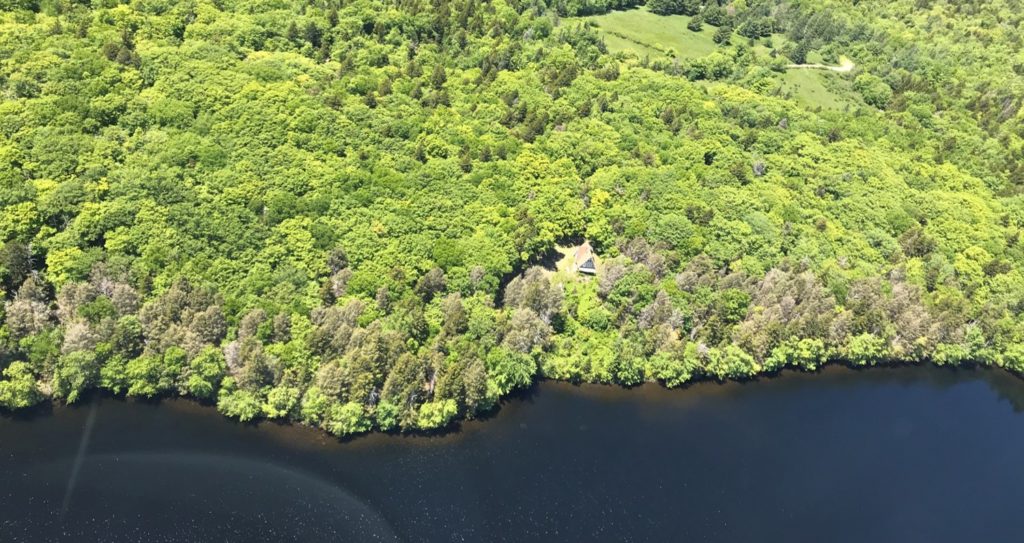
Two recent studies show that climate change is driving changes to pest ranges. These pose a serious threat to forests of eastern Canada.
A study by Aubin et al. (2026; full citation at end of blog) assessed the risk that climate change would exacerbate the impacts of 14 non-native forest insect pests The 14 insect species were selected from an original group of 76 species using the following criteria:
1) They have the potential to cause mature tree mortality to at least one of the 37 tree species most abundant in Canada; and
2) They have been detected in Canada recently or have established populations actively spreading through the Canadian landscape.
Major Findings
Twenty-four tree species are affected currently by at least one of the 14 non-native insect pests (excluding Asian longhorned beetle; see below). (I list the tree and insect species below.) Four of them are already considered globally endangered or threatened due to invasive pests: black and white ash (Fraxinus nigra and F. americana), whitebark pine (Pinus albicaulis) and eastern hemlock (Tsuga canadensis). Another ash species (blue ash; Fraxinus quadrangulata) and another pine (limber pine; Pinus flexilis) are considered rare or threatened species in Canada.
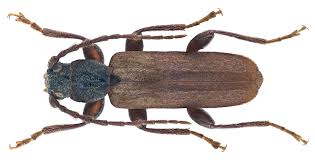
Of the 24 species at risk, black spruce (Picea mariana) is most exposed because it grows in areas where eastern spruce gall adelgid and brown spruce longhorned beetle (Tetropium fuscum) are established. Expansion of these two pests could potentially reach 75% of black spruce biomass in Canada. However, Aubin et al. (2026) expect tree mortality to be limited because these insects target trees that are already stressed or weakened. Of course, the changing climate might increase the trees’ susceptibility. Thirty percent of the black spruce’s range is projected to be outside its current climatic niche by 2040.
The 24 tree species currently affected by at least one of the 14 non-native insects (excluding ALB) collectively constitute 3.2 billion tons of tree biomass. The impact is projected to increase more than four-fold — to 13.6 B tons of biomass — within two decades. Reinvasion by the Asian longhorned beetle would put at risk six additional tree species in the genera Acer, Betula, and Populus. Their jeopardy would add another 3.1 billion tons of live tree biomass to the “at risk” category.
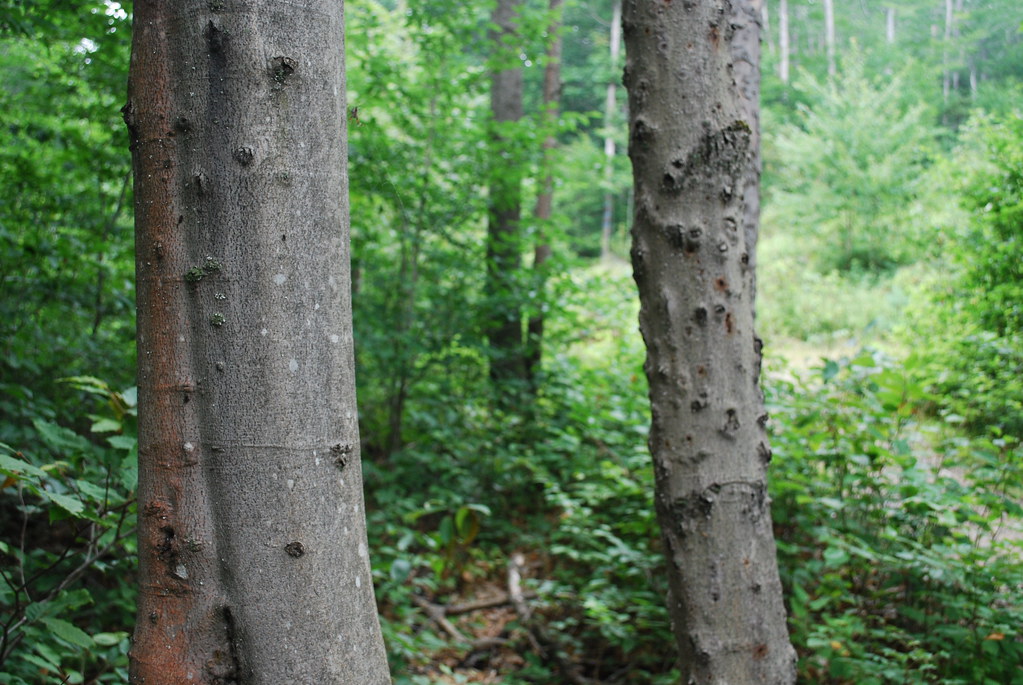
Aubin et al. (2026) note that affected trees might remain alive but moribund, that is, lose their functional role within the ecosystem. for several years before finally dying. Therefore their analysis might underestimate pests’ impact on the forest. Their example is American beech – as weakened by beech bark disease. A reminder: beech bark disease causes widespread death of mature beech – opening the canopy and eliminating such wildlife-supporting aspects as nesting cavities and abundant crops of nuts. Vigorous root sprouting results in dense stands of young beech, crowding out other species.
Hotspots of greatest vulnerability
The analysis identified two hotspots of greatest vulnerability: north-central British Columbia near the border with Alberta, and along the St. Lawrence Seaway near the border with the United States. The pest pressures differ.
The threat to the British Columbia hotspot comes from expansion of mortality in dense pine forests caused by the native mountain pine beetle (Dendroctonus ponderosae). Aubin et al. (2026) describe a two-pronged impact from the changing climate: trees lose vigor because they become maladapted to the new growing conditions (temperature and drought); while the beetle increases the frequency of outbreak due to reduced overwintering mortality.
Along the St. Lawrence Seaway (southern Ontario and Quebec) the threat comes from a suite of non-native insects, including emerald ash borer, hemlock woolly adelgid, and beech scale. While emerald ash borer and beech scale were introduced directly to Canada by international trade, hemlock woolly adelgid spread across the border from the U.S. Further northward expansion of all three is projected under both low and high emission climate change scenarios.
Most alarming is that some regions in eastern Canada are vulnerable to invasion by all 14 insect species. Two additional pests loom: Aubin et al. (2026) fear northward expansion might reintroduce the Asian longhorned beetle or introduce the southern pine beetle (Dendroctonus frontalis). The latter has been expanding northward in the U.S.
Pests often move across the Canada-U.S. border. In addition to the five pests mentioned above, spongy moth, and two pathogens, the beech leaf disease nematode, and the oak wilt fungus, have spread from the U.S. into neighboring parts of Canada. The woodwasp Sirex noctillio was probably introduced simultaneously to both countries. Winter moth and beech bark disease spread from Canada to the U.S. I worry that the brown spruce longhorned beetle might do the same.
Asian longhorned beetle: can this disaster be averted?
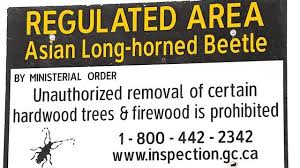
As noted above, the Canadians are alarmed by the prospect that the Asian longhorned beetle might be reintroduced – either by spread from extant populations in the United States or directly on imports from China. Aubin et al. (2026) note that the two earlier – successful! — eradication programs were expensive, costing an estimated CND$35.5 million. This expenditure is dwarfed by the costs estimated to arise from an unmanaged invasion: CDN$431 million annually in timber products and CDN$358 million annually in edible maple products. There would also be enormous ecological impacts, including threats to an additional 3,08 metric tonnes of tree biomass comprising ~24.96 tons of CO2 equivalent.
Canada’s central boreal forest is at lower risk both in terms of exposed tree biomass and number of invasive insect species present. The reasons are not understood. Aubin et al. (2026) suggest that the boreal ecosystem is more resistant to invasion due to a combination of environmental barriers and native natural enemies. For example, the introduced woodwasp Sirex noctilio did not cause widespread pine mortality in the region, probably due to antagonistic interactions with other subcortical species.
Species’ Details
The 14 insect species the authors studied are:
Adelges abietis, Adelges tsugae, Agrilus planipennis, Agrilus sulcicollis, Coleophora serratella, Dendroctonus ponderosae (they include climate-change-related range expansion), Diprion similis, Neodiprion sertifer, Operophtera brumata, Cryptococcus fagisuga-Neonectria coccinea, Tetropium fuscum, Coleophora laricella, Acantholyda erythrocephala.
Although it does not fit this definition, Aubin et al. (2026) also evaluated the Asian longhorned beetle (ALB Anoplophora glabripennis), because of its huge impact if it is reintroduced to Canada (see above).
One of the focal groups, beech scale, Cryptococcus fagisuga, differs from the others because it is a vector of a tree-killing fungal pathogen (Neonectria coccinea); the scale itself does not cause notable harm.
Aubin et al. (2026) acknowledge that additional species represent a possible threat to Canadian forests. Therefore their study does not represent the total risk posed by all potential invasive insects in Canada, but provides a snapshot of selected, current vulnerabilities.
The 37 most abundant tree species in Canada together represent 88% of total mature forest tree biomass in Canada. They include 17 conifers and 7 deciduous trees:
Abies amabilis, Ab. balsamea, Ab. lasiocarpa; Acer rubrum, Ac. saccharinum, Ac. saccharum; Alnus rubra; Betula alleghaniensis, B. papyrifera; Callitropsis nootkatensis; Fagus grandifolia; Fraxinus american, F. nigra; Larix laricina, L. occidentalis; Picea engelmanii, P. glauca, P. mariana, P. rubens, P. sitchensis; Pinus albicaulis, P. banksiana, P. contorta, P. ponderosa, P. resinosa, P. strobus; Populus balsamifera, P. grandidentata, P. tremuloides; Pseudotsuga menziesii; Quercus rubra; Thuja occidentalis, T. plicata; Tilia Americana; Tsuga canadensis, T. heterophylla, T. mertensiana
The 14 insects collectively have 63 host tree species in Canada. The pine genus is susceptible to the largest number of pests. Genera found to be not vulnerable to any of the 14 insects are Acer, Callitropsis, Populus, Pseudotsuga, Tilia, and Thuja. The proportion of total exposed tree biomass in Canada varied by species, from 8% of Jack pine (Pinus banksiana) to 95% for red spruce (Picea rubens).
Although most of the 14 insect species are projected to benefit from larger areas of suitable climate in Canada over the next 20 years, there are interesting exceptions: European oak borer (Agrilus sulcicollis), brown spruce longhorned beetle, and winter moth (Operophtera brumata). Distributions of the host tree species are projected to change insignificantly over the 20 years covered by the study.
With northward expansion of suitable climates for 12 of the 14 species, large areas of the boreal forest will be exposed to potential invasion. The entire Canadian distribution of 13 of the 37 dominant tree species might be at risk: three Abies, two Betula, both Fraxinus, Picea mariana, Pinus contorta, Picea glauca, Pinus banksiana. Aubin et al. (2026) mention specifically Engelmann spruce (Picea engelmanii) and American beech (Fagus grandifolia).
Other Factors
The analysis did not consider possible alterations of the insects’ life history traits other than potential expansion of their distributions. Warmer temperatures can cause changes in voltinism, diapause periods, development rates, reproduction, and population growth; cumulatively, these changes might alter their invasion dynamics. The mountain pine beetle is an example. Populations have experienced outbreaks more frequently, so increasing the species’ invasion threat and severity. On the other hand, shifts in temperature and precipitation could decouple the phenology of trees and their associated pests, reducing insect survival. Finally, complex changes in tree tissue and their secondary defensive metabolites (see below) also could alter interactions between non-native insects and their new hosts – possibly exacerbating or mitigating the herbivores’ impacts.
Aubin et al. (2026) remind us that loss of a dominant species might lead to reorganization of forest composition and structure. They expect the impacts to be particularly critical in stands with low tree diversity, such as the pure jack pine stands in the eastern boreal forest. Loss of a foundation species might also profoundly disrupt ecosystem functions, carbon budgets, wildlife habitats and stand productivity. They cite cascading effect on aquatic invertebrate communities and invasions by non-native plant species following widespread death of ash trees caused by the emerald ash borer. Finally, death of some species reduces functional redundancy within tree communities, and a shrinking pool of viable native replacement species. The widespread planting of ash trees in urban areas after the demise of most elms is such a case.
The possibility that the tree hosts might increase production of defensive metabolites was corroborated by Mike Aucott in a different context. Dr. Aucott is retired from the New Jersey Department of Environmental Protection. He authored a guest blog in December 2022, in which he discussed changes in plant chemistry brought on by the 50% increase in atmospheric CO2 levels over the last century. By happenstance, Dr. Aucott engaged in an exchange of letters in Science (2/26/26), in which he reiterated the likelihood that plants, “fertilized” by access to this nutrient, might be better able to fend off insect attacks. (See the “Sources” section for references to additional information on this phenomenon.)
Compounding Threat: The Spruce Budworm in Eastern Canada
The spruce trees of eastern Canada face another pest threat: the native spruce budworm (SBW, Choristoneura fumiferana). It is already a major defoliator in North American boreal forests.
Boulanger et al. (2025; full reference at end of this blog) documented pronounced changes in the moth’s range, especially in the East. Over the past 60 years, suitable climate conditions for the budworm have expanded northward. On the other hand, winter mortality has increased in southern parts of its range due to warmer temps. Overall, the total area highly suitable for population growth remained virtually the same. Still, the budworm’s earlier activation might exacerbate its impact on the previously less vulnerable black spruce, Picea mariana. If so, this might fuel further increased population growth rates northward.
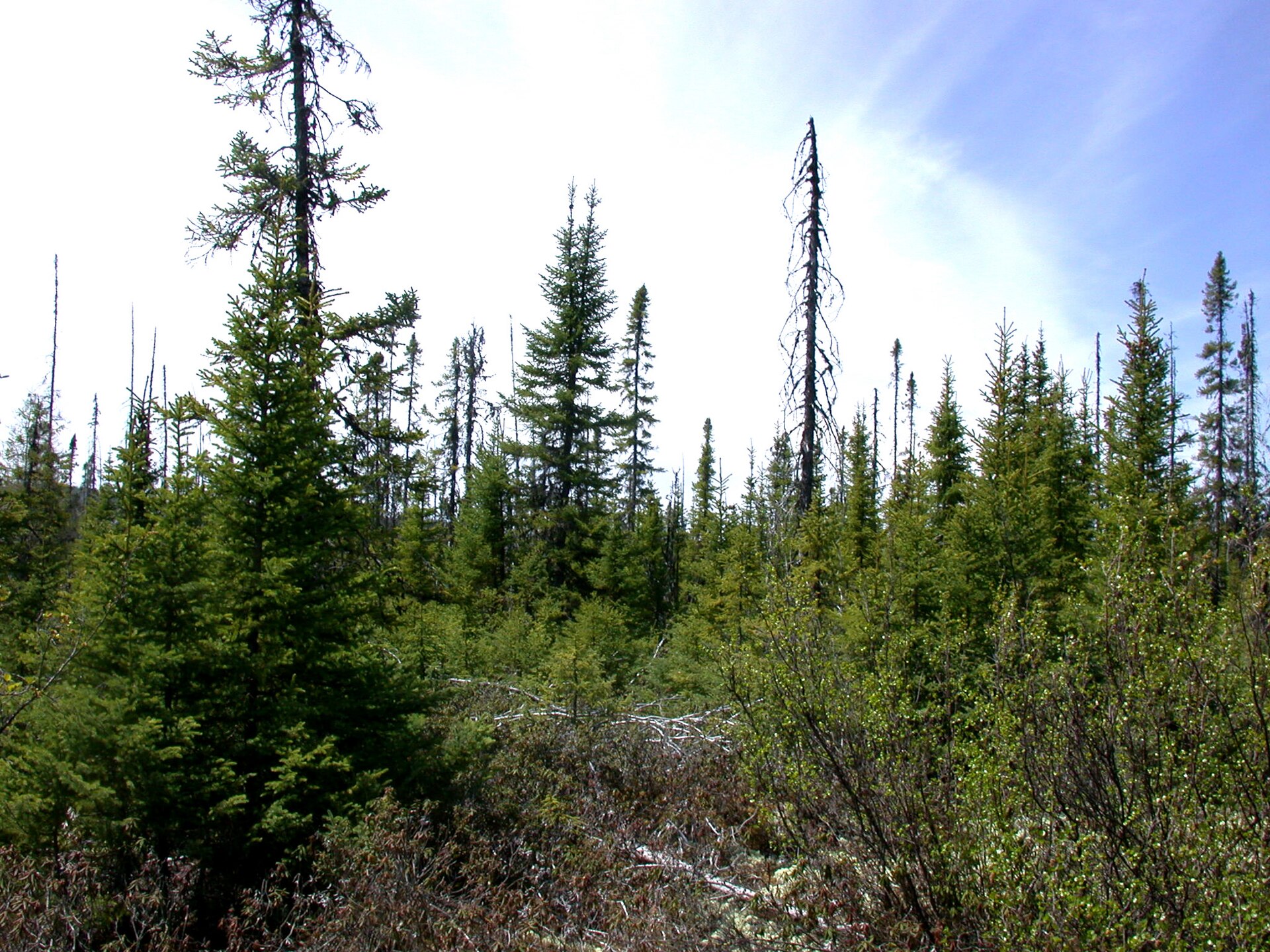
Like Aubin et al. (2026), Boulanger et al. (2025) found that Canadian forests in the east and Atlantic regions are likely to experience greater impacts on tree growth than are forests in western and central regions. The host most vulnerable to SBW, balsam fir (Abies balsamea), is a dominant or codominant species in the East and Atlantic regions. The fir is sparsely distributed in those areas of central and western Canada where the climate is becoming highly suitable for the insect. The frequent wildfires promote growth of young pioneer tree species, e.g., jack pine and trembling aspen, that do not support SBW.
At the most general level Boulanger et al. (2025) suggest that climate change might have already surpassed impacts of land use change on spruce budworm dynamics. Climate change puts additive and synergistic pressures on insects, which are already more sensitive than trees to climatic factors and able to adapt more quickly. As a result, climate change is becoming the most significant driver of recent declines in insect abundance and shifts in community structure, development, dispersal patterns, and phenology. (Again, see Aucott, above, for an alternative explanation.)
Boulanger et al. (2025) mention but do not discuss possible impacts of climate change and a shift in SBW distribution and tree hosts on a third trophic level, i.e., natural enemies. They note that many factors – not just climate suitability — influence trophic interactions. Another complication is that most SBW parasitoids require alternate hosts.
Boulanger et al. (2025) join others in urging forest managers to quickly adapt their management strategies to the novel climate-induced threats. They call for a proactive and integrated approach in forest management. Ecological research will be crucial to mitigate the compounded effects of climate change and to preserve the integrity & sustainability of forest ecosystems.
SOURCES
Aubin, I., A. Roe, B. Marquis, L. Boisvert-Marsh, J. Pedlar,S. Erni, B. Hamel, G. Lawrence, D. McKenney, T. Scarr. 2026. Vulnerability of Canadian forests to invasive insects under climate change. Accepted by the Canadian Journal of Forest Research.
Aucott’s letters to entomology journals: https://academic.oup.com/ee/article-abstract/48/2/274/5372493 & https://www.sciencedirect.com/science/article/abs/pii/S0006320720302822?via%3Dihub
Boulanger, Y., A. Desaint, V. Martel, M. Marchand, S. Massoda Tonye, R. Saint-Amant, et al. (2025) Recent climate change strongly impacted the population dynamic of a North American insect pest species. PLOS Clim 4(2): e0000488. https://doi.org/10.1371/journal. pclm.0000488
Ziska, Lewis. 2022. Greenhouse Planet https://cup.columbia.edu/book/greenhouse-planet/9780231556613/ (book)
See also an article describing declining nutrient value of food crops in response to increased atmospheric C02 levels: https://www.washingtonpost.com/climate-environment/interactive/2026/carbon-pollution-diluting-key-nutrients-food/
Posted by Faith Campbell
We welcome comments that supplement or correct factual information, suggest new approaches, or promote thoughtful consideration. We post comments that disagree with us — but not those we judge to be not civil or inflammatory.
For a detailed discussion of the policies and practices that have allowed these pests to enter and spread – and that do not promote effective restoration strategies – review the Fading Forests report at http://treeimprovement.utk.edu/FadingForests.htm
Or