Promising Biocontrol to Protect Some Cacti

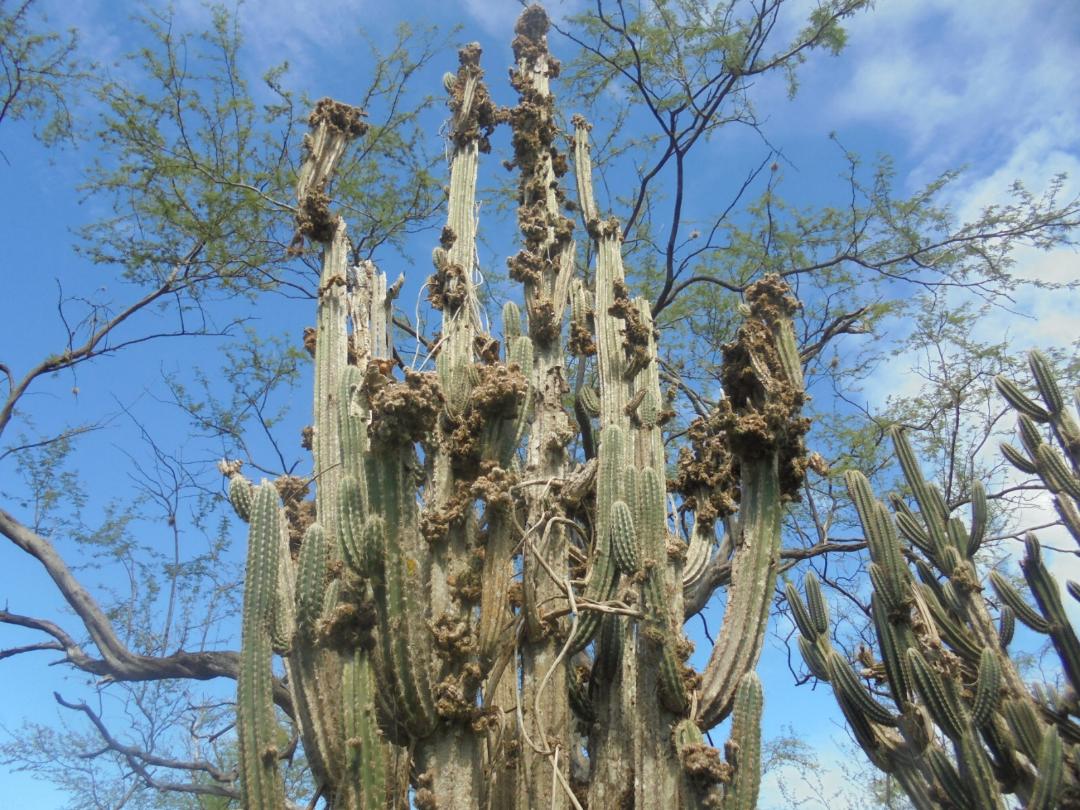
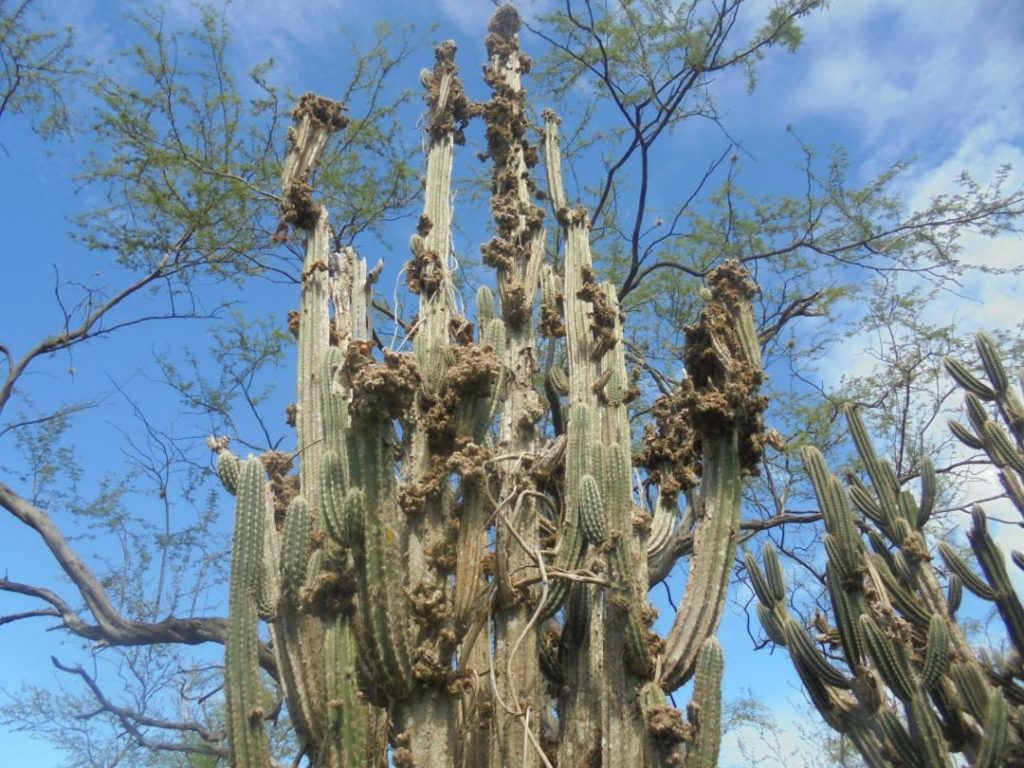
Photo of infested cactus at Cabo Rojo National Wildlife Refuge, Puerto Rico. Taken August 20, 2018 by Yorelyz Rodríguez-Reyes

Three and a half years ago, I blogged about the threat to columnar cacti in Puerto Rico from the Harrisia cactus mealybug. The mealybug clearly threatens the endemic cacti of the Caribbean islands, and possibly some of the hundreds of other columnar cacti growing across two million square miles of desert ecosystems that straddle the U.S.-Mexico border region.

I am pleased to report that scientists continue efforts to find biocontrol agents to reduce this insect’s damage on Caribbean islands. Much of this work is being done by the Center for Excellence in Quarantine and Invasive Species at University of Puerto Rico. The team consists of Michael West Ortiz, Yorelys Rodrígues Reyes, Ferdinand Correa and Jose Carlos Verle Rodrigues.

As of February 2019, the Center is conducting host specificity tests on a primary parasitoid of the Harrisia Cactus mealybug — Anagyrus cachamai. This wasp was found as a result of almost a decade of searching in South America and other locations. It is native to Argentina and Paraguay (Triapitsyn et al. 2018; sources listed at the end of the blog).The Center also continues surveys and studies of other primary and secondary parasitoids of the mealybug.

The work to develop a biocontrol agent for the mealybug continues despite continuing uncertainty about the true species of the mealybug. At the time of its discovery on Puerto Rico, the mealybug was believed to belong to a species used as a biocontrol agent for invasive cacti in Australia and South Africa, designated as Hypogeococcus pungens. However, H. pungens is now thought to be a species complex, and the species in Puerto Rico differs from the earlier designation (Triapitsyn et al. 2018). 

Apparently the mealybug was introduced in Puerto Rico around 2000   — probably on the ornamental common purslane (Portulaca olerácea), an annual succulent. (Note: the introduction was on a host different from the vulnerable cacti.) Within five years of the first detection in San Juan, the mealybug was sighted on cacti on the other side of the island in the Guánica State Forest and Biosphere Reserve. By 2010, the mealybug was widely distributed in most dry districts. Surveys found it in all 11 municipalities surveyed in southern Puerto Rico. At some locations, infestation levels were extremely high – e.g., 86% of stems surveyed were infested at Guánica. Infestation rates were lower in other municipalities. As of 2010, infestations were estimated to be present on about 1,400 km2 on the southern coast; the rate of new infestations suggests that the mealybug was spreading rapidly (Segarra-Carmona et al. 2010).  I have been unable to obtain more recent estimates.

The mealybug impacts seven of 14 native cactus species occurring in dry forests of the island, including three endemic and two endangered species in the subfamily Cactoideae. The two endangered species are Harrisia portoricensis and Leptocereus grantianus (USDA ARS). The tissue damage caused by the mealybug interferes with sexual reproduction and can cause direct mortality of the plant (Triapitsyn et al. 2018).  These cacti provide food or shelter for endemic bats, birds, moths and other pollinators (Segarra & Ramirez; USDA ARS). The mealybug is also now killing native cacti on the U.S. Virgin Islands (H. Diaz-Soltero pers. comm. August 2015).

 USDA Funds Conservation Efforts Despite Apparent Absence of a Constituency Calling for Such Action

Efforts to identify and test possible biocontrol agents targetting the Harrisia cactus mealybug received significant funds from the Plant Pest and Disease Management and Disaster Prevention Program. This is a competitive grant program managed by APHIS. It is permanently funded and thus not subject to the vagaries of annual appropriations. Until last year, this program operated under Section 10007 of the 2014 Farm Bill. With passage of a new Farm Bill, it is now designated as Section 7721 of the Plant Protection Act.

Since Fiscal Year 2018, APHIS has had authority to spend more than $60 million per year on this program.  In Fiscal Year 2017, , the program provided $120,000 to an unspecified federal agency, $70,000 to an academic institution in Puerto Rico (presumably the Center), $15,000 to another academic institution in California, and $3,000 divided among two APHIS facilities – for a total of $208,000. The next round of funds came in FY19, when the program provided $277,267 to an unspecified federal agency to continue work on biocontrol. In addition, the program provided $78,507 to an unspecified federal agency to “safeguard[e] genetic diversity of native and listed cacti threatened by Harrisia cactus mealybug in Puerto Rico”.

No Apparent Action on Threats to Opuntia Cacti

In my earlier blog, I also described the threat to flat-padded Opuntia (prickly pear) cacti from the cactus moth Cactoblastis cactorum. Various federal, state, and academic entities received $463,000 from the permanent fund in Fiscal Year 2016 and another $100,000 in FY2017. No cactus moth programs have received funds in more recent years.

SOURCES

Segarra-Carmona, A.E., A. Ramirez-Lluch. No date. Hypogeococcus pungens (Hemiptera: Pseudococcidae): A new threat to biodiversity in fragile dry tropical forests.

Segarra-Carmona, A.E., A. Ramírez-Lluch, I. Cabrera-Asencio and A.N. Jiménez-López. 2010.  FIRST REPORT OF A NEW INVASIVE MEALYBUG, THE HARRISIA CACTUS MEALYBUG HYPOGEOCOCCUS PUNGENS (HEMIPTERA: PSEUDOCOCCIDAE). J. Agrie. Univ. RR. 94(1-2):183-187 (2010)

Triapitsyn, Aguirre, Logarzo, Hight, Ciomperlik, Rugman-Jones, Rodriguez. 2018. Complex of primary and secondary parasitoids (Hymenoptera: Encyrtidae and Signiphoridae) of Hypogeococcus spp. mealybugs (Hemiptera: Pseudococcidae) in the New World. Florida Entomologist Volume 101, No. 3 411

USDA Agriculture Research Service, Research Project: Biological Control of the Harrisia Cactus Mealybug, Hypogeococcus pungens (Hemiptera:pseudococcidae) in Puerto Rico Project Number: 0211-22000-006-10 Project Type: Reimbursable

West Ortiz, M. pers. comm. February 2019

Posted by Faith Campbell

We welcome comments that supplement or correct factual information, suggest new approaches, or promote thoughtful consideration. We post comments that disagree with us — but not those we judge to be not civil or inflammatory.

Cacti under Threat – Does No One Care?

Nearly 2 million square miles of ecologically significant and beautiful desert ecosystems straddle the U.S.-Mexico border regions. Cacti are either dominate or are extremely important components of these ecosystems. Two South American insects already present in the United States threaten to kill large numbers of these cacti and transform these desert ecosystems. Iconic species – prickly pears, saguaro, and organ pipe cacti – are at risk.

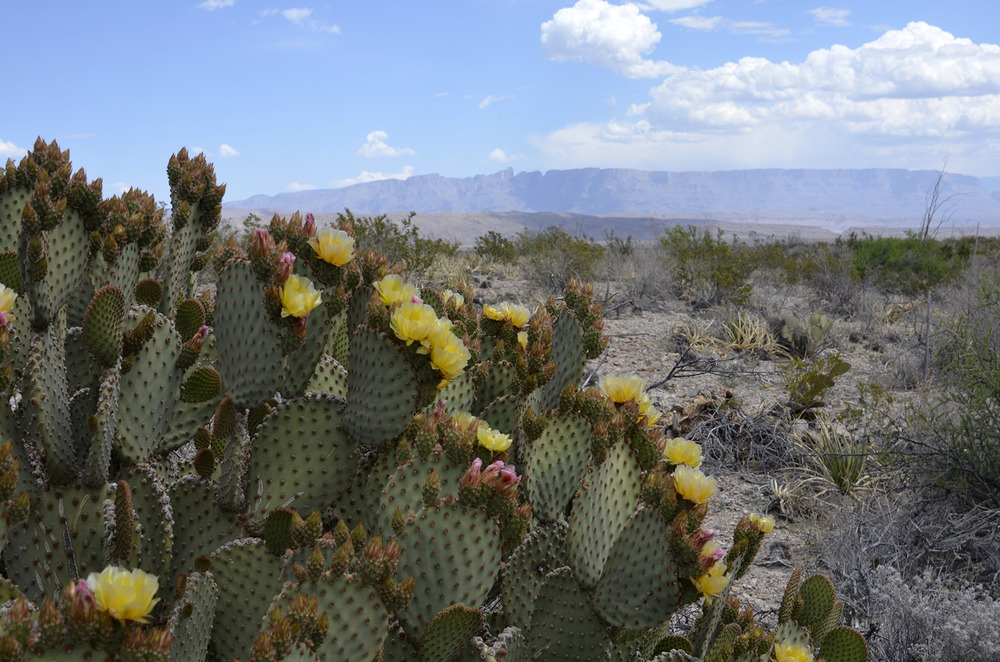
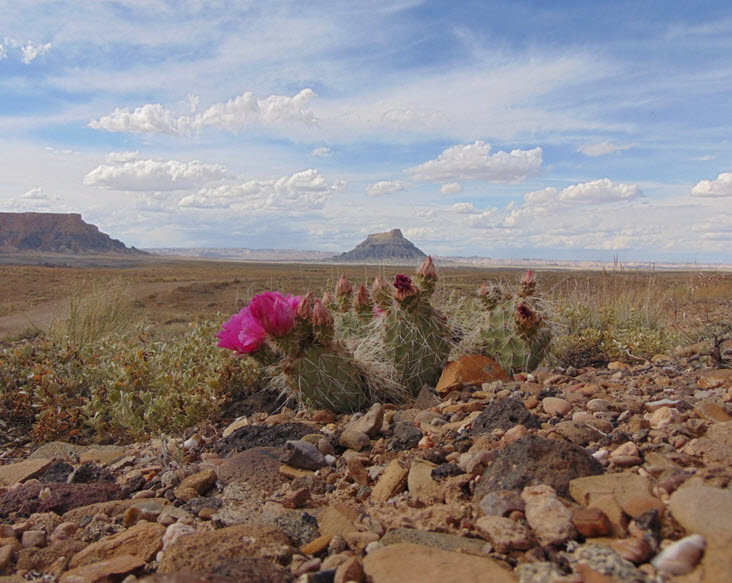
prickly pear cactus at Factory Butte; photo by S.E. Schlarbaum

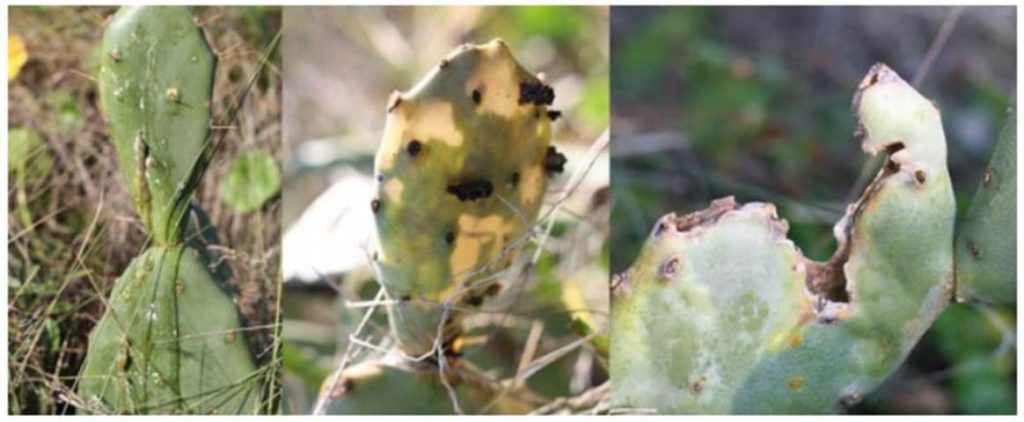
Flat-padded prickly pear cacti of the genus Opuntia are threatened by the cactus moth, Cactoblastis cactorum.
In 1989, the cactus moth was found in southern Florida, to which it had spread from the Caribbean islands (Simonson 2005). Since then, it has spread west as far as southern Louisiana. Two small outbreaks on islands off Mexico’s Caribbean coast have been eradicated. If it reaches the arid regions of Texas, it is likely to spread throughout the desert Southwest.
In Florida, the cactus moth has caused considerable harm to six native species of prickly pear, three of which are listed by the state as threatened or endangered. In the American Southwest, at least 80 species of flat-padded prickly pears are at risk (Simonson et al. 2005) and there are more in Mexico, which is the center of endemism for Opuntia.
These cacti support a diversity of pollinators as well as deer, javalina (peccaries), tortoises, and lizards. Prickly pears also shelter packrats –which in turn are fed on by raptors, coyotes, and snakes; nesting birds and plant seedlings. Their roots hold highly erodible soils in place (Simonson 2005).
The U.S. Department of Agriculture began trying to slow the spread of the cactus moth in 2005 – 15 years after it was first detected in Florida (Mengoni Goñalons et al. 2014).  However, the program never received an appropriation from Congress so funding was always inadequate. For several years, a patchwork of projects was stitched together: Mexico provided some funding; a volunteer network managed by Mississippi State University monitored lands along the Gulf Coast for the moth; and a laboratory operated by the Florida Department of Agriculture reared moths for research, sterile male releases and biocontrol host specificity testing.
The continuous funding problems led APHIS to abandon its regional program and focus on biocontrol, which is the only viable control measure in the desert Southwest where vulnerable cacti are numerous and grow close together. A newly described wasp, Apanteles opuntiarum (Mengoni Goñalons et al. 2014), is the most promising candidate.
Harrisia cactus mealybug might attack columnar cacti
The 2 million square miles of desert in Southwest United States and Mexico are home to more than 500 columnar cactus species in the Cactoideae (Zimmerman et al. 2010). Some are already endangered; others are totems of the desert, e.g., saguaro, organ pipe, and barrel cacti. The larger ones, particularly, play important ecological roles.
A second South American insect threatens columnar cacti in the Caribbean basin now and in the future could put others at risk in the American Southwest and Mexico: the Harrisia cactus mealybug (Zimmerman et al. 2010).
A mealybug in the genus Hypogeococcus has been killing several of the 13 columnar cactus species in southern Puerto Rico since 2005. Two are endangered species: Harrisia portoricensis and Leptocereus grantianus (USDA ARS). These cacti provide food or shelter for endemic bats, birds, moths and other pollinators (Segarra & Ramirez; USDA ARS). This mealybug is also now killing native cacti on the U.S. Virgin Islands (H. Diaz-Soltero pers. comm. August 2015).
Mealybugs in the same genus in Florida and Hawai`i do not attack cacti (University of Florida fact sheet; Hawai`i Department of Agriculture new pest report). In South America, though, insects in this genus feed on many columnar cacti, including ones in the genera Cereus, Echinopsis, Harrisia, Cleistocactus, Monvilea, and Parodia (USDA ARS; Zimmerman et al. 2010). Scientists are uncertain how many mealybug species are involved, which complicates efforts to determine the level of threat to columnar cacti on the U.S. mainland (H. Diaz-Soltero pers. com. August 2015). No one knows how vulnerable individual cactus species growing in the Southwest are to Hypogeococcus mealybugs (Golubov pers. comm. January 2011). Nor does anyone know whether natural enemies of mealybugs native to Mexico might also attack alien mealybugs and so prevent significant damage to native cacti (Zimmerman et al. 2010).
Still, the possible threat warrants studies to determine the vulnerability of these cacti to non-native mealybugs in the Hypogeococcus genus.
Meanwhile, scientists at the USDA ARS laboratory in Argentina have been searching for possible biocontrol agents but are stymied by the confusion over which mealybugs attach which cacti. Use of DNA sequencing and other tools should clarify these issues (H. Diaz-Soltero pers. comm. August 2015). However, no funds have been appropriated for this work, which has hindered progress (H. Diaz-Soltero pers. comm. August 2015).
To date, no organized constituency has advocated for protection of our cacti from these two pests. In the past I tried to persuade native plant societies, Nature Conservancy chapters, the leadership of the American Cactus and Succulent Society, and other groups that champion the desert to help lobby the Congress to fund USDA’s efforts. I was never successful.
Are Americans truly indifferent to the threat that many cacti in our deserts will be killed by non-native insects? Do they not realize that these threats must be countered before they reach the areas where cacti are dense and numerous?

Sources
California Plant Pest and Disease Report. 2005. Vol. 22 No. 1. Covering Period from July 2002 through July 2005.
Hawaii Department of Agriculture. 2006. http://hawaii.gov/hdoa/pi/ppc/2006-annual-report/new-pest-detections (accessed 11/1/10)
Mengoni Goñalons, C., L. Varone, G. Logarzo, M. Guala, M. Rodriguero, S.D. Hight, and J.E. Carpenter. 2014. Geographical range & lab studies on Apanteles opuntiarum (hymenoptera: braconiDae) in AR, a candidate for BC of Cactoblastis cactorum (Lepidoptera: Pyralidae) in North America. Florida Entomologist 97(4) December 2014
Segarra-Carmona, A.E., A. Ramirez-Lluch. No date. Hypogeococcus pungens (Hemiptera: Pseudococcidae): A new threat to biodiversity in fragile dry tropical forests. {title/org/other identifying information for Segarra-Carmona plus an entry for the pers. comm.}
Simonson, S.E., T. J. Stohlgren, L. Tyler, W. Gregg, R. Muir, and L. Garrett. 2005. Preliminary assessment of the potential impacts and risks of the invasive cactus moth, Cactoblastis cactorum Berg, in the U.S. and Mexico. Final Report to the International Atomic Energy Agency, April 25, 2005 © IAEA 2005
USDA Agriculture Research Service, Research Project: Biological Control of the Harrisia Cactus Mealybug, Hypogeococcus pungens (Hemiptera:pseudococcidae) in Puerto Rico Project Number: 0211-22000-006-10 Project Type: Reimbursable
Zimmermann, H.G., M.P.S. Cuen, M.C. Mandujano, and J. Golubov. 2010. The South American mealybug that threatens North American cacti. Cactus and Succulent Journal. 2010 Volume 82 Number 3

Posted by Faith Campbell