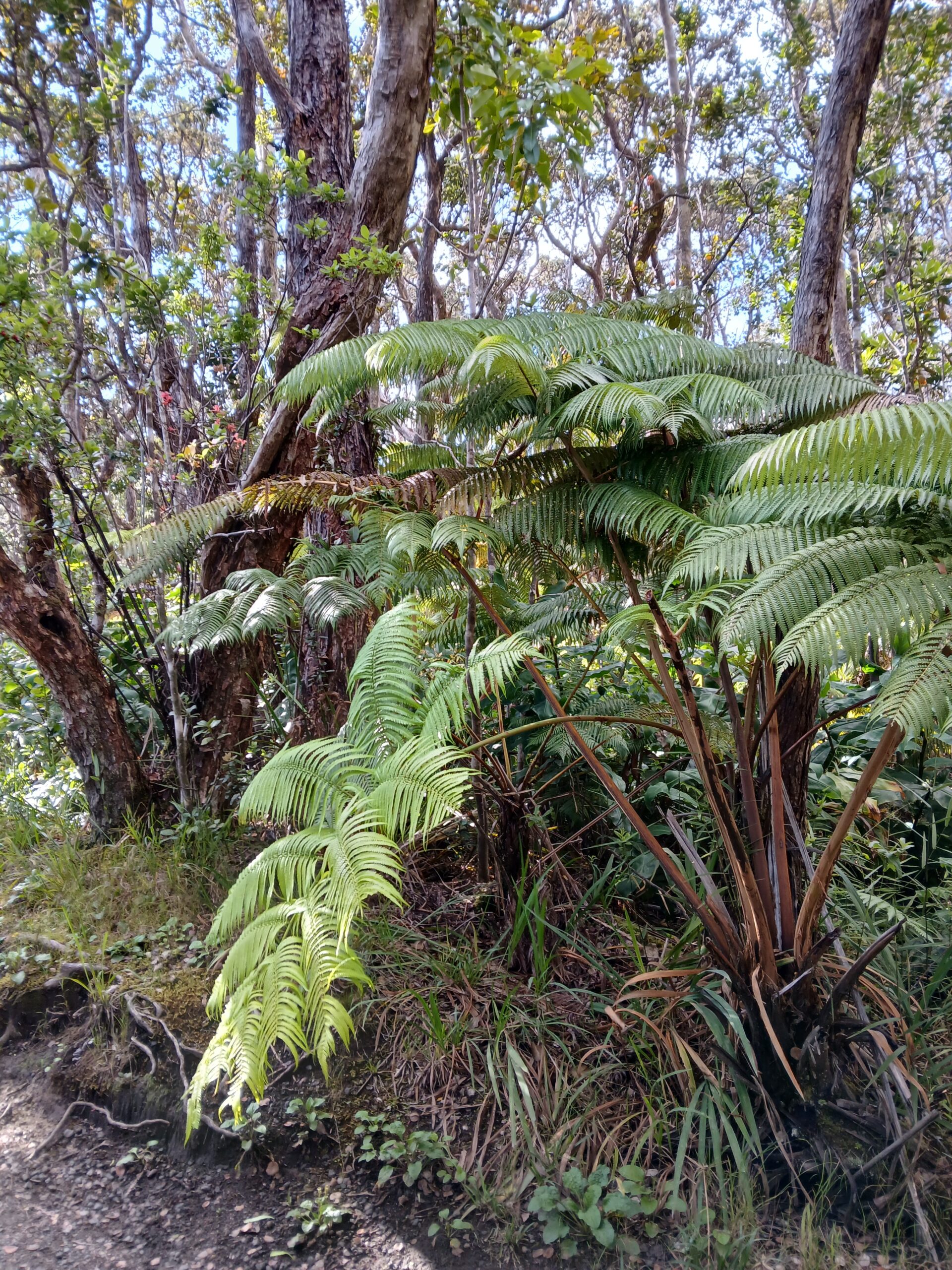
A year ago I blogged about the status of Hawaiian species in the face of high levels of bioinvasions. I now update that discussion as it pertains to one of the invaders, the Australian tree fern Sphaeropteris cooperi.
S. cooperi has successfully invaded multiple regions, including the southern coast of South Africa, the Azores and Mascarene Archipelagos, and Hawai`i. The invasion’s impacts have been assessed only in Hawai`i. Studies found that the non-native tree ferns have outcompeted the dominant native tree fern Cibotium glaucum (Cibotiaceae), and altered leaf litter composition hence soil nutrient cycling. This in turn affects species assemblages (van den Berg et al. 2025).
Chau, Walker and Mehltreter (2013) documented the litter and soil chemistry in Hawaiian rainforests. They found that S. cooperi produces more leaves that grow faster, contain more nitrogen and phosphsorus, and decompose faster than the leaves of the dominant native tree fern C. glaucum. They compared the effect of leaf litter from the native and tree ferns on the growth and nutrient content of four native angiosperm species when they were grown in N-rich forest soil and P-rich landslide soil. The results suggested that nitrogen availability is the strongest driver of growth. The introduced tree fern, S. cooperi, can thus prompt more rapid growth of some native HI plants. They point out, however, that under natural conditions, native plants must compete for these additional nutrients with various non-native plants, including S. cooperi. The ultimate impact, then, remains unclear.
van den Berg et al. (2025) report that other invaded sites are at great risk Both the Garden Route region of South Africa and La Reunion Island in the Mascarene Archipelago in the eastern Indian Ocean have high bioidiversity. Both contain large, globally-recognized protected areas established to protect the native biodiversity: UNESCO Garden Route Biosphere Reserve and Reunion National Park. Despite their biological importance, both are among the top10 most invaded countries/territories globally (Tuberlin et al. 2017).
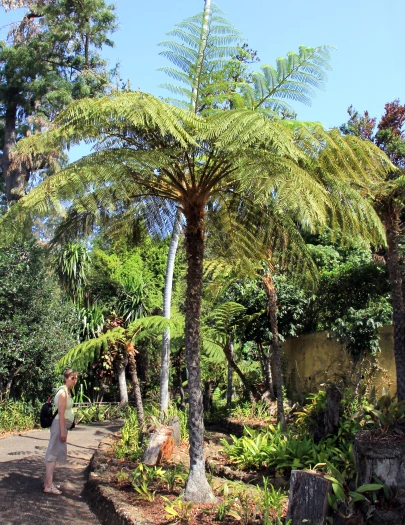
While climate change is expected to reduce the extent of suitable habitat for the Australian tree fern in both South Africa and La Reunion, the current situation is troubling. At present the tree fern occupies a narrower range of climatic conditions in both the Garden Route and especially on La Reunion than in Australia. (On La Reunion, 13.74 % of the fern’s apparent niche remains unoccupied.) van den Berg et al. (2025) are not sure what factors might be limiting the tree fern’s spread. They do urge educational campaigns to persuade people living near the Biodiversity Reserve to avoid planting the non-native tree fern.
The tree fern’s actual niche is somewhat uncertain because predation by deer (non-native to Australia) might have reduced its reproduction. The authors mention this but do not speculate further on the possible response of the fern to the absence of such stresses on La Reunion.
SOURCES
Chau, M.M., Walker, L.R. and Mehltreter, K. An invasive tree fern alters soil and plant nutrient dynamics in Hawaii. Biol Invasions 15, 355–370 (2013). https://doi.org/10.1007/s10530-012-0291-0
Turbelin,A.J., Malamud,B.D., Francis,R.A. 2017. Mapping the global state of invasive alien species: patterns of invasion and policy responses. Glob. Ecol. Biogeogr. 26,78–92. https://doi.org/10.1111/geb.12517.
van den Berg, M.L., G. Singh, E.J. McCulloch-Jones, M. Rouget, D.M. Richardson, T.B. Robinson. 2025. The invaded range of the tree fern Sphaeropteris cooperi is predicted to shrink in two southern hemisphere biodiversity hotspots. African Journal of Botany 178 (2025) 390-399
Posted by Faith Campbell
We welcome comments that supplement or correct factual information, suggest new approaches, or promote thoughtful consideration. We post comments that disagree with us — but not those we judge to be not civil or inflammatory.
For a detailed discussion of the policies and practices that have allowed these pests to enter and spread – and that do not promote effective restoration strategies – review the Fading Forests report at http://treeimprovement.utk.edu/FadingForests.htm
Or