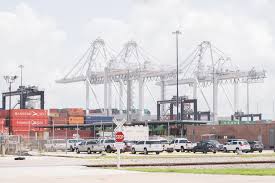
I blogged recently about ports in the southeast dredging channels and taking other actions to increase the number of container ships they can service. Michael Angell of the Journal of Commerce reports that the Port of Houston is competing vigorously for visits by ships from Asia. Of course, rising ship visits increase the opportunity for Asian pests such as Asian longhorned beetle or several ambrosia beetles in the Euwallaceae complex to invade the Gulf Coast region. (The emerald ash borer is already present in Texas.)
Considering the immediate future, the Port of Houston is expanding capacity of its two existing terminals. The Port is dredging portions of its channel down to a 46-foot depth. It expects to complete dredging of the main channel to 55 feet – the depth of Norfolk currently by ten years from now.
One of the existing terminals, the Bayport container terminal, handles most of the trans-Pacific Asia services coming into the Gulf Coast. Two new berths and storage yard space are being added, so that Bayport will be able to handle five super-post-Panamax ships simultaneously. The other terminal, Barbours Cut terminal, is also being renovated to improve handling of super-post-Panamax ships. At full buildout, the Bayport and Barbours Cut will have capacity for handling 8 million TEUs per year.
Houston has begun design work for a third container terminal. At full capacity – more than a decade from now — this third terminal will handle another 4 million TEUs. The project has been approved by the Federal Permitting Improvement Steering Council for streamlined environmental under the 2015 FAST Act. This program does not alter any applicable statutory or regulatory requirement, or guarantee approval. It seeks to expedite lawfully mandated environmental and other review through standardized interagency consultation and coordination practices. It also created a public online tool to track progress in completing these requirements.
Through May 2026, Houston handled 502,387 TEUs in container imports from Asia, up 10% from the same period in 2025. The number of container ships over 10,000 TEUs in capacity calling at Houston doubled, from four in the second half of 2025 to nine during the first half of 2026.
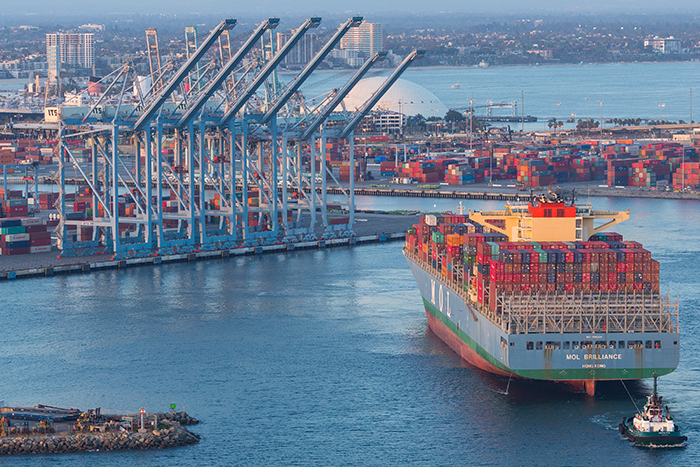
Houston ranked fifth in container volumes during this period. Los Angeles was the top port, with 1,974,330, followed closely by Long Beach with 1,851,159. Together, the two California ports received more than seven times as many containers as Houston. Houston is competing with other ports in the Southeast. Savannah still handles more than a third higher numbers than Houston, at 823,823 containers. The Port of Virginia (see earlier blog) received 285,046 containers, and Charleston only 256,499 Both were decreases from the 2025 number. All three southeastern ports saw small decreases from their 2025 numbers.
Posted by Faith Campbell
We welcome comments that supplement or correct factual information, suggest new approaches, or promote thoughtful consideration. We post comments that disagree with us — but not those we judge to be not civil or inflammatory.
For a detailed discussion of the policies and practices that have allowed these pests to enter and spread – and that do not promote effective restoration strategies – review the Fading Forests report at http://treeimprovement.utk.edu/FadingForests.htm
Or