What is being introduced, and how? APHIS — make data public!

It is important that officials responsible for phytosanitary protection, Congressional oversight committees, and stakeholders have access to key trade and pest data as well as independent analyses of them in order to evaluate programs’ effectiveness.

Capitol

But we don’t have such access … and existing analyses cannot be used to detect trends.

My focus is on tree-killing insects and diseases, but these constitute a small fraction of the total number of all plant pests that have become established in North America since Jamestown was settled. According to Aukema et al. (2010), approximately 450 non-native insects have colonized forest and urban trees. This is about 17% (less than one-fifth) of the total of 3,540 non-native insects established in North America according to Yamanaka et al. (2015). The larger number includes ones apparently causing negligible harm, along with a significant proportion of insects and diseases affecting row crops.
What could we learn from comparisons of data on introduced tree-related vs. overall plant pests? Could we uncover new pathways? Identify more effective approaches to phytosanitary protection?
Unfortunately, neither published studies nor USDA/APHIS’ data allow comparisons and tracking of trends in pest establishment.

For example, a study by Work et al. (2005) estimated that during the late 1990s, approximately 10 new phytophagous insects were established each year. The authors considered all phytophagous insect pests, not just tree-killing pests; but they did not include pathogens or insects that feed on dead wood (e.g., termites).

The Work team’s number is about four times larger than the estimated rate of establishment provided by Aukema et al. (2010), which estimated that approximately 2.5 new tree-killing insects and pathogens became established each year from 1860 to 2006. The Aukema study did not attempt to track establishments of all pests that use arboreal hosts. On the other hand, it did include pathogens. So the two studies’ findings are not truly comparable.

In its 2009 Implementation Plan for Section 10201 of the Food, Conservation and Energy Act of 2008, APHIS reported that between 2001 and summer 2008, 212 plant pests had been reported as new to the United States – an average of 30 new pest establishments detected each year. This estimate does include pathogens … but not insects that do not feed on living plants. So it is not comparable to the Yamanaka study. Still, the APHIS figure is 12 times higher than the Aukema et al. estimate for tree-killing pests.

I am unaware of a publicly available estimate for more up-to-date establishment rates.

An internal USDA APHIS database was made available to me. It lists about 90 new species of plant pests (of all types, ranging from insects to nematodes to fungal pathogens) with populations that were detected in the U.S. during the four-year period 2009 – 2013. The rate of detection of “new” species established during this four-year period was approximately 22 per year. This establishment rate is higher than the estimate of approximately 10 new phytophagous insects per year during the late 1990s put forward by Work et al. — not surprising since taxa other than insects are included. However, this estimate is lower than the 30 new pest introductions each year estimated by USDA APHIS for 2001-2008.

So what is the current rate? How has the establishment rate been affected by changing volumes of imports over this 20-year period (imports rose until 2008, then fell because of the Great Recession)? How has the reported number of new establishments been affected by changes in monitoring program criteria and funding levels?
Do the databases include sufficient information about dates of probable establishment, likely pathways of introduction, etc., to allow a more complete analysis of at least the new insect species?
I have not seen the database compiled by Yamanaka’s team so I don’t know.

The USDA database from 2009-2013 does not specify the probable pathways by which these pests entered the United States. I have concluded that the viruses, fungi, aphids and scales, whiteflies, and mites were probably introduced via imports of plants, cuttings, or cut foliage or flowers. These pests number 37 – or 41% of the total.

The database on tree-killing insects and pathogens compiled by the Aukema team includes both date of probable introduction and likely pathway; and articles by this team discuss trends in introduction rates. Thus, Liebhold et al. 2012 reports that approximately 69% of the pests in the database were introduced via the trade in live plants. This figure is one-third higher than the proportion I calculated from the USDA database (which, I remind you, includes all plant pests, not only those that attack trees).

Many of the pests associated with imports of plants in the Liebhold study were introduced decades ago, before the U.S. adopted phytosanitary regulations. Does the difference in the proportion of pests associated with plant imports in the 2009-2013 period compared to the earlier period covered by Liebhold et al. reflect a reduced risk from this pathway as the result of tighter regulations and shifts in the market? I doubt anyone can say – beyond the acknowledged increase in wood-borers associated with wood packaging.

Without better, and more readily available, data, we won’t ever be able to answer key questions. It is urgent that APHIS make available its data on trade volumes, pest interceptions, newly established pests, etc., for analysis by academics, other agencies, and stakeholders. And certainly it would be helpful if both APHIS and other researchers used more consistent approaches so to make possible longitudinal studies that can disclose trends.

Sources:

Aukema, J.E., D.G. McCullough, B. Von Holle, A.M. Liebhold, K. Britton, & S.J. Frankel. 2010. Historical Accumulation of Nonindigenous Forest Pests in the Continental United States. Bioscience. December 2010 / Vol. 60 No. 11

Liebhold, A.M., E.G. Brockerhoff, L.J. Garrett, J.L. Parke, and K.O. Britton. 2012. Live Plant Imports: the Major Pathway for Forest Insect and Pathogen Invasions of the US. www.frontiersinecology.org

Work, T.T.; McCullough, D.G.; Cavey, J.F.; Komsa, R. 2005. Arrival rate of nonindigenous species into the United States through foreign trade. Biological Invasions7: 323-3

Yamanaka, T., N. Morimoto, G.M. Nishida, K. Kiritani, S. Moriya, A.M. Liebhold. 2015. Comparison of insect invasions in NoAm, JP and their Islands Biol Invasions DOI 10.1007/s10530-015-0935-y
Posted by Faith Campbell

Wood packaging again ???!!!!!! Yes – problems need to be fixed!!

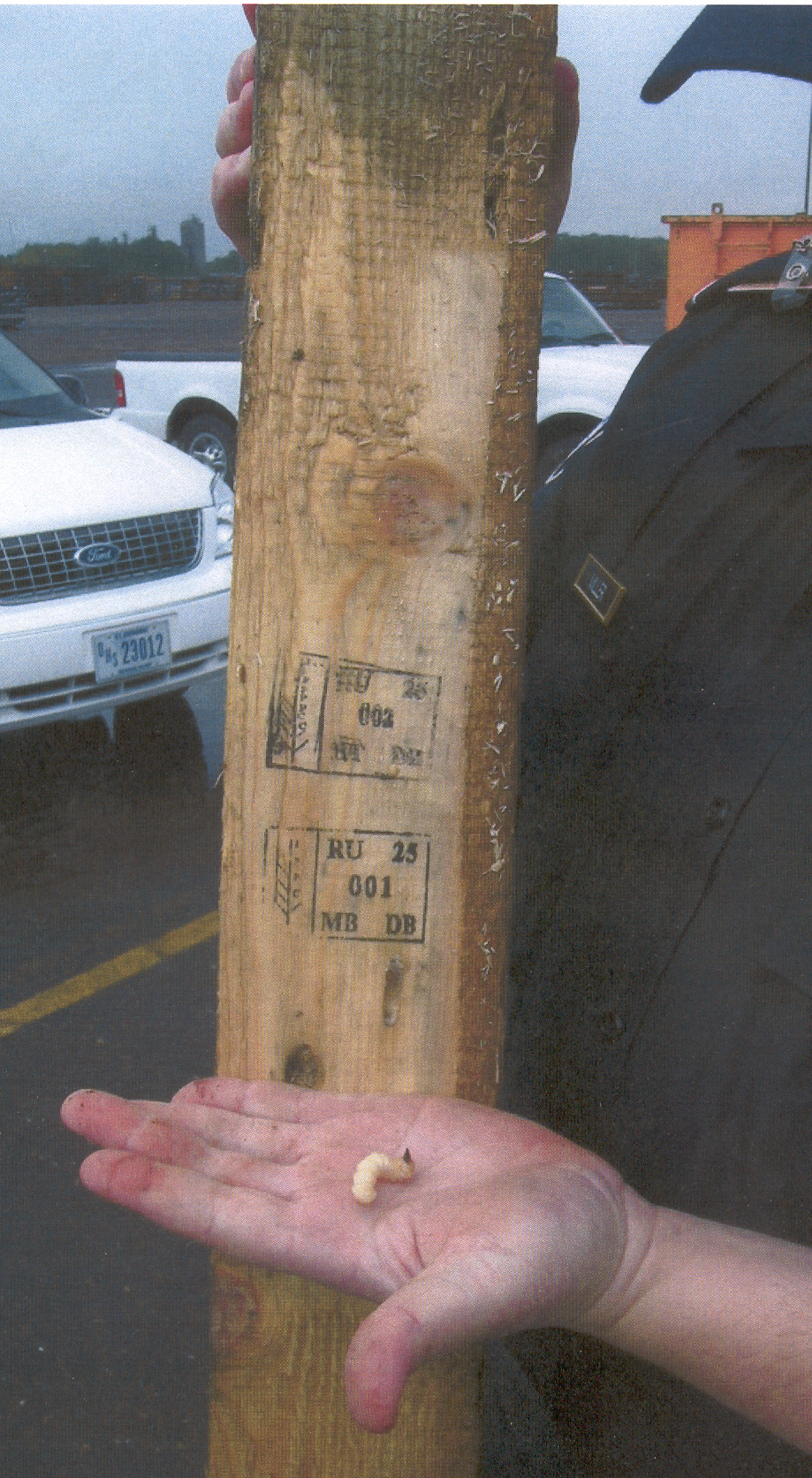
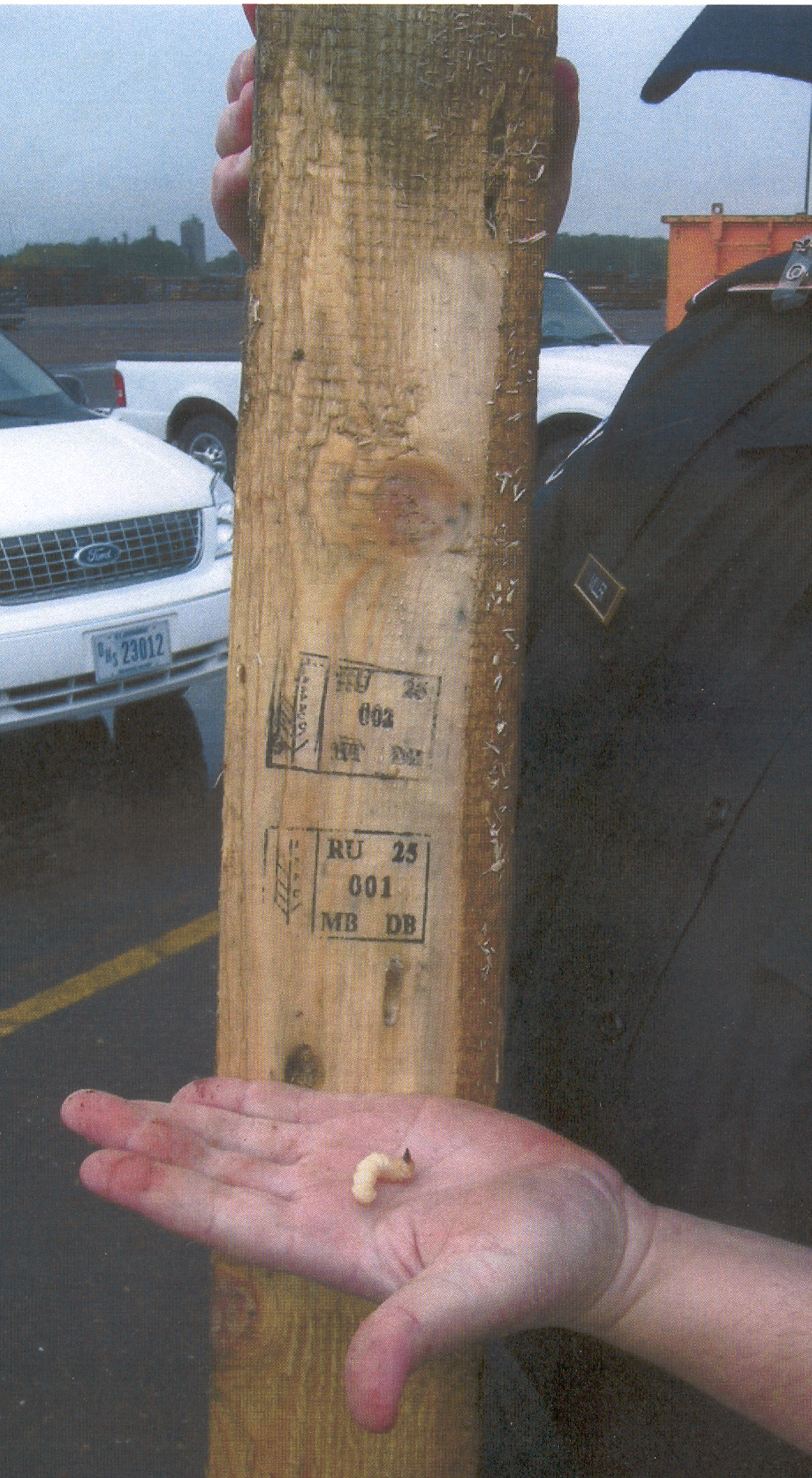
CBP inspector views Cerambycid larvae found in wood packaging that bears ISPM#15 stamp

Do we want triple the current number of wood-boring non-native insects to be established in just 35 years? We all know the damage that some of these insects can do (see summary or longer descriptions; for specific insects).
Over the past 30 years, at least 58 non-native species of wood- or bark-boring insects have been detected in the United States (not quite 2 new insects per year). Most were presumably introduced via imported wood, especially wood packaging (Haack et al.).

Yes, the U.S. has implemented the International Standard for Phytosanitary Management (ISPM)#15.  Nevertheless, USFS researcher Bob Haack estimates that 13,000 shipping containers per year – or 35 per day – transport tree-killing pests to the U.S. This is the basis for an estimate that by 2050 – just 35 years from now – the number of wood-boring pests introduced to the country will triple above current levels.
We don’t need to rely only on extrapolations to know that APHIS’ implementation of ISPM#15 is not protecting our trees. As noted in my blog of 11 September, inspectors at the ports continue to find insects in wood packaging – even wood packaging marked as having been treated according to the requirements of the standard. Nearly half of the wood packaging entering the country that does not comply with the treatment requirements comes from Mexico. U.S. and Mexican forests are separated by deserts – allowing insects to evolve there to which our trees are vulnerable (see my blog from 11 September and descriptions of goldspotted oak borer, soapberry borer, and walnut twig beetle and its accompanying fungus here).
An on-going study seeks to identify insect larvae found in wood packaging; it is a cooperative effort of USDA APHIS’ laboratory at Otis, Massachusetts, and Customs and Border Protection staff at eight ports. Since 2012, these ports have sent 848 cerambycid and buprestid beetle larvae to Otis for identification. The APHIS scientists have succeeded in identifying 292 larvae, or only 34%. They constituted 39 species and 29 genera.

At least 44 of these insects were from China; they included 6 Asian longhorned beetles. Remember, the U.S. first adopted regulations requiring China to treat its wood packaging at the end of 1998 – nearly 17 years ago!!! Another 20 insects were from Russia – which has been required to treat its wood packaging since early 2006 – nearly 10 years ago.
As noted in the documents linked to above, and in earlier blogs (15 July, 22 and 31 August, 11 September), wood-boring pests collectively have been the most costly of the types of tree-killing pests introduced. One study estimated that they cost local governments and homeowners $2.4 billion each year to manage dying and dead trees. The homeowners lose another $830 million in residential property values.

What the Government Has Done

While USDA APHIS has cracked down on U.S. producers of wood packaging who cheat and is promoting workshops to educate our trade partners on wood packaging treatment requirements, the government should do more to protect our forests.

What More Can be Done

• At present, U.S. policy allows an importer to be caught 5 times in 1 year with wood packaging that does not comply with the regulatory requirements. Requirements adopted a decade or more ago should be enforced more strictly! The Bureau of Customs and Border Protection and USDA APHIS should instead penalize all importers whose wood packaging does not comply with regulatory requirements.

• The Bureau of Customs and Border Protection should incorporate the wood packaging requirements into its “Customs-Trade Partnership Against Terrorism” (C-TPAT) program .

• USDA APHIS should re-examine the economic pros and cons of requiring importers to switch to packaging made from materials other than wooden boards. The new review should incorporate the high economic and ecological costs imposed by insects introduced via the wood packaging pathway.

• USDA leadership should move forward and the President’s Office of Management and Budget should approve final regulations – proposed by APHIS 5 years ago! – that would apply the same treatment requirements to wood packaging used in trade between the US and Canada. (Canada has been ready to adopt this measure for several years.)

Sources (my apologies – I apparently cannot attach to specific points in the blog):

Aukema, J.E., B. Leung, K. Kovacs, C. Chivers, K. O. Britton, J. Englin, S.J. Frankel, R. G. Haight, T. P. Holmes, A. Liebhold, D.G. McCullough, B. Von Holle.. 2011. Economic Impacts of Non-Native Forest Insects in the Continental United States PLoS One September 2011 (Volume 6 Issue 9)

Haack RA, Britton KO, Brockerhoff EG, Cavey JF, Garrett LJ, et al. (2014) Effectiveness of the International Phytosanitary Standard ISPM No. 15 on Reducing Wood Borer Infestation Rates in Wood Packaging Material Entering the United States. PLoS ONE 9(5): e96611. doi:10.1371/journal.pone.009661

Leung, B., M.R. Springborn, J.A. Turner, E.G. Brockerhoff. 2014. Pathway-level risk analysis: the net present value of an invasive species policy in the US. The Ecological Society of America. Frontiers of Ecology.org

Posted by Faith Campbell

APHIS has a tough job – and deserves praise

Carrying out a pest eradication program is a tough job – technically difficult, expensive, frustrating, and often generating opposition from various groups. But often eradication is crucial. It is the essential backup to the strategies aimed at preventing introduction in the first place.

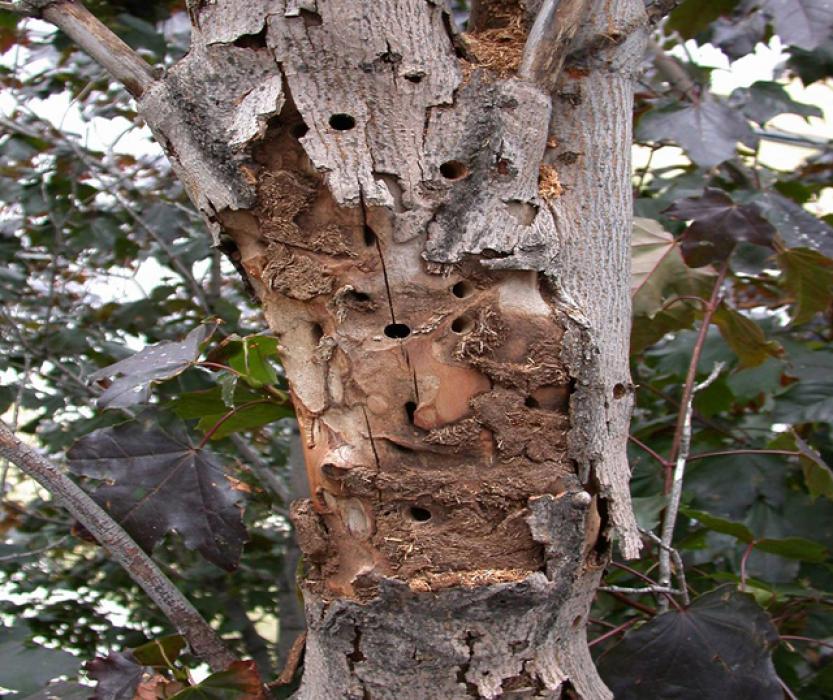
Damage to red maple; photo by Michael Smith, USDA

USDA APHIS is responsible for developing and implementing eradication programs targeting non-native plant pests – including those that kill trees. APHIS just released an environmental impact statement covering its efforts to eradicate the Asian longhorned beetle (ALB) it is available here. The EIS justifies both the eradication program targeting this species, itself, as well as the specific measures used.
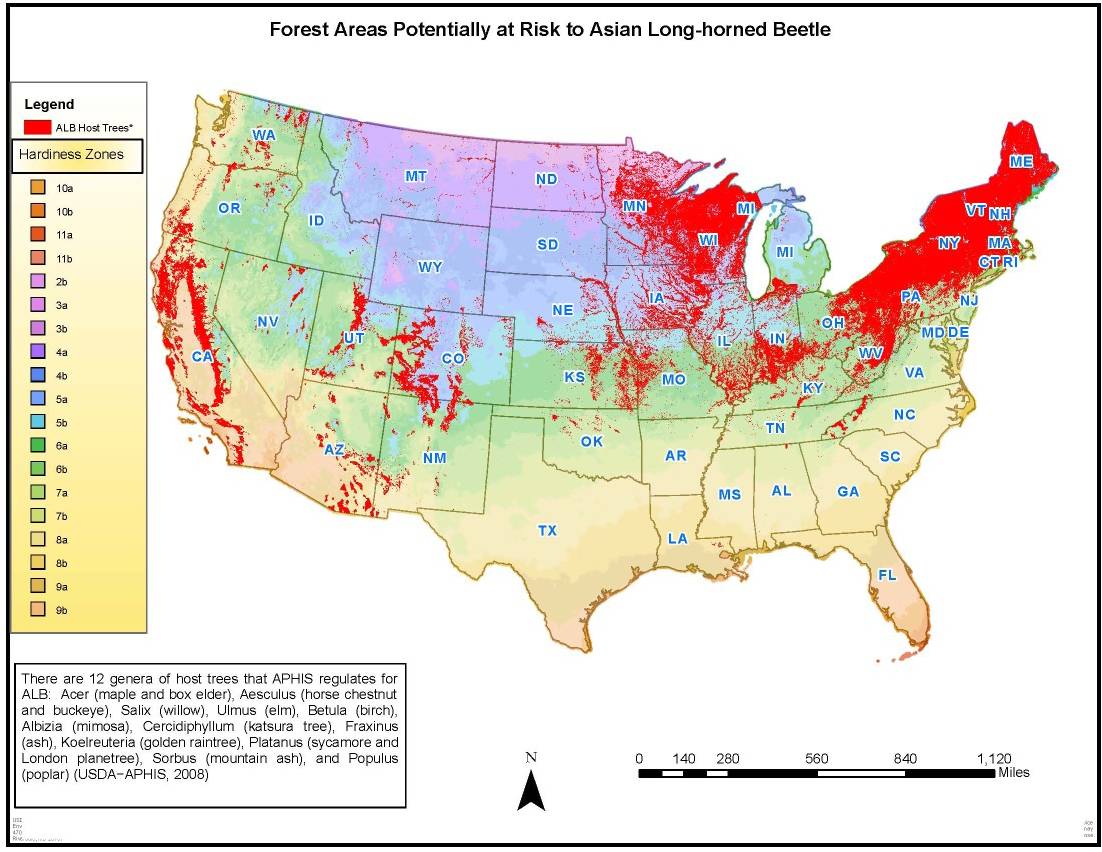
The ALB is one of the most damaging pests ever introduced to North America; it would kill trees in 12 genera which collectively grow in forests across the 48 continental states. In the Northeast (a 20-state area reaching from Minnesota south to Missouri and east to Maine and Virginia), trees vulnerable to ALB dominate two forest types that collectively make up 45% of all forests. Indeed, these vulnerable forests cover almost 20% of the entire land area of these states. For a longer description of the ALB threat, read about the pest in the Gallery of Pests and consider the map below.

Areas at risk to ALB; USGS. 2014. Digital representations of tree species range maps from “Atlas of United States Trees” by Elbert L. Little Jr. (and other publications).
Areas at risk to ALB;
USGS. 2014. Digital representations of tree species range maps from “Atlas of United States Trees” by Elbert L. Little Jr. (and other publications).

The APHIS program – carried out with the help of the USDA Forest Service, other federal agencies, state agencies, local governments, and citizen volunteers – has succeed in eradicating ALB from six sites.
The EIS also makes clear what a tremendous effort such an eradication program demands. APHIS began trying to eradicate ALB 19 years ago, upon discovery of the outbreak in Brooklyn. Since then, APHIS has spent $500 million tackling outbreaks in five states, cut down more than 124,000 trees, and treated tens of thousands of additional trees with the systemic insecticide imidacloprid. Yet more work remains because large outbreaks in Worcester, Massachusetts and Clermont County, Ohio are not yet contained. Eradicating these outbreaks will take many years.
The EIS does not explicitly acknowledge the strong opposition that APHIS has faced from people who were understandably anguished over loss of their trees – especially the trees that were still healthy but posed a risk of enabling ALB to persist and spread across the Continent. Some of the opponents were further angered because they believed – based on misunderstandings or false information – that removing those trees was not a necessary action to protect trees across the Continent.
APHIS deserves our gratitude for persisting in its eradication efforts, despite vocal opposition, uncertainty over funding levels, and the many discouraging setbacks encountered while the agency was trying to improve methods to detect ALB and to contain pest populations.
I’m discouraged that the people who owe the most to APHIS don’t recognize the agency’s efforts. Unfortunately, many appear either to take these actions for granted or to ignore them completely. APHIS received only 27 comments on its notice that it would develop the EIS, and only 14 comments on the EIS itself.
Who should have commented? Everyone who cares about:
• The health of hardwood forests composed of maples, elms, ash, poplars, buckeyes, birch, or willows; these genera are most dense in forests of the Northeast, but – as the map above shows – they grow in forested areas throughout the “lower 48”.
• The health of urban forests and the ecosystem and public health benefits they provide. Cities with high proportions of trees vulnerable to ALB range from Seattle to Boston.
• Clean drinking water for. In the Northeast, 48% of the water supply originates on forestlands – and 45% of those forest lands are composed primarily of species that are vulnerable to ALB.
• The economy and jobs in the Northeast. Vulnerable hardwoods produce timber and maple syrup and are the foundation of the “leaf peeper” tourism industry.
Those who actually did provide comments included:
• Six state departments of Agriculture and their national association, the National Plant Board;
• Four officials in other state agencies (primarily forestry or environmental quality);
• Four officials from other federal agencies (three from National Park Service, one from Fish and Wildlife Service);
• About 20 representing the public, of which:
o Four were affiliated with the maple syrup industry;
o Six organizations focused on wildland or rural forests.

I hope that the next time APHIS seeks public input on its programs, the following organizations will provide thoughtful input:
• the national or regional representatives of state forestry departments;
• the many environmental organizations that engage so actively on other types of forest management issues;
• the organizations that advocate for planting and protecting urban forests;
• the groups that support recreation in forests and on associated lakes and streams;
• the organizations that advocate for protection of wildlife habitat.
APHIS tried hard to inform all who might be interested. APHIS posted the scoping notice and availability of the draft environmental impact statement in the Federal Register. Also, it posted alerts on its Stakeholder Registry (which contains almost 12,000 contacts); its e-newsletter; its Facebook and Twitter accounts; and the agency’s “news and information” and ALB-related web pages. In addition, APHIS notified ALB project managers in New York, Massachusetts, and Ohio and their state counterparts and asked that they notify their key contacts; tribal contacts; USDA Forest Service and U.S. Fish and Wildlife Service contacts; plus several specific partners and organizations. APHIS also issued a press release which it shared with federal and state partners.
Why does it matter that APHIS received so few comments? This silence gives political and agency leaders the impression that the American public does not support efforts to prevent the spread or to eradicate tree-killing insects and pathogens. I hope this is not true!
This negative impression remains even if there are many stakeholders who are pleased with the program’s direction and progress. Their choice not to voice their support meant that only those who object to at least some components of the program are heard in the policy arena.
I plead with you – get involved! Support those parts of APHIS’s eradication and containment programs that you think are wise. Criticize those components that you think should be strengthened or changed.
Posted by Faith Campbell

Wood-borers in Wood Packaging: How Did We Get to This Crisis?

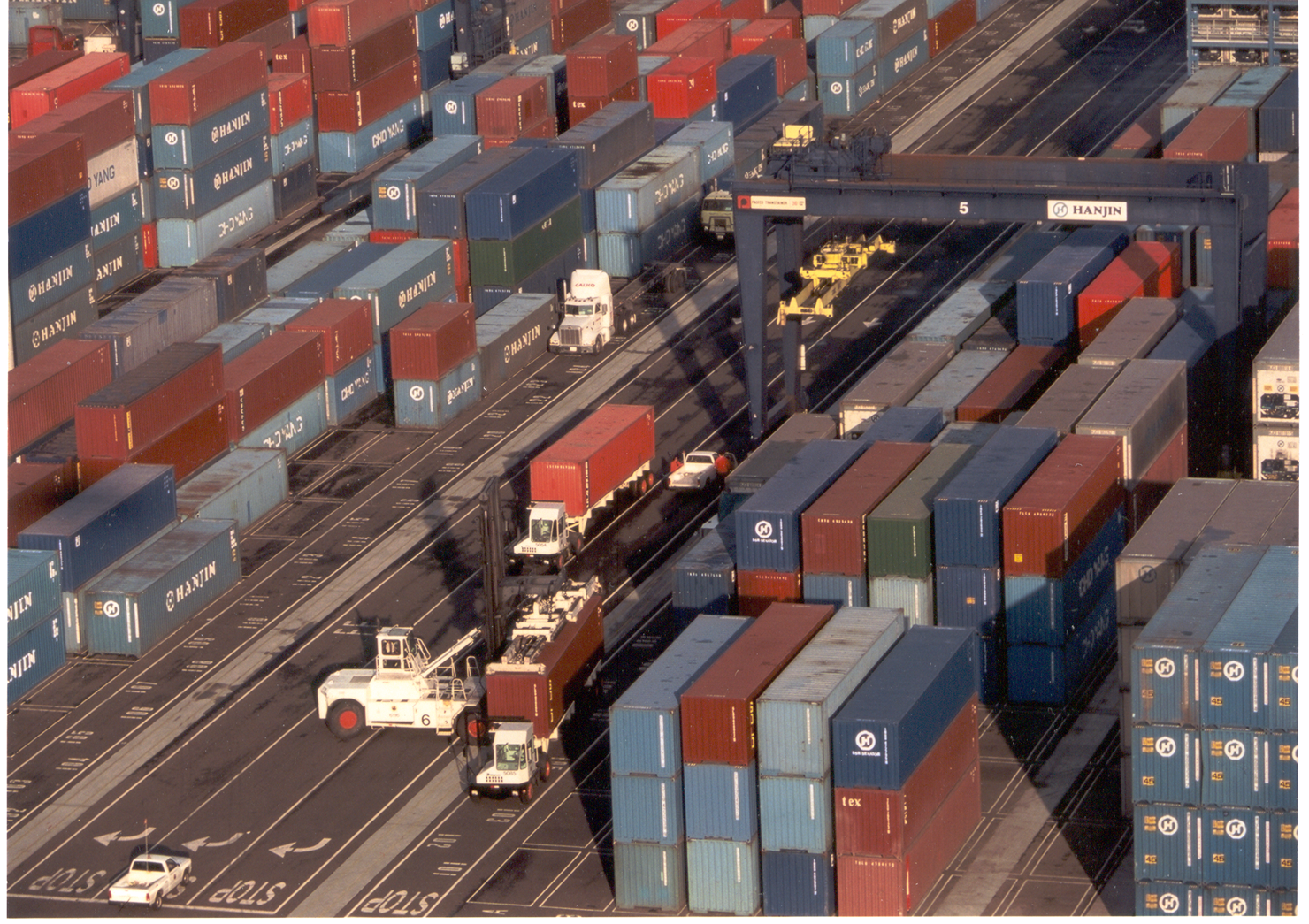
shipping containershipping container being unloaded at Long Beach

The rising numbers of tree-killing wood-boring insects introduced to the U.S. (see  blogs from July 15 and August 3 & fact sheet and sources linked there) are a result of ballooning of trade volumes and use of wood packaging.

This irruption of trade was made possible by adoption of the shipping container to transport a wide range of goods.Moving from place to place are not just finished products but also components that originated in one country and that are to be assembled in another country.

How the shipping container revolutionized trade and manufacturing is detailed by Marc Levinson in his book, The Box: How the Shipping Container Made the World Smaller and the World Economy Bigger (Princeton University Press 2008). The transformation affected not only trade between countries, but also within countries, with some regional economies growing while others faltered.

Dr. Levinson recognizes that he has not addressed environmental damage caused by massive movement of cargo. While Dr. Levinson does not explain which damage he is thinking about, I doubt that he includes introductions of non-native wood-boring pests.

(I don’t know enough about the ballast water pathway to understand the impact of containerized shipping on introductions of aquatic invaders, but it seems likely to be an important factor through three factors: directing trade to new port areas; the ships’ huge size; and taking on of ballast water for those segments of a voyage carrying fewer filled cargo containers. On the other hand, Dr. Levinson says that a balance of cargo moving both ways on a trade route is an important factor in determining which ports thrive.)

Before containers, port costs represented the highest proportion of transport costs. Those costs are no longer an important consideration in determining manufacturing and transport choices. Nor is distance as important as before. What is most important are ports that can move large volumes of goods efficiently. The manufacturer or retailer at the top of the chain finds the most economical place for each step in the manufacturing and assembly process without regard to its location.

The containerization revolution was rapid. Containers were first used in international trade in 1966; within three years, nearly one-third of Japanese exports to the U.S. were containerized, half of those to Australia. In the decade after containers were first used in international trade, the volume of international trade in manufactured goods grew more than twice as fast as the volume of global manufacturing production, 2.5 times as fast as global economic output. Large numbers of specialized container ships were built, at ever-increasing sizes. The largest container ship in 1969 could carry 1,210 20-ft containers. By the early 2000s, ships being built to carry 10,000 20-foot containers; or 5,000 40-foot containers.

When Dr. Levinson wrote his book in 2005, the equivalent of 300 million 20-foot containers were crossing the world’s oceans each year.

The container revolution interacted with “just-in-time” manufacturing, which required rapid and reliable transport. Large companies signed written contracts with suppliers and shippers which included penalties for delays.

In the U.S., Long Beach quickly became the principal port because it (as well as Oakland and Seattle) had excellent rail connections to the interior. By 1987, one-third of containers from Asia destined for the East Coast landed at Long Beach and crossed the U.S. by rail. Perhaps counter to our expectation, only one-third of containers entering southern California in 1998 contained consumer goods. Most of the rest contained intermediate or partially processed goods as part of the new international supply and manufacturing chain.

containers at Long Beach Containers at Long Beach

On the East coast, Charleston SC and Savannah similarly grew because of transport connections – this time, primarily highways.

So, global trade is huge and growing; and the shipping container moves immense quantities of goods from one ecosystem to another and provide shelter for a vast range of hitchhiking living organisms (in addition to insects in the wood, there can be other insects’ eggs attached to the sides of the container, snails, weed seeds, even vertebrates – a raccoon once staggered out of a shipping container that had crossed the Atlantic from the U.S. to France!).

We need to imagine, test, and apply a variety of tools to suppress the numbers of living organisms traveling in shipping containers.

For example,
• if importer-supplier contracts specify penalties for delivery delays, we should ask why don’t importers amend the contracts to add penalties for non-compliant wood packaging?
• Might the Bureau of Customs and Border Protection incorporate the wood packaging requirements into its “Customs-Trade Partnership Against Terrorism” (C-TPAT) program.
• A decade ago, USDA APHIS funded research which developed an ingenious method for detecting mobile pests inside a container. It was an LED light attached to a sticky trap. Placed inside a container, the light attracted snails, insects and possibly other living organisms. The whole mechanism was attached to a mailing container that could be pre-addressed for sending to a lab that could identify the pests. Why was this tool never implemented?

We can’t stop the trade, but we can be much more aggressive in adopting measures to minimize pest introductions.

Posted by Faith Campbell

Non-Native Pest Threat to Forests of the West Coast

As we Americans import more stuff, the risk of new pest introductions rises, too. Many tree-killing insects arrive as larvae living in crates, pallets, and other forms of wood packaging. While the USDA requires that incoming wood packaging be treated to prevent pests, this regulation has not prevented pests from entering the country on wood packaging.

piece of wood packaging with Cerambycid larva; detected in Oregon

A study has found that perhaps 35 shipping containers harboring tree-killing pests reach our ports each day (Haack et al. 2014). At this rate, in just 35 years, America might suffer invasion by more than 100 new wood-boring species. This would result in a tripling of borers introduced to U.S. (Leung et al. 2014).

Already, wood-boring beetles have been among the most damaging tree-killing pests introduced to the U.S. Our environment certainly doesn’t need invasions by three times as many new wood-borers!

West-coast ports receive lots of incoming shipping containers. Long Beach alone receives about half of the nearly 25 million shipping containers arriving at the U.S. each year. So it is alarming that high-risk insects, including the Asian longhorned beetle (ALB), continue to be found in wood packaging (Berger 2014).

Imported goods that are heavy are more likely to be packaged in wood and that thus pose the greatest pest risk. The highest risk commodities are
• machinery (including electronics) and metals;
• tile and decorative stone (such as marble or granite counter tops) (Harriger 2014).
The west coast ports of Seattle, Los Angeles/Long Beach, and San Francisco all rank in the top 15 out of 3,500 (1/2 of 1%) cities nation-wide for imports of tile and decorative stone, machinery and metals (Colunga-Garcia et al. 2009).

Not only do west coast cities import high volumes of risky goods; a significant proportion of the trees growing in those cities are vulnerable to these pests. Seattle’s three to four million trees belong to more than 300 species – although a mere seven genera constitute two-thirds of the trees (Ciecko et al. 2012). It has been estimated that just four non-native pests (ALB, gypsy moth, emerald ash borer, and “Dutch” elm disease) could cause $3.5 billion in damages. The ALB alone threatens 39.5% of all trees lining the city’s streets (City of Seattle 2013).

San Francisco has an estimated 669,000 trees; 12% are at risk to the ALB (Nowak et al. 2007). Apparently no one has yet estimated the numbers of trees at risk to sudden oak death (SOD), goldspotted oak borer (GSOB), or polypagous shot hole borer (PSHB).

It is essential that USDA APHIS act more aggressively to prevent additional introductions of pests via wood packaging. (For a longer discussion of the wood packaging pathway, visit my previous blog posted on July 15th). In brief:
• APHIS & the Bureau of Customs and Border protection should penalize all importers whose wood packaging does not comply with decade-old regulatory requirements.
• The Bureau of Customs and Border Protection should incorporate the wood packaging requirements into its “Customs-Trade Partnership Against Terrorism” (C-TPAT) program
• APHIS should re-consider the advantages of requiring importers to switch to packaging made from materials other than wooden boards.
• The President’s Office of Management and Budget should allow APHIS to finalize regulations – proposed in 5 years ago! – that would apply the international standard’s treatment requirements to wood packaging used in trade between the US and Canada. (Canada has been ready to adopt this measure for several years.)

SOURCES
Berger, P. Executive Director, PPQ Science and Technology, Presentation to the Continental Dialogue on Non-Native Forest Insects and Diseases, November 3, 2014

Ciecko, L., K. Tenneson, J. Dilley, K. Wolf. 2012. Seattle’s Forest Ecosystem Values: Analysis of the Structure, Function, and Economic Benefits; August 2012; GREEN CITIES RESEARCH ALLIANCE; City of Seattle Urban Forest Stewardship Plan 2013.

City of Seattle Urban Forest Stewardship Plan 2013.

Colunga-Garcia, M., R.A. Haack, and A.O. Adelaja. 2009. Freight Transportation and the Potential for Invasions of Exotic Insects in Urban and Periurban Forests of the US. J. Econ. Entomol. 102(1): 237-246 (2009); and raw data for the study provided by the authors.

Haack, R.A., F. Herard, J. Sun, J.J. Burgeon. 2009. Managing Invasive Populations of Asian Longhorned Beetle and Citrus Longhorned Beetle: A Worldwide Perspective. Annu. Rev. Entomol. 2010. 55:521-46.

Haack RA, Britton KO, Brockerhoff EG, Cavey JF, Garrett LJ, et al. (2014) Effectiveness of the International Phytosanitary Standard ISPM No. 15 on Reducing Wood Borer Infestation Rates in Wood Packaging Material Entering the United States. PLoS ONE 9(5): e96611. doi:10.1371/journal.pone.0096611

Harriger, K. 2014. Presentation to the Continental Dialogue on Non-Native Forest Insects and Diseases, November 3, 2014

Leung, B., M.R. Springborn, J.A. Turner, E.G. Brockerhoff. 2014. Pathway-level risk analysis: the net present value of an invasive species policy in the US. The Ecological Society of America. Frontiers of Ecology.org

Nowak, D.J., R.E. Hoehn III, D.E. Crane, J.C. Stevens, J. T. Walton. 2007. Assessing Urban Forest Effects and Values: San Francisco’s Urban Forest. USDA Forest Service. Northern Research Station. Resource Bulletin NRS-8.


posted by F.T. Campbell

Government Should Act Now! to Shut Wood Packaging Pathway

Revise Decade-Old Policies that Do Not Prevent Introductions

Despite regulations adopted 9 or more years ago, tree-killing insects continue to enter the U.S. in wood packaging. Aggressive enforcement is needed now to prevent further huge ecological and economic losses.

Disasters already introduced via this pathway

As Americans import more stuff, the risk rises that larvae of tree-killing insects will be enter the country hiding in wooden crates, pallets, etc. – called “solid wood packaging” or SWPM.  For more information on this threat, the agencies responsible, and actions taken or proposed, visit here.

Damaging pests still found in SWPM

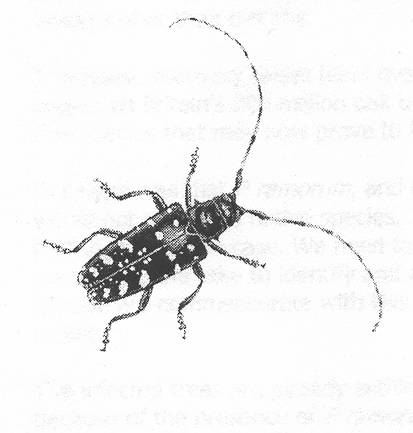
USDA APHIS (for more information about APHIS, read “Invasives 101” at www.cisp.us) required treatment of wood packaging from China 15 years ago, and treatment of wood packaging from other trade partners 9 years ago! Yet, a small proportion of incoming wood packaging still carries tree-killing pests. As many as 13,000 shipping containers harboring tree-killing pests probably enter the country each year – or 35 each day. [i] The Asian longhorned (illustrated below) is among the pests still detected in wood packaging from China. [ii]

ALB profile jpg

Cities that import the most goods from Asia are at particular risk – New York, Chicago, Los Angeles and Long Beach. Others are also at risk: Washington, D.C.; Virginia Beach; Jacksonville. [To see a more complete list, visit here]

What the Government Has Done

While USDA APHIS has cracked down on U.S. producers of wood packaging who cheat and is promoting workshops to educate our trade partners on wood packaging treatment requirements (see write-up on www.CISP.us referenced above), the government should do more to protect our forests.

What More Can be Done

  • At present, U.S. policy allows an importer to be caught 5 times in 1 year with wood packaging that does not comply with the regulatory requirements. Requirements adopted a decade or more ago should be enforced strictly! The Bureau of Customs and Border Protection and USDA APHIS should instead penalize all importers whose wood packaging does not comply with regulatory requirements.
  • The Bureau of Customs and Border Protection should incorporate the wood packaging requirements into its “Customs-Trade Partnership Against Terrorism” (C-TPAT) program .
  • USDA APHIS should re-examine the economic pros and cons of requiring importers to switch to packaging made from materials other than wooden boards. The new review should incorporate the high economic and ecological costs imposed by insects introduced via the wood packaging pathway.
  • The President’s Office of Management and Budget should allow APHIS to finalize regulations – proposed in 5 years ago! – that would apply the same treatment requirements to wood packaging used in trade between the US and Canada. (Canada has been ready to adopt this measure for several years.)

[i] Haack RA, Britton KO, Brockerhoff EG, Cavey JF, Garrett LJ, et al. (2014) Effectiveness of the International Phytosanitary Standard ISPM No. 15 on Reducing Wood Borer Infestation Rates in Wood Packaging Material Entering the United States. PLoS ONE 9(5): e96611. doi:10.1371/journal.pone.0096611

[ii] Haack, R.A., F. Herard, J. Sun, J.J. Turgeon. 2009. Managing Invasive Populations of Asian Longhorned Beetleand Citrus Longhorned Beetle: A Worldwide Perspective. Annu. Rev. Entomol. 2010. 55:521-46; these authors report six separate introductions; after the article was published, a seventh was detected in Clermont County, Ohio; and a new outbreak was detected near Toronto, Ontario. Also, Philip Berger, Executive Director PPQ Science and Technology, Presentation to the Continental Dialogue on Non-Native Forest Insects and Diseases, November 3, 2014