I learned at the beginning of August that Canadian scientists have discovered a new pathogen causing wilt disease on American elms (Ulmus americana). The pathogen is Plenodomus tracheiphilus, which is known primarily for causing serious disease in citrus.
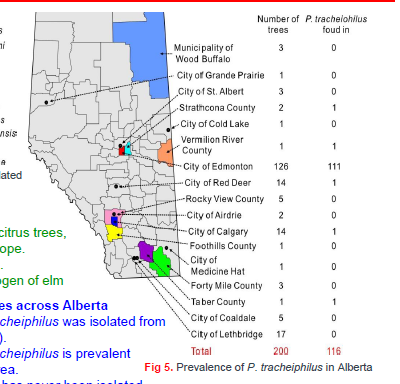
P. tracheiphilus is described as common on Alberta’s elm trees, especially in the Edmonton area. It was found on 116 of 200 trees which were sampled – see map. The wilting had previously been blamed on Dothiorella ulmi. I have been unable to find a source for the geographic origin of Dothiorella ulmi; perhaps it is native to North America. It is reported to be present at least from Alberta to Texas. (Presumably if Plenodomus tracheiphilus were in Texas it would have caused obvious symptoms on that state’s citrus crops.)
poster prepared by Alberta Plant Health Lab, Alberta Agriculture & Irrigation, and Society to Prevent Dutch Elm Disease
I am unaware of any North American forest pathologists studying whether this pathogen is also established in the United States, or its possible effects. The discovery in Alberta is the first time this organisms has been associated with disease on elms; I have asked European and North American forest pathologists whether they are looking into possible disease on any of the European or North American elm species. So far, no one reports that s/he has been.
In the meantime, the California Department of Food and Agriculture has begun the process of assigning Plenodomus tracheiphilus the highest pest risk designation for the state. CDFA is worried primarily about damage to the state’s $2.2 billion citrus industry. CDFA is seeking comments on its proposed action; go here .
CDFA points out that despite awareness of the disease on economically important citrus since at least 1900 and efforts by phytosanitary agencies, it has spread to most citrus-growing countries around the Mediterranean and Black seas and parts of the Middle East. The primary mode of spread is movement of infected plant material, e.g., rootstocks, grafted plants, scions, budwood, and even fruit peduncles and leaves. Transmission is possible from latently infected, asymptomatic material. Once established at a site, the conidia produced on diseased plant parts can be spread over relatively short distances by rain-splash, overhead irrigation, water surface flow, or wind-driven rain. Transport by birds and insects is also suspected. The pathogen can survive on pruned material or in soil containing infected plant debris for up to four month.
The report from Canada does not speculate on how a disease associated with plants in a Mediterranean climate was transported to Alberta, which has a cold continental climate. Nor is there any information on the possible presence of the disease on elms in warmer parts of Canada.
U.S. elms appear to be at high risk because phytosanitary restrictions leave dangerous gaps.
First, under the Not Authorized for Importation Pending Pest Risk assessment (NAPPRA) program, USDA APHIS has prohibited importation of plants in the Ulmus genus from all countries except Canada. Second, importation of cut greenery is allowed from all countries – and the CDFA analysis indicates that the pathogen can be transported on leaves. Third, it appears to me that it is probable that this pathogen survives on plants in additional taxa.
See this profile for a description of other threats to North American elms.
Yang, Y., H. Fu, K. Zahr, S. Xue, J. Calpas, K. Demilliano, et al. 2024. Plenodomus tracheiphilus, but not Dothiorella ulmi, causes wilt disease on elm trees in Alberta, Canada. European Journal of Plant Pathology 169(2):409-420. Last accessed August 1, 2024, from https://link.springer.com/article/10.1007/s10658-024-02836-x
Posted by Faith Campbell
We welcome comments that supplement or correct factual information, suggest new approaches, or promote thoughtful consideration. We post comments that disagree with us — but not those we judge to be not civil or inflammatory.
For a detailed discussion of the policies and practices that have allowed these pests to enter and spread – and that do not promote effective restoration strategies – review the Fading Forests report at https://treeimprovement.tennessee.edu/
Breeding Port-Orford cedar for resistance to Phytophthora lateralis; photo by Richard Sniezko, USDA Forest Service
At the annual meeting of the National Plant Board in July, I learned that two new Phytophthora species have been detected in the United States. Questions remain about how each arrived.
Phytophthora austrocedrii
This species was detected in a nursery in Oregon, then traced back to a supplier in Ohio. Officials are trying to determine how it entered the country – and then spread.
junipers in Great Britain killed by P. austrocedri; Forestry Research
In the United Kingdom, P. austrocedri has killed trees in the Juniperus and Cupressus genera. Damage is particularly significant at two sites in northern Scotland and in England’s Lake District. The principal host, Juniperus communis, is an important native species. It is already considered vulnerable. P. austrocedri has also been detected in Argentina, where it is killing the native Chilean or Patagonian cedar (Austrocedrus chilendris). The cedar species is the only one in the genus. Evidence indicates the pathogen was introduced to both Britain and Argentina; but its origin is unknown. Indeed, the species was first isolated by scientists as an unknown Phytopthora taxon on a juniper in an import/export nursery in Germany. All reported hosts are members of the Cupressaceae family (UK forest research website).
Of greater concern to Americans, P. austrocedri has also infected individual trees of Port-Orford cedar (Chamaecyparis lawsoniana). (UK forest research website).
Port-Orford cedar is a species endemic to a small range in southwestern Oregon and Northwestern California.
POC populations have been severely reduced over the past century by a different non-native Phytophthora, P. lawsonii. US Forest Service scientists recently announced that they have bred trees resistant to this pathogen – and offered seedlings for widespread planting.
Possible hosts in the Pacific Northwest – other than Port Orford cedar – include Juniperus californica, Juniperus grandis, Juniperus occidentalis, and Juniperus maritima – although the junipers might be limited to arid environments, where they would presumably be less vulnerable. https://plants.usda.gov/home/classification/15147
Research in Great Britain shows that P. austrocedri spreads in water and by movement of infected plants and contaminated soil. Footwear, camping equipment, and vehicle tires can all carry the pathogen. This makes the pathogen particularly difficult to control (this is another similarity with P. lawsonii).
Phytophthora abietivora
P. abietivora was originally found on a diseased Christmas tree (Fraser fir, Abies fraseri) in Connecticut in 2019. It has since been reported in Pennsylvania and Virginia; and in forest nurseries and Christmas tree plantations in Quebec and Ontario. The Canadians report that it has not caused disease (Canadian website). However, the Canadian representative at the National Plant Board meeting expressed concern and asked USDA APHIS to clarify what actions it is taking regarding this species.
(Natural populations of Fraser fir have been severely reduced over the past century by the balsam woolly adelgid.)
Fraser fir killed by balsam woolly adelgid; Clingman’s Dome, Great Smoky Mountains National Park
Several additional hosts have been identified, including balsam fir (Abies balsamea) and eastern hemlock (Tsuga canadensis); and deciduous or hardwood species: hickory (Carya sp.), flowering dogwood (Cornus florida), American witch hazel (Hamamelis virginiana), mountain holly (Ilex montana), red maple (Acer rubrum), silver birch (Betula lenta), American beech (Fagus grandifolia); and several oaks: white (Quercus alba), chestnut (Q. montana) and northern red oak (Q. rubra) (Canadian fact sheet).
According to the Canadian website, P. abietivora causes root rot and subsequent foliar chlorosis, discoloration, stem cankers, and sometimes tree decline and death. Determining which Phytophthora species is the causal agent of a tree’s symptoms requires laboratory testing. The Canadian fact sheet reports that wet, cool conditions provide ideal environments for P. abietivora. Like other Phytophthora species, P. abietivora can be spread through soil and water, as well as via infected plant material or pots or trays (particularly if soil remains on the equipment). The Canadian fact sheet has several photographs illustrating symptoms and additional sources.
Liriodendron tulipifera; photo by Evelyn Simak via Geograph
Phytophthora kernoviae
P. kernoviae was first detected in southwestern England in 2003. link In England, this pathogen has caused significant diseases in native Fagus sylvatica (European beech) and lesions on trunks of a European oak, Quercus robur. More worrying are the trunk lesions on the North American native yellow or tulip poplar (Liriodendron tulipifera) and lesions on foliage of Monterey pine (Pinus radiate), giant sequoia(Sequoiadendron giganteum), and several North American native shrubs, Rhododendron macrophyllum (Pacific rhododendron), R. occidentale (western rhododendron), R. catawbiense(Catawba rosebay) and Umbellularia californica (California bay laurel).
The infestation in Cornwall is sustained by heavy sporulation on the non-native shrub Rhododendron ponticum, which is invasive in woodlands. Worrying for Americans is the fact that P. kernoviae sporulates on three plant species native to West coast forests — Rhododendron macrophyllum, R. occidentale, and Umbellularia californica – as well as on R. catawbiense, which is native to the southern Appalachians.
USDA APHIS requested adoption of a “response plan” targetting P. kernoviae under the National Plant Disease Recovery System (NPDRS). This plan was adopted in 2008 and updated in 2015.
The recovery plans found the areas at highest risk are eastern slopes of the Appalachian Mountains because this area combines a native sporulating host and residential landscaping choices that are likely to include hosts that could transport the pathogen. A lower risk was identified for West Coast forests.
Because of this status, P. kernoviae is also a “priority” pest for surveys under the Cooperative Agricultural Pest Survey (CAPS) program. According to Purdue University’s “pest tracker” website four states have reported carrying out surveys for P. kernoviae in one or more years since 2016: Oregon, Tennessee, Pennsylvania, and Virginia. Surveys in Oregon were carried out in 2018 – 2020. In 2020 the counties surveyed included Curry County, where three strains of P. ramorum link have become established. The Purdue list is not certified as accurate or complete. To date, no surveys have detected P. kernoviae in the United States or – I believe – in Canada.
For details on existence of two clonal lineages of Phytophthora austrocedrii, see Henricot, B. A. Perez-Sierra, A.C. Armstrong, P.M. Sharp, and S. Green. Phytopathology 2017. 107:12, 1532-1540.
Posted by Faith Campbell
We welcome comments that supplement or correct factual information, suggest new approaches, or promote thoughtful consideration. We post comments that disagree with us — but not those we judge to be not civil or inflammatory.
For a detailed discussion of the policies and practices that have allowed these pests to enter and spread – and that do not promote effective restoration strategies – review the Fading Forests report at https://treeimprovement.tennessee.edu/
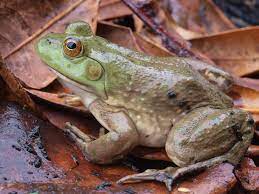
American bullfrog (Lithobates catesbeianus); photo by Will Brown via Wikimedia; one of invasive animals deliberately introduced to Europe in the past
In February 2024 the European Parliament approved legislation outlawing “ecocide” and providing sanctions for environmental crimes. Member states now have two years to enshrine its provisions in national law.
The new rules update the list of environmental crimes adopted in 2008 and enhance the sanctions. The goal is to ensure more effective enforcement. Listed among the offenses are:
the import and use of mercury and fluorinated greenhouse gases,
the import of invasive species,
the illegal depletion of water resources, and
pollution caused by ships.
This action followed an in-depth analysis of the failures of the previous EU environmental directive, first adopted in 2008 (Directive 2008/99/EC). The review found that:
The Directive had little effect on the ground.
Over the 10 years since its adoption few environmental crime cases were successfully investigated and sentenced.
Sanction levels were too low to dissuade violations.
There had been little systematic cross-border cooperation.
EU Member states were not enforcing the Directive’s provisions. They had provided insufficient resources to the task. They had not developed the needed specialized knowledge and public awareness. They were not sharing information or coordinating either among individual governments’ several agencies or with neighboring countries.
The review found that poor data hampered attempts by both the EU body and national policy-makers to evaluate the Directive’s efficacy.
The new Directive attempts to address these weaknesses. To me, the most important change is that complying with a permit no longer frees a company or its leadership from criminal liability. These individuals now have a “duty of care”. According to Antonius Manders, Dutch MEP from the Group of the European People’s Party (Christian Democrats), if new information shows that actions conducted under the permit are “causing irreversible damage to health and nature – you will have to stop.” This action reverses the previous EU environmental crime directive – and most member state laws. Until now, environmental crime could be punished only if it is unlawful; as long as an enterprise was complying with a permit, its actions would not be considered unlawful. Michael Faure, a professor of comparative and international environmental law at Maastricht University, calls this change revolutionary.
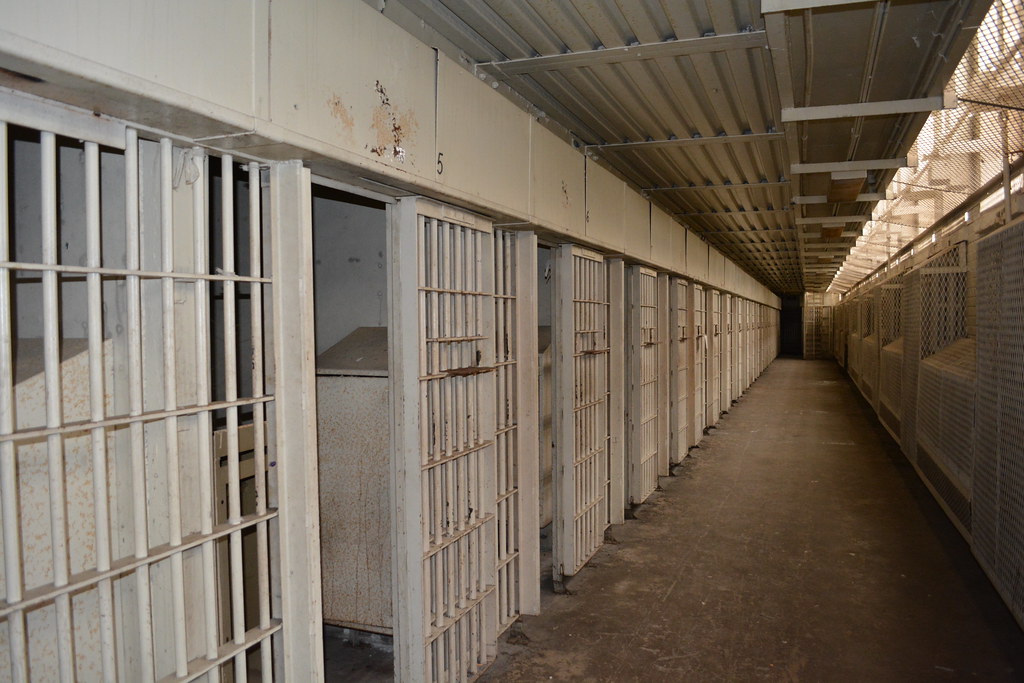
Lorton Prison; via Flickr
Another step was to make corporate leadership personally liable to penalties, including imprisonment. If a company’s actions cause substantial environmental harm, the CEOs and board members can face prison sentences of up to eight years. If the environmental harm results in the death of any person, the penalty can be increased to ten years.
Financial penalties were also raised. Each Member state sets the fines within certain parameters. Fines may be based on either a proportion of annual worldwide turnover (3 to 5%) or set at a fixed fine (up to 40 million euros). Companies might also be obliged to reinstate the damaged environment or compensate for the damage caused.Companies might also lose their licenses or access to public funding, or even be forced to close.
Proponents of making ecocide the fifth international crime at the International Criminal Court argue that the updated directive effectively criminalizes “ecocide”— defined as “unlawful or wanton acts committed with knowledge that there is a substantial likelihood of severe and either widespread or long-term damage to the environment being caused by those acts.”
Individual member states also decide whether the directive will apply to offences committed outside EU borders by EU companies.
Some members of the European Parliament advocate for an even stronger stance: creation of a public prosecutor at the European Union level. They hope that the Council of Europe will incorporate this idea during its ongoing revision of the Convention on the Protection of the Environment through Criminal Law. To me, this seems unlikely since the current text of the Convention, adopted by the Council in 1998, has never been ratified so it has not come into force.
The Council of Europe covers a wider geographic area than the European Union – 46 member states compared to 27. Members of the Council of Europe which are not in the EU include the United Kingdom, Norway, Switzerland, Bosnia-Hercegovina, Serbia, Kosovo, Albania; several mini-states, e.g., Monaco and San Remo; and countries in arguably neighboring regions, e.g., Armenia, Azerbaijan, Georgia, and Turkey.
While I rejoice that invasive species are included in the new Directive, I confess that I am uncertain about the extent to which this inclusion will advance efforts to prevent spread. The species under consideration would apparently have to be identified by some European body as “invasive” and its importation restricted. As we know, many of the most damaging species are not recognized as invasive before their introduction to a naïve environment. On the other side, the requirement that companies recognize new information and halt damaging actions – even when complying with a permit! – provides for needed flexibility.
Posted by Faith Campbell
We welcome comments that supplement or correct factual information, suggest new approaches, or promote thoughtful consideration. We post comments that disagree with us — but not those we judge to be not civil or inflammatory.
For a detailed discussion of the policies and practices that have allowed these pests to enter and spread – and that do not promote effective restoration strategies – review the Fading Forests report at http://treeimprovement.utk.edu/FadingForests.htm
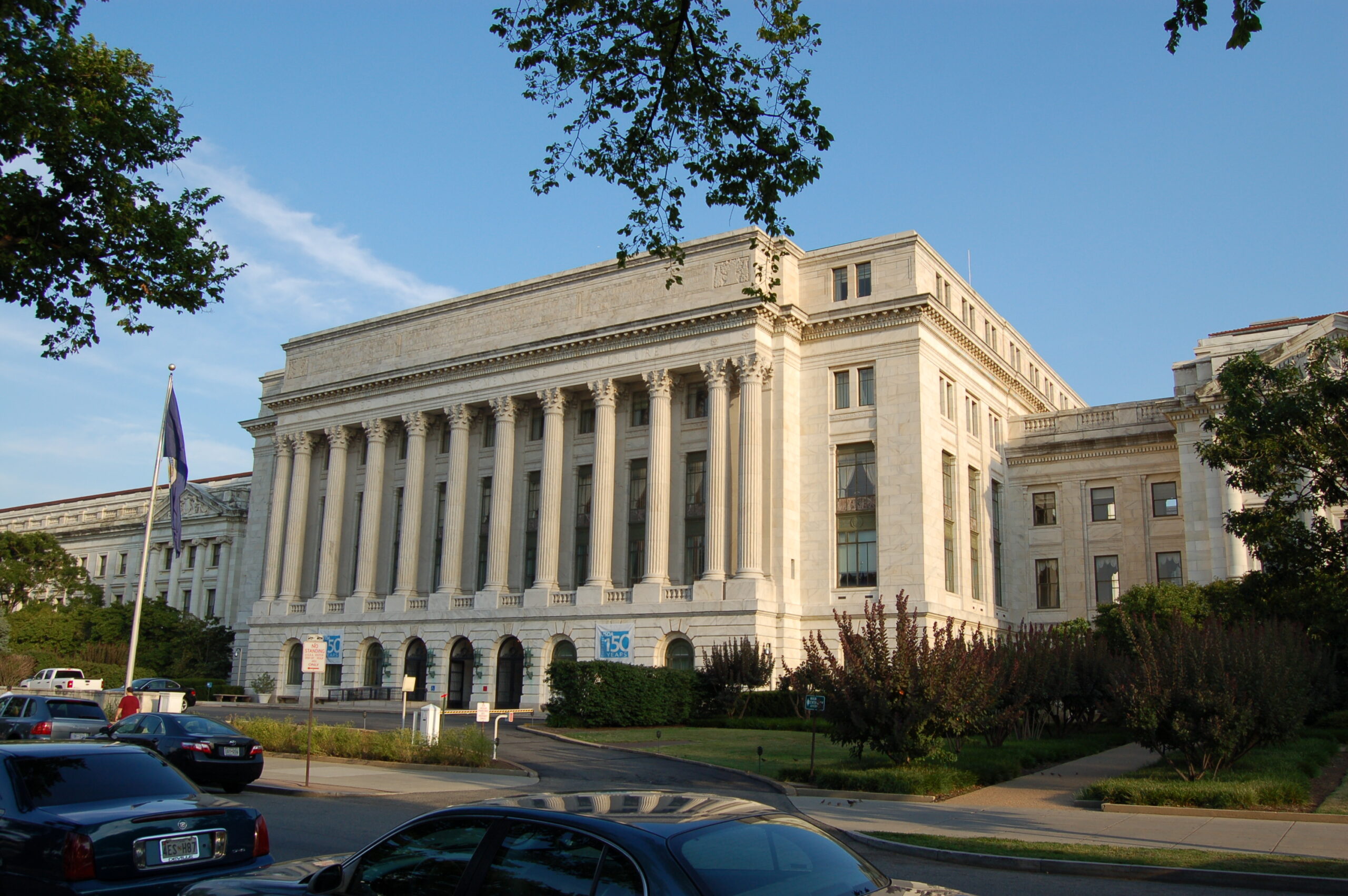
U.S. Department of Agriculture headquarters; lets lobby these people! photo by Wikimedia
Twenty-three scientists based around the world published a Letter to the Editor titled “Overwhelming evidence galvanizes a global consensus on the need for action against Invasive Alien Species” It appears in the most recent edition of Biological Invasions (2024) 26:621–626.
The authors’ purpose is to draw attention to the release of a new assessment by the Intergovernmental Science-Policy Platform on Biodiversity and Ecosystem Services’ (IPBES).
The report was issued in September 2023. It is described as the most comprehensive global synthesis of the current knowledge on the bioinvasion process and the impacts of invasive alien species (952 pages!). Its preparation took nearly a decade. Most important, it represents the first consensus among governments and scientists worldwide on the magnitude and extent of the threats that bioinvasions pose to nature, people, and the economy.
The proposed solutions are astoundingly broad and ambitious: transformation of how governments and societies perform. I don’t disagree! However, we need interim steps – “bites of the elephant.” In my view, the report falls short on providing these.
Our challenge: join others in bringing this analysis to decision-makers’ attention. Can we pull out information that will help persuade U.S. decision-makers – governmental and non-governmental – that the threat is both urgent and solvable? How do we more effectively advocate for the aggressive, science-based action that we all know is needed?
(I hope that the fact that the report was prepared under the auspices of the Convention on Biodiversity, to which the U.S. is not a party, does not intensify the challenge for us.)
Why we need to restructure the behavior of governments and societies
Bioinvasions are facilitated by policies, decision-making structures, institutions, and technologies that are almost always focused on achieving other goals. Species transport and introduction are driven by policies aimed at promoting economic growth – especially trade. Later stages of invasions, i.e., establishment and some spread, are accelerated by certain uses of land and sea plus climate change. For example, activities that fragment habitats or cause widespread habitat disturbance provide ready places for bioinvasions. Rarely are those who gain by such policies held accountable for the harms they produce via bioinvasions.
To address these unintended consequences, the IPBES report calls for “integrated governance.” Its authors want coordination of all policies and agencies that touch on the indirect drivers, e.g., conservation; trade; economic development; transport; and human, animal, and plant health. Policy instruments need to reinforce – rather than conflict with — strategic invasive species management across sectors and scales. This involves international agreements, national regulations, all governmental sectors, as well as industry, the scientific community, and ordinary people – including local communities and Indigenous Peoples.
The report also calls for establishment of open and inter-operable information systems. This improved access to information is critical for setting priorities; evaluating and improving regulations’ effectiveness; and reducing costs by avoiding duplication of efforts.
Critically important information that is often unspoken:
Indirect causes underlying the usual list of human activities that directly promote bioinvasions are the rapid rise of human population and even more rapid rise in consumption and global trade.
Biosecurity measures at international borders have not kept pace with the growing volume, diversity, and geographic origins of goods in trade.
Continuation of current patterns is expected to result in one-third more invasive species globally by 2050. However, this is an underestimate because today’s harms reflect the consequences of past actions – often from decades ago. Drivers of invasions are expected to grow in both volume and impact.
We can prevent and control invasive alien species – but that success depends on the availability of adequate, sustained resources, plus capacity building; scientific cooperation and transfer of technology; appropriate biosecurity legislation and enforcement; and engaging the full range of stakeholders. These require political will.
A major impact of bioinvasion is increased biotic homogenization (loss of biological communities’ uniqueness). This concerns us because we are losing the biotic heterogeneity that provides insurance for the maintenance of ecosystem functioning in the face of ongoing global change.
The IPBES study asserts that successfully addressing bioinvasions can also strengthen the effectiveness of policies designed to respond to other drivers, especially programs addressing conservation of biological diversity, ensuring food security, sustaining economic growth, and slowing climate change. All these challenges interact. The authors affirm that evidence-based policy planning can reflect the interconnectedness of the drivers so that efforts to solve one problem do not exacerbate the magnitude of others and might even have multiple benefits.
More Key Findings
Overall, 9% (3,500) of an estimated 37,000 alien species established in novel environments are invasive (those for which scientists have evidence of negative impacts). Proportions of invasives is high among many taxonomic groups: 22% of all 1,852 alien invertebrates; 14% of all 461 alien vertebrates; 11% of all 141 alien microbes; and 6% of all 1,061 alien plants. (The discussion of probable undercounts relates to aquatic systems and certain geographic regions. However, I believe these data are all undermined by gaps in studies.)
Invasive alien species – solely or in combination with other drivers – have contributed to 60% of recorded global extinctions. Invasive species are the only driver in 16% of global animal and plant extinctions. Some invasive species have broader impacts, affecting not just individual species but also communities or whole ecosystems. Sometimes these create complexoutcomes that push the system across a threshold beyond which ecosystem restoration is not possible. (No tree pests are listed among the examples.)
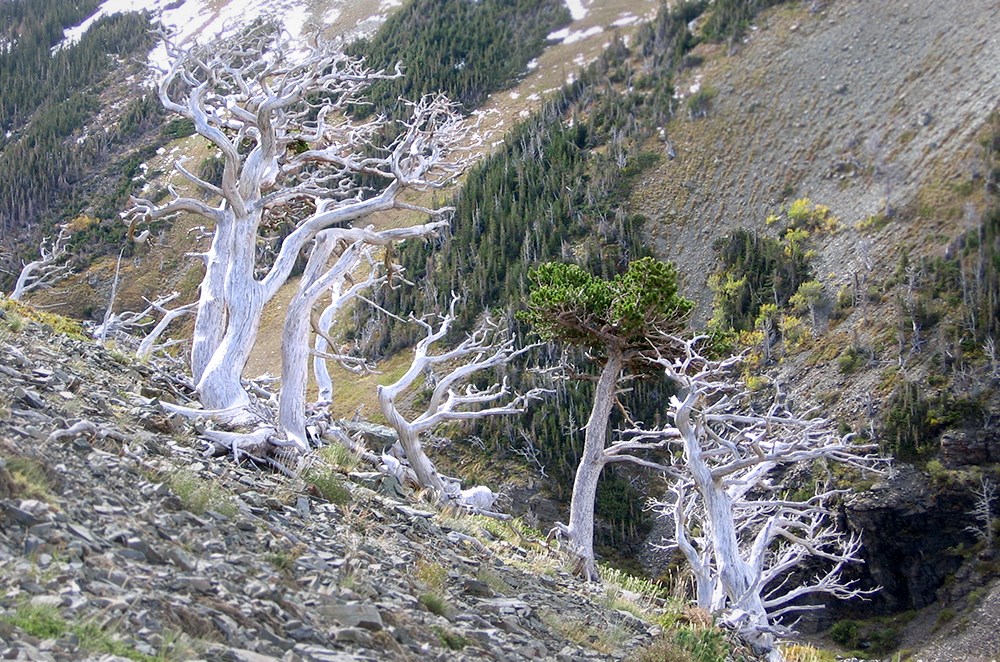
dead whitebark pine in Glacier National Park; photo by National Park Service
The benefits that some non-native – even invasive – species provide to some groups of people do not mitigate or undo their negative impacts broadly, including to the global commons. The report authors note that beneficiaries usually differ from those people or sectors that bear the costs. The authors cite many resulting inequities.
There are insufficient studies of, or data from, aquatic systems, and from Africa; Latin America and the Caribbean; and parts of Asia.
The number of alien species is rising globally at unprecedented and increasing rates. There are insufficient data specifically on invasive species, but they, too, are thought to be rising at similar rates.
Horticulure is a major pathway for introducing 46% of invasive alien plant species worldwide.
Regarding invasive species’ greater impact on islands,the IPBES report mentions brown tree snakes on Guam and black rats on the Galapagos Islands. It also notes that on more than a quarter of the world’s islands, the number of alien plants exceeds the total number of native ones. See my blogs on non-native plants on Hawai`i and Puerto Rico. In addition, I have posted several blogs regarding disease threats to rare bird species in Hawai`. The IPBES report does not mention these.
Where the Report Is Weak: Interim Steps
The report endorses adoption of regulated species (“black”) lists.
The report emphasizes risk analysis of species. Unfortunately IPBES’ analysis was completed before publication of the critique of risk analysis methods by Raffa et al. ( (2023) (see references). However, we must take the latter into consideration when deciding what to advocate as U.S. policy.
The report authors call for more countries to adopt national legislation or regulations specifically on preventing and controlling invasive species. (They note that 83% of countries lack such policies). They also list the many international agreements that touch on invasive species-relevant issues. However, Raffa et al. found that the number of such agreements to which a country is a party bears no relationship to the numbers of alien species detected at its border or established on its territory.
The challenge to risk assessment posed by multiple sources of uncertainty can be managed by recognizing, quantifying, and documenting the extent of that uncertainty.
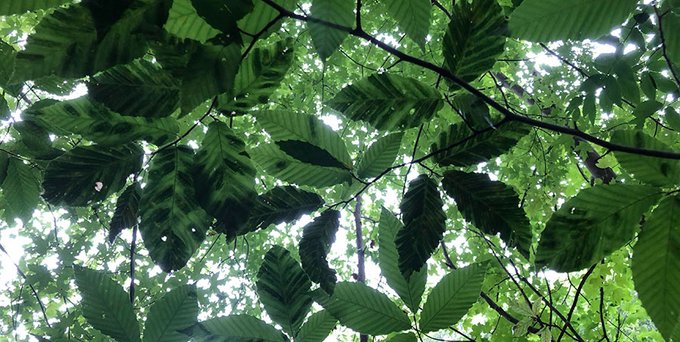
Beech leaf disease – one of many non-native pests that were unknown before introduction to a naive ecosystem. Photo by Jennifer Koch, USDA Forest Service
I appreciate the report’s emphasis on the importance of public awareness and engagement, but I thought the discussion of effective campaigns lacked original ideas.
The report did not fulfill its own goal of fully exploring unappreciated impacts of policies in its discussion of habitat fragmentation. For example, the report notes that grazing by feral alien ungulates facilitates the spread of invasive alien plant species. However, it does not mention the similar impact by livestock grazing (Molvar, et al. 2024).
SOURCES
Molvar, E.M., R. Rosentreter, D. Mansfield, and G.M. Anderson. 2024. Cheat invasions: History, causes, consequences, and solutions. Hailey, Idaho: Western Watersheds Project, 128 pp.
Raffa, K.F., E.G. Brockerhoff, J-C. GRÉGOIRE, R.C. Hamelin, A.M. Liebhold, A. Santini, R.C. Venette, and M.J. Wingfield. 2023. Approaches to forecasting damage by invasive forest insects and pathogens: a cross-assessment. BioScience 85 Vol. 73 No. 2 (February 2023) https://academic.oup.com/bioscience
Posted by Faith Campbell
We welcome comments that supplement or correct factual information, suggest new approaches, or promote thoughtful consideration. We post comments that disagree with us — but not those we judge to be not civil or inflammatory.
For a detailed discussion of the policies and practices that have allowed these pests to enter and spread – and that do not promote effective restoration strategies – review the Fading Forests report at http://treeimprovement.utk.edu/FadingForests.htm
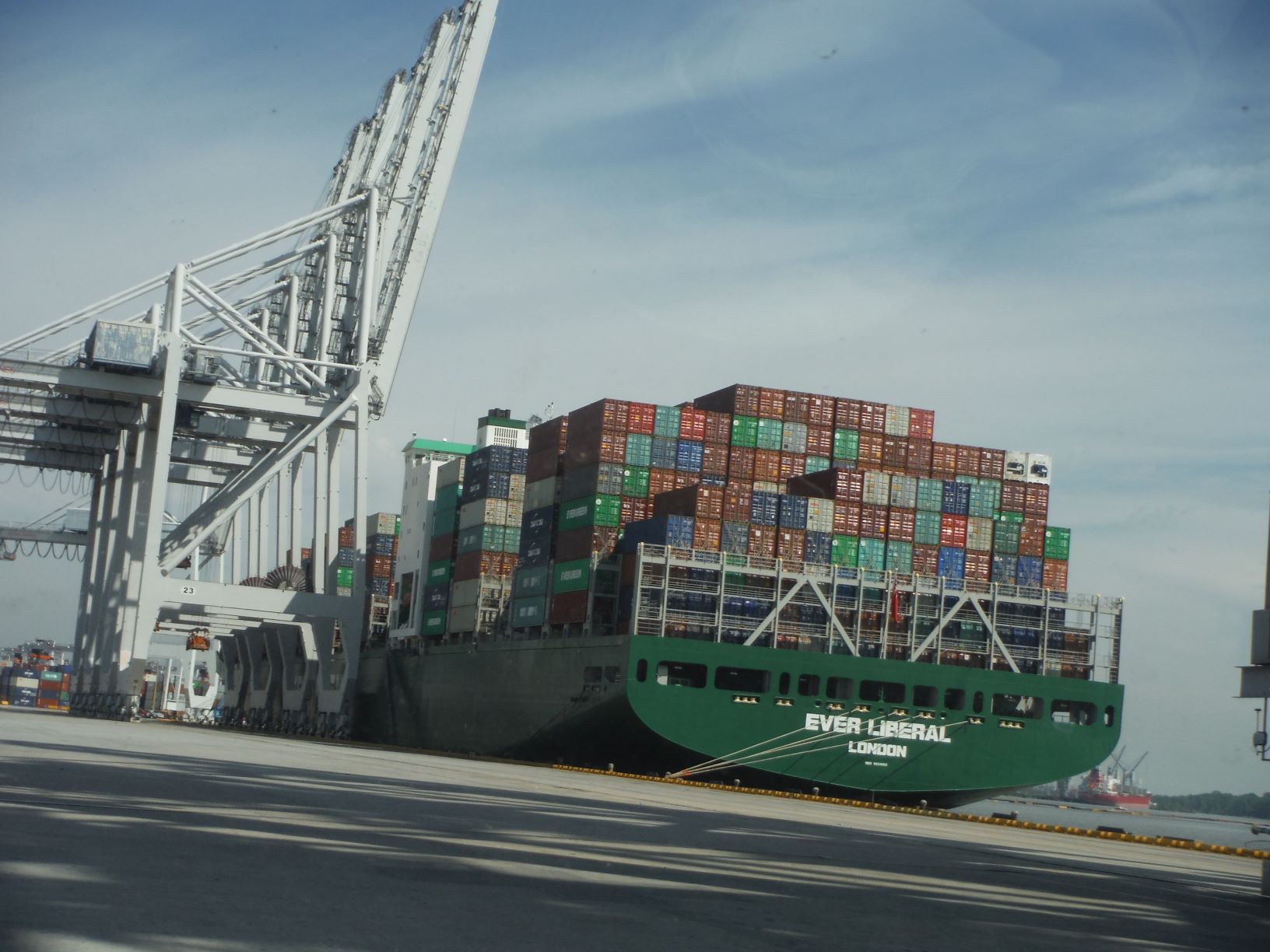
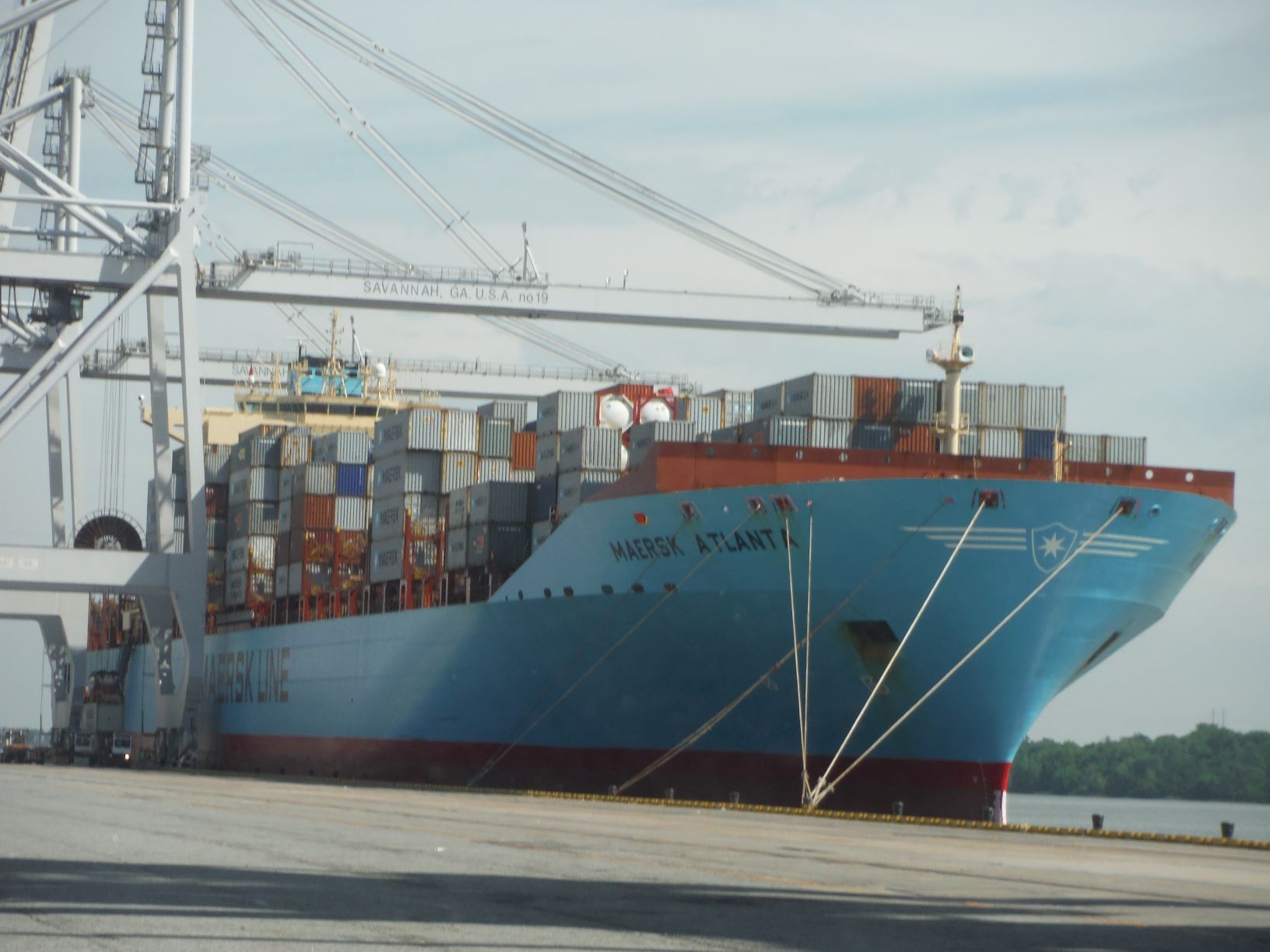
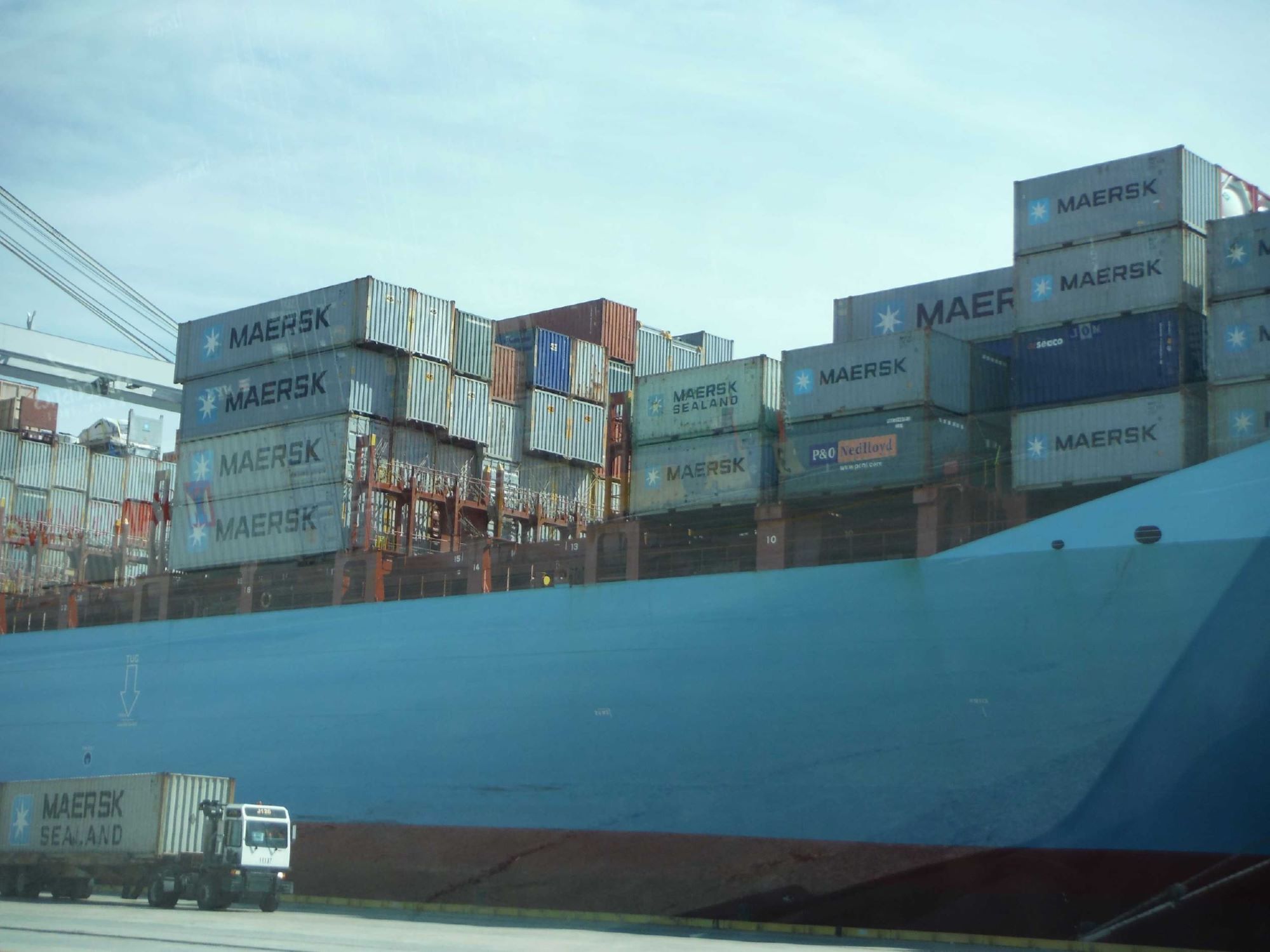
container ship at Port of Savannah; photo by F.T. Campbell
Import Volumes in 2023
U.S. imports in 2023 fell about 13% from 2022 levels, returning to approximate pre-pandemic 2019 levels (Mongelluzzo 2024). The 2023 total was 24.2 million TEUs, (a united equal to twenty-foot container) compared to nearly 28 million TEUs in the previous two years (JoC.com February 2024). Imports from Asia in 2023 totalled 16.2 million TEUs. This was above the 2019 level (15.9 million TEUs) but below the more than 18.5 million TEUs in 2022 and 2021 (Mongelluzzo 2024).
This decline in imports from Asia reflected trends in the first months of 2023. This trend reversed sharply in October; during that month, containerized imports were 12.4% higher than in October 2022, even 1.1% higher than in pre-COVID October 2019 (Mongelluzzo, 2023). The upward trend continued through November: U.S. imports from Asia that month were 10.8% higher than the same month in 2022 (Journal of Commerce).
New Shipping Routes = More Possible Pests
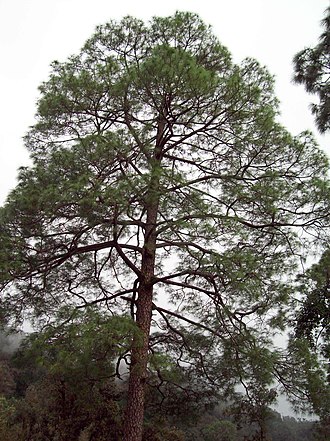
chir pine (Pinus roxburghii) – a 5-needle pine native to the Himalaya in India; photo by Treesftf via Flickr
Proposed new shipping routes will expand the range of pests that can be introduced to eastern ports. For example, in November 2023, the Indian company Ocean Network Express announced plans to begin direct shipments from India to the Ports of New York-New Jersey, Savannah, Jacksonville, Charleston, and Norfolk. Expected cargo includes electronics, apparel, textiles, and foods. (Angell, 2023a) Have USDA authorities evaluated what pest species might be introduced from India?
Traders also expect rising trade volumes from South America in response to shifts in supply chains. Industries include textiles, pharmaceuticals, renewable energy, information technology, and agriculture.
The U.S. is importing more chilled produce from the west coast of South America to meet demand when these fruits are out-of-season in the U.S. The number of refrigerated containers rose to 395,572 TEUs (equivalents of twenty-foot containers). (Knowles. 2023) The Port of Savannah is actively courting these imports; it can now handle more than 3,000 refrigerated containers at one time and is expanding its capacity (Griffis 2023). Chile has a Mediterranean climate similar to that of California; Dr. Mark Hoddle reports several pests of avocado are found in neighboring Peru.
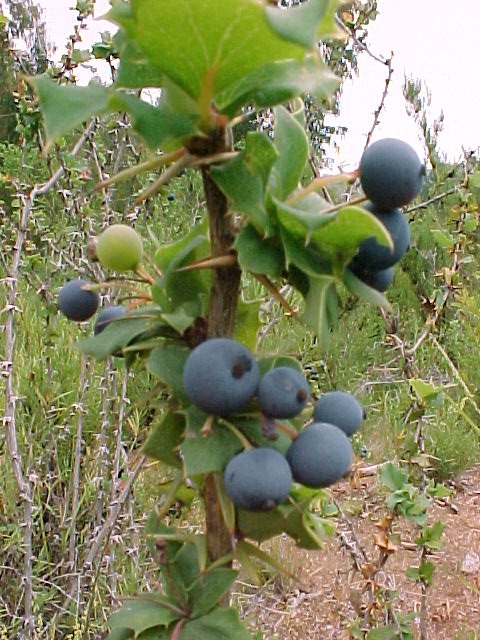
blueberries in Chile; Jardin Botanico Nacional, Chile via Flickr
Problems in the canals likely to push trade from Asia back to California ports
In an editorial published on January 25, 2024, The Washington Post reports that drought has caused water levels in the Panama Canal to fall below what is needed to operate the locks. In normal years, about 5% of global maritime trade passes through the canal. This includes nearly half the containers shipped from northeast Asia to the eastern United States. The reduction in numbers of ships moving through the Canal has affected supply chains in agriculture and energy. The situation is further complicated by wars in the Middle East hampering shipments through the Suez Canal.
The Post describes the Panamanian government’s efforts to buttress the canal, which is a major source of income. Droughts elsewhere are also impeding transport, e.g., the Amazon, Rhine, and Mississippi rivers. In the Post’s view, “threats to global growth will make it harder to … respond to poverty and hunger. … Ultimately, prevention, by arresting the emission of planet-warming greenhouse gases, is the only way to stop the list of looming climate-related threats to the global economy from getting even longer.”
Here, my focus is on what this means for volumes of ships and containers visiting ports in the eastern United States – and the associated risks of pest introductions.
Ambitious Plan for Eastern Ports
As I have pointed out in previous blogs [on the website home page, scroll below the “Archives” to “Categories”, click on “wood packaging”, especially this one], ports in eastern and Gulf Coast states have been eagerly conducting dredging operations and making other preparations to attract large container ships bringing goods from Asia. As of just a few months ago, several ports had ambitious plans. The Port of Virginia will reach a depth of 55 feet this year (Angell, 2023b). The Port of Charleston already has a 52-foot depth. Nevertheless, the port authority hopes to further deepen the channel so that it can quintuple its capacity over a decade — from 500,000 TEUs to 2.5 million TEUs (Anonymous, 2024). The Port of New York-New Jersey has approved $19 million to study deepening the ship channels from 50 to 55 feet. The Port Authority hopes to persuade Congress to share the costs (Angell, 2023b). None of the reporting mentions any consideration of the possible pest risk despite past disasters – e.g., introduction of the redbay ambrosia beetle to Savannah or Asian longhorned beetle to Charleston.
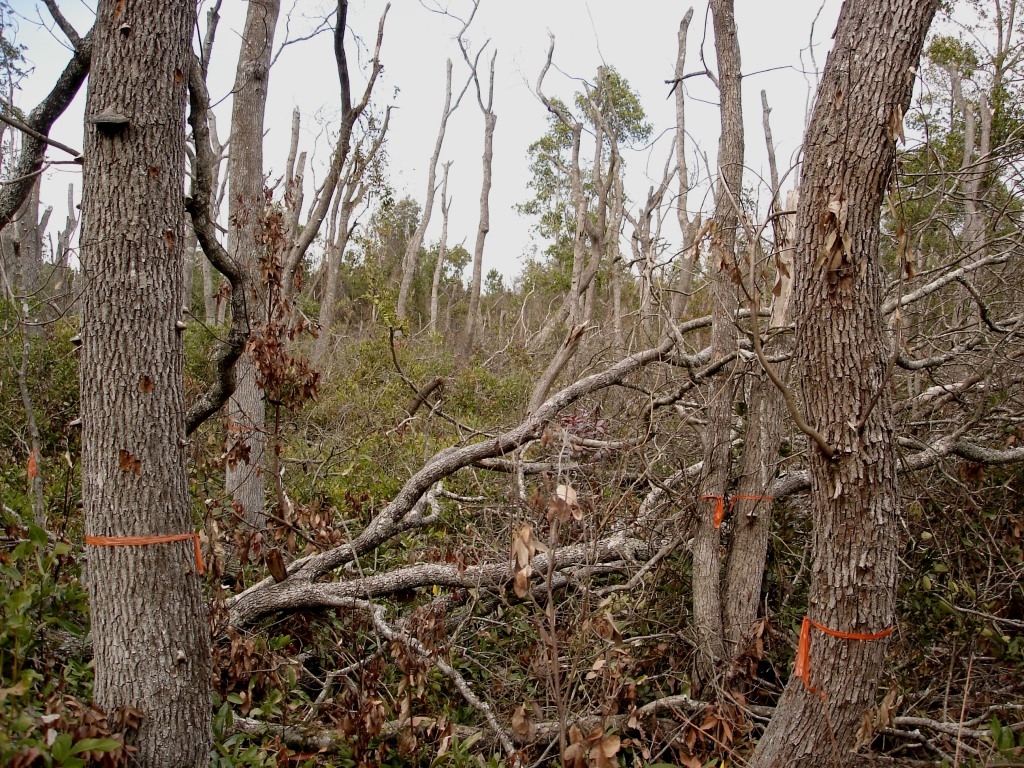
redbay mortality in Claxton, GA; photo by Scott Cameron
The proportion of total U.S. imports going to West Coast ports in 2023 was 53.6% (Mongelluzzo, 2023). Journal of Commerce’ long-time analyst Bill Mongelluzzo expects the effective closure of both the Suez (attacks on shipping) and Panama canals will push more imports from Asia to the Ports of Los Angeles and Long Beach. These linked ports now handle 32% of all U.S. imports. Mongelluzzo expects the increased volume to create new congestion problems (Mongelluzzo 2024).
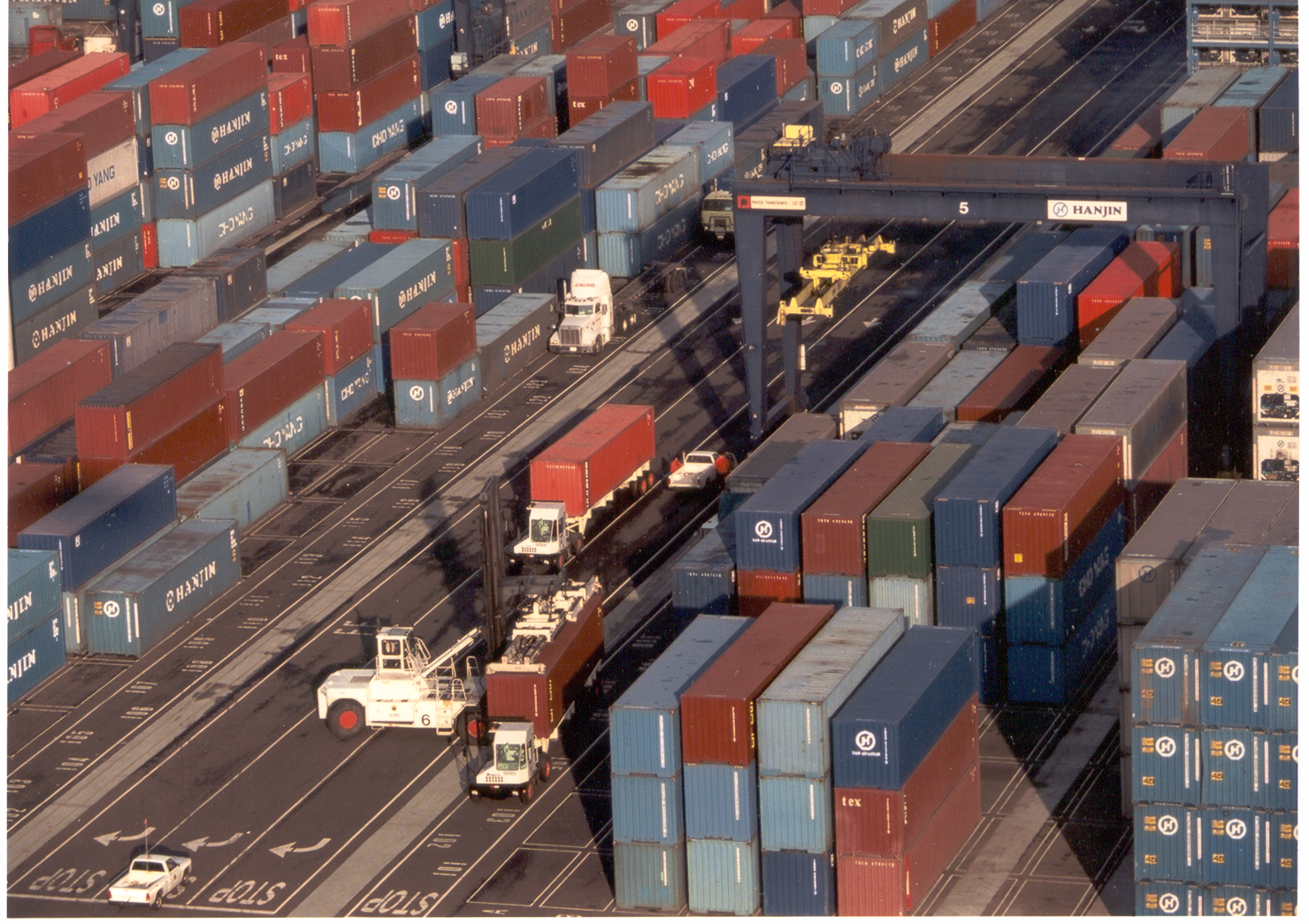
containers at Long Beach in early 2000s; photo courtesy of Port of Long Beach
SOURCES
Angell, M. 2023a. ONE readies Indian-U.S. East Cost service as part of 2024 network rollout. Journal of Commerce. November 27, 2023.
Wood packaging – crates, pallets, spools for wire, etc. — has been recognized as a major pathway for introduction of tree-killing pests since the Asian longhorned beetle was detected in New York and Chicago in the late 1990s. As of 2021, 65 new species of non-native wood- or bark-boring Scolytinae had been detected in the United States (Rabaglia; full citation at end of the blog).
As I have often reported [To see my 40+ earlier blogs about wood packaging material, scroll down below archives to “Categories,” click on “wood packaging”.], the international phytosanitary community adopted the International Standard for Phytosanitary Measures (ISPM) #15. The goal of ISPM#15 is to “significantly reduce” [not eliminate] the risk of pests associated with solid wood used for constructing packaging (e.g., crates, pallets), from being introduced to other countries through international trade.
I recently reviewed the first 20+ years of implementation of ISPM#15 including two analyses by Robert Haack and colleagues in a blog in December 2022. I have also provided the broader context of the World Trade Organization (WTO) in my Fading Forests II report.
I last blogged about U.S. import volumes in June. My silence since reflected the significant decline in U.S. imports from Asia. This reduction had reduced the likelihood that a new tree-killing pest would be introduced from that region – or that an already-established pest would be introduced to a U.S. region that had escaped it so far.
However, U.S. imports from Asia have suddenly grown! In October 2023, containerized imports from Asia were 12.4% higher than a year ago – and 6% higher than in September. According to the Journal of Commerce (full citation at end of blog), U.S. retailers anticipate consumers will purchase lots of gifts for the upcoming Christmas season.
The U.S. imported 1.57 million TEU from Asia in October. This volume exceeded even the pre-COVID levels. How great is the associated risk of a pest introduction? To calculate that, I apply the following:
most U.S. imports arrive in 40-foot-long containers, so divide TEU by 2 = 785,000
a decade-old estimate that 75% of containers in maritime shipments contain wood packaging (Meissner et al.) = 588,750 containers with wood packaging (I suspect it is more).
the estimate by Haack et al. 2014 that 0.1% (1/10th of 1 percent) of consignments (which usually means a single container) harbor tree-killing pests;
the estimate by Haack et al. 2022 that 0.22% of consignments harbor tree-killing pests.
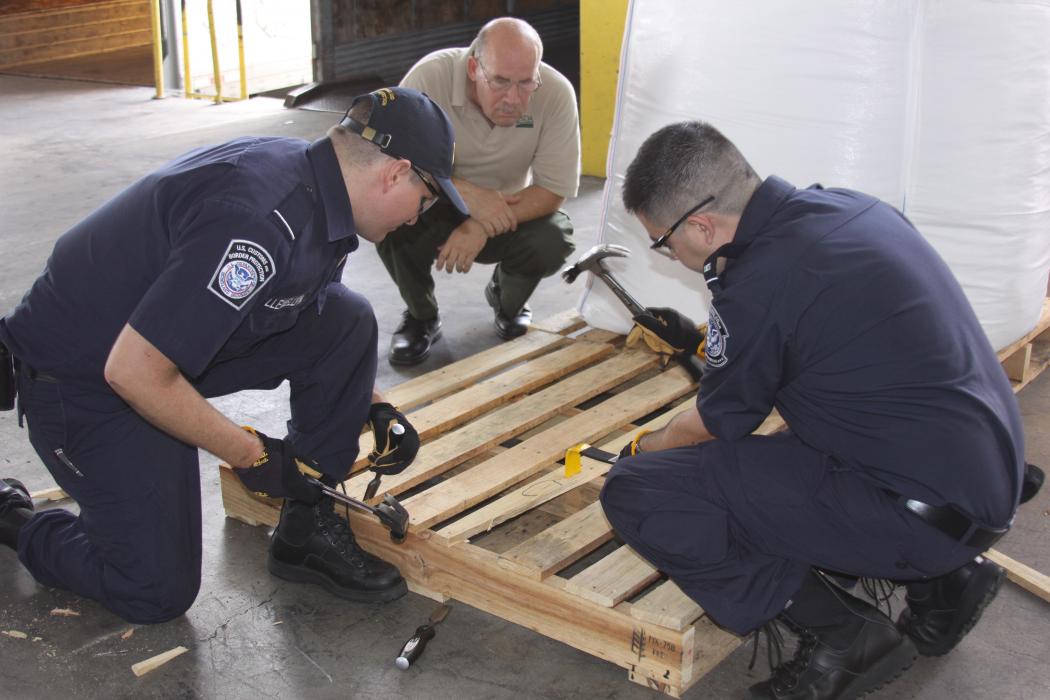
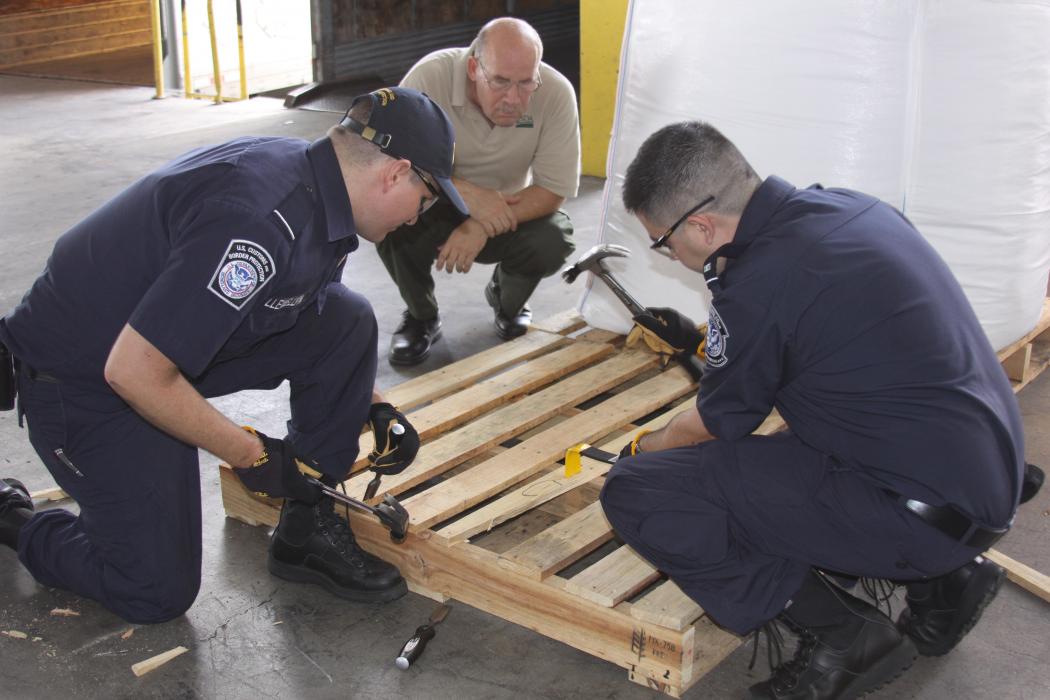
inspecting a pallet; CBP photo
The result of these calculations is an estimate of 648 containers (using the 2009 global estimate), or 1,727 containers (using the 2022 global estimate), or 5,730 containers (using the 2010-2020 estimate for China specifically) entering the country in one month harbored tree-killing pests. Since West Coast ports received 54% of those containers, the estimated number of containers transporting pests that enter California, Washington, or Oregon ranged from 349 to 3,042. The rest are scattered among the dozens of ports on the East and Gulf coasts.
With drought limiting container ship transits through the Panama Canal (Szakonyi 2023), the threat to East and Gulf coast ports might not rise commensurately.
Because of the low levels of imports in previous months, U.S. imports from Asia remain significantly below levels in previous years: 16.6% lower for the January – September period compared to 2022.
The 2022 analysis found that the rate of wood packaging from China that is infested has remained relatively steady since 2003: 1.26% during 2003–2004, and ranged from 0.58 to 1.11% during the next three time periods analyzed. Packaging from China made up 4.6% of all shipments inspected, but 22% of the 180 consignments with infested wood packaging. Thus the proportion of Chinese consignments with infested wood is five times greater than would be expected based on their proportion of imports. Note the great impact of this high infestation rate on the number of containers transporting tree-killing pests to the U.S. in the paragraph above: more than 8,000 containers compared to about 2,000.
I remind you that the U.S. and Canada have required treatment of wood packaging from China since December 1998. Why are the responsible agencies in the United States not taking action to correct this problem? [which has persisted for 2 decades]
The fact is – as I have argued numerous times — a pallet or crate bearing the ISPM#15 mark has not proved to be a reliable indicator as to whether the wood is pest-free. (This might be because the wood had not been treated, or if it was, the treatment failed). All the pests detected in the Haack et al. studies (after 2006) were in wood packaging bearing the ISPM#15 mark. As noted in my past blogs [click on the “wood packaging” category to bring up blogs about wood packaging and enforcement], Customs and Border Protection also report that nearly all the wood packaging in which that they detected insect pests bore the ISPM#15 mark.
According to Angell in November (full citation at end of blog), U.S. imports from India to the east coast fell by 15% in the first 10 months of 2023 compared to last year – to a total of 623,356 TEUs. This might change in the future: a shipper has promised to start weekly arrivals from India beginning in May 2024. the company plans calls at New York-New Jersey, Savannah, Jacksonville, Charleston, and Norfolk. The ships will call, en route, at ports in Saudi Arabia, Egypt, and Spain. What pests might be hitching a ride on these shipments?
SOURCES
Haack RA, Britton KO, Brockerhoff EG, Cavey JF, Garrett LJ, et al. 2014. Effectiveness of the International Phytosanitary Standard ISPM No. 15 on reducing wood borer infestation rates in wood packaging material entering the United States. PLoS ONE 9(5): e96611. doi:10.1371/journal.pone.0096611
Haack RA, Hardin JA, Caton BP and Petrice TR. 2022. Wood borer detection rates on wood packaging materials entering the United States during different phases of ISPM#15 implementation and regulatory changes. Frontiers in Forests and Global Change 5:1069117. doi: 10.3389/ffgc.2022.1069117
Meissner, H., A. Lemay, C. Bertone, K. Schwartzburg, L. Ferguson, L. Newton. 2009. Evaluation of pathways for exotic plant pest movement into and within the greater Caribbean Region.
Angell, M. 2023. ONE readies India-US East Coast service as part of 2024 network rollout. Journal of Commerce. November 27, 2023
Rabaglia, R. 2021. The increasing number of non-native bark and ambrosia beetles in North America. International Union of Forest Research Organizations. Prague, Czech Republic. September 2021
Szakonyi, M. 2023. Carriers Weigh Options as Panama Canal restrictions become fact of life. Journal of Commerce. November 21, 2023. (Access limited to subscribers, unfortunately)
Posted by Faith Campbell
We welcome comments that supplement or correct factual information, suggest new approaches, or promote thoughtful consideration. We post comments that disagree with us — but not those we judge to be not civil or inflammatory.
For a detailed discussion of the policies and practices that have allowed these pests to enter and spread – and that do not promote effective restoration strategies – review the Fading Forests report at http://treeimprovement.utk.edu/FadingForests.htm
Rome: home of the International Plant Protection Convention
I often assert that the international phytosanitary system has proven to be a failure in preventing introductions.
Some of the recent publications support my conclusion – although most don’t say so explicitly. For example, the Fenn-Moltu et al. (2023) study of insect transport and establishment around the world found that the number of invasive species-related treaties, regulations and legislation a country has adopted had no significant effect on either the number of insect species detected at that country’s border or the number of insect species that established in that country’s ecosystems..
Weber et al. also found considerable evidence that international and U.S. phytosanitary systems are not curtailing introduction of insects and entomophagic pathogens. In my earlier blog I review their study of unintentional “self-introductions” of natural enemies of arthropod pests and invasive plants. They conclude that these “self-introductions” might exceed the number of species introduced intentionally. These introductions have been facilitated by the usual factors: the general surge in international trade; lack of surveillance for species that are not associated with live plants or animals; inability to detect or intercept microorganisms; huge invasive host populations that allow rapid establishment of their accidentally introduced natural enemies; and lack of aggressive screening for pests already established. Examples cited include species introduced to the United States’ mainland and Hawai`i specifically.
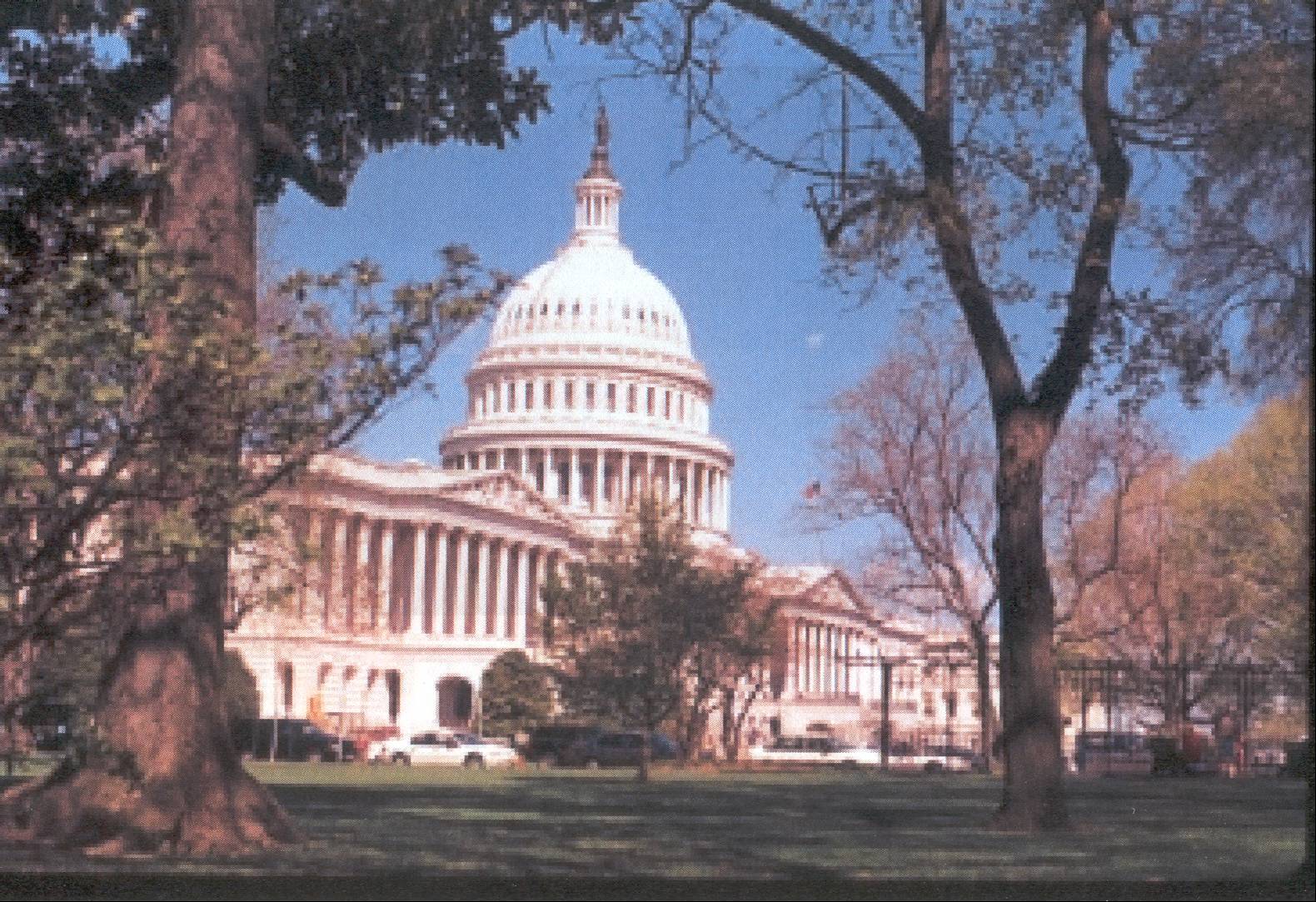
The U.S. Capitol – one of the entities that can reflect our priorities in setting phytosanitary policy
As I point out often, altering human activities that facilitate invasion is a political process. So is amending international agreements that are not effective. We need to determine the cause of the failures of the existing institutions and act to rectify them. See my critiques of both the American and international phytosanitary system Fading Forests II and Fading Forests III (see links at the end of this blog) and my earlier blogs, especially this and this.
SOURCES
Fenn-Moltu, G., S. Ollier, O.K. Bates, A.M. Liebhold, H.F. Nahrung, D.S. Pureswaran, T. Yamanaka, C. Bertelsmeier. 2023. Global flows of insect transport and establishment: The role of biogeography, trade and regulations. Diversity and Distributions DOI: 10.1111/ddi.13772
Weber, D.C., A.E. Hajek, K.A. Hoelmer, U. Schaffner, P.G. Mason, R. Stouthamer, E.J. Talamas, M. Buffington, M.S. Hoddle and T. Haye. 2020. Unintentional Biological Control. Chapter for USDA Agriculture ResearchService. Invasive Insect biocontrol and Behavior Laboratory. https://www.ars.usda.gov/research/publications/?seqNo115=362852
Posted by Faith Campbell
We welcome comments that supplement or correct factual information, suggest new approaches, or promote thoughtful consideration. We post comments that disagree with us — but not those we judge to be not civil or inflammatory.
For a detailed discussion of the policies and practices that have allowed these pests to enter and spread – and that do not promote effective restoration strategies – review the Fading Forests report at http://treeimprovement.utk.edu/FadingForests.htm
Clive Braser and others study Phytophthora species in their native habitats of Vietnam; which will become aggressive invaders in North America?
For years, one focus of this blog has been on scientists’ efforts to improve prevention of new introductions of forest pests. In earlier blogs, I summarized and commented on efforts by Mechet al. (2019) and Schultzet al. (2021), who extrapolate from insect-host relationships of pests already established in North America. [Full citations are presented at the end of this blog.] Both limited their analysis to insects; Mech et al. focused on those that attack conifers, Schultz et al. on those that attack single genera of angiosperms (hardwoods).
However, many of the most damaging agents are pathogens; for an indication, review the list under “invasive species” here. Indeed, Beckman et al. (2021) reported that only three non-native organisms pose serious threats to one or more of the 37 species of Pinus native to the U.S. All are pathogens: white pine blister rust (WPBR), pitch canker, and Phytophthora root rot (Phytophthora cinnamomi).
For this reason I welcome a study by Li et al. (2023), who used laboratory tests to evaluate the threat posed by more than 100 fungi associated with bark beetles. Since there are more than 6,000 species of bark and ambrosia beetles and they are commonly intercepted at the U.S. border, determining which should be priorities is important. Li et al. point out that the vast majority of such introductions have had minimal impacts. Two, however, have caused disastrous levels of damage: Dutch elm disease and laurel wilt disease.
Li et al. tested 111 fungi associated with 55 scolytine beetles from areas of Eurasia with latitudes and ecosystems analagous to those in the southeastern U.S. The beetles assessed included beetle species responsible for recent major tree mortality events in Eurasia: Dendroctonus species, Platypus koryoensis (Korean oak wilt), Platypus quercivorus (Japanese oak wilt) and Tomicus species.
The authors tested the fungi’s virulence on four species of trees native to the Southeast – two pines (Pinus taeda and P. elliottii var. elliottii), and two oaks(Quercus shumardii and Q. virginiana).
Li et al. found that none of 111 fungal associates caused a level of damage on these four hosts equal to Dutch elm disease on elms or laurel wilt disease on trees in the Lauraceae. Twenty-two of the fungi were minor pathogens – meaning they might cause damage under certain conditions or when loads of inoculum are large enough.
redbay trees killed in coastal Georgia by laurel wilt; photo by Scott Cameron
I think Li et al. set an extremely high bar for “serious” damage. Surely we wish to prevent introduction of pathogens that cause damage at a lower level than the catastrophes to which these two diseases have exposed a genus (elms) and a family (Lauraceae)! Still, the scientific approach used here is a step toward addressing pathogens. These agents of tree mortality are addressed much less frequently than insects. I hope that scientists will continue to test the virulence of these fungi on some of the thousands of other species that make up the forests of the United States, or at least the dominant species in each ecosystem.
It is discouraging that Raffaet al. (2023) found none of four approaches to predicting a new pest’s impact to be adequate by itself. Instead, they outlined the relative strengths and weaknesses of each approach and the circumstances in which they might offer useful information. I am particularly glad that they have included pathogens, not just insects. The four approaches they review are:
(1) pest status of the organism in its native or previously invaded regions;
(2) statistical patterns of traits and gene sequences associated with high-impact pests;
(3) sentinel plantings to expose trees to novel pests; and
(4) laboratory tests of detached plant parts or seedlings under controlled conditions.
They emphasize that too little information exists regarding pathogens to predict which microbes will become damaging pathogens when introduced to naïve hosts in new ecosystems. See the article, especially Figure 4, for their assessment of the strengths each of the several approaches.
Raffa et al. raise important questions about both the science and equity issues surrounding invasive species. As regards scientific issues, they ask, first, whether it will ever be possible to predict how each unique biotic system will respond to introduction of a new species. Second, they ask how assessors should interpret negative data? In the context of equity and political power, they ask who should make decisions about whether to act?
In my blog I expressed concern about finding that most introduced forest insects are first detected in urban areas whereas introduced pathogens are more commonly detected in forests. I hope scientists will redouble efforts to improve methods for earlier detection of pathogens. Enrico Bonello at Ohio State and others report that spectral-based tools can detect pathogen-infected plants, including trees.
Japanese cherry trees burned on the Washington D.C. mall because infested by scale; on order of Charles Marlatt
International trade is considered the single most important pathway for unintentional introductions of insects. Updated figures remind us about the stupendous amounts of goods being moved internationally. According to Weber et al., international shipping moves ~133 million TEU containers per year between countries, the majority between continents. Four times this number move within regions via coastal shipping. On top of that, four billion passenger trips take place by air every year. Air freight carries another ~220 million tons of goods; while this is a tiny fraction of the weight shipped by boat, the packages are delivered in less than a day – greatly increasing the likelihood that any unwanted living organisms will survive the trip. The U.S. also imports large numbers of live plants – although getting accurate numbers is a challenge. MacLachlan et al. (2022) report 5 billion plants imported in 2021, but the USDA APHIS annual report for FY22 puts the number at less than half that figure: 2.2 billion plant units.
Given the high volume of incoming goods, Weber et al. advocate improved surveillance (including analysis of corresponding interceptions) of those pathways that are particularly likely to result in non-native species’ invasions, e.g. live plants, raw lumber(including wood packaging), and bulk commodities e.g. quarried rock. Isitt et al. and Fenn-Moltu et al. concur that investigators should focus on the trade volumes of goods that are likely to transport plant pests – in their cases, plant imports.
The importance of the plant trade as a pathway of introduction for has been understood for at least a century – as witnessed by the introductions of chestnut blight DMF and white pine blister rust, DMF and articles by Charles Marlatt. A decade ago, Liebhold et al. (2012) calculated that the approach rate of pests on imported plants was 12% — more than 100 times higher than the 0.1% approach rate found by Haack et al. (2014) for wood packaging.
Since plant-insect interactions are the foundation of food webs, changes to a region’s flora will have repercussions throughout ecosystems, including insect fauna. See findings by teams led by Doug Tallamy and Sara Lalk; and a chapter in the new forest entomology text written by Bohlmann, and Krokene (citation at end of blog under Allison, Paine, Slippers, and Wingfield). Sandy Liebhold and Aymeric Bonnamour also addressed explicitly links between introductions of non-native plant and insect species. Weber et al. call this phenomenon the “receptive bridgehead effect”: a non-native plant growing prolifically in a new ecosystem provides a suitable host for an organism that feeds on that host, raising the chance for its establishment.
Recent studies confirm the importance of the “receptive bridgehead effect”. Isitt and colleagues found that the large numbers of introduced European insect species – all taxa, not just phytophagous insects – established in North America and Australia/New Zealand were best explained by the numbers of European plants introduced to these regions – in other words, the most important driver appears to be the diversity of non-native plants.
The presence of European plants in North America and Australia/New Zealand promoted establishment of European insects in two ways. First, these high-volume imports increased the propagule pressure of insects associated with this trade. Live plant imports might have facilitated the establishment of ~70% of damaging non-native forest insects in North America. Second, naturalization of introduced European plants provided a landscape replete with suitable hosts. This is especially obvious in Australia/New Zealand, which have unique floras. In Australia, nearly 90% of non-native pest insects are associated with non-native plants. Those non-native insects that do feed on native plants are more likely to be polyphagous.
Amur honeysuckle – one of the hundreds of Asian plants invading North American ecosystems; via Flickr
I hope U.S. phytosanitary officials apply these lessons. Temperate Asia is the source of more non-native plants established in both North America and Australia/New Zealand than is Europe. Already, many insects from Asia have invaded the U.S. The logicof the “receptive bridgehead effect” points to prioritizing efforts to prevent even more Asian insects from reaching our shores!
Fenn-Moltu et al. sought to elucidate which mechanisms facilitate species’ success during the transport and introduction/establishment stages of bioinvasion. They studied the transport stage by analyzing border interceptions of insects from 227 countries by Canada, mainland U.S., Hawai`i, Japan, New Zealand, Great Britain, and South Africa over the 60 year period 1960 – 2019. They studied establishment by analyzing attributes of 2,076 insect species recorded as established after 1960 in the above areas plus Australia (North America was treated as a single unit comprised of the continental U.S. and Canada).
The number of species transported increased with higher Gross National Income in the source country. The number of species transported decreased with geographic distance. They suggest that fewer insects survive longer journeys, but say additional information is needed to verify this as the cause. The number of species transported was not affected by species richness in the native region.
More species established when introduced to a country in the same biogeographic region. They were not surprised that environmental similarity between source and destination apparently strongly affected establishment success. The number of species established was not affected by species richness in the native region. For example, the greatest number of established species originated from the Western and Eastern Palearctic regions, which together comprise only the fifth-largest pool of native insect species.
Gaps Despite Above Studies
As I noted at the beginning, most of the studies examining current levels of pests transported on imported plants have been limited to insects. This is unfortunate given the impact of introduced pathogens (again, review the list damaging organisms under “invasive species” here).
In addition, most studies analyzing the pest risk associated with plant imports use port inspection data – which are not reliable indicators of the pest approach rate. The unsuitability of port inspection data was explained by Liebhold et al. in 2012 and Fenn-Moltu et al. a decade later – as well as Haack et al. 2014 (as the data pertain to wood packaging). Fenn-Moltu et al. note that inspection agencies often (and rightly!) target high-risk sources/commodities, so the records are biased. Other problems might arise from differences in import volume, production practices, and differences in records that identify organism only to genus level rather than species. Fenn-Moltu et al. call for relying on randomized, statistically sound inspection systems; one such example is USDA’s Agriculture Quarantine Inspection System (AQIM). Under AQIM, incoming shipments are randomly selected and put through more thorough inspections to produce statistically based estimates of approach rates, defined as the percent of inspected shipments found to be infested with potential pests (Liebhold et al. 2012). I ask why scientists who are aware of this issue have not obtained AQIM data for pests associated with plant imports. Plant imports have been included in the AQIM system since 2008. Have they not been able to persuade APHIS to provide these data? Or are these data available for only limited types of imported plants? Too narrow a focus would create a different source of potential bias.
Both Isitt et al. and Fenn-Moltu et al. list factors not addressed and other caveats of which we should be aware when extrapolating from their findings.
Beckman, E., Meyer, A., Pivorunas, D., Hoban, S., & Westwood, M. (2021). Conservation Gap Analysis of Native U.S. Pines. Lisle, IL: The Morton Arboretum.
Fenn-Moltu, G., S. Ollier, O.K. Bates, A.M. Liebhold, H.F. Nahrung, D.S. Pureswaran, T. Yamanaka, C. Bertelsmeier. 2023. Global flows of insect transport and establishment: The role of biogeography, trade and regulations. Diversity and Distributions DOI: 10.1111/ddi.13772
Hoddle. M.S. 2023. A new paradigm: proactive biological control of invasive insect pests. BioControl https://doi.org/10.1007/s10526-023-10206-5
Isitt, R., A.M. Liebhold, R.M. Turner, A. Battisti, C. Bertelsmeier, R. Blake, E.G. Brockerhoff, S.B. Heard, P. Krokene, B. Økland, H. Nahrung, D. Rassati, A. Roques, T. Yamanaka, D.S. Pureswaran. 2023. Drivers of asymmetrical insect invasions between three world regions. bioRxiv preprint doi: https://doi.org/q0.1101/2023.01.13.523858
Li, Y., C. Bateman, J. Skelton, B. Wang, A. Black, Y-T Huang, A. Gonzalez, M.A. Jusino, Z.J. Nolen, S. Freemen, Z. Mendel, C-Y Chen, H-F Li, M. Kolarik, M. Knizek, J-H. Park, W. Sittichaya, T-H Pham, S. Ito, M. Torii, L. Gao, A.J. Johnson, M. Lu, J. Sun, Z. Zhang, D.C. Adams, J. Hulcr. 2022. Pre-invasion assessment of exotic bark beetle-vectored fungi to detect tree-killing pathogens. Phytopathology Vol 112 No. 2 February 2022
Liebhold, A.M., E.G. Brockerhoff, L.J. Garrett, J.L. Parke, and K.O. Britton. 2012. Live Plant Imports: the Major Pathway for Forest Insect and Pathogen Invasions of the US. www.frontiersinecology.org
Liebhold, A.M., T. Yamanaka, A. Roques, S. August, S.L. Chown, E.G. Brockerhoff and P. Pyšek. 2018. Plant diversity drives global patterns of insect invasions. Sci Rep8, 12095 (2018). https://doi.org/10.1038/s41598-018-30605-4
MacLachlan, M.J., A. M. Liebhold, T. Yamanaka, M. R. Springborn. 2022. Hidden patterns of insect establishment risk revealed from two centuries of alien species discoveries. Sci. Adv. 7, eabj1012 (2021).
Mech, A.M., K.A. Thomas, T.D. Marsico, D.A. Herms, C.R. Allen, M.P. Ayres, K.J. K. Gandhi, J. Gurevitch, N.P. Havill, R.A. Hufbauer, A.M. Liebhold, K.F. Raffa, A.N. Schulz, D.R. Uden, and P.C. Tobin. 2019. Evolutionary history predicts high-impact invasions by herbivorous insects. Ecol Evol. 2019 Nov; 9(21): 12216–12230.
Raffa, K.F., E.G. Brockerhoff, J-C. Gregoirem R.C. Hamelin, A.M. Liebhold, A. Santini, R.C. Venette, and M.J. Wingfield. 2023. Approaches to Forecasting Damage by Invasive Forest Insects and Pathogens: A Cross-Assessment. Bioscience Vol. 73, No. 2. February 2023.
Schulz, A.N., A.M. Mech, M.P. Ayres, K. J. K. Gandhi, N.P. Havill, D.A. Herms, A.M. Hoover, R.A. Hufbauer, A.M. Liebhold, T.D. Marsico, K.F. Raffa, P.C. Tobin, D.R. Uden, K.A. Thomas. 2021. Predicting non-native insect impact: focusing on the trees to see the forest. Biological Invasions.
Weber, D.C., A.E. Hajek, K.A. Hoelmer, U. Schaffner, P.G. Mason, R. Stouthamer, E.J. Talamas, M. Buffington, M.S. Hoddle and T. Haye. 2020. Unintentional Biological Control. Chapter for USDA Agriculture ResearchService. Invasive Insect biocontrol and Behavior Laboratory. https://www.ars.usda.gov/research/publications/?seqNo115=362852
Posted by Faith Campbell
We welcome comments that supplement or correct factual information, suggest new approaches, or promote thoughtful consideration. We post comments that disagree with us — but not those we judge to be not civil or inflammatory.
For a detailed discussion of the policies and practices that have allowed these pests to enter and spread – and that do not promote effective restoration strategies – review the Fading Forests report at http://treeimprovement.utk.edu/FadingForests.htm
infested wood bearing ISPM#15 mark; photo by Oregon Department of Agriculture
SWPM has been recognized as a major pathway for introduction of tree-killing pests since the Asian longhorned beetle was detected in New York and Chicago in late 1990s. As of 2014, 58 new species of non-native wood- or bark-boring insects had been detected – many probably introduced via wood packaging [Leung et al. 2014]. Other examples include the emerald ash borer, redbay ambrosia beetle, and, possibly, the invasive shot hole borers.
In response to recognition of the pest risk associated with wood packaging, countries adopted ISPM#15. This process was reviewed in the two articles by Haack et al. and my recent blog. I provided the broader context of the World Trade Organization (WTO) in my Fading Forests II report.
I have blogged often about the continuing poor compliance with wood packaging regulations, especially by China; and USDA APHIS’ insufficient efforts to fix the problems. The DHS Bureau of Customs and Border Protection (CBP) has tried much harder. See particularly my blog about Bob Haack’s re-evaluation of the pest approach risk in wood packaging. Given the high volumes of imports, pests infesting even a small proportion of incoming shipments can result in tens of thousands of pest-infested containers entering the U.S. or Canada each year. For an explanation of these calculations, see the “background” section of this blog.
Since 2010, CBP has discovered actionable pests in more than 700 shipments each year (pers. comm.). [APHIS reports half as many detections – 300 wood boring and bark beetles (Greenwood et al. citing APHIS report from 2021). Perhaps the difference arises from some of the actionable pests not being wood-borers, e.g., snails.] The persistence of pest presence has disappointed CBP staffers, because the agency has taken several actions intended to discourage violations. These include imposing fines and revoking the violators’ participation in the U.S. Trade Partnership Against Terrorism (C-TPAT) program. Greenwood et al. describe these consequences of non-compliance, as well as the expense of re-exporting the goods and associated wood packaging, as “significant”. Regardless of how significant they might be, so far these consequences have not reduced non-compliances substantially.
The fact is, countries cannot rely on the presence of the ISPM#15 mark or stamp to indicate that the wood packaging is pest-free. In both the United States and Europe, more than 90% of the SWPM found to be infested has born the ISPM#15 stamp (pers. comm.; Eyre et al. 2018). All the pest-infected shipments imported after 2006 discussed in the Haack et al. 2022 study were in wood packaging bearing the ISPM#15 mark. While many of the problems arise on shipments from Asia, findings occur sporadically with countries all across the globe- and notably, U.S. importers have also found serious problems with dunnage from Europe.
But that is the purpose of the standard!
Two outstanding questions that need answers
Continuing poor compliance with regulations by China. This is despite the fact that the U.S. and Canada have required treatment of wood packaging from China since December 1998 – nearly 24 years. Haack et al. found that the proportion of Chinese consignments with infested wood is five times greater than expected based on their proportion of the dataset. The rate of wood packaging from China that is infested has remained relatively steady: the Chinese infestation rate was 1.26% during 2003–2004, and ranged from 0.58 to 1.11% during the next three periods.
Why are the responsible agencies in the United States not taking more aggressive action to correct this long-standing problem? This is a matter of political will.
Despite the ISPM#15 mark being unreliable for more than a decade, countries have not carried out research to determine the root causes. Even now (i.e., Haack et al. 2022; Greenwood et al.) no one can say what proportion of these ISPM-marked but pest-infested pieces of wood results from the treatment not being effective in killing all pests; what proportion results from inadequate application of treatments that are per se effective; and what proportion from fraud (deliberate claims to have applied a treatment that was not done)?
Admittedly, answering these questions will not be easy. First, there is no independent test for whether treatments have been applied; the treatments do not alter the wood’s properties in measurable ways. Scientists need experiments to test the real-world efficacy of treatments in the specific contexts of solid wood packaging.
Second, each country is responsible for its own compliance. Countries differ in their capacity and political will to address this issue. However, success of ISPM#15 depends on determining the cause of continuing pest presence in wood marked as treated, and taking appropriate action to solve the underlying problem.
Greenwood et al. attempt to make progress toward carrying out this necessary task by describing the many steps in the wood packaging supply chain, associated opportunities for pests to infest the wood at each step, and actions exporters and importers can take to try to minimize the risk.
Again, as I discussed in the earlier blog, Haack et al. (2022) found several disturbing situations:
While the pest approach rate has fallen since U.S. implementation of ISPM#15, the extent of the decline has progressively decreased as time passes. The reduction during 2005–2006 was 61%; during 2007–2009, 47%; during 2010-2020 only 36%.
The 2010 – 2020 pest approach rate was calculated at 0.22%. This is more than double the rate based on 2009 data (0.1%, as stated in Haack et al. 2014). While we cannot directly compare these two data points (the two studies used different methods, as discussed in the blog), the bottom line is that the approach rate remains too high. Our forests continue to be exposed to the risk of introduction of highly damaging wood-boring pests. Furthermore, since the number of countries sending us infested wood packaging has increased, those potential pests include insects from a greater variety of countries (biomes).
The two most commonly intercepted families of wood borers are Cerambycidae and Scolytinae (Haack et al. 2022). These families include the Asian longhorned beetle, , redbay ambrosia beetle, and invasive shot hole borers. The 2009 amendment requiring debarking has not apparently resulted in substantial decreases in pest presence, although the proportion of pests that are true bark beetles has declined – from 100% of Scolytinae identified to genus or species detected before 2009 to only 23% in 2010–2020 period.
Michigan’s champion green ash killed by emerald ash borer
Haack et al. (2022) Recommendations
Haack et al. (2022) call for several improvements. Several pertain to how data are collected. Recording the number of infested pieces of wood instead of reporting only consignments would help clarify whether the numbers of insects reaching our borders has fallen, risen, or remained steady. Recording the presence of bark – and the size of any bark remnants – would help clarify whether pests are re-infesting treated wood.
They also note opportunities to improve ISPM#15 implementation and enforcement through training. However, compliance issues persist despite past educational efforts by APHIS and the IPPC.
The Wood Packaging Supply Chain Offers many Opportunities for Pests to Infest the Wood
Greenwood et al. describe each step in fabricating wood packaging material and the opportunities each step presents for unwanted organisms to enter that supply chain. They note that ensuring that these organisms are not then transported on wood packaging being used to carry goods requires that the pests be removed; rendered infertile, inactive, unable to complete development or reproduce; or killed.
The first step in fabricating wood packaging is to harvest trees. Those trees probably harbor various insects, fungi, nematodes, and other organisms that use trees as a resource — for food, shelter, or as a substrate for oviposition. Greenwood et al. mention that the multiplicity of organisms’ life histories pose different challenges for detection and management depending on size, type of tissue utilized, and other factors. The likelihood that a pest or pathogen will be present on or in tree tissues depends on several biotic and abiotic factors, including a species’ proclivity to experience periodic or episodic outbreaks; blow-down events (e.g., hurricanes, windstorms); and harvesting practices. Some of these factors can be controlled by people harvesting the wood.
One of the most frequent opportunities for pest infestation, escape, or cross-contamination is when the wood is stored in the environment. Such storage events happen after the tree is felled — at either the harvest site or processing facility; after the pallet or crate is built – either empty or after the goods have been packed; at the port of export before embarkation; at the importing port before inspection or onward transport; at distribution centers; at retailers; at “pallet graveyards” while awaiting repair or recycling. Retailers and customers have few resources for responsible handling of SWPM – and few incentives to be careful.
a “pallet graveyard”; photo by Adnan Prasad, then with Davey Tree
The risk is exacerbated if storage takes place near woodlands. photo from Savannah At ports and distribution centers, the presence of SWPM from many origins adds to the risk of cross-contamination. Enclosing the SWPM in containers does not completely eliminate the risk since organisms might enter through cracks or air vents. Greenwood et al. suggest management tactics to prevent or reduce pest interaction with the wood during these periods.
container storage near a treed area – Port of Savannah; photo by F.T. Campbell
One of the ISPM#15 requirements intended to minimize the pest risk is debarking the wood. This process removes most organisms that live in and just under the bark. However, debarked wood usually retains some patches of bark because trees are not perfectly round cylinders. Therefore ISPM#15 specifies that remaining bark must be less than 3 cm wide or, if the piece is longer than 3 cm, less than 50 cm2 in area.
Greenwood et al. state that after debarking and treatments per ISPM#15, the risk that a pest will be present on the SWPM has been significantly reduced. However, other challenges appear as the newly-minted packaging is put into use – primarily through the possibility of contamination during storage – as described above. There are also risks associated with inadequate or insufficient treatment or fraud.
Once loaded onto a ship, containers and any SWPM, including dunnage, are very difficult to inspect. That means that the loading process presents that last opportunity for inspection and mitigation of contaminating pests. Greenwood et al. note that it is the shipper’s responsibility to ensure containers are “clean, free of cargo residues, noxious materials, plants, plant products and visible pests” before being loaded on the ship. However, the International Maritime Organization (IMO) provides only recommendations, not mandates. Australia has adopted more stringent requirements.
Arrival at the importing country’s port presents the first opportunity for non-indigenous organisms to escape and the first domestic opportunity for the receiving country to inspect the shipment. While U.S. and Canadian customs agencies have authority to board ships before they dock to inspect them, Mexican agencies do not. The most extensive pre-docking requirements are aimed at preventing arrival of moths in the Lymantria genus from Asia.
dunnage in Houston; photo by S. Useman, CBP
Greenwood et al. note that dunnage presents unique risks. After it is removed from ships during the unloading process it is often stored at the port. As noted above, storage in the open allows pests to escape to nearby trees or to cross-contaminate other SWPM. Ports struggle to manage these piles. In 2016 the U.S. revised its regulations to allow for the more rapid destruction of illegally deposited dunnage via incineration at the port. Since 2008 Canada has considered all shipborne dunnage to be non-compliant – regardless of whether it bears the ISPM#15 stamp. In the largest Mexican ports, dunnage is fumigated and destroyed. However, the dunnage might be stored in the open for considerable periods before being destroyed.
Worse, it is often impossible to assign chain of custody information and responsibility for either disposition of non-compliant dunnage or penalties for non-compliance. Dunnage or blocking pieces might be added immediately before shipping by entities other than the owners or brokers for the commodities being shipped. I have already noted that it is nearly impossible to inspect dunnage in a ship’s hold.
Unfortunately, studies have not clarified the level of infestation of dunnage in comparison to other wood packaging types made from multiple pieces of milled wood, such as pallets or spools.
Greenwood et al. describe the different fates of pallets, dunnage, crates, spools, and other types of SWPM. Wood pallets are frequently recycled or remanufactured in the U.S., although there are no data on the proportion of the recovery market that is composed of pallets initially manufactured overseas. In the U.S., most repairs are done with components from reclaimed pallets so they probably conform to ISPM#15 repair guidelines. However, contamination could happen while the pallets are in storage awaiting reuse. As SWPM ages, different types of pests might be attracted.
SWPM deemed not suitable for reuse is either destroyed in controlled settings (i.e., solid waste facilities, wood processing facilities, or landfills), used in recycling or downcycling markets, or reclaimed. It might be chipped and sold as mulch, soil amendment, or animal bedding; or it might enter the commercial fiber market and be manufactured into other wood products (e.g., paper, chipboard, fuel pellets). These dispositions present very low pest risk, due to the final dimensions of the wood products being too small to sustain pest development in most cases. However, some microorganisms and very minute arthropods might persist even on chipped or shredded material. There is little data on the final disposition of SWPM globally.
Greenwood et al. reiterate that the presence of hitchhiking or contaminating pests does not imply failure of ISPM#15 treatments, which do not target such organisms. Such pests can also be present on non-wood packaging material such as plastic and metal. Countries vary in their concern about these hitchhiking pests, which include dry wood borers and brown marmorated stinkbug (Halyomorpha halys). Since these pests are not addressed by ISPM#15, countries can implement their own management strategies to counter contaminating pests on all SWPM, containers, and conveyances. Indeed, Pennsylvania regulates the movement of SWPM and other high risk articles to prevent the spread of the non-specific hitchhiking pest, spotted lanternfly, Lycorma delicatula.
They also note that reuse, disposal, and recycling of packaging made from metal, plastic, or even paper requires very different processes and facilities than those used for wood.
Greenwood Recommendations
Greenwood et al. advocate additional research on several questions:
to test whether currently accepted ISPM#15 treatments are sufficiently effective within the newly proposed metrics found in Ormsby 2022.
to determine the risk profile and enforcement of dunnage, especially whether organisms in dunnage are more likely to survive treatment (dunnage pieces are often much larger than any component piece of a pallet or crate).
to develop new treatments – including to counter re-infestation later in the supply chain. Scientists will probably have to replace Probit9 as a standard because it is not practical to exposing tens of thousands of wood-infesting insects to the new treatment. This is also discussed in Ormsby 2022.
to develop ways to test whether treatments have been applied – needed to verify whether fraud has occurred.
social and economic motivations around compliance
Most of these studies will require international cooperation.
Other steps are also need. As U.S. importers of break-bulk cargo have found out, procuring apparently compliant SWPM does not protect them from legal, financial, and logistical consequences if that SWPM turns out to be non-compliant or otherwise infested with live actionable pests. Some importers have begun exploring options toward additional private inspection at the exporting port, beyond solely requiring the use of ISPM#15 compliant materials. Greenwood et al. suggest the possibility of third-party certification. They also supported calls for officials to release of information about which foreign facilities have a history of selling SWPM subsequently found to be non-compliant. This information would empower importers to procure pest-free SWPM – thus harnessing market incentives to improve compliance.
Managing all this + pest risks? Photo by Port Authority of Long Beach
Greenwood et al. say that reducingexternal contamination on conveyances – ships, airplanes, trucks, and trains – is challenging. It would require the cooperation of multiple entities who manage yards, equipment, and facilities. Improved management must make sense to people who have severe constraints on time, staffing, space, and safety protocols. Persuading them to act will probably depend on improved information (research) on the cost effectiveness of various strategies and real-world incidence of contamination in different storage scenarios (beyond Lymantria complex), plus development of new surveillance tools.
Greenwood et al. suggest that conducting a HACCP assessment of the supply chain could help identify how a systems approach might better mitigate pest risks of SWPM. They think systems approaches might be especially promising for reducing risks of contaminating organisms. NAPPO recently adopted a standard for designing and implementing systems approaches for wood commodities.
Finally, I remind you of my recommendations for immediate policy actions to hold foreign suppliers responsible for non-compliant wood packaging:
U.S. and Canada should refuse to accept wood packaging from foreign suppliers that have a record of repeated violations – whatever the apparent cause of the non-compliance. They should institute severe penalties to deter foreign suppliers from taking devious steps to escape being associated with their violation record.
I also support the suggestion (above) that phytosanitary agencies inform importers on which foreign treatment facilities have a record of poor compliance or suspected fraud – so the importers can avoid purchasing SWPM from them.
U.S. and Canada should encourage importers to switch to materials that won’t transport wood-borers. Cardboard and manufactured wood packaging (e.g. oriented strand board and compressed wood block) are wood fiber products that have near zero risk of wood-borer infestation. Plastic is also one such material. I note that Earth is drowning under discarded plastic.
APHIS and CFIA have the authority to take these action under the “emergency action” provision (Sec. 5.7) of the World Trade Organization’s Agreement on the Application of Sanitary and Phytosanitary Standards (WTO SPS Agreement). (For a discussion of the SPS Agreement, go to Fading Forests II, here.)
Longer-term Actions
APHIS and CFIA should exercise their right to set a higher “level of protection” to minimize introductions of pest that threaten our forests (described inter alia here.) They should prepare a risk assessment to justify adopting more restrictive regulations that would prohibit use of packaging made from solid wood – at least from the countries with records of high levels of non-compliance.
The studies needed to determine the cause of the continuing issue of the wood treatment mark’s unreliability, and appropriate actions to fix the problem, should be conducted with other countries. Appropriate entities would be the International Plant Protection Convention (IPPC) and International Forest Quarantine Research Group (IFQRG). However, if attempting such collaboration causes delays, APHIS and CFIA should begin unilaterally.
Meanwhile, what can we do?
Urge Congress to conduct oversight on APHIS’ failure to protect America’s natural resources from continuing introductions of nonnative insects and diseases. Note that the Mediterranean oak borer has apparently been introduced several times in recent years – despite ISPM#15.
Raise the issue with local, state, and federal candidates for office;
Urge Congress to include provisions of H.R. 3174 / S. 1238 in the 2023 Farm Bill;
Ask any associations of which you are a member to join in communicating these concerns to Congressional representatives and senators. These include:
if you work for a federal or state agency – raise to leadership; they can act directly or through National Plant Board, National Association of State Departments of Agriculture, National Association of State Foresters, National Governors Association, National Association of Counties …
scientific membership societies – e.g., Society of American Foresters, Entomological Society of America, Phytopathological Society;
individual conservation organizations, either with state chapters or at the national level;
woodland owners’ organizations, e.g., National Woodland Owners Association, National Alliance of Forest Owners, and their state chapters
urban tree advocates
International Forest Quarantine Research Group
Write letters to the editors of your local newspaper or TV news station.
SOURCES
Eyre, D., R. Macarthur, R.A. Haack, Y. Lu, and H. Krehan. 2018. Variation in Inspection Efficacy by Member States of Wood Packaging Material Entering the European Union. Journal of Economic Entomology, XX(X), 2018, 1–9 doi: 10.1093/jee/tox357
Greenwood, L.F., D.R. Coyle, M.E. Guerrero, G. Hernández, C.J. K. MacQuarrie, O. Trejo, M.K. Noseworthy. 2023. Exploring pest mitigation research and management associated with the global wood packaging supply chain: What and where are the weak links? Biol Invasions https://doi.org/10.1007/s10530-023-03058-8
Haack, R.A., K.O. Britton, E.G. Brockerhoff, J.F. Cavey, L.J. Garrett, et al. 2014. Effectiveness of the International Phytosanitary Standard ISPM No. 15 on Reducing Wood Borer Infestation Rates in Wood Packaging Material Entering the United States. PLoS ONE 9(5): e96611. doi:10.1371/journal.pone.0096611
Haack R.A., J.A. Hardin, B.P. Caton and T.R. Petrice. 2022. Wood borer detection rates on wood packaging materials entering the United States during different phases of ISPM#15 implementation and regulatory changes. Frontiers in Forests and Global Change 5:1069117. doi: 10.3389/ffgc.2022.1069117
Leung, B., M.R. Springborn, J.A. Turner, and E.G. Brockerhoff. 2014. Pathway-level risk analysis: the net present value of an invasive species policy in the US. Front Ecol Environ. 2014. doi:10.1890/130311
Posted by Faith Campbell
We welcome comments that supplement or correct factual information, suggest new approaches, or promote thoughtful consideration. We post comments that disagree with us — but not those we judge to be not civil or inflammatory.
For a detailed discussion of the policies and practices that have allowed these pests to enter and spread – and that do not promote effective restoration strategies – review the Fading Forests report at http://treeimprovement.utk.edu/FadingForests.htm
I have blogged many times about the risk of pest introductions on imports of live plants [= “plants for planting” in USDA’s terms]. Last October I reviewed 14-year old data indicating that nearly 70% of 455 damaging tree pests introduced to the continental U.S. had probably been introduced via plant imports. These included 95% of sap feeding and 89% of foliage feeding insects and about half of the pathogens. The approach rate of pests on imported plants was apparently 12% (Liebhold et al. 2012) — more than 100 times higher than the 0.1% approach rate found by Haack et al. (2014) for wood packaging.
First, those analyses focus almost exclusively on insects (MacLachlan et al. 2022 focused on a single insect order, the Hemiptera!), despite the many pathogens probably introduced by the plant trade in recent decades. Examples I cited included several Phytophthoras, rapid ohia death, beech leaf disease, and boxwood blight. There have been repeated detections of the Ralstonia solanacearum Race 3 biovar 2.
SOD- infected rhododendrons; photo by Jennifer Parke, Oregon State University
Second, most studies analyzing the pest risk associated with plant imports use port inspection data – which are not reliable indicators of the pest approach rate – as explained by Liebhold et al. 2012 and Haack et al. 2014 (as it pertains to wood packaging).
Third, many of the studies are based on data from a decade or longer in the past. This means the studies do not address whether APHIS’ recent changes in its approach – including adoption of NAPPRA – have resulted in reduced introductions.
A complication is that, since insects are difficult to detect, those associated with the high volumes of plants imported in recent years might not be detected for years or decades after their introduction.
I have called for APHIS to update the Liebhold et al. 2012 study to determine the approach rate for all types of organisms that threaten North American tree species. Any such study should include trees on Hawai`i, Guam, Puerto Rico, and other U.S possessions and territories. These islands are nearly always excluded from analyses of imported pests. I concede that there are probably scientific and data-management challenges but these islands are immensely important from a biodiversity point of view, and they are parts of the United States!
eastern hemlocks killed by hemlock woolly adelgid; Linville Gorge; photo by Steven Norman, USFS
MacLachlan et al. (2022) estimated that new establishments – of insects in the order Hemiptera – per unit of additional plant imports have shrunk substantially. They attribute this decline to a combination of increased imports and the presence of a growing number of insect species introduced in the past. They found that introductions to the Asian Palearctic and Neotropic regions have been reduced by depletion of species pools. Other factors are thought to explain the substantial decline in establishment likelihood for the other regions. However, lag times in detecting insect introductions complicate this assessment.
However, despite that significant decrease in risk per unit of imports, MacLachlan et al. (2022) found that the number of establishments has remained relatively constant over the past century because of substantial increases in overall import levels and diversification of the origins of imports across regions, which exposed the U.S. to new source species pools.
MacLachlan et al. (2022) suggested that APHIS should target biosecurity resources to the specific commodity-country pairs associated with a higher relative risk of introducing additional insect species.
Recent studies are taking a welcome new stance: looking at links between introductions of non-native plant and insect species. I first raised this approach a year ago. Studies by teams led by Doug Tallany and Sara Lalk [Lalk et al.; articles by Tallamy] agree that:
Non-native plants – some of which are invasive – are altering ecosystems across broad swaths of North America and the impacts are insufficiently understood.
The invasive plant problem will get worse because non-native species continue to be imported, planted … and to invade.
Plant-insect interactions are the foundation of food webs – they transfer energy captured by plants through photosynthesis to other trophic levels, plus play a major role as pollinators. Consequently, changes to a region’s flora will have repercussions throughout ecosystems.
Dr. Tallamy studies the response of herbivorous insects to non-native woody plants – not just invasive plants, but also non-native plants deliberately planted as crops or ornamentals, or in forestry. Introduced plants have completely transformed the composition of plant communities in both natural and human-dominated ecosystems world-wide. The impacts can be significant: Burghardt et al. found that 75% of North American lepidopteran species and 93% of specialist species were found exclusively on native plant species.
monarch butterfly on milkweed; photograph by Jim Hudgins, USFWS
Lalk and colleagues studied the relationships between individual species of invasive woody plants and the full range of arthropod feeding guilds – pollinators, herbivores, twig and stem borers, leaf litter and soil organisms. They decry the absence of data on the complex interactions between invasive woody plants and arthropod communities at a time when invasive shrubs and trees are so widespread and causing considerable ecological damage. (See the blog for their specific research recommendations.)
Nor is the impact of non-native plants on insect fauna limited to North America. Outhwaite et al. found that the combination of climate warming and intensive agriculture is associated with reductions of almost 50% in the abundance and 27% in the number of species within insect assemblages relative to levels in less-disturbed habitats with lower rates of historical climate warming. These patterns were particularly clear in the tropics (perhaps partially because of the longer history of intensive agriculture in temperate zones). They found that high availability of nearby natural habitat (that is, native plants) can mitigate these reductions — but only in low-intensity agricultural systems.
Recognizing that plant diversity drives global patterns of insect invasion, Liebhold et al. (2023) compared various factors associated with numbers of invasive insect species in 44 land areas.They determined that the numbers of established non-native insect species are primarily driven by diversity of plants – both native and non-indigenous. Other factors, e.g., land area, latitude, climate, and insularity, strongly affect plant diversity; thus they influence insect diversity as a secondary impact. When I blogged about this study, I noted that the article appeared more than four years earlier, but has apparently had little influence on either policy formulation governing plant introductions or pest risk analysis applied to insects or pathogens that might be introduced. I suggested that we need a separate analysis of whether fungi, oomycetes, nematodes, and other pathogens show the same association with plant diversity in the receiving environment.
Studies of plant-insect relationships continue to be published. I welcome this!
Bonnamour et al. (2023) builds on the earlier studies. They also found that the presence of non-native plant species was a better predictor of insect invasions than such more widely discussed socioeconomic variables as trade volumes generally or even trade in plant products. However, detection of the associated insect invasions occurs years after detection of the plant invasions. Indeed, numbers of established non-native insect species corresponded more closely to plant introduction volumes in 1900 than current or recent import volumes.
Bonnamour et al. note that while the insect taxa that respond most directly to the non-native plant diversity are those that rely on those plants as hosts, pollinators, and plant visitors, over time those non-native herbaceous insects support introduced predators and parasites also.
Because of the “invasion debt” associated with that lag, Bonnamour et al. estimate that newly detected insect invasions will increase by 35% worldwide as a result of only recent plant introductions. They differentiate this “invasion debt” from “future invasions”, meaning the actual introduction of additional species resulting from future trade activities.
The model developed by Bonnamour et al. points to the highest numbers of newly introduced insect species occurring in areas with less capacity to deal with bioinvasions. Thus, the Afrotropics are anticipated to receive 869 new insect species, or a 10-fold increase over the number currently known to be established in the region. The Neotropics are projected to be invaded by 809 insect species, also a 10-fold increase. The Indomalayan region will probably detect 776 new insect species, a startling 20-fold increase. In reality, the “invasion debt” might not be quite this severe, since – as Bonnamour et al. note several times – the low numbers of introduced insects currently reported for these tropical regions probably partially reflect limited sampling. They note that already a high proportion of insect species intercepted by biosecurity services on imports arriving from Africa and South America are not yet recorded as established in the exporting regions.
Although both the European Palearctic and Australasia have already received many non-native insect species, their “invasion debt” is relatively high: 417 species for Europe, 317 species for Australasia.
The Neotropics are expected to be the greatest source of insect invasions in the future (904 exported species), followed by the European Palearctic (732 species).
Bonnamour et al. did not include non-native plant species used in agriculture, forestry, or ornamental horticulture. As noted above, these widespread deliberate plantings also affect insect fauna and higher trophic layers.
The greatest number of recorded insect introductions so far are in the Nearctic, Oceania (primarily Hawaii), Europe, and Australasia. While this imbalance is probably caused in part by the significantly limited sampling of non-native insect species in the Asian Palearctic and tropics, it is also true that these regions have received the majority of plant introductions through 1900. This factor has changed in the century since then; many non-native plant species have been recorded in the Afrotropics, Oceania, and Asia.
Eucalyptus plantation in Kwa-Zulu-Natal, South Africa; Kwa-Zulu-Natal Dept. of Transportation
Bonnamour et al. offer several potential explanations for the lag in detecting introduced insects compared to detecting introduced plants. First, it might be necessary for non-native host plants to reach a threshold of abundance before the associated insects are able to establish and spread. Second, reaching that threshold might require repeated introductions of the insect’s host plant species. Third, since only some of the imported plants are transporting insects, repeated imports of host plants might be necessary for the insect to achieve sufficient numbers to establish. Fourth, while their analysis included all non-native insect species, only some insect feeding guilds – herbivores and pollinators – are probably directly facilitated by introduced host plants. Fifth, plant species’ presence tends to be more quickly recorded than insects’ presence. Indeed, MacLaughlin et al. reported a median delay of 80 years between establishment and discovery of plant-feeding Hemiptera. This suggests that the actual time lag between plant and insect establishments might be shorter than the period discussed in Bonnamour et al.
Many insects from the European Palearctic have been introduced to the Nearctic; fewer insects have been introduced in the opposite direction. There is no consensus on the explanation. Thirty years ago Mattson et al. argued that there might be fewer niches for non-native insects in Europe due to the lower host plant diversity in this region caused by the Pleistocene/Holocene glaciations. On the other hand, more plant species from the European Palearctic to the Nearctic than the opposite.
Bonnamour et al. call for further research on:
1) time lags at the scale of individual insect species with their host plants.
2) effects of non-native plants used in agriculture, forestry, or ornamental horticulture.
3) whether time lags between plant and insect invasions vary among taxonomic groups, feeding guilds, or among regions.
4) effect of non-native plant abundance, rather than just species richness, on non-native insect establishment.
Recommendations
Writers about interactions of non-native plant species and insect introductions make a common plea: limit the introduction and spread of non-native plants in order to prevent future invasions of both plants and insects. Bonnamour et al. suggest including the risk of insect introductions in plant invasion risk screening tools. Earlier, the Tallamy and Lalk teams called for ending widespread planting of non-native plants.
USDA Secretary Tom Vilsack
Will policy-makers accept this advice?
I believe that these same interaction of plant host and “pest” introductions presumably applies to pathogens, too. I reiterate my frequent complaint that regulators have not responded to two or more decades of criticism of the failures of the international phytosanitary system re: insect and pathogen introductions via the international nursery trade. Examples include Brasier 2008; Liebhold el. al. 2012; Santini et al. 2013; Roy et al. 2014; Eschen et al. 2015; Jung et al. 2015; Meurisse et al. 2019; O’Hanlon et al. 2021.
As I have said earlier, I appreciate that some scientists are trying to reduce scientific uncertainty about the invasive potential of pathogens native to regions other than North America; I refer here to Jiri Hulcr (see Li et al.), Mech, and Schultz. Many more such studies are needed, addressing potential impacts on a wider variety of North American host trees and shrubs.
The late (& very much lamented!) Gary Lovett of the Cary Institute had advocated halting imports of plants that are congenerics of important North American tree species, in order to minimize the risk that pests that damage those genera will be introduced.
In January I suggested that at the global level we need:
National agricultural agencies, stakeholders, FAO & International Plant Protection Convention (IPPC) should consider amending the IPPC requirement that scientists identify a disease’s causal agents before regulating it. Experience shows that this policy virtually guarantees that pathogens will continue to enter, establish, & damage natural and agricultural environments.
National governments & FAO / IPPC should fund greatly expanded research to identify microbes resident in regions that are important sources of origin for traded plants, vulnerability of hosts in importing countries, and new technologies for detecting pathogens (e.g., molecular tools, volatile organic compounds [VOCs]).
Researchers & agencies should expand international “sentinel plants” networks; incorporate data from forestry plantations, urban plantings, etc. of non-native trees.
NPPOs should adopt regulations that apply the “systems approach” or HACCP programs outlined in ISPM#36. I had discussed these approaches in my Fading Forests III report – link at end of this blog.)
I suggested further that Americans need to
Evaluate the efficacy of current regulations – that is, implementing NAPPRA & Q-37 revision. This evaluation should be based on AQIM data, not port interception data. It should include arthropods, fungal pathogens, oomycetes, bacteria, viruses, nematodes. It should include threats to U.S. tropical islands (Hawai`i, Puerto Rico, Guam, etc.) which are centers of plant endemism.
Apply existing programs (e.g., NAPPRA, Clean Stock Network, post-entry quarantine) to strictly regulate trade in plant taxa most likely to transport pests that threaten our native plants; e.g., plants belonging to genera shared between North American trees & plants on other continents.
Recognize that plant nurseries are incubators for microbial growth, hybridization, and evolution; require nurseries to adopt sanitary operation procedures regardless of whether they sell in inter-state or intra-state commerce
SOURCES
Bonnamour, A., R.E. Blake, A.M. Liebhold, H.F. Nahrung, A. Roques, R.M. Turner, T. Yamanaka, and C. Bertelsmeier. 2023. Historical plant intros predict current insect invasions. PNAS 2023 Vol. 120 No. 24 e2221826120 https://doi.org/10.1073/pnas.2221826120
Burghardt, K. T., D. W. Tallamy, C. Philips, and K. J. Shropshire. 2010. Non-native plants reduce abundance, richness, and host specialization in lepidopteran communities. Ecosphere 1(5):art11. doi:10.1890/ES10-00032.
Lalk, S. J. Hartshorn, and D.R. Coyle. 2021. IAS Woody Plants and Their Effects on Arthropods in the US: Challenges and Opportunities. Annals of the Entomological Society of America, 114(2), 2021, 192–205 doi: 10.1093/aesa/saaa054
Li, Y., C. Bateman, J. Skelton, B. Wang, A. Black, Y-T. Huang, A. Gonzalez, M.A. Jusino, Z.J. Nolen, S. Freeman, Z. Mendel, C-Y. Chen, H-F. Li, M. Kolařík, M. Knížek, J-H. Park, W. Sittichaya, T-H.
Pham, S. Itoo, M. Torii, L. Gao, A.J. Johnson, M. Lur, J. Sun, Z. Zhang, D.C. Adams, J. Hulcr. 2022. Pre-invasion assessment of exotic bark beetle-vectored fungi to detect tree-killing pathogens. https://apsjournals.apsnet.org/doi/full/10.1094/PHYTO-01-21-0041-R
Liebhold, A.M., E.G. Brockerhoff, L.J. Garrett, J.L. Parke, and K.O. Britton. 2012. Live Plant Imports: the Major Pathway for Forest Insect and Pathogen Invasions of the US. www.frontiersinecology.org
Liebhold, A.M., T. Yamanaka, A. Roques, S. August, S.L. Chown, E.G. Brockerhoff & P. Pyšek. 2018. Plant diversity drives global patterns of insect invasions. Sci Rep8, 12095 (2018). https://doi.org/10.1038/s41598-018-30605-4
MacLachlan, M.J., A. M. Liebhold, T. Yamanaka, M. R. Springborn. 2022. Hidden patterns of insect establishment risk revealed from two centuries of alien species discoveries. Sci. Adv. 7, eabj1012 (2021).
Mattson, W. J., P. Niemela, I. Millers, and Y. Ingauazo. 1994. Immigrant phytophagous insects on woody plants in the United States and Canada: an annotated list. USDA For. Ser. Gen. Tech. Rep. NC-169, 27 pp.
Mech, A.M., K.A. Thomas, T.D. Marisco, D.A. Herms, C.R. Allen, M.P. Ayres, K.J.K. Gandhi, J. Gurevitch, N.P. Havill, R.A. Hufbauer, A.M. Liebhold, K.F. Raffa, A.N. Schulz, D.R. Uden, and P.C. Tobin. 2019. Evolutionary history predicts high-impact invasions by herbivorous insects. Ecol Evol. 2019 Nov; 9(21): 12216-12230.,
Richard, M., D.W. Tallamy and A.B. Mitchell. 2019. Intro plants reduce species interactions. Biol Invasions https://doi.org/10.1007/s10530-018-1876-z
Schulz, A.N., A.M. Mech, M.P. Ayres, K. J. K. Gandhi, N.P. Havill, D.A. Herms, A.M. Hoover, R.A. Hufbauer, A.M. Liebhold, T.D. Marsico, K.F. Raffa, P.C. Tobin, D.R. Uden, K.A. Thomas. 2021. Predicting non-native insect impact: focusing on the trees to see the forest. Biological Invasions.
Tallamy, D.W., D.L. Narango and A.B. Mitchell. 2020. Ecological Entomology (2020), DOI: 10.1111/een.12973 Do NIS plants contribute to insect declines? Conservation Biology DOI: 10.1111/j.1523-1739.2009.01202.x
Uden, D.R, A.M. Mech, N.P. Havill, A.N. Schulz, M.P. Ayres, D.A. Herms, A.M. Hoover, K.J. K. Gandhi, R.A. Hufbauer, A.M. Liebhold, T.D. M., K.F. Raffa, K.A. Thomas, P.C. Tobin, C.R. Allen. 2023. Phylogenetic risk assessment is robust for forecasting the impact of European insects on North American conifers. Ecological Applications. 2023; 33:e2761.
Posted by Faith Campbell
We welcome comments that supplement or correct factual information, suggest new approaches, or promote thoughtful consideration. We post comments that disagree with us — but not those we judge to be not civil or inflammatory.
For a detailed discussion of the policies and practices that have allowed these pests to enter and spread – and that do not promote effective restoration strategies – review the Fading Forests report at http://treeimprovement.utk.edu/FadingForests.htm