1) Funds still not released
As of the end of June, the Office of Management and Budget has not released funds to programs under the USDA Forest Service’ State, Private, and Tribal section. This includes many programs – grants, etc. – that support state and other entities’ efforts and operation of the Forest Health Protection program. Meanwhile, tree-killing insects, pathogens, and nematodes pursue their lives … killing trees in the process.
Congress has not yet acted on legislation that will determine the funding level for USFS FHP and Research programs in Fiscal Year 2026, which begins on October 1. I remind you that the Administration has proposed 0 funds for these programs. Take advantage of the Congressional delay – contact your Member of the House and Senators.
2) the Mediterranean oak beetle (MOB) Xyleborus monographus has now been detected in nine California counties, including Napa, Sonoma, Lake, Sacramento, El Dorado, Yolo, Mendocino, and as of last month, Marin. MOB is also present in Oregon – in Multnomah, Clakamass, Marion and Washington counties.
There is no treatment for infected trees. California authorities urge landowners to search for the insect and remove infected trees – and to avoid moving infested wood.
3) Oregon Department of Forestry has announced that thousand canker disease (TCD) of walnut is killing trees of the Juglans genus in the Willamette Valley. Where the insect has been found in traps, the majority of black walnut trees have since died. Black walnut (Juglans nigra) is not native in Oregon; its range east of the Great Plains. Apparently the range of northern California black walnut (Juglans hindsii) also does not extend into Oregon.
Cities in Oregon are preparing for the inevitable arrival of the emerald ash borer (EAB) (Agrilus planipennis) which was detected in Forest Grove in June 2022. The City of Salem inventoried all of its street & park trees in the last 5 years. It plans to inject a systemic pesticide into at least 550 trees this year and a similar number next year. These trees have been judged to be in good condition. Ash trees in poor condition along streets or in parks are gradually being removed and replaced.
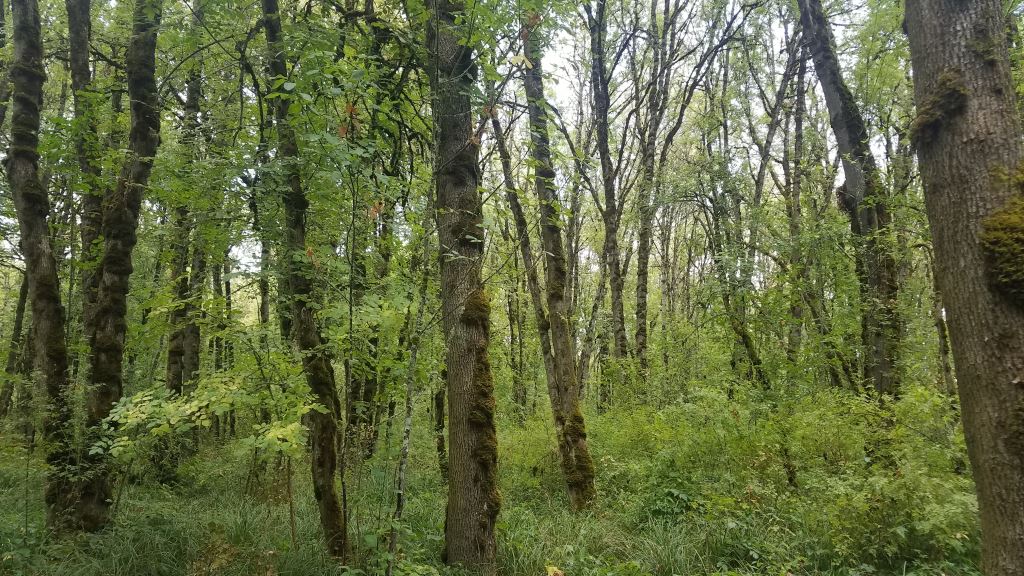
Salem also plans to inventory Oregon ash growing in the city’s natural areas so as to understand where they will need to plant other native species. I blogged earlier about the threat EAB and MOB pose to western Oregon’s wetlands and oak savannahs.
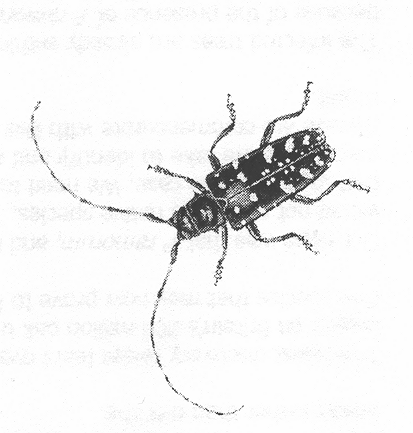
4) Ann Hajek of Cornell and colleagues haves published a review of 20 years of research on entomopathogens that might contribute to control efforts targetting the Asian longhorned beetle (ALB) (Anoplophora glabripennis). The authors call for renewed efforts to find appropriate control agents and techniques. They conclude that various pathogens – especially fungi – can support ALB eradication efforts. They would be particularly helpful if ALB populations spread – or a new outbreak is detected. (Remember, ALB has been detected in seven locations in North America – some the result of more than one introduction; and nine locations in Europe.)
The article is open access!! See
Ann E. Hajek, A.E., E.H. Clifton, and L.F. Solter. 2025. Entomopathogens for control of Asian longhorned beetles (Coleoptera: Cerambycidae). Environmental Entomology, XX(XX), 2025, 1–10 https://doi.org/10.1093/ee/nvaf016
Posted by Faith Campbell
We welcome comments that supplement or correct factual information, suggest new approaches, or promote thoughtful consideration. We post comments that disagree with us — but not those we judge to be not civil or inflammatory.
For a detailed discussion of the policies and practices that have allowed these pests to enter and spread – and that do not promote effective restoration strategies – review the Fading Forests report at http://treeimprovement.utk.edu/FadingForests.htm