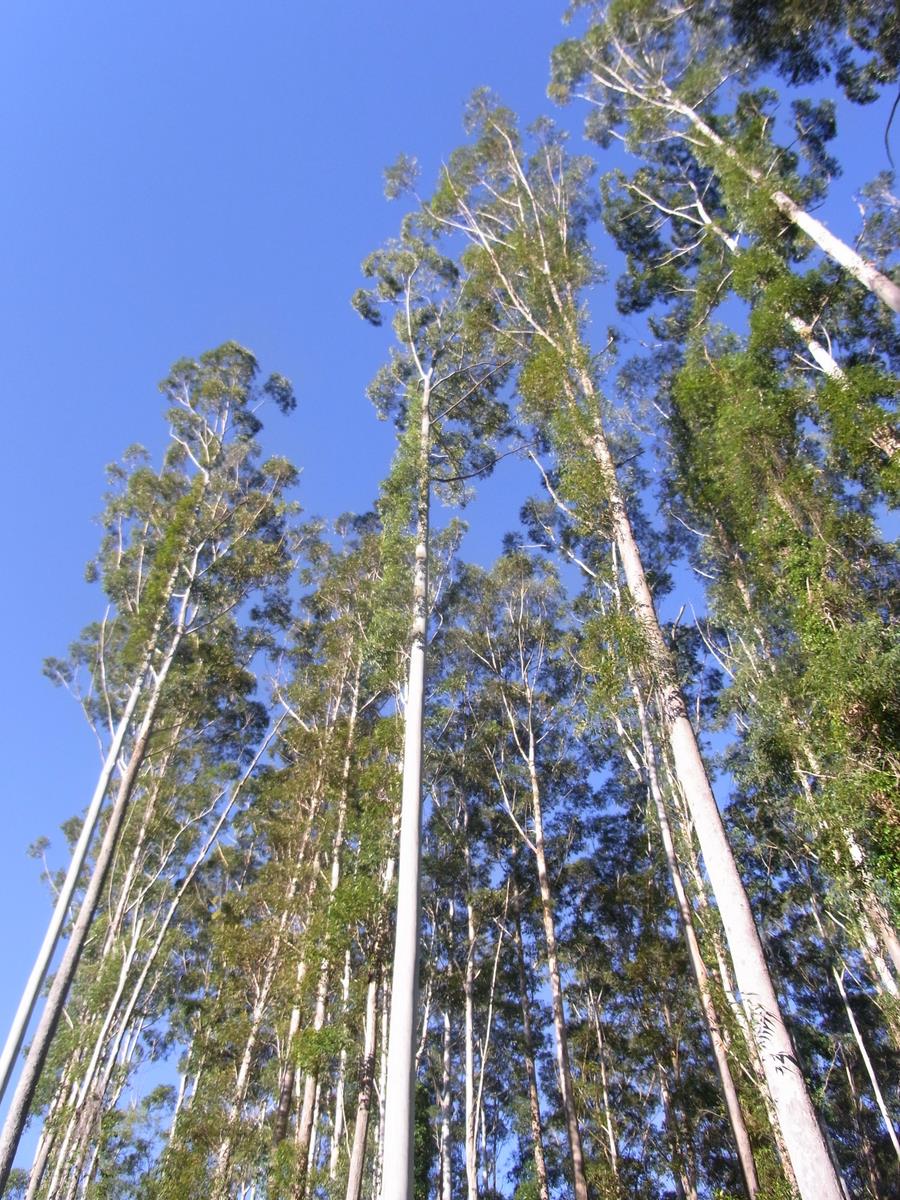
Deus et al. 2025 (full citation at the end of this blog) have published a review of current knowledge on the invasiveness of trees in the Eucalyptus genus. They report that eucalypt plantations cover more than 30 million ha globally; they could not determine the actual extent more precisely. The area is expanding at an estimated 4% per year. Eucalypts are so popular as timber trees because of their fast growth, ease of management, wood quality and environmental tolerance.
Until recently, trees in the Eucalyptus genus were thought to pose a low invasion risk. This was because these trees have limited seed dispersal, high juvenile mortality, and were expected to lack compatible ectomycorrhizal fungi in novel environments. However, several risk assessments and reports of ongoing invasions in some locations have raised questions. So Deus et al. undertook a literature survey to try to resolve the issue.
One of the risk assessments concerns the United States; see Gordon et al. (2012). This study – completed a dozen years before Deus et al. undertook their literature survey – cited several other sources documenting harmful invasiveness of nearly a dozen species, including Eucalyptus globulus, E. camaldulensis, E. grandis, and E. tereticornis.
Deus et al. found that the limitations listed above actually can be overcome, so they do not prevent invasions:
- seeds can disperse farther than 100 meters from parent plants;
- high recruitment densities can compensate for the high juvenile mortality; and
- ectomychorrhizal fungi can be found in the root systems of introduced eucalypt plants.
In fact, several Eucalyptus species meet criteria defining invasiveness in the Australian Weed Risk Assessment system. Still, Deus et al. found that existing studies cover too few plantations and species to allow an in-depth comprehensive understanding of eucalypts’ invasion ecology.
One reason that eucalypt trees’ invasiveness remains unresolved is that the countries which have established most large Eucalyptus plantations (Brazil, India and China) have not conducted many studies. Instead, most studies have been done in Iberia and South Africa, which together host less than six percent by area of the world’s estate of eucalypt plantations.
Deus et al. say that several possible reasons have been proposed to explain why Eucalyptus is considered to pose an invasion risk by scientists in Iberia and South Africa, but not in Brazil.
- The few studies in Brazil were conducted in intensively managed plantations with very short rotations, which are probably less prone to invasion than plantations managed at low intensity levels.
- The Brazilian plantations were established 40 to 50 years ago, whereas those in Iberia were introduced ~ 200 years ago.
- Iberia experiences recurrent forest fires.
- In Brazil, leaf eating ants attack the trees; this might reduce trees’ vigor.
- In Brazil, native forests dominate the environs.
Deus et al. say that these hypotheses have never been tested.
Since studies have been conducted in only a few countries, they have evaluated only a few of the species used in plantations. At least 372eucalypt species have been introduced outside their native range; nine species are planted widely. Yet most of the studies reviewed by Deus et al. covered just two species, Eucalyptus globulus (46% of the studies), and E. camaldulensis (33% of the studies). Still, these two widely cultivated species received the highest invasiveness ranking of all species reviewed (65 and 72, respectively). According to Deus et al., these scores are higher than the average score for 32 species of Acacia – a genus considered to be one of the most invasive tree genera in the world.
Other, potentially invasive species, have not received adequate attention. Deus et al. note that E. tereticornis, which is widely planted in China, India and other regions of Southern Asia, has an invasiveness score of 66, placing it second highest in the evaluation. However, only 12 of 140 articles analyzed by Deus et al. addressed this species.
These eucalypts’ high scores result from their potential to hybridize, to naturalize outside their natural habitat, and from high flammability. Other contributing factors are high seed production and ability to resprout after cutting or fire.
The analysis determined that the major drivers for Eucalyptus invasions are soil disturbance, availability of moisture (essential for seedling establishment), and fire. Recruitment density increases with harvesting and tree age; it decreases when the understory is managed. This partially explains why the abandonment of plantations might promote invasions by eucalypts.
Deus et al. fear that there might be a large “invasion debt” in the regions where few studies have been conducted. Assessments for California and Iberian Peninsula indicate that the best areas for cultivation – under either current conditions or expected new environments linked to climate change – are also those most prone to invasion. A further complication is that in some regions it might be difficult to distinguish plants escaping from small plantations from the plantations themselves. They suggest ways to overcome this difficulty: 1) surveys of recruitment along roadside, where trees would not have been planted; 2) genetic analysis of seedlings and possible parents
Another weakness is that that none of the studies considers changes in fire regime, which probably increases the areas prone to invasion.
Deus et al. think it is unlikely that eucalypt invasions will turn out to be as damaging as those of acacias or pines, but that further invasions involving more species and more regions are very likely.
Deus et al. call for considering eucalypt species’ potential invasiveness when developing strategies for the sustainable management of these plantations, including how to manage those that are no longer economically viable.
Status in the United States
The risk in the United States was evaluated by Gordon et al. in 2012. At the time, there were proposals to plant 5,000 to 10,000 ha/year in the Southeast over the next decade.
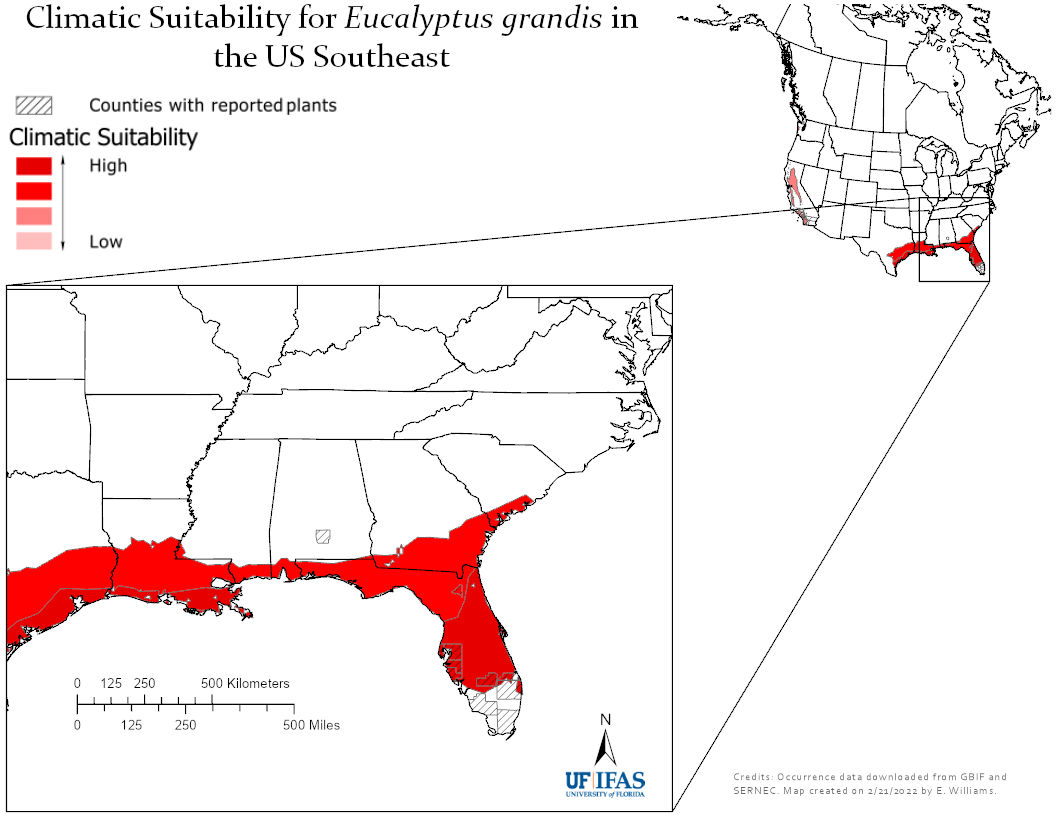
Gordon et al. adapted the Australian weed risk assessment system to evaluate 38 Eucalyptus taxa then being tested and cultivated in U.S. for pulp, biofuel, and other purposes. Their analysis concluded that 15 of these taxa posed a low risk; 14 taxa posed a high risk; and 9 taxa could not be ranked without further information. The four taxa cultivated most extensively – E. globulus, E. camaldulensis, E. grandis, and E. tereticornis – all had high risk outcomes, as did several other taxa. Gordon et al. thought that these differences reflected both new data and differences in how the assessors reacted to insufficient data.
Gordon et al. warned that novel genotypes with unknown invasiveness were being propagated in the search for increased cold tolerance. This meant that the taxa they had assessed might not indicate of the actual long-term invasion risks associated from this genus. A major source of uncertainty is the long lag time in appearance of evidence of a tree species’ invasiveness. Only one study (as of 2012) had quantified lag time for introduced tree species; it found an average of 170 years from the time introduction to identification of the taxon as invasive. Propagule pressure also influences the lag time and the probability of invasion.
Since the bulk of expanded cultivation was expected to be in the southeast, Gordon et al. recommended that a regional assessment be conducted to more precisely specify the effects of possible differences in phenology, age at reproductive maturity, seed viability, and cold tolerance.
Gordon et al. suggested several actions to reduce the invasion risk. First, selection and breeding strategies could aim to minimize relevant traits – especially eliminating seed production. Second, plantations could be so managed by avoiding cultivation near waterways, harvesting stems before seeds can mature, and restricting the extent of cultivation of any one taxon. More broadly, a fund could be established to cover control costs; growers would contribute the money.
What has happened in the dozen years since the analysis was published? My Google search led to publications from 2013 and earlier. I hope this indicates that no one has funded major expansions. Dr. Gordon reports that most Eucalyptus pulp is imported. ArborGen continues to breed Eucalyptus in Brazil – as I noted earlier, scientists there are not pursuing studies of possible invasiveness of eucalypts.
Still, the regional risk assessment has not been conducted. Worse, Dr. Gordon reports that the Florida Department of Agriculture and Consumer Services has exempted several species [E. amplifolia, E. benthamii, E. dorrigoensis, E. dunnii, E. grandis, E. gunni, E. nitens, E. smithii, and E. urograndis (E. grandis E. urophylla)] from a requirement that growers obtain Non-Native Species Planting Permits. So if the market does take off, there will be no regulation by the state.
At the end of December 2025, Dr. Gordon received information from Florida Division of Plant Industry that no one has applied for a permit to grow Eucalyptus in the state other than under USDA research auspices. So my worst fears have not (yet) come to pass.
I note that in 2022, Potter, Riitters, & Guo ranked Eucalyptus grandis & E. globulus as potentially highly invasive. Their criterion was that at least 75% of stems detected by USFS Forest Inventory and Analysis (FIA) surveys were saplings or seedlings.
SOURCES
Deus, E., D.M. Richardson, F.X. Catry, F.C. Rego, J. Gaspar, M. Nereu, M. Larcombe, B. Potts, J.S. Silva. 2025. Invasion ecology of eucalypts: a review. Biol. Invasions (2025) 27:239 https://doi.org/10/1007/s10530-025-03695-1
Gordon, D.R.,S.L. Flory,.L. Cooper, and S.K. Morris. 2012. Assessing the Invasion Risk of Eucalyptus in the United States Using the Australian Weed Risk Assessment. International Journal of Forestry Research Volume 2012, Article ID 203768, 7 pages doi:10.1155/2012/203768
Potter K.M., Riitters, K.H. & Guo, Q. 2022. NIS tree regeneration indicates regional & national risks from current invasions. Frontiers in Forests & Global Change
doi: 10.3389/ffgc.2022.966407
Posted by Faith Campbell
We welcome comments that supplement or correct factual information, suggest new approaches, or promote thoughtful consideration. We post comments that disagree with us — but not those we judge to be not civil or inflammatory.
For a detailed discussion of the policies and practices that have allowed these pests to enter and spread – and that do not promote effective restoration strategies – review the Fading Forests report at http://treeimprovement.utk.edu/FadingForests.htm
Or