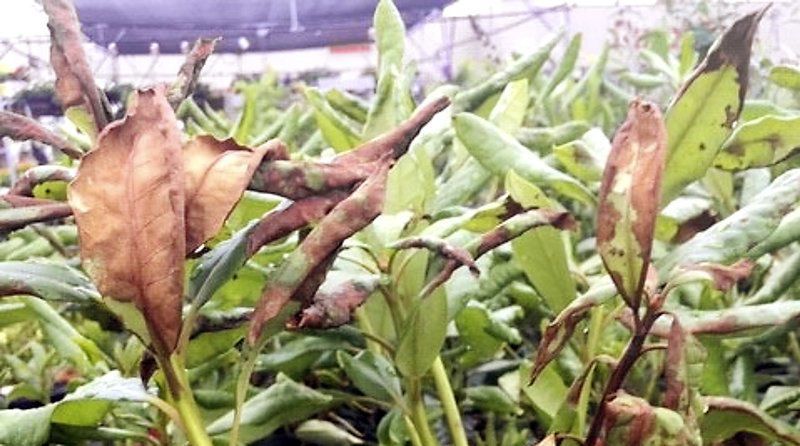
symptomatic feeding by EZM larva; photo by Gyorgy Csoka via Bugwood
The elm zigzag sawfly (EZM; Aproceros leucopoda) was reported in the Western Hemisphere for the first time in Quebec in July 2020.
In 2021, only a year later, the sawfly was confirmed in northern Virginia [David Gianino, State Plant Regulatory Official (SPRO) of Virginia, pers. comm.]
There is 700 miles between Quebec and Virginia.
In September 2022, the sawfly was detected in St. Lawrence County, New York — just across the St. Lawrence River from Canada, where the insect has been known for two years. There is no information yet on impacts. [Brynda, S. “New pest affecting elm trees in St. Lawrence County.” October 3, 2022.
Impact in Europe
Elm zigzag sawfly is native to Eastern Asia — Japan and China for certain and, possibly Far Eastern Russia. There it is considered a minor pest. Serious localized defoliation, though, has been reported at least once, on the island of Hokkaido (Blank et al. 2021).
The sawfly was first detected outside its native range in Hungary and Poland in 2003. By 2010, the outbreak was revealed to be present over an area of 1,700 km, from eastern Ukraine to Austria. Other countries reporting the sawfly were Hungary, Poland, Romania, and Slovakia (Blank et al. 2010). Spread continued. By 2013 or 2014 elm zigzag sawfly was also reported in Belgium, Netherlands, and Germany — apparently the result of separate instances of human-assisted transport. German scientists calculated a natural spread rate of 45–90 km/yr. By 2018 the insect had reached the United Kingdom.
Severe localized defoliation by the species has been recorded on elms in a variety of situations across Europe. In some countries, defoliation has reached 74% or higher, even 100%. However, in other countries, such as Bulgaria, defoliation rates appear to be much lower (1-2%). Aproceros leucopoda showed no preference for host trees of a particular age. Heavily defoliated trees in Hungary did not seem to be dying (Blank et al. 2010).
The fear – in Europe and North America – is that elms already severely depleted by Dutch elm disease will be unable to sustain any decline in vigor caused by defoliation (Blank et al. 2010)
Probable Hosts
On the European continent, the sawfly has fed on several elms, including Ulmus minor, U. pumila and U. pumila var. arborea,U. glabra, and possibly. U. laevis (Blank et al. 2010). In the United Kingdom, it has fed on English elm (Ulmus procera), wych elm (U. glabra) and field elm (U. minor).
In Japan, collaborators in the Blank et al. (2010) study collected sawfly larvae on U. japonica and U. pumila.
In Virginia, larvae were collected from Chinese elm (U. parvifola). However, all species of elm trees native to North America are considered at risk. Also threatened are the native elm-browsing insects which might be out-competed by elm zigzag sawfly.
How the Sawfly Is Moved
Some have suggested that the EZS is transported on plants for planting, but they have not reported observations. Because elms are usually moved while dormant, it is more likely that the cryptic wintering cocoons are transported in leaf litter accompanying the trees rather than on the trees themselves.
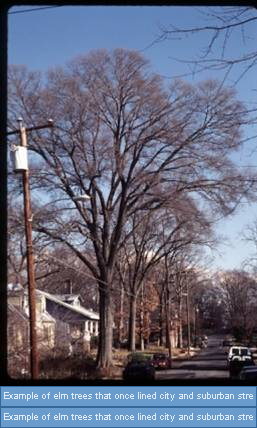
American elms in Arlington County, Va; photo by F.T. Campbell
Worrying Traits
The elm zigzag sawfly matures very rapidly. The total time from oviposition to emergence of mature individuals is 24–29 days (Blank et al. 2010). They can produce up to six or seven generations per year. The sawfly is also parthenogenic, so it can reproduce in the absence of males. As a result, populations can build up rapidly. No specific predators are known. The impact of generalist native parasitoids in Europe has not yet been studied.
Also, EZS tolerates a wide range of climates. Conditions on Hokkaido are similar to those in Central Europe. However, Hokkaido’s winters are usually colder, summers warmer, and annual precipitation higher. Blank et al. (2010) did not know limiting temperature and humidity but thought it probable that this species could spread into northern and south-western Europe wherever elms grow. In North America, the Canadian Food Inspection Agency expressed concern that EZS would be able to withstand temperatures as low as –30 °C which includes much of Canada.
While the elm zigzag sawfly was on the Alert List on the European and Mediterranean Plant Protection Organization (EPPO), in 2015 it was removed since no EPPO member country had requested international action (Blank et al. 2010).
SOURCES
Blank, S.M., H. Hara, J. Mikulas, G. Csoka, C. Ciornei, R. constantineanu, I. Constantineanu, L. Roller, E. Altemhofer, T. Huflejt, G. Vetek. 2010. Aproceros leucopoda (Hymenoptera: Argidae): An East Asian pest of elms (Ulmus spp.) invading Europe. European Journal of Entomology · March 2010
DOI: 10.14411/eje.2010.045
Blank, S.M., T. Köhler, T. Pfannenstill, N. Neuenfeldt, B. Zimmer, E. Jansen, A. Taeger, A.D. Liston. Zig-zagging across Central Europe: recent range extension, dispersal speed and larval hosts of Aproceros leucopoda (Hymenoptera, Argidae) in Germany. https://jhr.pensoft.net/articles.php?id=4395
We welcome comments that supplement or correct factual information, suggest new approaches, or promote thoughtful consideration. We post comments that disagree with us — but not those we judge to be not civil or inflammatory.
For a detailed discussion of the policies and practices that have allowed these pests to enter and spread – and that do not promote effective restoration strategies – review the Fading Forests report at http://treeimprovement.utk.edu/FadingForests.htm
Joro spider; photo by Dorothy Kozlowski, University of Georgia
Lately there has been lots of media attention to an introduced spider which has attracted attention because it is large and showy – and very numerous in 2021. The Joro spider, (Trichonephila (formerly Nephila) clavata) is — like so many introduced organisms — from East Asia (Japan, China, Korea, and Taiwan) (Hoebeke, Huffmaster and Freeman 2015; full citation at the end of the blog).
The spider was originally found in 2013 at several locations in three counties of northeast Georgia. All were near warehouses and other facilities associated with Interstate-85, a major transport corridor (Hoebeke, Huffmaster and Freeman 2015).
The Joro spider is one of about 60 species of non-indigenous spiders (Araneae) that have been detected in North America. The majority originated in Europe and Asia (species list posted here; see Araneae).
The Joro spider is one of the golden orb-web spiders, a group with conspicuously large and colorful females that weave exceptionally large, impressive webs. One species of the genus, N. clavipes (L.), occurs in the Western Hemisphere. It is found throughout Florida, the West Indies, as far north as North Carolina, across the Gulf States, through Central America, and into South America as far south as Argentina. It is also known as the “banana spider” or “golden silk spider.” (Hoebeke, Huffmaster and Freeman 2015)
Hoebeke, Huffmaster and Freeman (2015) describe both the spider’s discovery in Georgia (by Huffmaster) and how to distinguish it from other large spiders in the southeastern U.S. South Carolina has posted a fact sheet here.
In Asia and northeast Georgia, the spider apparently overwinters as eggs. Spiderlings emerge from the egg cocoons in the spring. Males reach maturity by late August. Females become sexually mature in September and early October. Oviposition occurs from mid-October to November resulting in the production of only a single egg sac. Large, mature females were first observed beginning in late September and persisted until mid-November when temperatures began to cool significantly. Most spiders were found in large webs attached to the exterior of homes near porch lights, on wooden decks, or among shrubs and flowering bushes near homes (Hoebeke, Huffmaster and Freeman 2015). By 2021 the webs were so numerous as to be consider major nuisances.
Probable Introduction Pathways
Hoebeke, Huffmaster and Freeman (2015) think the spiders are frequently transported (as adults or egg masses) in cargo containers, on plant nursery stock, and on crates and pallets. If accidental transport were to occur in late August to early October from East Asia, then the spiders’ reproduction would be at its height and there would be a greater likelihood that egg masses might be deposited on structures or plant material being exported.
This thought is supported by an email sent to Hoebeke in 2016 that a Joro spider had been seen on the outside of a freight container in Tacoma, Washington. There has been no report of additional sightings in Washington State (Hoebeke pers. comm.)
Spread within the United States
By 2021, the Joro spider had been detected in at least 30 counties in north and central Georgia, adjacent South Carolina; Hamilton and Bradley counties in Tennessee; and Rutherford and Jackson counties in North Carolina (Hoebeke pers. comm.). See the map here.
Spread in the United States is probably associated with major transport routes. The original detections were 64 km northeast of Atlanta near a thriving business location on the I-85 business corridor,
It is also possible that spiderlings balloon, that is, ride air currents to move some distance. This distance can be miles, depends on the spider’s mass and posture, air currents, and on the drag of the silk parachute (Hoebeke, Huffmaster and Freeman 2015). The 2014 Madison County detection in northeast Georgia was not near transport corridors but in a rural mixed farm landscape, downwind from the other sites. Males also use ballooning to find females for mating (Gavriles 2020).
How might the Joro spider affect the local ecosystem?
Many questions exist about the Joro spiders’ impact. Will they outcompete other orb weaving spiders – either native or nonnative? Will they reduce other insect populations through predation? Scientists do not yet see indication of displacement of native spiders or depletion of prey species (Gavriles 2020; Hoebeke pers. comm.)
Potential Range – update
In March 2022, two University of Georgia scientists (Andy Davis and Benjamin Frick) published a study that evaluated the Joro spider’s cold tolerance by studying the spider’s physiology and survival during a brief (2 minute) freeze. They found that the Joro spider’s more rapid metabolic and heart rates means it could probably survive throughout most of the Eastern Seaboard. The scientists reiterate earlier information that the Joro spider does not appear to have much of an effect on local food webs or ecosystems.
Hoebeke, E. Richard. University of Georgia Department of Entomology
Hoebeke, E.R., W. Huffmaster, and B.J. Freeman. 2015 Nephila clavata L. Koch, the Joro Spider of East Asia, newly recorded from North America (Araneae: Nephilidae) PeerJ https://peerj.com/articles/763/#
Posted by Faith Campbell
We welcome comments that supplement or correct factual information, suggest new approaches, or promote thoughtful consideration. We post comments that disagree with us — but not those we judge to be not civil or inflammatory.
For a detailed discussion of the policies and practices that have allowed these pests to enter and spread – and that do not promote effective restoration strategies – review the Fading Forests report at http://treeimprovement.utk.edu/FadingForests.htm
Asian giant hornet; photo by Yasunori Koide; Wikimedia commons
They’re still here … and perhaps more widespread than thought last year.What officials have learned is that colonies are often high up in trees, not in the ground, as expected based on behavior in Asia. This makes detection and control especially difficult.
In June a citizen found a dead Asian giant hornet (AGH) male in Snohomish County. This county in the Seattle metropolitan area is separated from Whatcom County (site of last year’s detections) by a third county, Skagit County. The Washington State Department of Agriculture (WSDA) responded by setting up traps in Snohomish and King counties, and urging citizens to be alert and report any hornet sightings.
Equally worrying, the dead wasp was determined by appearance and genetics to be unrelated to the colonies detected in 2019 and 2020 in Washington and British Columbia. Trapping in the areas found no additional specimens (S. Spichiger pers. comm.)
In July, WSDA designated the hornet genus Vespa as a quarantine pest; this action confirms WSDA authority to control access to nest sites.
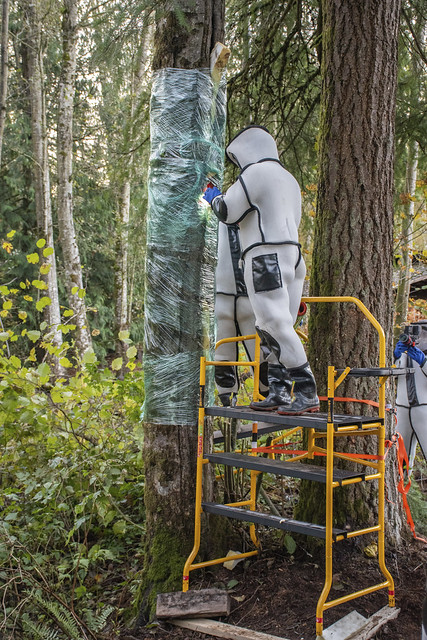
nest eradication; WSDA photo
Nests Found and Destroyed
Starting in late summer, citizens began reporting sightings and officials succeeded in tracking hornets to their nests. However, it was not easy! Eradicating Asian giant hornets demands lots of resources and commitment. While all these nests were in Whatcom County – site of last year’s detections — it is clear that several colonies had been established. It seems to me highly unlikely that they have all been detected.
Detection of the first nest in 2021 came in August, following several visual detections of the hornets attacking nests of paper wasps. WSDA staff captured and tagged three hornets over a couple of days. They succeeded in tracking the third hornet when it reappeared a week later. The nest was destroyed (after removal of all hornets) on August 25th. This nest held nine layers of comb with 292 eggs, 422 larvae, and 563 prepuae. Nearly 200 adult hornets were killed. One queen was found. [Hornet Herald 21.07 Sept. 8 2021] The nest was at the base of a dead alder tree in rural Whatcom County, east of Blaine, just 400 metres south of the Canadian border.
The second and third nests were detected on September 8 and 10, 2021. In these cases, tagging and tracking the hornets was easier than in August. Nest eradication was not easy, however. Both nests were high inside dead alder trees, making access difficult. Both nests held multiple combs with hundreds of larvae, eggs, and pupae. Fortunately, only one queen was found in each. [Hornet Herald 21.08; October 5, 2021]
No detections have occurred since these.
WSDA also collected data on foraging behaviors of wasps in the third nest. Data include information on periods during the day when the wasps are active, and what materials they bring back to the nest – which includes wood pulp for nest comb construction and insect thoraces for feeding the pupae. [Hornet Herald 21.08; October 5, 2021]
It is encouraging that only one queen was found in each nest; in 2020, the single nest officials destroyed held 200 queens!
Trapping in British Columbia
Although British Columbia officials increased the number of traps in 2021, and urged citizens to also set out traps, no confirmed AGH finds were made in British Columbia until early November, when one was caught in a trap set for Japanese beetles. This hornet was on the border with Washington, so officials are trying to determine whether it came from one of the nests already discovered there.
There were a couple of unconfirmed sightings. On October 22 a single, aged specimen was found in a Japanese beetle trap about 1.2 km north of the first hornet nest extracted this year in Washington. The beetle trap had been serviced one month earlier. Canadian government entomologists are analyzing the DNA of this specimen to see if it was related to the Washington State nests.
At least one citizen said he had seen an Asian giant hornet in July, but officials said they could not investigate until they had either a picture or a specimen.
Asian giant hornet with radio tag developed by USDA APHIS scientists
Intriguing wrinkle
Mattila et al. (2021) describe an “impressive array of strategies” Asian honey bees use to protect nests from attacks by hornets in the genus Vespa, including a previously unknown use of auditory and perhaps chemical signals to warn nest mates. The authors suggest that this diverse alarm repertoire is similar to alarms issued by socially complex vertebrates such as primates and birds.
Giant hornet (Vespa soror) attacks trigger frenetic antipredator signalling in honeybee (Apis cerana) colonies. R. Soc. Open Sci. 8: 211215. https://doi.org/10.1098/rsos.211215
Posted by Faith Campbell
We welcome comments that supplement or correct factual information, suggest new approaches, or promote thoughtful consideration. We post comments that disagree with us — but not those we judge to be not civil or inflammatory.
For a detailed discussion of the policies and practices that have allowed tree-killing pests to enter and spread – and that do not promote effective restoration strategies – review the Fading Forests report at http://treeimprovement.utk.edu/FadingForests.htm
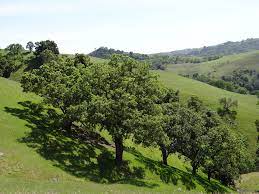
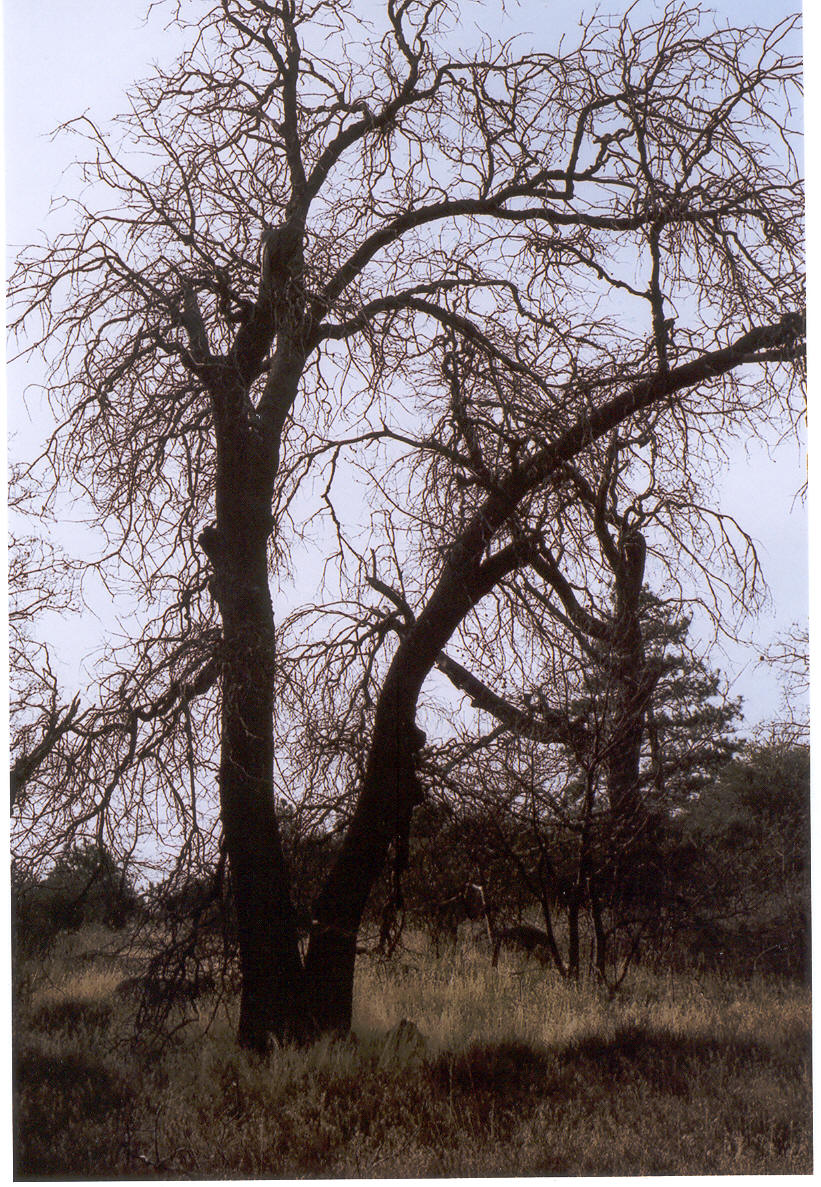
Quercus lobata in Alameda County, California; photo by Belinda Lo via Flickr
Five years ago I posted a blog about the threat to oak trees from non-native insects and pathogens. I am prompted to update what I said then by the publication of a monumental new analysis of endangered oak species (Beckman et al. 2021; full citation at end of blog). This report is packed with maps and graphics displaying centers of endemism, geographic areas with highest threat levels, etc., and individual profiles of all species it deems at risk.
The new study, led by the Morton Arboretum, says there are more than 200 oak species in North America – including Mexico; but only 91 species native to the United States. Of these, 28 species qualify as “of conservation concern” – defined as facing a moderate or greater threat. The principal threats to oak species are small populations or ranges and conversion of habitats for human use. Overall, 10 (36%) of the oak species “of conservation concern” have some actual or potential exposure to established non-native pests.
The report states that two species are significantly threatened by a non-native pathogen: Shreve oak (Quercus parvula) by the sudden oak death pathogen Phytophthora ramorum and Ogelthorp oak (Q. ogelthorpensis) by the chestnut blight pathogen Cryphonectria parasitica.
Several other California oaks are under some level of attack by the polyphagous and Kuroshio shot hole borers. The goldspotted oak borer (GSOB) is mentioned only in the individual species’ profiles, and largely as a potential or undetermined threat. For example, Engelmann oak (Quercus engelmannii) is reported to have suffered some damage from GSOB but that mortality is “likely a result of a complex of factors (e.g., drought and root diseases).” The potential threat from both SOD and oak wilt is mentioned for several of the oaks that are in the red oak subgenus (Erythrobalanus).
The Morton Arboretum’s determination is based on the fact that the non-native insects and pathogens that I described five years ago are attacking primarily widespread species and have not – to date – caused sufficient damage to imperil those species. This situation contrasts sharply with certain Lauraceae (e.g., redbay) threatened by laurel wilt disease; five-needle pines killed by white pine blister rust; eastern or Canadian hemlock killed by hemlock woolly adelgid; and American beech, which now faces threats from beech bark disease, beech leaf disease, and possibly European beech leaf weevil.
Meanwhile, the non-native pests of oaks that I described five years ago continue to spread.
My Update Incorporating Morton Arboretum’s Analysis: Threats in the East
In the East (from the Atlantic Ocean to the Great Plains), oaks are under serious attack from two non-native pests; a third pest has been suppressed by biological control.
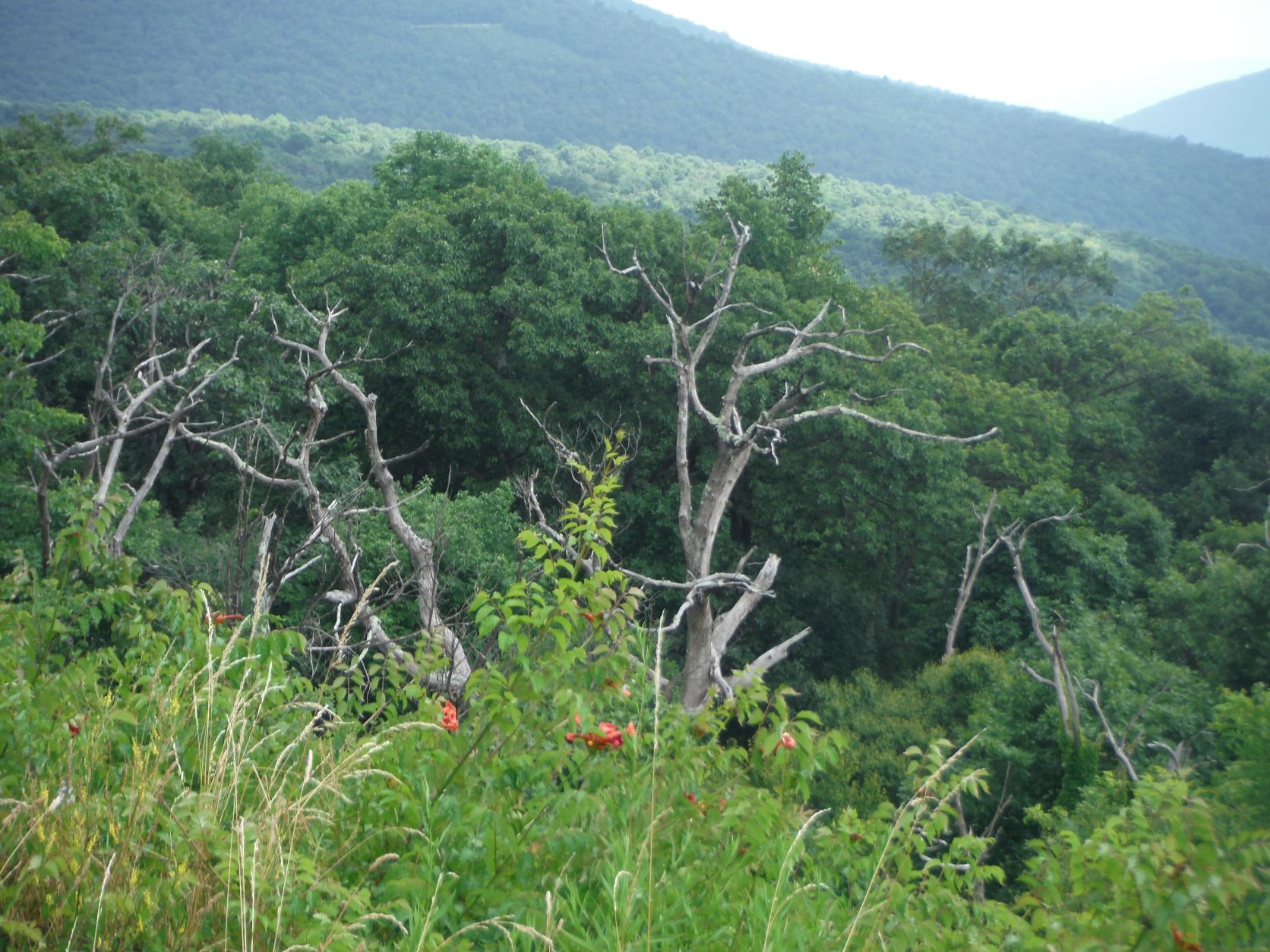
oaks killed by European gypsy moth, Shenandoah National Park; photo by F.T. Campbell
The European gypsy moth (Lymantria dispar). The APHIS quarantine map shows its spread to be largely contained. The moth is currently present throughout the Northeast as far west as Wisconsin and neighboring parts of Minnesota and Illinois; and as far south as Currituck and Dare counties in North Carolina. The European gypsy moth continues to be the target of major containment and suppression programs operated by USDA Animal and Plant Health Inspection Service (APHIS), the US Forest Service and the states. For years US Forest Service spent half of its entire budget for studying and managing non-native pests on the European gypsy moth. By FY2021, this allocation had been reduced to a quarter of the total budget. The European gypsy moth is the most widespread non-native pest (see map, linked to above) and attacks a wide range of tree and shrub species. Still, it rarely causes death of the trees.
Oak wilt (caused by the fungus Ceratocystis fagacearum) is widespread from central Pennsylvania to eastern Minnesota and across Iowa, down the Appalachians in West Virginia and North Carolina-Tennessee border, in northern Arkansas and with large areas affected in central Texas. There are several outbreaks in New York State. The most recent map I can find is from 2016 so it is difficult to assess more recent status. In that year, the US Forest Service called oak wilt one of the most serious tree diseases in the eastern U.S. It attacks primarily red oaks and live oaks. It is spread by both bark-boring beetles and root grafts.
In 2016 I also listed the winter moth (Operophtera brumata) as a threat. Now, its presence in coastal areas of New England and Nova Scotia (and British Columbia) has been reduced to almost nuisance levels by action of the biological control agent Cyzenis albicans. (See this report.)
SOD-infested rhododendron plant; photo by Indiana Department of Natural Resources
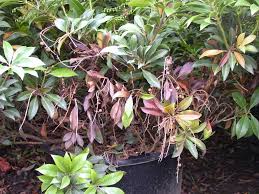
The most significant potential threat to eastern oaks identified to date is the sudden oak death (SOD) pathogen, Phytophthora ramorum. Several oak species have been shown in laboratory studies to be vulnerable to infection by this pathogen. Furthermore, the climate in extensive parts of the East is considered conducive to supporting the disease. SOD has not been established in the East. However, too frequently SOD-infected plants have been shipped to eastern nurseries, where some are sold to homeowners before regulatory officials learn about the situation and act to destroy the plants.
My Update Incorporating Morton Arboretum’s Analysis: Threats in the West
In the West, millions of oaks have been killed by several pathogens and insects that are established and spreading. Another has been introduced since my earlier blog (see Mediterranean oak beetle, below). Additional threats loom, especially Asian species of tussock moths.
Coast live oaks, canyon live oaks, California black oaks, Shreve’s oaks, and tanoaks growing in coastal forests from Monterey County north to southern Oregon that catch fog/rain are being killed by sudden oak death (SOD). In this region, SOD has killed an estimated 50 million trees. While the preponderance of dead trees are not true oaks, but tanoaks (Notholithocarpus densiflorus), significant numbers of coast live oak (Quercus agrifolia), Shreve oak (Q. parvula var. shrevei), and California black oaks (Q. kelloggii) have also been killed. SOD continues to intensify in this region, and to expand. Sixteen California counties are now infected, and the infection in Curry County, Oregon has spread farther North. More worrying, two additional strains of the pathogen have been detected in forests of the region.
The Morton Arboretum analysis singled out Q. parvula as particularly threatened by SOD. Californians note that it is the subspecies Q. parvula var. shrevei that is threatened by SOD; the other subspecies, Q. parvula var. parvula (Santa Cruz Island oak) is – so far – outside the area infested by SOD.
California black oak killed by GSOB; photo by F.T. Campbell
Also in California, coast live oaks, black oaks, and canyon oaks in the southern part of the state are being killed by goldspotted oak borer. Confirmed infestations are now in San Diego, Orange, Riverside, San Bernardino, and Los Angeles counties. See the map here. At least 100,000 black oaks have been killed in less than 20 years. Neither the State of California nor USDA APHIS has adopted regulations aimed at preventing spread of the goldspotted oak borer.
The Morton Arboretum analysis considers California black oak (Q. kellogii) to be secure.
Two more wood-boring beetles threaten oaks in southern California – the Polyphagous and Kuroshio shot hole borers. One or both of the invasive shot hole borers are known to be present in San Diego, Orange, Los Angeles, Riverside, San Bernardino, Ventura, and Santa Barbara counties. The beetles feed on coast live oaks, canyon live oaks, Engelmann oaks, and valley oaks – as well as many other kinds of trees. In the process, the beetles transmit a fungus that kills the tree. Many of the vulnerable tree species anchor the region’s riparian areas and urban plantings. See a map of the shot hole borers’ distribution here.
In November 2019, scientists discovered a new ambrosia beetle in symptomatic valley oaks (Quercus lobata) trees in Calistoga, Napa County. The insect was determined to be a European species, Xyleborus monographus. The common name is Mediterranean oak borer, or MOB. Within a few months it was known that this beetle is fairly widespread in Napa and neighboring Lake counties. The beetle had never been intercepted at ports in California or found in traps designed to detect bark beetles deployed in the San Francisco Bay area but not including Napa or Sonoma. Like other beetles in the Scolytinae subfamily, MOB can transmit fungi. One of the fungal species detected in the Calistoga infestation is Raffaelea montetyi, which is reported to be pathogenic on at least one European oak species.
The California Department of Food and Agriculture proposed assigning a pest rank to the beetle in December 2020. In their draft document ranking risk, state officials note that a proven host — Q. lobata — is widespread in California and the insect is probably capable of establishing over much of the state. The possible economic impact was described as possibly affecting production of oaks in California nurseries and triggering quarantines.
Therefore, X. monographus could exacerbate the effects of SOD on California oaks.
The Morton Arboretum has singled out Q. lobata as at risk because of conversion of more than 90% of its habitat to agriculture.
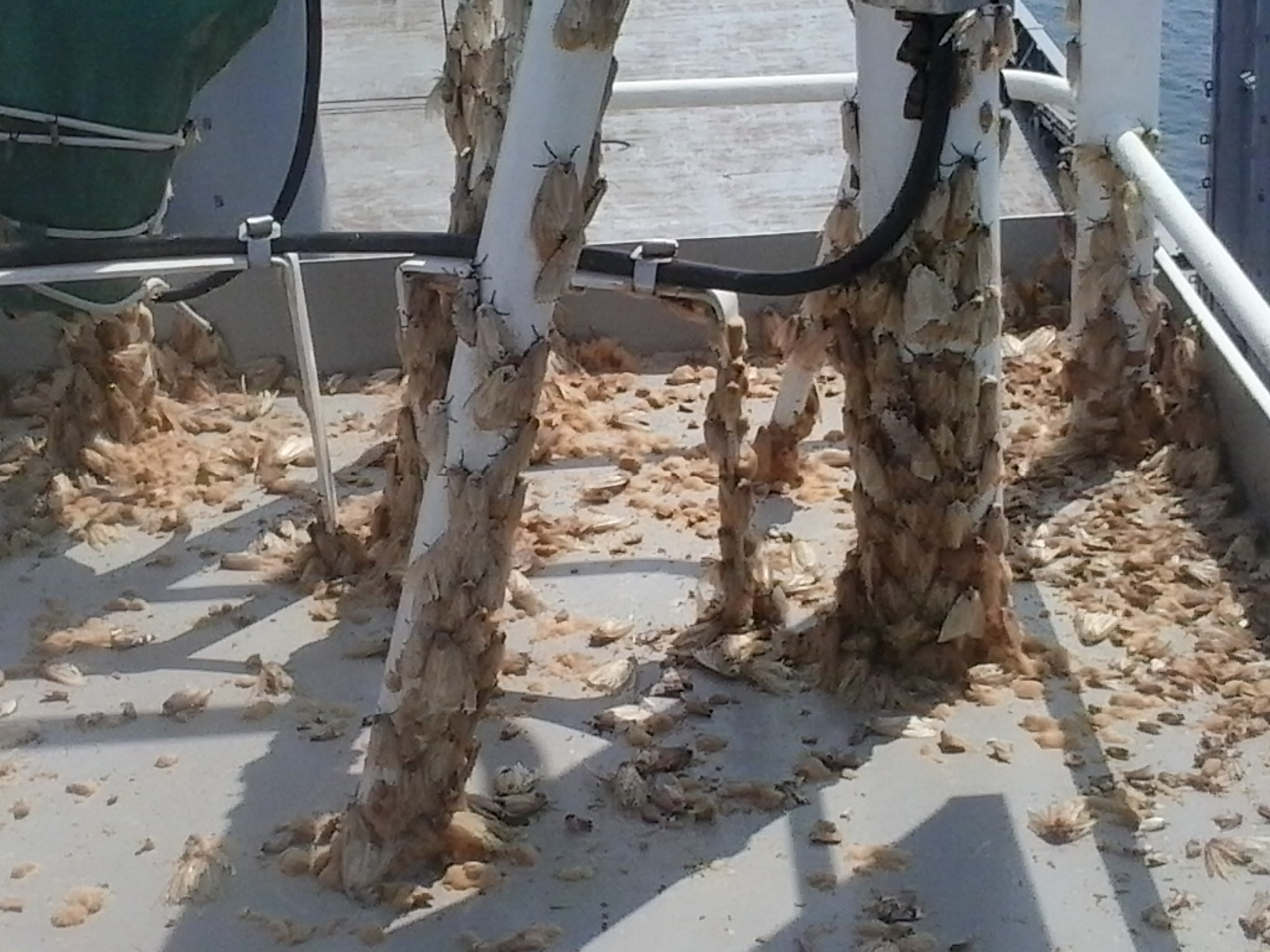
Asian gypsy moths swarm a ship in Nakhodka, Russian Far East; USDA APHIS photo
A looming potential threat to oaks on the West coast is the risk that tussock (gypsy) moths could be introduced to the area. The risk is two-fold – the Asian gypsy moth continually is carried to the area on ships bearing imports from Asia (as discussed in my blog in April). The European gypsy moth is sometimes taken across the country from its widespread introduced range in the East on travellers’ vehicles, outdoor furniture, or firewood. Both the West Coast states and USDA search vigilantly for any signs of gypsy moth arrival.
We welcome comments that supplement or correct factual information, suggest new approaches, or promote thoughtful consideration. We post comments that disagree with us — but not those we judge to be not civil or inflammatory.
For a detailed discussion of the policies and practices that have allowed these pests to enter and spread – and that do not promote effective restoration strategies – review the Fading Forests report at http://treeimprovement.utk.edu/FadingForests.htm
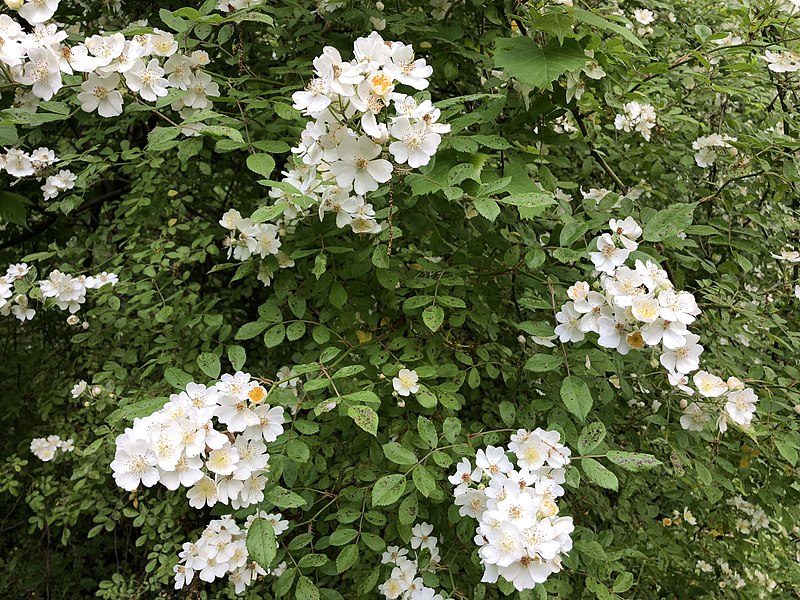
It’s everywhere! multiflora rose (photo by Famartin)
The United States is overrun with introduced plants. Five years ago, Rod Randall’s database listed more than 9,700 non-native plant species as naturalized in the U.S. Not all of these species were “invasive”.
At that time, regional invasive plant groups listed the following numbers of invasive species in their regions:
Southeast Exotic Plant Pest Council – approximately 400 invasive plants
Mid-Atlantic Invasive Plants Council – 285 invasive plants
Midwest Invasive Plants Network reported that state agencies or state-level invasive plant councils in its region listed more than 270 plant species as invasive, noxious, or pest species
California Invasive Plants Council listed 208 species.
Texas Invasives reported more than 800 non-native plant species in the state, of which 20 were considered invasive.
Species – Rankings and Extents
We know that these invaders are affecting wide swaths of many ecosystems. A recent study based on Forest Inventory and Analysis (FIA) data (explained here) showed that nation-wide, 39% of forested plotssampled contained at least one invasive species. Hawai`i was first, at 70%. Eastern forests were second, at 46%. In the West overall, 11% of plots contained at least one invasive species. Plots in both Alaska and the Intermountain states were at 6% of plots invaded. A different study (Barrett and Robertson 2021; full citation at end of blog) reported the proportion of Western forest covered by invasive plants. This approach resulted in different numbers, but the same general ranking: Hawai`i again “led” at 46%; Pacific Coast states at 3.3%; Rocky Mountain states at 0.75%; coastal Alaska at 0.01%.
In more arid regions, data from the Bureau of Land Management showed that invaded acreage had more than doubled between 2009 and 2015.
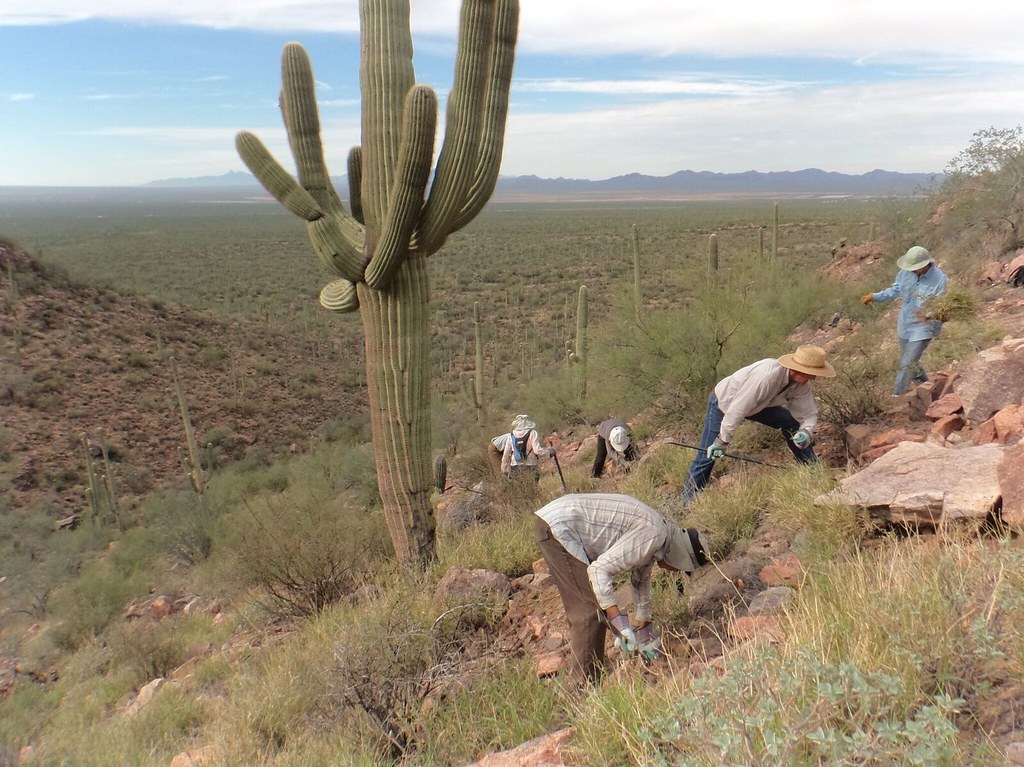
buffelgrass removal in Tucson; Photo by Julia Rowe, Arizona Sonora Desert Museum
The situation is expected to get worse: a study of just one small portion of U.S. naturalized plants found that non-native plant species were more widely distributed than native species and that the average invasive plant inhabited only about 50% of its expected range. Furthermore, human actions were more important in facilitating spread than the species’ biological attributes.
Most of the detailed studies have been conducted in the Northeast – by both Forest Service and National Park Service scientists. The USFS’ Northern Region (Region 9) contains 24 states, from Maine to Minnesota, from Delaware to Missouri. A review of forest inventory (FIA) data (Oswaltet al. 2015) provided details on 50 plant species. (Unfortunately, the Southern Region [Region 8] has chosen to report in different formats, so it is hard to get an overall picture of invasive plants throughout the forests of the entire East. This is especially annoying to those of us who live in Mid-Atlantic states, which are divided between the two regions.)
Oswalt et al. (2015) provided data on the percentage of FIA plots in each state that were reported to have at least one invasive plant species. The northern Midwest ranked highest – e.g., one state (Ohio) at 93%; one state (Iowa) at 81%; two states (Indiana and Illinois) above 70%. Parts of the Mid-Atlantic region were almost as invaded – West Virginia at 79% and Maryland at 65%. The Northern plains states ranked lowest in invasions – North Dakota at 29% and South Dakota at 15%.
A study by the National Park Service of part of the Northeast (from Virginia and West Virginia to Maine) found a situation similar to that found by USFS researchers. In 35 of 39 park units, more than half of the plots had at least one invasive plant species when the 2015-2018 survey began. In 10 parks (a quarter of those surveyed), every plot had at least one. Invasions are worsening: 80% of the park units showed there was a significant increase in at least one trend measuring abundance.
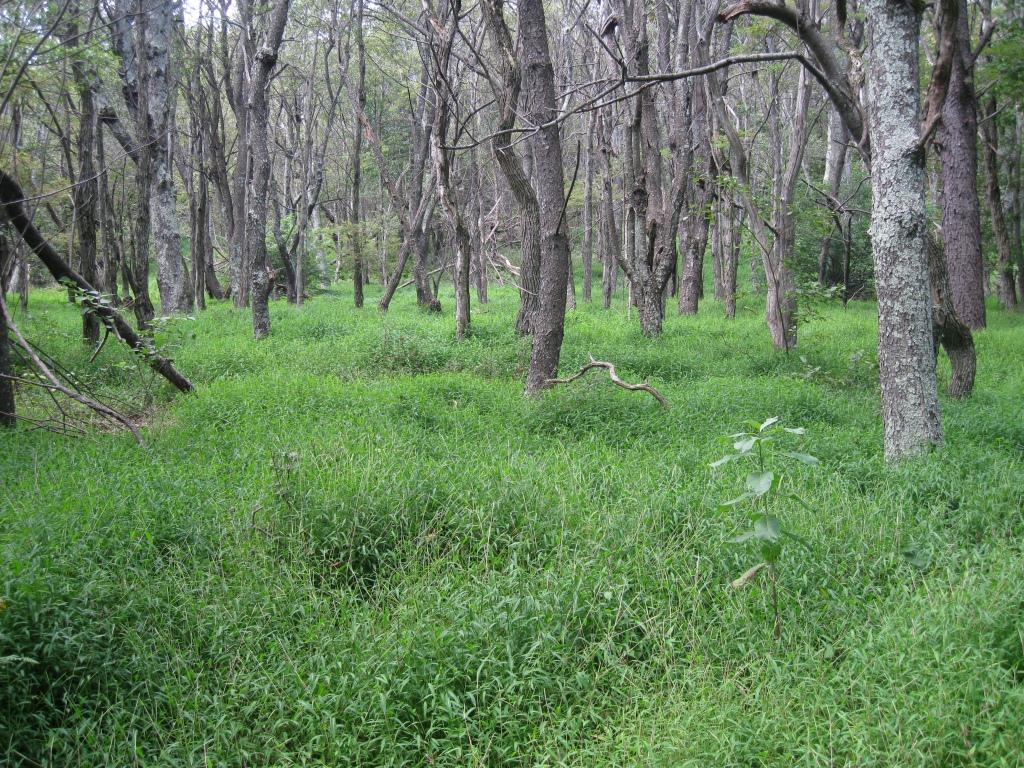
Japanese stiltgrass in Shenandoah National Park; Photo by J. Hughes
The USFS and NPS report different species to be most widespread. In the National Park Service-managed units, Japanese stiltgrass (Microstegium vimineum) was found on 30% of all plots, in more than 75% of all NPS-managed units in the study. This magnitude comes despite the species not being found north of 41o N latitude. In forest plots inventoried by the USDA Forest Service, Japanese stiltgrass was the 14th most widespread species in the Northern region. I speculate that the species might not be common in the upper Midwest, which was not included in the NPS study. Oswalt et al. (2015) noted that Japanese stiltgrass was the 5th most common invasive plant in the Southern region.
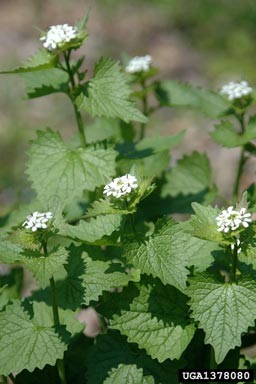
Both studies agreed that garlic mustard (Alliaria petiolata) is widespread. The NPS study found it to be the most frequently detected non-grass herbaceous species, detected in 20% of plots throughout the study area (Virginia and West Virginia to Maine). On forest plots monitored by the USFS, garlic mustard was the 3rd most frequently detected species, on 4.5% of the surveyed plots. The species is reported to be present in 36 states & 5 provinces.
Why do Studies Ignore Deliberate Planting as a Factor?
Both USFS & NPS found shrubs and vines to be highly widespread. NPS specified Japanese barberry (Berberis thunbergii), Japanese honeysuckle (Lonicera japonica), multiflora rose (Rosa multiflora), and wineberry (Rubus phoenicolasius). USFS FIA data showed multiflora rose to be the most frequently recorded invasive plant, present on 16.6% of surveyed plots. It is otherwise recorded in 39 states and 5 provinces. Multiflora rose is almost ubiquitous in some states; in Ohio it is recorded on 85% of the plots. “Roses” were reported to be the 3rd most common invasive plant in the Southern Region. Other shrubs also dominated FIA plot detections: European buckthorn was 4th most frequently detected species, present on 4.4% of survey plots; or in 34 states and 8 provinces. Its presence is highest in New York, at 16.8% of plots. If the plots invaded by the various bush honeysuckle species do not overlap, these shrubs occupy 9.5% of all surveyed plots – second to multiflora rose. The vine Japanese honeysuckle ranked 6th – present on 3.6% of survey plots across the region. Japanese honeysuckle is reported to be the most common invasive plant in the Southern region. Other shrubs ranking 12th or above included Autumn olive and Japanese barberry
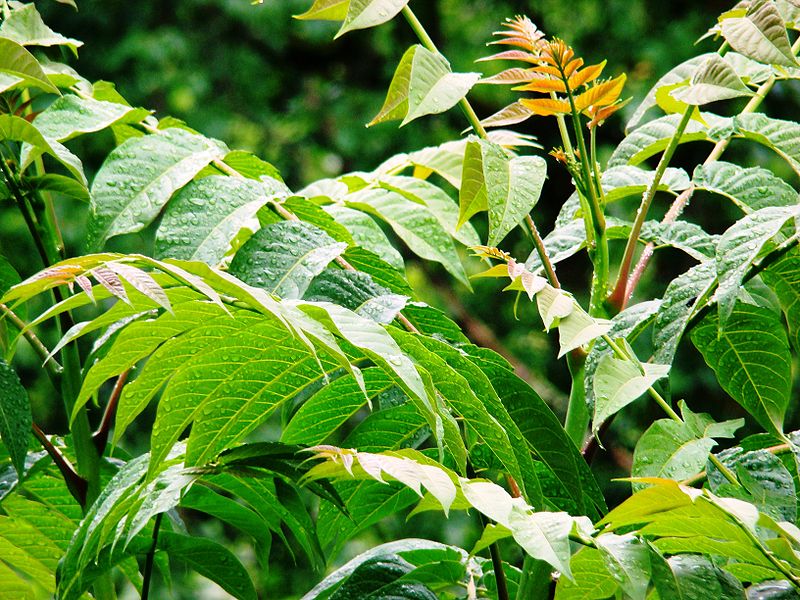
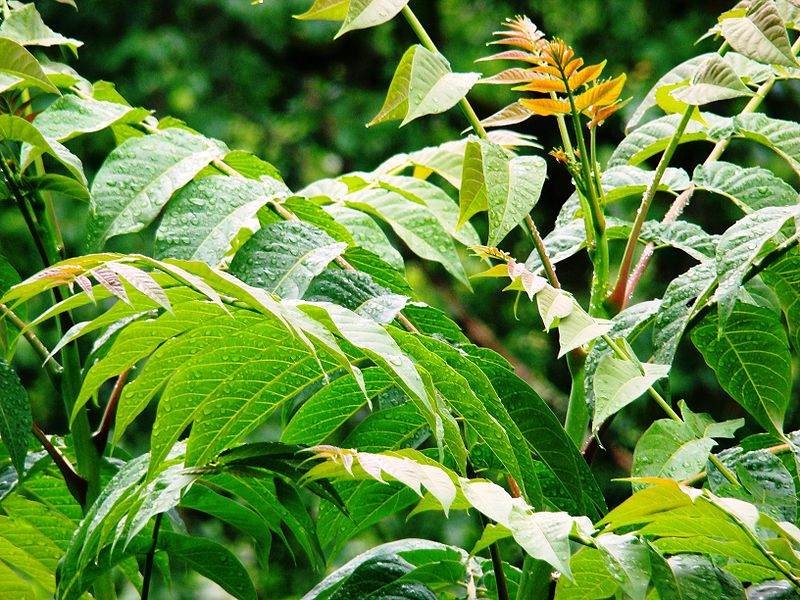
Tree-of-heaven (Ailanthus altissima) was the most common invasive tree found in National parks, again, despite not growing north of 41o N latitude. It is found in 9% of plots.
Ailanthus
I will say that I find it extremely annoying that the scientists carrying out these studies never mention that virtually all these shrub species had been deliberately planted in forests or nearby lands! Instead, they focus on such factors as histories of agriculture and other disturbances and fragmentation. It is well documented (e.g., Lehan et al. 2013) that the vast majority of shrub species introduced to the U.S. were introduced deliberately. Furthermore, more than 500 plant species invasive in some region are being sold on-line globally.
Deliberate planting of species that turn out to be invasive is also rarely recognized in the West, e.g., Pearson et. al. There, the motivation for planting might be livestock forage or erosion control rather than wildlife habitat “enhancement” or ornamental horticulture.
I am pleased that the most recent study (Barrett and Robertson 2021) differs somewhat by noting (sometimes) both invasions by forage grasses and the appearance in the mesic forests of Pacific states such planted species as Armenian blackberry. However, while this report notes the potential that pathogens might be transported to new areas by restoration planting and “assisted migration”, it does not mention the concomitant risk of introducing plant species that might prove invasive in the naïve ecosystems.
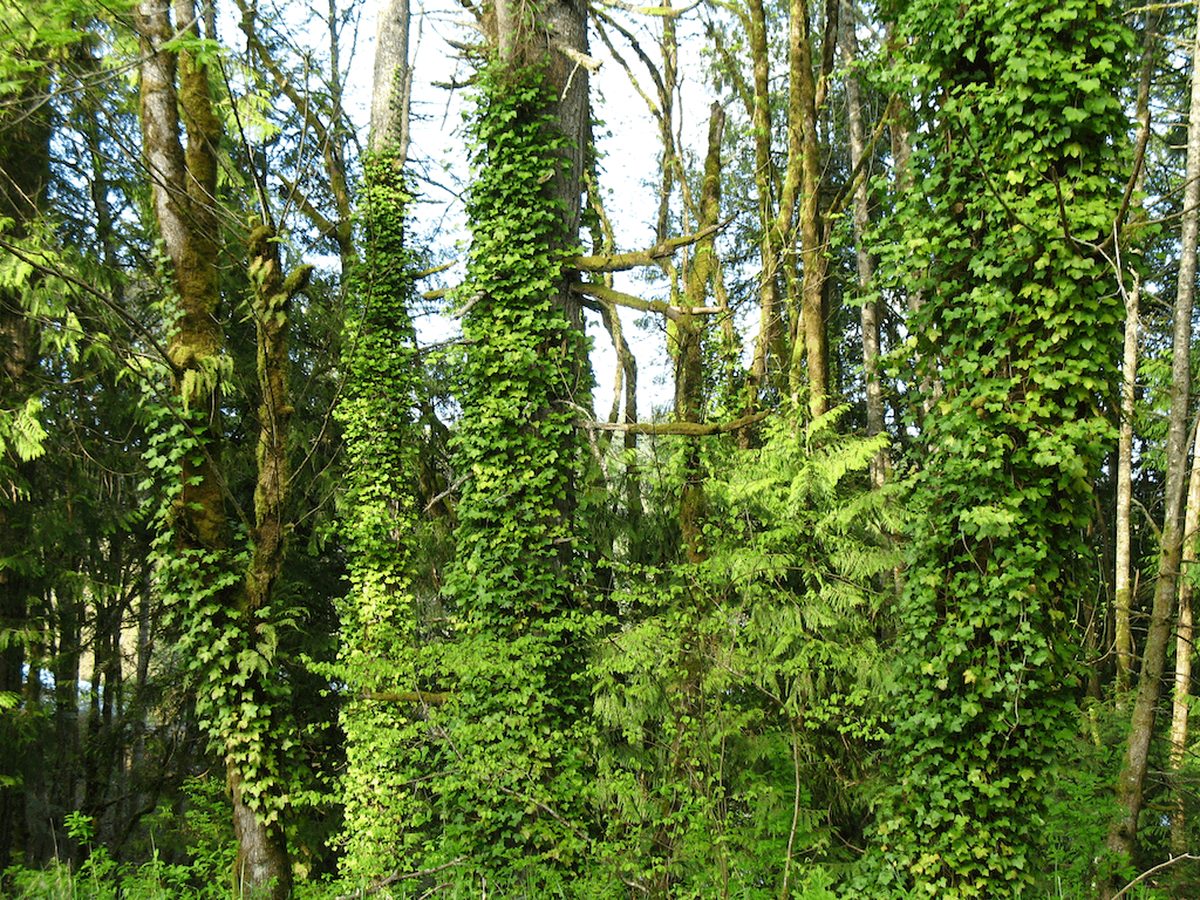
English ivy invading forest in Washington State; photo from Washington Noxious Weed Board
[Go to the earlier blogs linked here and the Western forests report for discussions of management strategies.]
Barrett and Robertson (2021) state that although invasive plants are increasing in extent and intensity in Western forests, they are usually considered to be contributing factors rather than as proximate causes. However, they note two caveats: 1) determining the ultimate causes and resulting implications of these recent increases is more difficult; and 2) data are particularly poor on plant species’ presence. Indeed, the FIA survey process link is ineffective for early detection and tactical monitoring [that is, identifying particular species in specific habitats of concern] of plant invasions.
Of the 23.4 M ha of forested lands that have experienced a disturbance over a five-year window (the time frame for FIA), only 600,000 ha was affected by the combined categories of geologic, vegetation, and other disturbances. (This is 10% of the area affected by either insects or pathogens.) Cheatgrass (Bromus tectorum) was by far the most abundant species in Western forests, covering 480,000 ha, or about 0.49%cover of all forested land in the conterminous Western United States. Because of the difficulties of surveying, Barrett and Robertson (2021) conclude that the area covered by IAS plants on the Pacific Coast and Rocky Mountains could be twice recorded values.
FIA surveys detected the highest number of non-native plant species in the forests of the continental Pacific states — 259 species. Many were grasses (although different species than in the Rockies), but shrubs and other forbs were also present. In the Rocky Mountain states the surveys detected a total of 195 non-native species, primarily grasses. FIA surveys in Hawai`i detected 136 non-native species. The most abundant was strawberry guava, which was detected on 9% of the forested area in the state. Surveys of FIA plots in coastal Alaska detected only 8 non-native plant species; common dandelion was the most abundant. Except in Hawai`i, the plants were expected to have substantially lower impacts than in eastern forests.
I note that the US Geological Service (Simpson and Eyler, 2018) reports there are approximately 1,754 non-native plants in Hawai`i and 424 in Alaska. Not all are necessarily invasive. And the USGS study covered all of Alaska, not just the southeastern coastal region.
Barrett and Robertson (2021) found that plant invasions are less extensive in older forest stands, mesic stands in contrast to drier areas and those with sparse or open tree canopies, and farther from roads. Thus, invasive plant cover was higher in hardwood and low-elevation and dry conifer forest types than in high-elevation and moist conifer types. In Hawai`i, mean plant cover was more than 40 % in all forest types except cloud forest, where it was 7.8 %. Again, proximity to roads was mentioned in the context of the likelihood of disturbance but no mention was made of the fact that households and businesses (e.g., tourist facilities, even agency facilities!) might deliberately introduce plants – e.g., horticulture.
Barrett and Robertson (2021) expect the impacts of NIS plants on forest lands to increase in the future, due to both additional introductions (despite efforts to prevent such) and spread of established species. They note that every disturbance creates an opportunity for the many ruderal and graminoid species to establish – facilitated by their abundance nearby. They note the significant challenge presented by secondary invaders, which often respond to space made available by “weed control” projects better than natives.
I welcome their concern about shade-tolerant plants apparently increasing in wetter areas of the Pacific coast states. They note that the presence of non-native plants in a forest is less obvious, and the impacts might be more subtle, perhaps primarily affecting tree regeneration through competition or other effects (e.g., promoting fire). Barrett and Robertson (2021) note that many of the shade-tolerant non-native species abundant in temperate Eastern U.S. forests (e.g., garlic mustard) are present in the West and are likely to become important.
SOURCES
Barrett, T.M. and G.C. Robertson, Editors. 2021. Disturbance and Sustainability in Forests of the Western US. USDA Forest Service Pacific Northwest Research Station. General Technical Report PNW-GTR-992
March 2021
Simpson, A., and Eyler, M.C., 2018, First comprehensive list of non-native species established in three major regions of the United States: U.S. Geological Survey Open-File Report 2018-1156, 15 p., https://doi.org/10.3133/ofr20181156.
ISSN 2331-1258 (online)
Posted by Faith Campbell
We welcome comments that supplement or correct factual information, suggest new approaches, or promote thoughtful consideration. We post comments that disagree with us — but not those we judge to be not civil or inflammatory.
For a detailed discussion of the policies and practices that have allowed tree-killing pests to enter and spread – and that do not promote effective restoration strategies – review the Fading Forests report at http://treeimprovement.utk.edu/FadingForests.htm (These reports do not discuss invasive plants.)
In late July I participated in the annual meeting of the National Plant Board (NPB) – the organization representing the states’ phytosanitary agencies. USDA’s APHIS, DHS’ Bureau of Customs and Border Protection (CBP), and various industry associations also participated in the meeting. As usual, I learned lots of depressing developments.
A. Old problems continue to vex:
rhododendron plant infested by P. ramorum; photo by Jennifer Parke, Oregon State University
1) Sudden Oak Death in the Nursery Trade – Again!!!
As you might remember, spring 2019 saw an alarming number of plants infested by the sudden oak death pathogen (Phytophthora ramorum) shipped from west coast nurseries to nurseries in 18 states. Another major incident occurred in 2021. The California Oak Mortality Task Force (COMTF) newsletter for June 2021 reports that one nursery in Oregon shipped plants exposed to P. ramorum to big-box stores in 36 states — twice the number of states that received pathogen-exposed plants in 2019.
The first such incident was in 2004 – 17 years ago! Officials of the states that receive these infested plants are angry that every few years they must divert their resources from other duties to inspect nurseries in their states that have been exposed to the pathogen. They note that these “trace-forward” projects cost state governments money and prevent their carrying out other duties; they also impose significant costs on the in-state nurseries due to holds on sales. When infested plants are found, all these costs rise substantially.
The plant health official from Alabama noted that a single west coast nursery that had repeatedly been found to have infected plants shipped 29 lots of host plants to her state in spring 2021. As is clear from the COMTF article, other states also received thousands of plants that had been exposed to the pathogen. The Alabama official questioned why APHIS tilts so far toward a regulatory system that makes it possible for the “exporting” nurseries to ship. The result – too often – is that an infection at one small business can (repeatedly) impose high costs on hundreds of receiving nurseries and states. [I wonder whether anyone has considered a lawsuit against the source nurseries claiming damages? Would that be successful if the regulatory agencies approved the shipments because – at that time – their inspections had failed to detect the problem?]
Officials from the three west coast states, however, want to support their own nurseries’ efforts to relax regulations and maintain or open markets in the central and eastern states. They point to their own considerable efforts to inspect and certify the pest-free status of nurseries in their states.
Because of the different points of view among the states, the National Plant Board per se has never taken a position on the issue.
However, many states – and even APHIS Deputy Administrator El-Lissy – agree that something is not working. So APHIS is in the midst of reviewing its program, with input from NPB members. Such program reviews have been undertaken several times over the past 18 years. So far, they have never produced a program that effectively stops sales of pathogen-infested plants.
2) Contaminated Wood Packaging
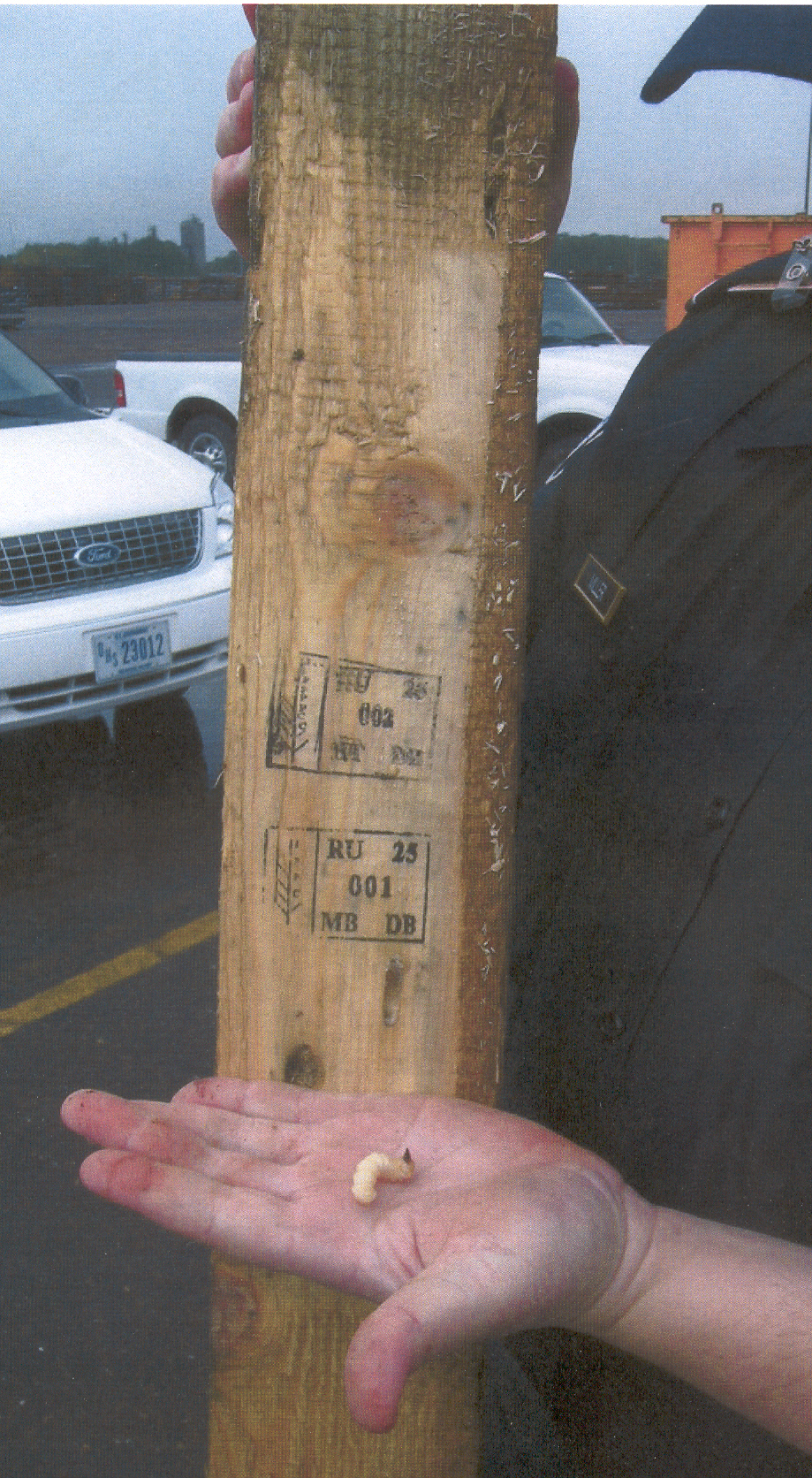
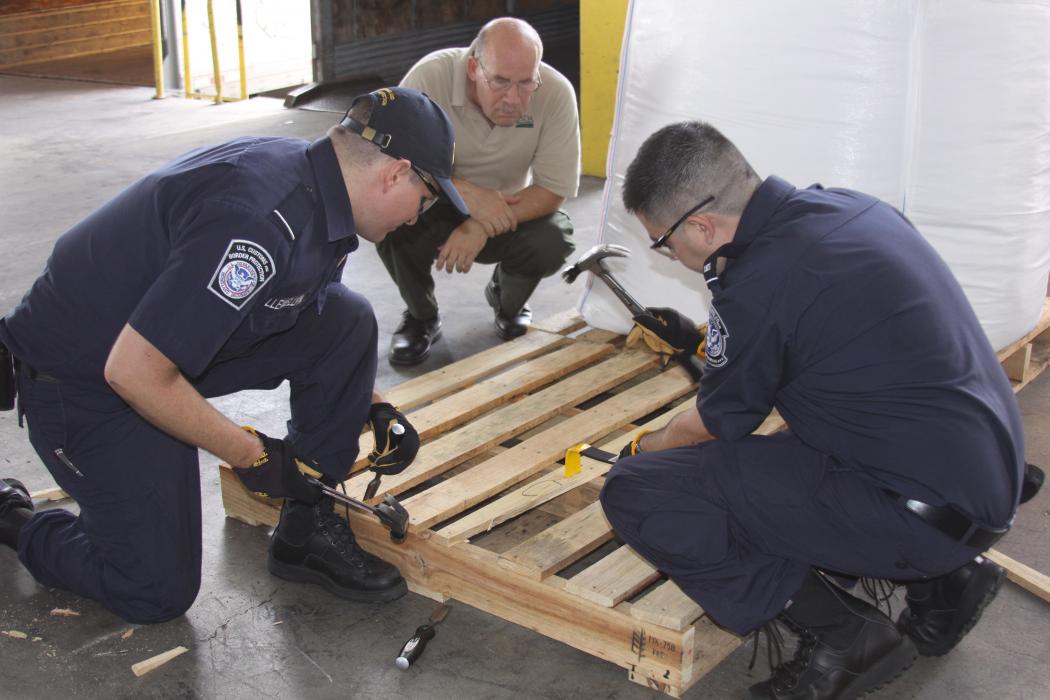
Kevin Harriger of CBP reported that over the nine-month period October 2020 – June 2021, CBP intercepted 1,563 shipments that were in violation of ISPM#15, the international rule that requires that wood packaging be treated to kill pests. Most, or 1,148 shipments (73%), lacked the required mark certifying treatment. Four hundred fifteen (26%) of the total number of shipments had a live pest present. Nearly three quarters of the non-compliant shipments transported miscellaneous cargo. This is not a surprise: all of these characteristics are in keeping with past experience.
Meanwhile, APHIS Deputy Director El-Lissy said APHIS was working with importers, exporting countries’ departments of agriculture, and others to improve compliance. Apparently there were two high-profile incidents when shipments of car components were rejected because of ISPM#15 issues. I am trying to learn more about these incidents.
I recently blogged about the pest risk associated with incoming shipping containers and dunnage.
3) Asian Gypsy Moths (Tussock moths) Still Infesting Ships
Harriger also said that the period 2019-2020 saw the largest number of ships infested by Asian tussock moth eggs since the program began in 2012. [I am aware that the Entomological Society is searching for a new name for this group of insects.] On average, 12 of 100 approaching vessels was infested. CBP is using sophisticated models to identify regions within Asian ports where conditions exacerbate the risk of moth contamination. CBP can match individual ships’ loading records to this information to pinpoint which are most likely to be infested.
Oregon and Washington continue to find both Asian and European tussock moths in traps along the Columbia River. Such detections prompt eradication programs of varying expense and disruption.
[In April, I blogged about a report evaluating the risk posed by several Asian tussock moths; the report was prepared by experts under the auspices of the North American Plant Protection Organization.]
B. In addition to the arrival of new pests, there is an alarming spread of established ones:
1) Beech leaf disease
State phytosanitary officials reported detections of beech leaf disease (BLD) in Maine and Virginia. The devastating impact of BLD on this hard mast tree species is described here. BLD has now spread through much of southern New England (Connecticut, Rhode Island, Massachusetts) and up the coast to Maine. Connecticut reports that trees of all sizes are affected. Maine reports that the disease is widespread in the central coastal region.
beech trees in Prince William Forest Park
Virginia reported that the disease has been detected in Prince William Forest Park, a forested area south of Washington, D.C., managed by the National Park Service. This detection is too recent to say how widespread it is.
2) Laurel wilt
Kentucky’s plant health officer reported that laurel wilt disease has been detected on sassafras trees in Louisville, at the northern tip of the state and across the river from Ohio. He noted that a second host plant, spice bush, is in the nursery trade. While laurel wilt is not regulated, officials are concerned about its impact in natural forests. Neighboring states are concerned.
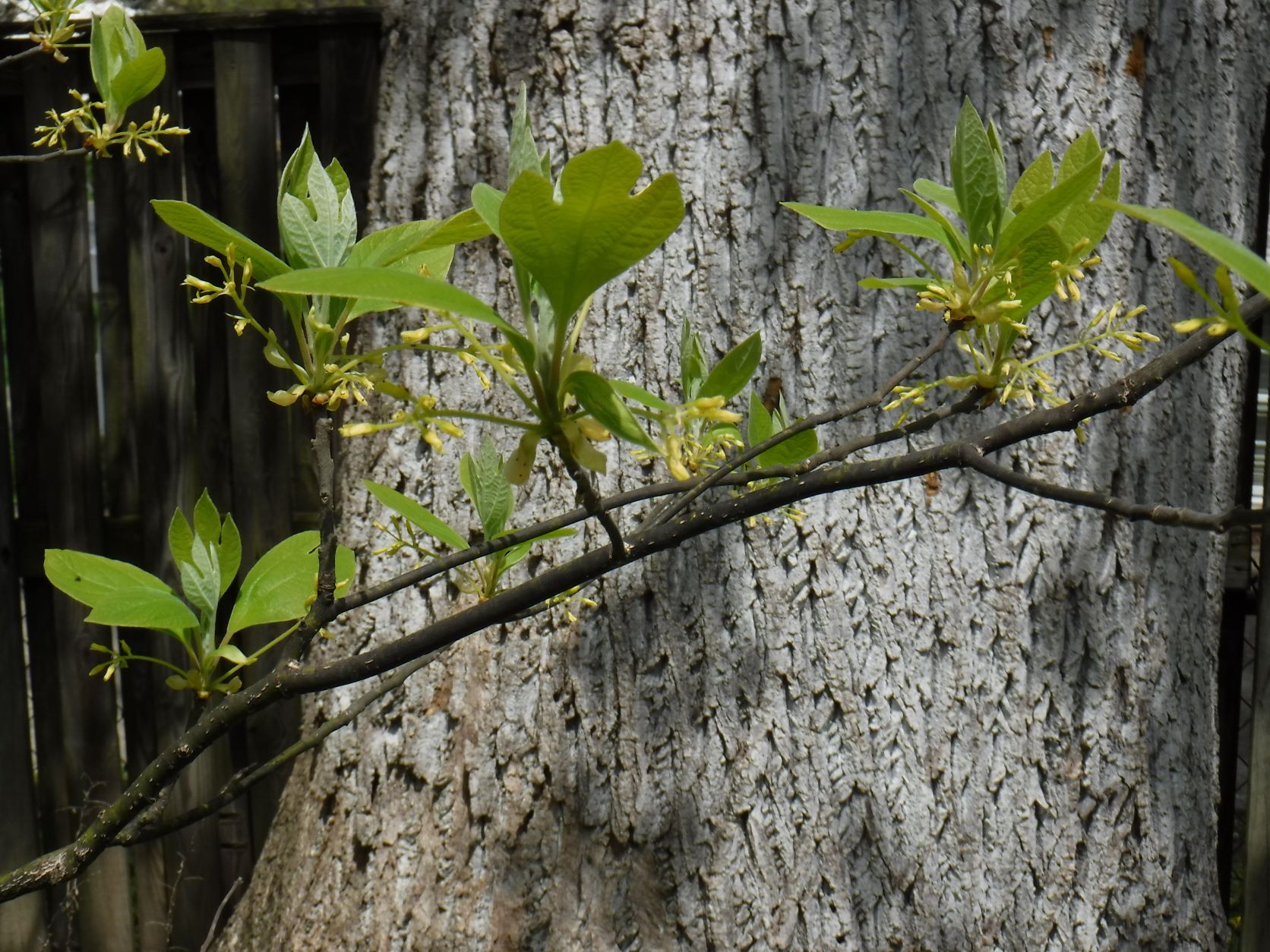
sassafras in northern Virginia; photo by F.T. Campbell
I learned by looking at the map that laurel wilt has also been detected in Sullivan County, Tennessee, on the Virginia border.
This pest of grapes, tree fruits, and a wide variety of native trees is spreading in Pennsylvania, Delaware, New Jersey, and Maryland. It has also been found in Ithaca, NY, and in Connecticut. The populations in Virginia and West Virginia also continue to spread; a disjunct outbreak has been detected in Prince William County, VA. (south of D.C.). Most alarming are disjunct populations in Ohio on the West Virginia border and in Indiana on the Ohio River border with northern Kentucky. See map here.
The Indiana population has been present for several years. The affected woodland is close to RV parks and other facilities that make further spread likely.
California has established an external quarantine targetting the spotted lanternfly .
C. Wrestling with Continuing Issues:
1) States try to compensate for APHIS’ end of regulating the emerald ash borer and firewood
The members of the NPB have spent years discussing the pros and cons of continuing to regulate ash wood to contain the emerald ash borer (EAB). As I blogged earlier, APHIS has ended its regulatory program. One state – Minnesota – is seeking to use an APHIS procedure to get APHIS’ continued protection from importation of EAB-infested wood (presumably from Canada). Under the Federally Recognized State Managed Phytosanitary Program (FRSMP), a state petitions APHIS to recognize its program for a specific pest. If APHIS grants that recognition, the agency will support the state by continuing to regulate imports of that pest or commodities that might transport the pest when they are destined for the regulating state.
The states have also tried to formulate a system to maintain regulation of firewood (nearly all states’ firewood regulations were based on the federal regulation of all hardwoods to prevent transport of the EAB). As part of this process, the NPB developed guidelines for adoption of regulations by the individual states (available here). The NPB members are just beginning to explore whether states might set up third-party certification system(s). Among the challenges to any harmonization are states’ differing legal authorities and disagreement on what threat levels should be applied, and for how long.
2) New information about the Asian longhorned beetle in South Carolina
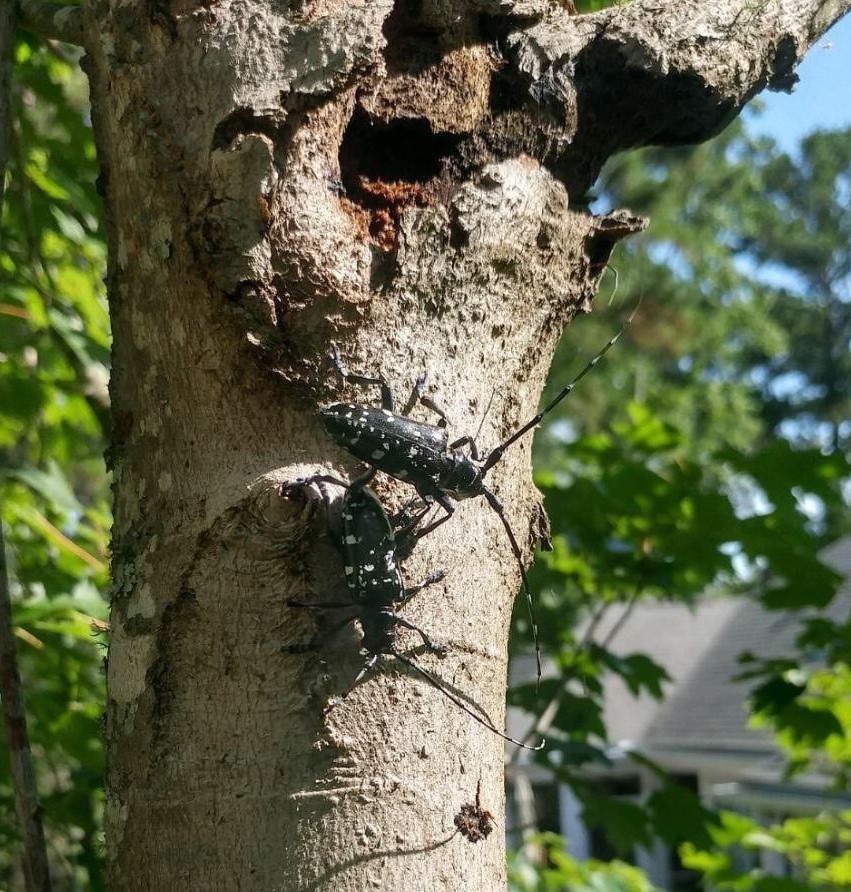
ALB in South Carolina; photo by R. Brad Thompson, APHIS
South Carolina authorities reported that dendrological studies indicated Asian longhorned beetle (ALB) had been present near Charleston, S.C. since 2012, and possibly earlier. The population has the same genetic makeup as the outbreak in Ohio. This might be explained by either transport of infested wood from Clermont County, Ohio, or that wood packaging entering Charleston harbor came from the same part of China. (Charleston is an important port.) In South Carolina, ALB attacks primarily red maple – as is true at the other infestation sites. However, maple densities are much lower in the swamps of South Carolina and scientists don’t know whether the ALB will fly farther or intensify attacks on other host species. Other questions raised by differences between South Carolina and other, more northern, outbreak sites include possible changes in the beetle’s life cycle and flight periods.
Authorities noted the extremely difficult conditions, which impede survey and control efforts – which I described in an earlier blog.
One innovation was sharing of resources: staff from the North Carolina and Tennessee departments of agriculture went to South Carolina to help with surveys. The Resource Sharing Initiative was started a few years ago as a collaborative effort of APHIS and the NPB. This was the first time states tried it. There were several issues that had to be worked out. One issue was the long time it takes to train people to recognize ALB symptoms. All three states’ officials said the project was worthwhile.
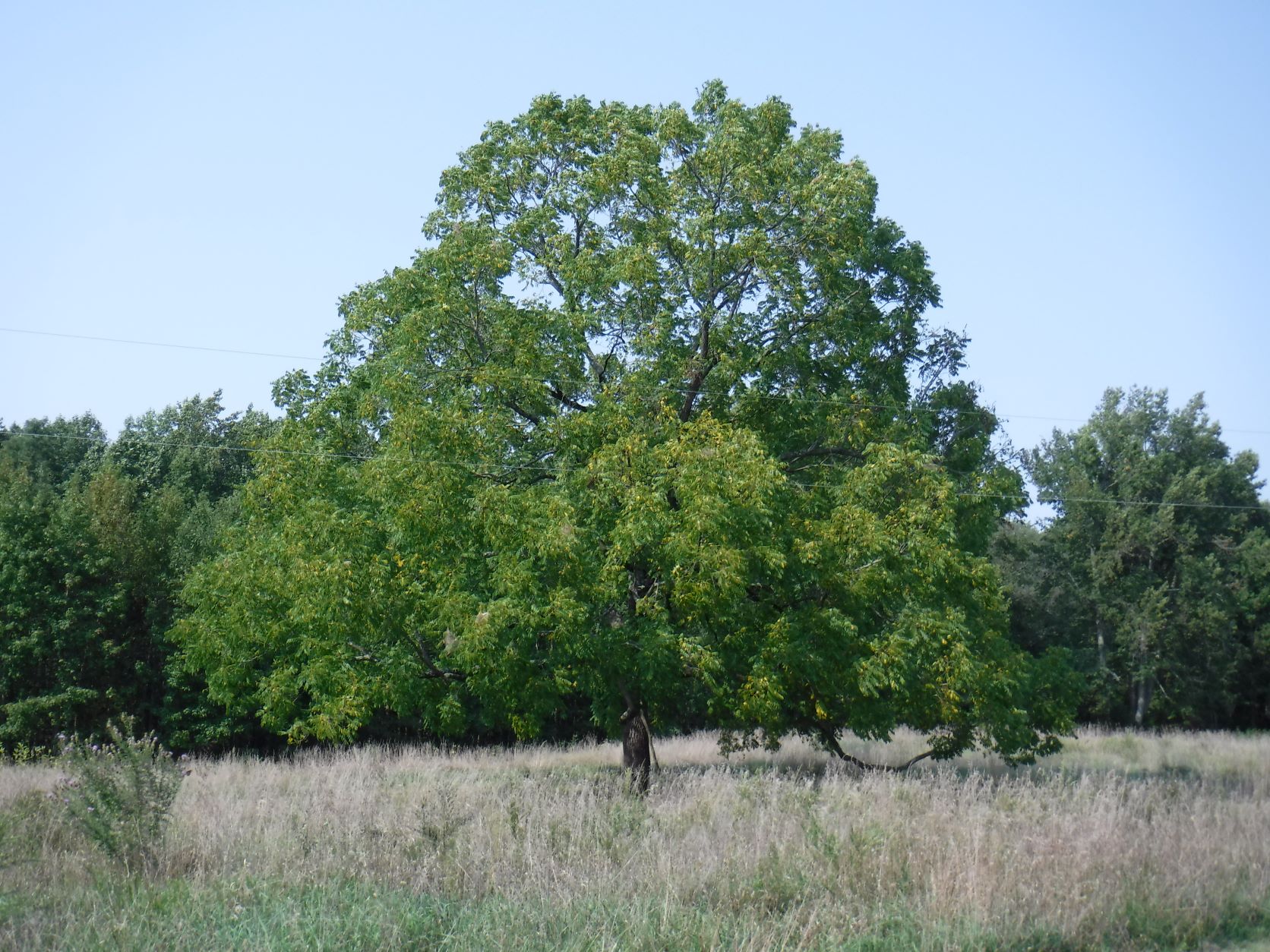
black walnut in Fairfax County, VA — in an area where thousand cankers disease has been present for more than a decade; photo by FT Campbell
3) Recinding quarantines of thousand cankers disease of walnut
States which adopted quarantines targetting this insect/pathogen complex a decade ago now think that it poses little risk to black walnut (Juglans nigra) growing in its native range (as distinct from trees planted in the West). Several are in the process of rescinding their quarantines. I think these states have considered the science carefully and are taking the appropriate action.
4) Nursery self-certification – System Set Up; Will Nurseries Participate? Will Customers Support the Process?
Craig Regelbrugge of AmericanHort noted that the SANC program has now been officially launched – it has graduated from being a pilot program. [SANC stands for Systems Approach to Nursery Certification] Participants are exploring incentives to recruit wider participation by nurseries that produce plants and how to get support from plant retailers. SANC is conceived as an elite program for the best nurseries and marketplace leaders. It was never intended to be a remedial program to clean up problem issues such as the P. ramorum debacle. To work, it seems to me, SANC will need to find a way to persuade customers to want to pay more for quality plants. Hence the critical importance of getting retailers involved.
Posted by Faith Campbell
We welcome comments that supplement or correct factual information, suggest new approaches, or promote thoughtful consideration. We post comments that disagree with us — but not those we judge to be not civil or inflammatory.
For a detailed discussion of the policies and practices that have allowed these pests to enter and spread – and that do not promote effective restoration strategies – review the Fading Forests report at http://treeimprovement.utk.edu/FadingForests.htm
In February the USFS published a lengthy analysis of invasive species: Invasive Species in Forests and Rangelands of the United States. A Comprehensive Science Synthesis for the US Forest Sector (Poland et al. 2021; full citation at the end of the blog). More than 100 people contributed to the book; I helped write the chapters on legislation and regulations and international cooperation. The book is available for download at no cost here.
Chapters address impacts in terrestrial and aquatic systems; impacts on ecosystem processes; impacts on various sectors of the economy and cultural resources; interactions with climate change and other disturbances; management strategies for species and landscapes; tools for inventory and management. Each chapter evaluates the current status of knowledge about the topic and suggests research needs. There are also summaries of the invasive species situation in eight regions.
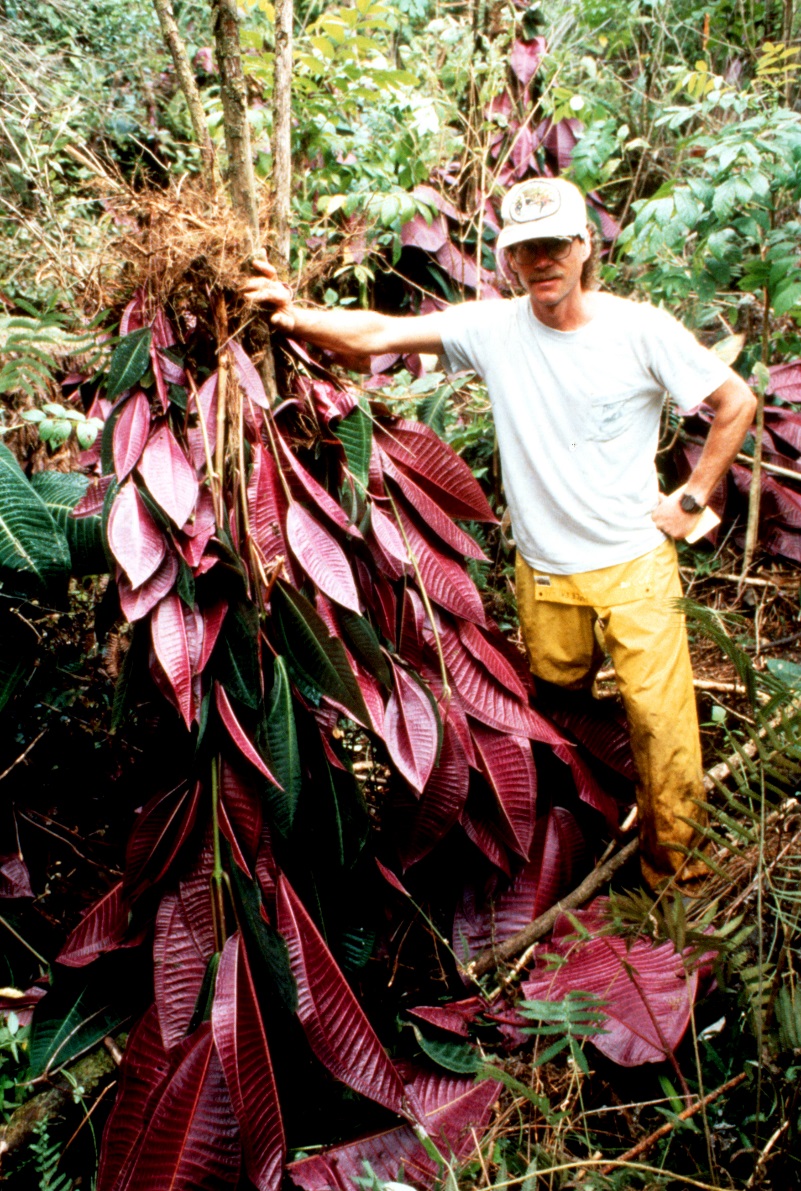
Miconia – one of many invasive plants damaging ecosystems in Hawai`i
I greatly appreciate the effort. Authors first met in 2015, and most chapters were essentially written in 2016. The long delay in its appearance came largely from negotiations with the publisher. The delay means some of the information is out of date. I am particularly aware that several experts – e.g., Potter, Guo, and Fei – have published about forest pests since the Aukema source cited. I wonder whether inclusion of their findings might change some of the conclusions about the proportion of introduced pests that cause noticeable impacts.
Since the report’s publication in February I have struggled with how to describe and evaluate this book. What is its purpose? Who is its audience? The Executive Summary says the report is a sector-wide scientific assessment of the current state of invasive species science and research in the U.S.
However, the Introduction states a somewhat different purpose. It says the report documents invasive species impacts that affect ecosystem processes and a wide range of economic sectors. This would imply an intention to enhance efforts to counter such effects– not just to shape research but also to change management. Indeed, the Conclusion of the Executive Summary (pp. xvi-xvii) is titled “An Imperative for Action”.
Tom Vilsack, Secretary of Agriculture
I am not the author to evaluate how effectively the book sets out research agendas. Regarding its usefulness in prompting policy-makers to do more, I regretfully conclude that it falls short.
Getting the balance right between an issue’s status and what needs to be done is difficult, perhaps impossible. I appreciate that the report makes clear how complex bioinvasion and ecosystem management and restoration are. Its length and density highlight the difficulty of making progress. This daunting complexity might well discourage agency leadership from prioritizing invasive species management.
On the other hand, summary sections sometimes oversimplify or bury important subtleties and caveats. The question of whether some key questions can ever be resolved by science is hinted at – but in detailed sections that few will read. The same is true regarding the restrictions imposed by funding shortfalls.
The Report Would Have Benefitted from Another Round of Editing
Editing this tome was a Herculean task. I feel like a curmudgeon suggesting that the editors do more! Nevertheless, I think the report would have been improved by the effort. One more round of editing – perhaps involving a wider range of authors – could have pulled together the most vital points to make them more accessible to policymakers. It could also have tightened the ecosystem-based descriptions of impacts, which are currently overwhelmed by too much information.
A precis for policymakers
A precis focused on information pertinent to policymakers (which the current Executive Summary does not) should contain the statement that the continued absence of a comprehensive investigation of invasive species’ impacts hampers research, management, and policy (mentioned only in §16.5, on p. 332). It should note situations in which insufficient funding is blocking recommended action. I note three examples: programs aimed at breeding trees resistant to non-native pests (resource issues discussed only in §§8.3.1 and 8.3.2, p. 195); sustaining “rapid response” programs (§6.4.3, p. 125); costs of ecosystem restoration, especially for landscape-level restoration (§16.4). I am sure there are additional under-funded activities that should be included!
cross-bred ash seedlings being tested for vulnerability to EAB; photo courtesy of Jennifer Koch
Other important information that should be highlighted in such a precis includes the statement that many ecosystems have already reached a point where healthy functions are in a more tenuous balance due to invasive species (p. 51). Effective carbon storage and maintaining sustainable nutrient and water balance are at risk. Second, costs and losses caused by invasive forest pests generally fall disproportionately on a few economic sectors and households. They cannot be equated to governmental expenditures alone (p. 305). Third, even a brief estimate of overall numbers of invasive species appears only in §7.4. Information about individual species is scattered because it is used as example of particular topic (e.g., impacts on forest or grassland ecosystems, or on ecosystem services, or on cultural values).
Ecosystem Impacts Overwhelmed
As noted above, the report laments the absence of a comprehensive investigation of invasive species’ impacts. Perhaps the editors intended this report to partially fill this gap. To be fair, I have long wished for a “crown to root zone” description of invasive species’ impacts at a site or in a biome. Concise descriptions of individual invasive species and their impacts are not provided by this report, but they can be found elsewhere. (The regional summaries partially address the problem of too much information – but they do not provide perspective on organisms that have invaded more than one region, e.g., emerald ash borer or white pine blister rust.) Another round of editing might have resulted in a more focused presentation that would be more easily applied by policymakers.
Welcome Straightforward Discussion of Conceptual Difficulties
I applaud the report’s openness about some important overarching concepts that science cannot yet formulate. If supportable theories could be conceived, they would assist in the development of policies:
Despite decades of effort, scientists have not established a clear paradigm to explain an ecosystem’s susceptibility to invasion (p. 85). Invasibility is complex: it results from a dynamic interplay between ecosystem condition and ecological properties of the potential invader, especially local propagule pressure.
Scientists cannot predict how climate warming will change distributions of invasive species [see Chapter 4] and alter pathways. This inability hampers efforts to develop effective prevention, control, and restoration strategies (p. xi). Climate change and invasive species need to be studied together as interactive drivers of global environmental change with evolutionary consequences.
The Report’s Recommendations
Policy-oriented recommendations are scattered throughout the report. I note here some I find particularly important:
Measures of progress should be based on the degree to which people, cultures, and natural resources are protected from the harmful effects of invasive species.
Managers should assess the efficacy of all prevention, control, and management activities and their effect upon the environment. Such an evaluation should be based on a clear statement of the goals of the policy or action. [I wish the report explicitly recognized that both setting goals and measuring efficacy are difficult when contemplating action against a new invader that is new to science or when the impacts are poorly understood. Early detection / rapid response efforts are already undermined by an insistence on gathering information on possible impacts before acting; that delay can doom prospects for success.]
Risk assessment should both better incorporate uncertainty and evaluate the interactions among multiple taxa. Risk assessment tools should be used to evaluate and prioritize management efforts and strategies beyond prevention and early detection/rapid response.
Economic analyses aimed at exploring tradeoffs need better tools for measuring returns on invasive species management investments (§16.5).
Actions that might be understood as “restoration” aim at a range of goals along the gradient between being restored to a known historic state and being rehabilitated to a defined desired state. The report stresses building ecosystem resilience to create resistance to future invasions, but I am skeptical that this will work re: forest insects and disease pathogens.
Propagule pressure is a key determinant of invasion success. Devising methods to reduce propagule pressure is the most promising to approach to prevent future invasions (p. 115). This includes investing in quarantine capacity building in other countries can contribute significantly to preventing new invasions to the US.
Resource managers need additional studies of how invasive species spread through domestic trade, and how policies may differ between foreign and domestic sources of risk.
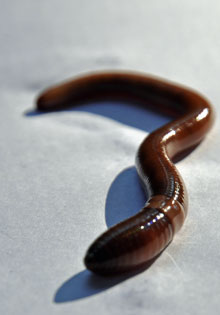
I appreciate the report’s attention to such often-ignored aspects as non-native earthworms and soil chemistry. I also praise the report’s emphasis on social aspects of bioinvasion and the essential role of engaging the public. However, I think the authors could have made greater use of surveys conducted by the Wisconsin Department of Natural Resources and The Nature Conservancy’s Don’t Move Firewood program.
Lost Opportunities
I am glad that the report makes reference to the “rule of 25” rather than “rule of 10s”. I would have appreciated a discussion of this topic, which is a current issue in bioinvasion theory. As noted at the beginning of this blog, the long time between when the report was written and when it was published might have hampered such a discussion
Also, I wish the report had explored how scientists and managers should deal with the “black swan” problem of infrequent introductions that have extremely high impacts. The report addresses this issue only through long discussions of data gaps, and ways to improve models of introduction and spread.
I wish the section on the Northwest Region included a discussion of why an area with so many characteristics favoring bioinvasion has so few damaging forest pests. Admittedly, those present are highly damaging: white pine blister rust, sudden oak death, Port-Orford cedar root disease, balsam woolly adelgid, and larch casebearer. The report also notes the constant threat that Asian and European gypsy moths will be introduced. (The Entomological Society of America has decided to coin a new common name for these insects; they currently to be called by the Latin binomial Lymatria dispar).
And I wish the section on the Southeast and Caribbean discussed introduced forest pests on the Caribbean islands. I suspect this reflects a dearth of research effort rather than the biological situation. I indulge my disagreement with the conclusion that introduced tree species have “enriched” the islands’ flora.
SOURCE
Poland, T.M., P. Patel-Weynand, D.M Finch, C.F. Miniat, D.C. Hayes, V.M Lopez, editors. 2021. Invasive species in Forests and Rangelands of the United States. A Comprehensive Science Synthesis for the US Forest Sector. Springer
Posted by Faith Campbell
We welcome comments that supplement or correct factual information, suggest new approaches, or promote thoughtful consideration. We post comments that disagree with us — but not those we judge to be not civil or inflammatory.
For a detailed discussion of the policies and practices that have allowed these pests to enter and spread – and that do not promote effective restoration strategies – review the Fading Forests report at http://treeimprovement.utk.edu/FadingForests.htm
are wood-borers examples of species more likely to “proceed through the steps of invasion” than the theory suggests?
Much of the literature about biological invasion has relied on the “tens rule”. First enunciated in the mid-1990s by Williamson and Fitter (1996), it was actually conceived a decade earlier by Williamson and Brown (1986).
The “tens rule” hypothesizes that about 10% of all species transported to a new environment will be released or escape and become introduced species. Subsequently, 10% of those introduced species establish viable populations in the wild. Finally, about 10% of the established species become highly damaging. That is, 1% of the number originally transported to the new environment is a highly damaging invader.
Is the “tens rule” supported by evidence?
Empirical support for the hypothesis has been mixed; the number of studies questioning it has increased over the decades (Jeschke and Pyšek 2018). So Jeschke and Pyšek (2018) decided to evaluate the basis for the hypothesis. First, they divided the hypothesis into two sub-hypotheses so they could separate the concept of impact from the process of introduction, establishment, and spread. They justified this separation by noting that novel species can have an impact at any stage. The two sub-hypotheses:
1st sub-hypothesis: At each of the three transitions between the invasion stages listed here the number of species completing the transition is reduced by 90% (invasion tens rule).
transport to exotic range
transition
introduction (release or escape into the environment)
transition
establishment of a least one self-sustaining population
transition
spread
2nd sub-hypothesis: about 10% of established non-indigenous species cause a significant detrimental impact. This sub-hypothesis applies to the transition from establishment (iii, above) to significant impact (iv). Stepping back to the earlier introduction, so as to consider the situation overall, about 1% of all introduced non-native species cause a significant detrimental impact; this sub-hypothesis thus relates to the transition from introduction (ii) to significant impact (iv).
Jeschke and Pyšek carried out a quantitative meta-analysis of 102 empirical tests of the tens rule drawn from 65 publications. They found no support for the “invasion tens rule”. Indeed, their analysis found that about 24% of non-native plant and 23% of non-native invertebrate species are successful in taking consecutive steps of the invasion process. Among non-native vertebrates, about 51% are successful in taking consecutive steps of the invasion process.
The “impact tens rule” is also not supported by currently available evidence. However, Jeschke and Pyšek decided that more data are needed before a reasonable alternative hypothesis can be formulated.
Findings
Jeschke and Pyšek state that the “tens rule” is not based on a model or other defensible concept. It is also hampered by confusion of terms. Thus, different authors define the invasion process differently. Particularly confounding is the mixing of “impact” with steps in the invasion process. At the same time, there have been few studies of the “impact tens rule” hypothesis.
Finally, the “tens rule’s” predictions are not adjusted to consider changes in temporal and spatial scales. That is, it does not recognize that more invaders will be detected in any given place during more recent times than in the past. Furthermore, more invaders will find suitable niches in large areas than small.
The note that analysis is hampered by the paucity of reliable data about establishment success – especially for taxa other than mammals and birds. They do not discuss how this lack might affect efforts to analyze proportions of entering species that succeed in becoming invasive, especially among the small and inconspicuous taxa such as insects and fungal organisms that concern thus of us that focus on threats to forests. This same data gap has limited other studies as well; see, for example, Aukema et al. (2010) – who restricted their discussion of pathogens to “high impact” species.
Although Jeschke and Pyšek (2018) do not specify which studies they relied on to determine the proportion of successful invaders among species belonging to particular taxa, it seems likely that they relied principally on Vila et al. (2010) in determining that on average 25% invertebrates that are introduced (that is, proceed to the second stage in the process given above) become invasive. Vila et al. analyze introductions to Europe. They found that 24.2% of terrestrial invertebrates caused recognized economic impacts.
Jeschke and Pyšek (2018) Results and Discussion
Considering the “invasion tens rule”, two-thirds of the empirical tests in the dataset focused on the “invasion tens rule”. The majority of these focused on the transition from introduction to establishment (the transition from (ii) to (iii). The observed average percentage of species making this transition is more than 40% – or greater than four times larger than the “tens rule’s” prediction.
At the next transition, from establishment to spread (from iii to iv), the observed percentage of species making the transition is greater than 30% – or greater than three times the predicted value under the “tens rule”.
Considering the “impact tens rule”, on average a quarter of established non-indigenous species have a significant detrimental impact, which is again significantly more than the 1 out of 10 species predicted by the rule. Specifically by taxon, 18% of established plants have shown detrimental impacts. Among invertebrates and vertebrates that estimate is greater than 30%. All these observations are higher than predicted by the rule. However, sample sizes are low so more studies are needed to test whether these values hold true.
Regarding the fullest possible extent of the invasion process, 16 out of 100 species that were introduced (stage ii) had a significant impact. This is 16 times greater than the 1% predicted by the “tens rule”. Considering specific taxa, 6% of established plants and 15% of established invertebrates had a significant impact. Data were too poor to support an evaluation for vertebrates.
I note that the alarmingly high “impact” estimates for invertebrates are probably biased by scientists’ and funding entities’ lack of interest in species that don’t cause noticeable impacts.
Poor data preclude an analysis of the transition from transport (i) to introduced (ii).
Strengthening The Estimates
Might these introduction and impact estimates be tightened by analysis of additional sources, such as the studies led Seebens, forest pest impact analyses by Potter et al. (2019) and Fei (2019) and reviews of pest introduction numbers by Haack and Rabaglia (2013)?
Is it worth pursuing efforts to refine the Jeschke and Pyšek (2018) estimates? I think it is. An underestimation of the risk of introduction might lead decision-makers to downplay the need for a response.
Some scientists have accepted the new “rule of 25” (Schulz, Lucardi, and Marsico. 2021. Full citation at end of blog; also cited by USFS report – Poland et al. 2021). Others have not. Venette and Hutchison (2021; full reference at end of blog) continue to cite the estimate of approximately one “invasion success” for every 1,000 attempts – that is, a low-probability, high-consequence event. This challenges those responsible for managing invasive species.
Or are there other conundrums of introduction, establishment, and predicting impacts that have more direct relationship to improving programs? I note that the recent Forest Service report on invasive species (Poland et al. 2021) does not address the “rule of tens”.
Other Reasons Why Bioinvasion Damage is Underestimated
Jaric´ and G. Cvijanovic´ (2012) note that scientists lack a full understanding of ecosystem functioning, so they probably often miss more subtle – but still important – impacts.
Jeschke and Pyšek (2018) note that the percentage of introduced or established species with a quantifiable impact is not always the most important information. A single introduced species can have devastating impact by itself. They cite the amphibian disease chytrid (Batrachochytrium dendrobatidis) and such mammals as rats and cats.
SOURCES
Aukema, J.E., D.G. McCullough, B. Von Holle, A.M. Liebhold, K. Britton, & S.J. Frankel. 2010. Historical Accumulation of Nonindigenous Forest Pests in the Continental United States. Bioscience. December 2010 / Vol. 60 No. 11
Brockerhoff, E.G. and A. M. Liebhold. 2017. Ecology of forest insect invasions. Biol Invasions (2017) 19:3141–3159
Fei, S., R.S. Morin, C.M. Oswalt, and A.M. Liebhold. 2019. Biomass losses resulting from insect and disease invasions in United States forests. Proceedings of the National Academy of Sciences of the United States of America, 12 Aug 2019, 116(35):17371-17376
Haack, R.A. and R.A. Rabaglia. 2013 Exotic Bark and Ambrosia Beetles in the USA: Potential and Current Invaders. CAB International. 2013. Potential Invasive Pests of Agricultural Crops (ed. J. Pena)
Jaric´, I. and G. Cvijanovic´. 2012. The Tens Rule in Invasion Biology: Measure of a True Impact or Our Lack of Knowledge and Understanding? Environmental Management (2012) 50:979–981 DOI 10.1007/s00267-012-9951-1
Poland, T.M., Patel-Weynand, T., Finch, D., Miniat, C. F., and Lopez, V. (Eds) (2019), Invasive Species in Forests and Grasslands of the United States: A Comprehensive Science Synthesis for the United States Forest Sector. Springer Verlag. (in press).
Potter, K.M., M.E. Escanferla, R.M. Jetton, G. Man, and B.S. Crane. 2019. Prioritizing the conservation needs of United States tree species: Evaluating vulnerability to forest insect and disease threats. Global Ecology and Conservation. (2019)
Schulz, A.N., R.D. Lucardi, and T.D. Marsico. 2021. Strengthening the Ties That Bind: An Evaluation of Cross-disciplinary Communication Between Invasion Ecologists and Biological Control Researchers in Entomology. Annals of the Entomological Society of America · January 2021
Seebens, H., T.M. Blackburn, et al. 2018. Global rise in emerging alien species results from increased accessibility of new source pools. www.pnas.org/cgi/doi/10.1073/pnas.1719429115
Vilà, M., C. Basnou, P. Pyšek, M. Josefsson, P. Genovesi, S. Gollasch, W. Nentwig, S. Olenin, A. Roques, D. Roy, P.E. Hulme and DAISIE partners. 2010. How well do we understand the impacts of alien spp on ecosystem services? A pan-European, cross-taxa assessment. Frontiers in Ecology and the Environment, Vol. 8, No. 3 (April 2010), pp. 135-144
Venette R.C. and W.D. Hutchison. 2021. Invasive Insect Species: Global Challenges, Strategies & Opportunities. Front. Insect Sci.1:650520. doi: 10.3389/finsc.2021.650520
Williamson M.H. and K.C. Brown. 1986. The analysis and modelling of British invasions. Philosophical Transactions of the Royal Society of London Series B 314:505–522
Williamson M. and A. Fitter. 1996 The varying success of invaders. Ecology 77(6):1661–1666
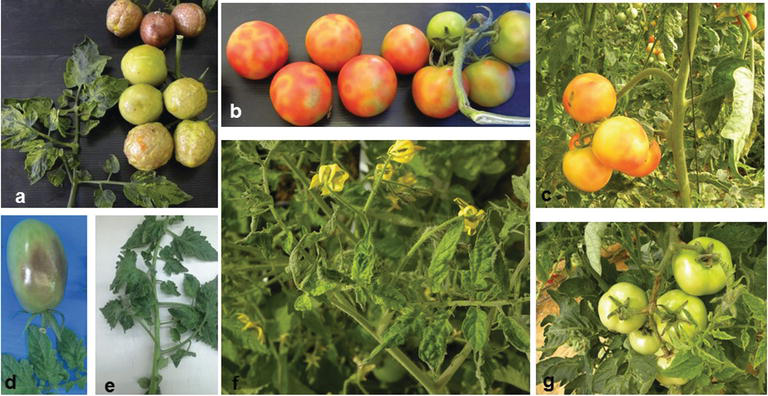
symptoms of tomato brown rugose fruit virus; Wikimedia
The US Department of Agriculture (USDA) is making efforts to strengthen pest prevention by setting up “early warning” systems. As part of this effort, the USDA-funded regional Integrated Pest Management Center in Raleigh, NC, has published a review of existing systems. These are intended to inform national phytosanitary agencies, such as APHIS, about pest species that might pose a threat to natural or agricultural resources. The ultimate goal is providing information that empowers the agency to enact effective preventive measures. [Noar et al. 2021. A full reference to the study is posted at the end of this blog.]
The review looked at six early warning systems’ goals, as well as their procedures for obtaining and disseminating information about potential threats. With one exception, these systems focus on plant pests.
The review did not undertake a rigorous analysis of the various programs’ efficacy.
The article points to the high economic costs associated with invasive plant pests. As a consequence of the huge volume of international trade – which is the principal vector of plant pests’ introduction – national phytosanitary agencies need information on which pests are moving most frequently, and on what commodities, so they can target the most risky pathways. The early warning systems are intended to do this before the pests are introduced to a new region. The several systems use different methodologies and criteria to identify such potential pests. They also are intended to raise awareness about high risk pests and pathways – but for different audiences.
Several of the early warning systems were set up and are managed by national phytosanitary agencies or their regional organizations. These include PestLens and the EPPO and NAPPO alert systems (described below). The article notes that these systems usually do not report diseases for which the causal agent has not been identified, because identification of the pathogen species is typically necessary before regulations can be adopted – and these are regulatory organizations. The authors do not analyze whether this constraint reduces the systems’ ability to provide timely warnings.
PestLens is an early warning system set up by APHIS. It therefore focuses on pests that might become quarantine pests – that is, subject to regulation under terms of the Plant Protection Act. Such pests must pose a defined threat to US agricultural and natural resources. PestLens monitors more than 300 sources, including scientific journals, reports from national phytosanitary agencies, Google alerts, newspapers, e-mail lists and other plant-health-related websites. PensLens staff evaluate the information for relevance to APHIS based on: a) whether the information is new to APHIS; b) whether the plant pest is of quarantine significance to the US; c) its potential economic impact if introduced; d) the likelihood of a pathway for introduction; and e) the likelihood that action by APHIS might be needed to prevent its introduction. Information considered relevant includes indication that a pest is associated with a previously unknown host, has been detected in a new location, or has been eradicated from a country. The information has not necessarily been confirmed by the country (warning included in PestLens notices).
When the PestLens criteria are met, the analysts write a brief article including the new information and any existing background, such as previously known host range and distribution. These articles are compiled into a weekly e-mail notification sent to PPQ employees and thousands of other subscribers. They are also archived on the PestLens website. APHIS staff evaluate the information and make decisions as to whether some regulatory action is appropriate.
I am puzzled because some of the five criteria appear to require a pest risk analysis. Pest risk analysis is a complex task that I do not believe PestLens is equipped to carry out – certainly not as quickly as is required by an alert system.
Update
A review of PestLens (Meissner et al. 2015; full citation at end of the blog) describes the system more fully. It found that during the period October 2012 – October, 2014, 73% of PestLens articles were based on articles in scientific journals; 17% on federal, state, or regional governmental sources; 8% fon news media sources; and 3% on other sources. The principal government pest reports used were from the web sites of IPPC, EPPO & NAPPO.
The majority of PestLens articles reporting new locations, interceptions, and new hosts came from journals. New pest descriptions, new reports of an organism as a pest, and articles on research of interest came exclusively from journals. Articles on pest detections, outbreaks, and eradications came largely from government sources.
Meissner et al. analyzed APHIS’ response to PestLens notices. They said that certain APHIS actions, such as the implementation of official control programs, initiation of research activities, or the formation of specliazed task groups were not captured in this analysis. They found that over a ten month period in 2014, APHIS used the PestLens notices to update its pest databases 350 times; updated pest datasheets or pest profiles on the PPQ website 16 times; evaluated a pest’s regulatory status (e.g., prepared a risk assessment) 11 times; and revised its regulations 4 times.
Meissner et al. consider that it is vital to maintain up-to-date databases, especially regarding pest host and distribution ranges. Another benefit from the PestLens system is a set of metrics to improve accountability, for example identifying duplication of efforts and providing permanent records of when actions are taken (or declined) and the rationale.
The European and Mediterranean Plant Protection Organization (EPPO) has 52 member countries stretching from Russia and Uzbekistan to Spain, Algeria, and Morocco, and including their off-shore islands. EPPO maintains a pest Alert List of species chosen by the EPPO Secretariat based on the scientific literature and suggestions by member’s phytosanitary agencies. Factors leading to a listing include newly described pests, reports of spread to new geographical locations, and reports of major outbreaks in the EPPO region. Each listed pest has a fact sheet which contains known hosts and distribution, the type of damage, the mode of dissemination, and potential pathways for spread. Some pests are selected for pest risk analysis (PRA). Once the PRA is completed, the pest might be placed on the EPPO A1/A2 lists, which are species recommended for regulation by the member states. Pests not selected for PRA stay on the EPPO Alert List temporarily, typically three years, then their information is archived.
The EPPO Secretariat also publishes a monthly Reporting Service newsletter, which details phytosanitary events that might threaten the EPPO region, including both officially designated quarantine pests as well as emerging ones. Information includes new hosts, new geographical locations, new pests, and new identification and detection methods.
The North American Plant Protection Organization (NAPPO) comprises Canada, the United States and Mexico. It has a web-based alert system that provides official pest reports from member countries. NAPPO also puts out Emerging Pest Alerts that contain news about plant pests and pathogens not established in this region. Sources are public, including scientific journals, newspapers, records from port interceptions, and domestic plant pest surveys. Generally NAPPO does not confirm its reports with the corresponding country’s phytosanitary agency.
4. IPPC Pest Reports
The International Plant Protection Convention (IPPC) has been ratified by more than 180 countries. The member countries’ phytosanitary agencies submit official pest reports concerning the occurrence, outbreak, spread, or eradication of organisms that are quarantine pests in that country or for neighboring countries and trading partners. These pest reports are posted on the IPPC website.
The International Plant Sentinel Network is a collaboration between the National Plant Diagnostic Network (NPDN) and the American Public Gardens Association. It is funded through cooperative agreements with APHIS under Section 10007 of the Farm Bill (Now Plant Protection Act §7721.) Launched in 2010, it has now grown to include more than 300 gardens across North America (information from the website).
The underlying premise is based on biogeography: plant-associated insects, fungi, and other pathogens introduced to plants that did not co-evolve with them (naïve plants) might cause unexpected damage. Since arboreta and botanical gardens cultivate many plant taxa outside their native range, they present an opportunity to observe new pest-host associations and the level of damage caused. Pests attacking native plants in North American botanical gardens might constitute “early detection” of a pest already in the country rather than a warning before the pest is introduced. Still, early detection is valuable.
The Program for Monitoring Emerging Diseases (ProMED) is a program of the International Society for Infectious Diseases (ISID). ProMED was launched in 1994 as an Internet service to identify unusual health events related to emerging and re-emerging infectious diseases and toxins affecting humans, animals and plants. It focuses on outbreaks in new geographic regions, newly described diseases, and diseases for which the causal agent is unknown. By its own estimation, ProMED is the largest publicly-available system conducting global reporting of infectious diseases outbreaks (information from the website). ProMED maintains several e-mail lists that disseminate information pertaining to disease outbreaks; subscribers can choose among lists to fit their areas of interest and their geographic region. ProMED has a much broader scope than the other early warning systems. Also, ituses informal and nontraditional sources, including local media, on-the-ground experts, and professional networks.
Stakeholders can access much of the information on these websites and use them to report findings of new alien species to phytosanitary agencies.
Gaps
The review of early warning systems has disappointing gaps. First, I am puzzled that the authors looked only at the U.S.-based sentinel gardens effort and did not consider a parallel international network. The International Plant Sentinel Network was established in 2013. It is coordinated by the Botanical Garden Conservation Initiative, headquartered at Kew Gardens, United Kingdom. At present, 67 gardens and arboreta are participating; they are located in China, Australia and New Zealand, South Africa, South America, and Europe (including the Caucuses Mountains). After all, it is this international network that could inform APHIS about potential pests when they observe attacks on North American plants growing in their facilities. I confess that it is not clear to me whether participating gardens and arboreta would take the initiative to inform APHIS of pest attacks on North American plant species. It might be that APHIS would need to send inquiries to participants, probably focused on named pests. If these caveats are true, the network might not be a fully functional “early warning” body.
Update
Indeed, the USFS International Programs office is cooperating with the International Plant Sentinel Network to have some botanic gardens around the world monitor several North American species planted at their locations for disease and pest problems. In June 2021 the USFS sought suggestions from contacts on which North American tree species should be monitored. Candidates could be tree species of high economic, ecological, or urban/landscape value. The candidate list would probably be limited to 10 species. They should represent a diverse range of conifers and hardwoods.
Second, the articles authors make no mention of one of the principal sources of information on plant pests – CABI (Center for Agriculture and Bioscience International). CABI is a global source of information on organisms’ distribution. It is particularly strong in Commonwealth countries – which are important sources of plant material imported into the U.S.
Third, they apparently did not assess phytosanitary alert systems in place or anticipated in Australia, New Zealand, and South Africa. This is a significant gap since these countries are leaders on phytosanitary issues. They are also potential sources of damaging pests.
Most disappointing is the lack of analysis of programs’ efficacy and weaknesses. The only step in this direction is contrasting ProMED’s willingness to report diseases for which the causal agent is unknown. PestLens, EPPO, and NAPPO refuse to do this. We desperately need an analysis of the extent to which this narrow concept of the task limits the ability of these systems to provide early warnings.
At least several of the networks, including PestLens and NAPPO, do not limit themselves to information that has been confirmed by countries – which might be reluctant to admit the presence of a damaging organism on their turf.
I suggest that it would have been particularly instructive to analyze the reasons why Australia’s early warning efforts failed to detect introduction of the myrtle rust pathogen sufficiently early to facilitate eradication.
This review did discuss how several of the networks tracked the global movement of the Tomato brown rugose fruit virus (ToBRFV). The virus was first detected in Jordan in 2015; this was reported by PestLens in 2016. PestLens reported the virus had spread to Israel 2017. The NAPPO system then reported the virus in Mexico in 2018. The virus was detected in the United States in 2018, although difficulties in taking official samples and diagnosing the virus probably delayed awareness of this outbreak. APHIS restricted imports of tomato and pepper seed, transplants and fruits from countries where the virus was known to be present in November, 2019. Still, APHIS acted after the virus had been detected in the country. ToBRFV has continued to spread; it is now found in Asia, Europe, the Middle East, and northern Africa. I am not completely convinced that this episode illustrates successful utilization of early warning networks. Did the apparently tardy action by APHIS arise from overconfidence that the virus would be limited to the Middle East? Or is it attributable to rules which limit agency actions until official confirmation of the detection? Another actor might have been delay in proving that the virus was being spread by the international seed trade; international phytosanitary rules require agencies to define the introductory pathway before regulating.
I hope other scientists will undertake a more comprehensive analysis of early warning systems. We need our phytosanitary systems to be made as effective as possible. Further evaluation of current efforts would provide valuable insight.
[A separate article reporting on the international sentinel gardens network from a British perspective is Marfleet, K. and S. Sharrock. 2020. The International Plant Sentinel Network: an update on phase 2. The International Journal of Botanic Garden Horticulture.]
SOURCES
Meissner, H., J. Fritz, L. Kohl, H. Moylett, J. Moan, S. Emerine, and A. Kaye. 2015. PestLens: An early-warning system supporting U.S. safeguarding against exotic plant pests. Bull. OEPP 45: 304-310
Noar, R.D, C.J. Jahant-Miller, S. Emerine, and R. Hallberg. 2021. Early Warning Systems as a Component of IPM to Prevent the Intro of Exotic Pests. Journal of IPM, (2021) 12(1): 16; 1–7 doi: 10.1093/jipm/pmab011
Posted by Faith Campbell
We welcome comments that supplement or correct factual information, suggest new approaches, or promote thoughtful consideration. We post comments that disagree with us — but not those we judge to be not civil or inflammatory.
For a detailed discussion of the policies and practices that have allowed these pests to enter and spread – and that do not promote effective restoration strategies – review the Fading Forests report at http://treeimprovement.utk.edu/FadingForests.htm
Ailanthus – one of the invasive species shared by South Africa and the U.S.
A few years ago, I posted a blog in which I pointed to a report on South Africa’s response to bioinvasion as a model for the U.S. and other countries. South Africa has published its second report. This report outlines the country’s status as of December 2019 and trends since the first report (i.e. since December 2016). (I describe the report’s findings on South Africa’s invasive species situation in a companion blog.) Again, I find it a good model of how a country should report its invasive species status, efforts, and challenges. In comparison, many U.S. efforts comes up short.
U.S. Reports Need to Be More Comprehensive
The South African report provides a national perspective on all taxa. Various United States agencies have attempted something similar a few times. The report issued by the Office of Technology Assessment in 1993 summarized knowledge of introduced species and evaluated then-current management programs.
The 2018 report by the U.S. Geological Service focused on data: the authors concluded that 11,344 species had been introduced and described the situation in three regions – the “lower 48” states, Alaska, and Hawai`i. However, the USGS did not evaluate programs and policies. The new USDA Forest Service report (Poland et al. 2021) describes taxa and impacts of invasive species in forest and grassland biomes, including associated aquatic systems. Again, it does not evaluate the efficacy of programs and policies.
The biennial national reports required by the Executive Order establishing the National Invasive Species Council (NISC) are most similar to the South African ones in intent. However, none has been comprehensive. For example, the most recent, issued in 2018, strives to raise concern by stating that invasive species effect a wide range of ecosystem services that underpin human well-being and economic growth. Some emphasis is given to damage to infrastructure. The report then sets out priority actions in six areas: leadership and prioritization, coordination, raising awareness, removing barriers, assessing federal capacities, and fostering innovation. NISC also issued a report in 2016 – this one focused on improving early detection and rapid response. NISC posted a useful innovation – a “report card” updating progress on priority actions — in October 2018. It listed whether actions had been completed, were in progress, or were no longer applicable. However, the “report card” gave no explanation of the status of various actions; the most notable omissions concerned the actions dismissed as “not applicable”. Worse, no report cards have been posted since 2018. I doubt if those or any more comprehensive reports will be forthcoming. This reflects the increasing marginalization of NISC. The Council has never had sufficient power to coordinate agencies’ actions, and now barely survives.
U.S. Reports Need to Be More Candid
The authors of the South African report made an impressive commitment to honest evaluation of the country’s gaps, continuing problems, progress, and strengths. As in the first report, they are willing to note shortcomings, even of programs that enjoy broad political support (e.g., the Working for Water program).
It is not clear whether decision-makers have acted — or will act — on the report’s findings. That is true in many countries, including the United States. However, that is separate whether decision-makers have an honest appraisal on which to base action.
Assessment of South Africa’s Invasive Species Programs
Here is a summary of what the authors say about South Africa’s invasive species program. I want to state clearly that my intention is not to criticize South Africa’s efforts. No country has a perfect program, and South Africa faces many challenges. These have been exacerbated by COVD-19.
The report identifies the areas listed below as needing change or improvement.
1) Absence of a comprehensive policy on bioinvasion. Such a policy would provide a vision for what South Africa aspires to achieve, clarify the government’s position, guide decision-makers, and provide a basis for coordinating programs by all affected parties (e.g., including conservation and phytosanitary agencies).
2) As in the first report, the authors call for monitoring program outcomes (results) rather than inputs (money, staffing, etc.) or outputs (e.g., acres treated). The authors also say data must be available for scrutiny. In those cases when data are adequate for assessing programs’ efficacy, they indicate that the control effort is largely ineffective.
3) Inadequate data in several areas. The report notes progress in developing and applying transparent and science-based criteria to species categorization as invasive (as distinct from relying on expert opinion). However, this change is taking time to implement, and sometimes results in species receiving a different rating. [I agree with the report that data gaps undermine understanding of the extent and impacts of bioinvasion, domestic pathways of spread, justification of expenditures, assessment of various programs’ efficacy (individually or overall), priority setting, and identifying changes needed to overcome programs’ weaknesses. However, I think filling these data gaps might demand time and resources that could better be utilized to respond to invasions – even when those invasions are not fully understood.]
4) Funding of bioinvasion programs by the National Department of Forestry, Fisheries, and the Environment has been fairly constant over 2012–2019, but this is a decline in real terms. The figure of 1 billion ZAR does not include spending by other government departments, national and provincial conservation bodies, municipalities, non-governmental organizations, and the private sector. Authors of the report expect funding to decrease in the future because of competing needs.
While at least 237 invasive species are under some management (see Table 5.1), funding is heavily skewed – 45% of funding goes to management of one invasive plant (black wattle); 72% to management of 10 species.
5) Need for policies to address the threat emerging from rising trade with other African countries, especially considering the probable adoption of the proposed African Continental Free Trade Area. Under this agreement, imported goods will only be inspected for alien species at the first port of entry, and most African countries have limited inspection capacity. [European pathologists Brasier, Jung, and others have noted the same issue arising in Europe, where imported plants move freely around the European Union once approved for entry by one member state.]
The authors of the South African report say programs’ efficacy would be considerably improved if species and sites were prioritized, and species-specific management plans developed. They warn that, in the absence of planning and prioritization, there is a risk that funding could be diluted by targeting too many species, leading to ineffective control and a concomitant increase in impacts.
In South Africa, regulations, permits, and other measures aimed at regulating legal imports of listed species are increasingly effective. However, there is still insufficient capacity to prevent accidental or intentional illegal introductions of alien species. There is also more enforcement of regulations requiring landowners to control invasive species. Six criminal cases have been filed and – as of December 2019, one conviction (guilty plea) obtained. However, the data do not allow an assessment of the overall level of compliance.
The report found little discernable progress on the proportion of pathways that have formally approved management plans. Management is either absent or ineffective for 61% of pathways. There has been no action to manage the ballast water pathway. On the other hand, in some cases, other laws focus explicitly on pathways, e.g., agricultural produce is regulated under the Agricultural Pests Act of 1983.
During the period December 2016 – December 2019, the Plant Inspection Services tested more than 12,000 plant import samples for quarantine pests and made 62 interceptions. The report calls for more detailed information from the various government departments responsible for managing particular pathways (e.g., the phytosanitary service), and for an assessments of the quality of their interventions.
The number of non-native taxa with some form of management has grown by 40% since December 2016 – although – as I have already noted — spending is highly skewed to a few plant species. The number and extent of site-specific management plans has also increased, apparently largely due to a few large-scale plans developed by private landowners. However, few of these plans have been formally approved by some unspecified overseer.
Citing the strengths and weaknesses described above, the current (second) report downgraded its assessment of governmental programs from “substantial” to “partial”.
Comparison to U.S.
How does the United States measure up on the elements that need change or improvement? I know of no U.S. government report that is as blunt in assessing the efficacy of our programs –individually or as a whole.
Nevertheless, each of the five weaknesses identified for South Africa also exist in the United States:
Re: lack of a comprehensive policy, I think the U.S. also suffers this absence. This is regrettable since the National Invasive Species Council (NISC) was set up in 1999.
Re: monitoring outcomes to assess programs’ efficacy, I think U.S. agencies do seem to be more focused on collecting data on programs’ results – see the Forest Service’ budget justification. However, I think too often the data collected focus on inputs and outputs.
Re: data gaps, I think all countries – including the U.S. — lack data on important aspects of bioinvasion. I differ from the South African report, however, in arguing for funding research aimed at developing responses rather than monitoring to clarify the extent of a specific invasive species. Information that does not lead to action seems to me to be a luxury given the low level of funding.
Re: funding, I find that, despite the existence of NISC, it remains difficult to get an overall picture of U.S federal funding of invasive species programs. Indeed, the cross-cut budget was dropped in 2018 at the Administration’s request. I expect all agencies are under-funded; I have often said so as regards key USDA programs. As in South Africa, funding is skewed to a few species that I think should be lower in priority (e.g., gypsy moth).
Re: upgrading invasive species programs to counter free-trade policies, I think U.S. trade policies place too high a priority on promoting agricultural exports to the detriment of efforts to prevent forest pest introductions. This imbalance might be present with regard to other taxa and pathways. See Fading Forests II here.
South African and U.S. agencies also face the same over-arching issues. For example, the U.S. priority-setting process seems to be a “black box.” Several USFS scientists (Potter et al. 2019) spent considerable effort to develop a set of criteria for ranking action on tree species that are hosts of damaging introduced pests. Yet there is no evidence that this laudable project influenced priorities for USFS funding.
SOURCES
Poland, T.M., P. Patel-Weynand, D.M Finch, C.F. Miniat, D.C. Hayes, V.M Lopez, editors. 2021. Invasive Species in Forests and Rangelands of the United States. A Comprehensive Science Synthesis for the US Forest Sector. Springer
Potter, K.M., Escanferla, M.E., Jetton, R.M., Man, G., Crane, B.S. 2019. Prioritizing the conservation needs of United States tree species: Evaluating vulnerability to forest P&P threats, Global Ecology and Conservation (2019), doi: https://doi.org/10.1016/j.gecco.2019.e00622.
SANBI and CIB 2020. The status of bioinvasions and their management in South Africa in 2019. pp.71. South African National BD Institute, Kirstenbosch and DSI-NRF Centre of Excellence for Invasion Biology, Stellenbosch. http://dx.doi.org/10.5281/zenodo.3947613
Posted by Faith Campbell
We welcome comments that supplement or correct factual information, suggest new approaches, or promote thoughtful consideration. We post comments that disagree with us — but not those we judge to be not civil or inflammatory.
For a detailed discussion of the policies and practices that have allowed these pests to enter and spread – and that do not promote effective restoration strategies – review the Fading Forests report at http://treeimprovement.utk.edu/FadingForests.htm