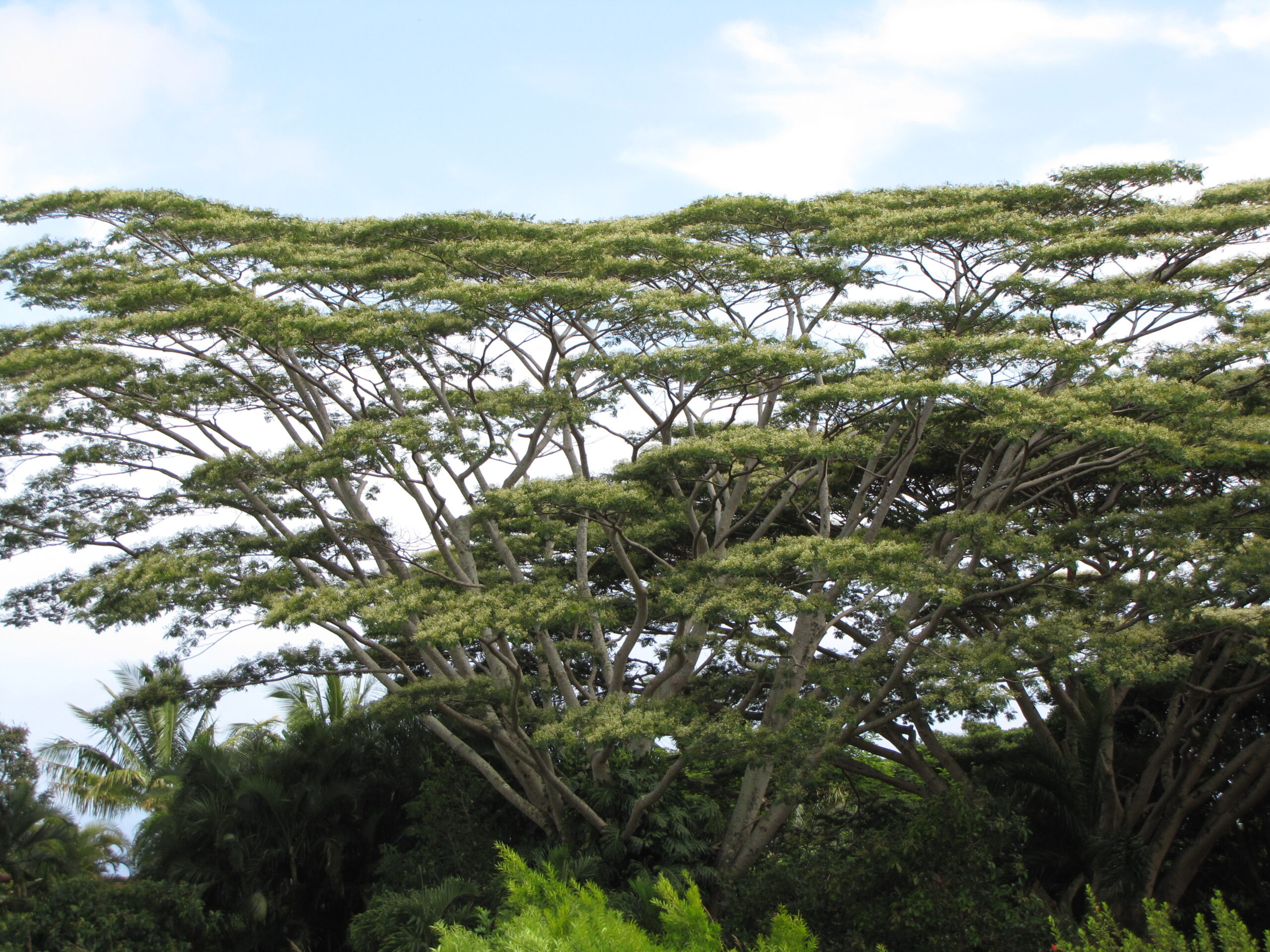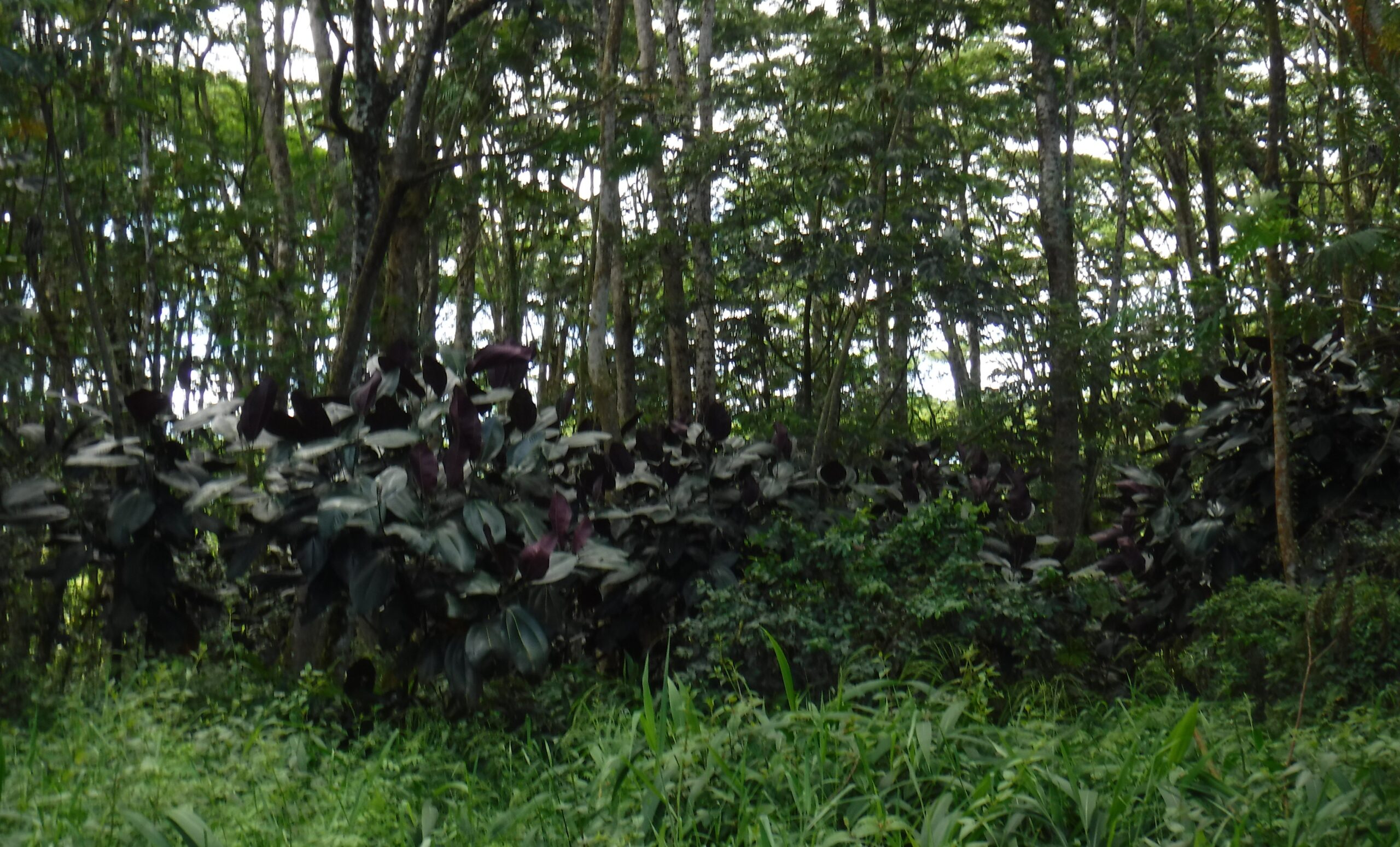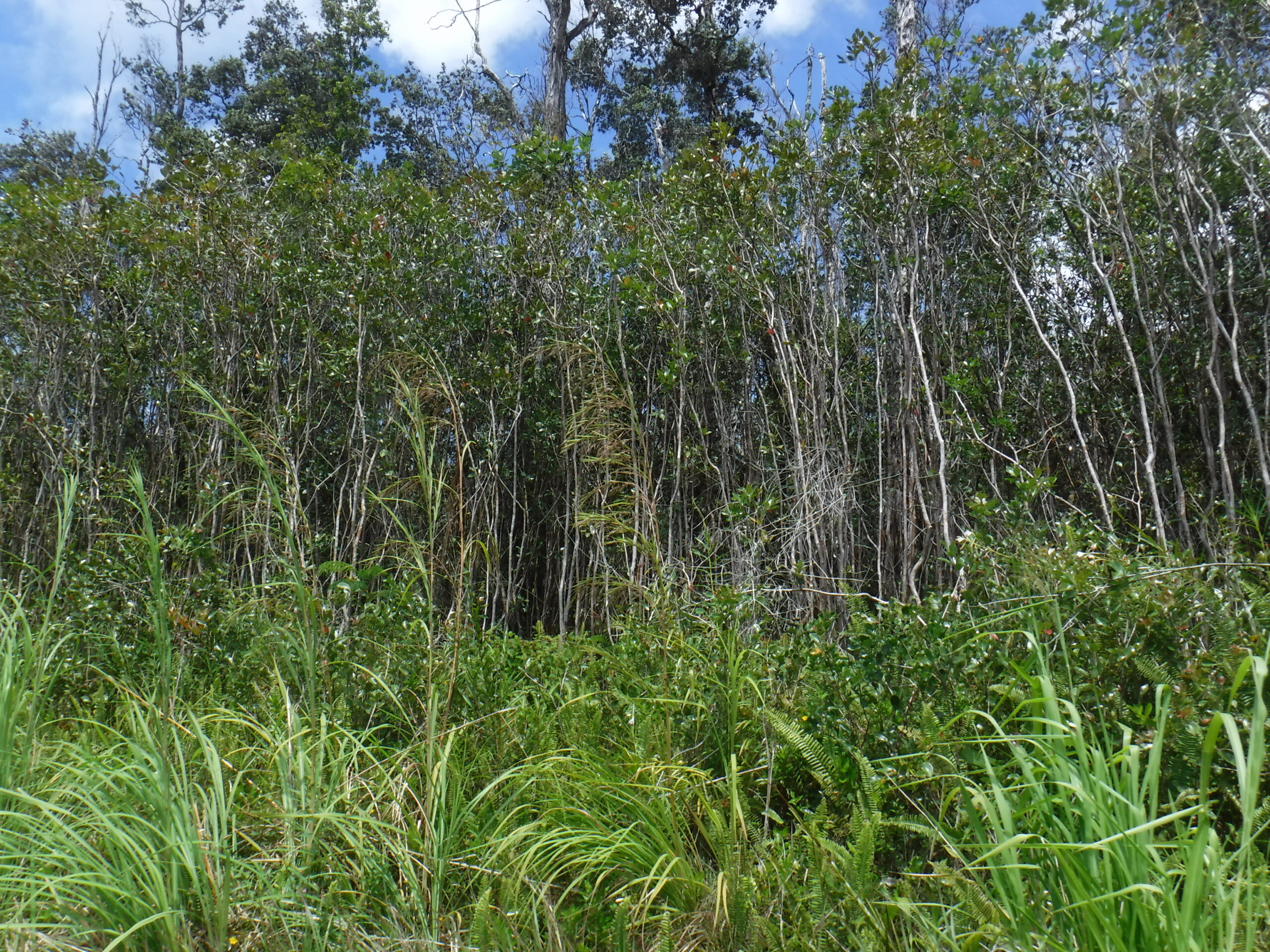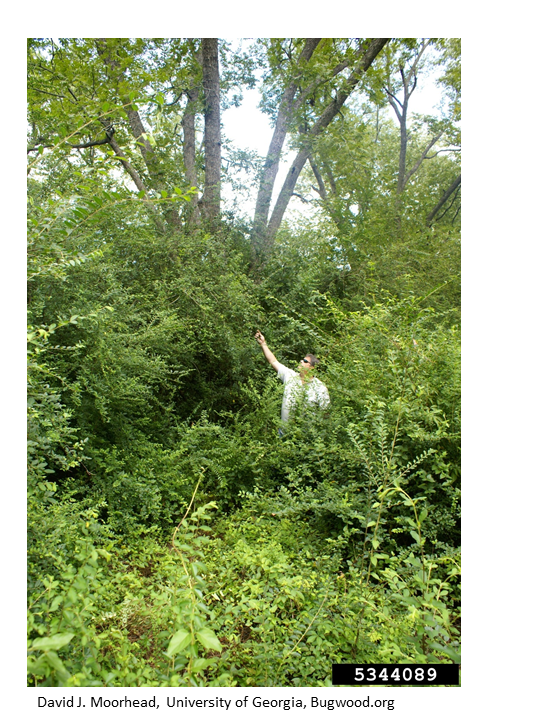
stand of Miconia under albizia overstory on Big Island, Hawai`i; photo by F.T. Campbell
As I will describe in another blog, participants in the annual meeting of the National Plant Board link in Honolulu learned the basics about the uniqueness of agriculture and native species on remote Pacific islands. I want to complement this information by reminding you about other Hawaiian and Guamaian species at risk – although did not learn anything new.
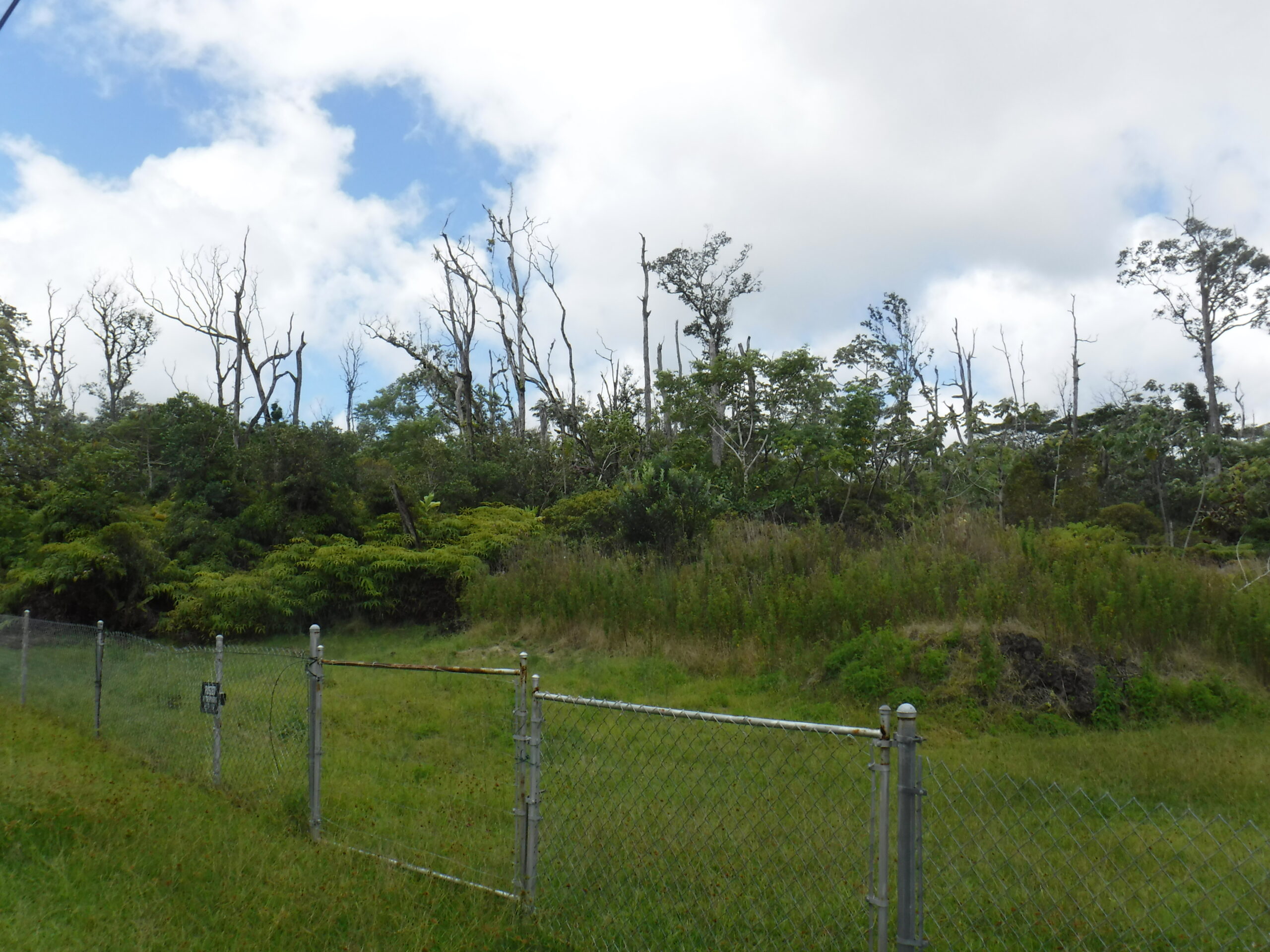
As Martin and Andreozzi pointed out, the Pacific islands import nearly all their food and other consumables. Considerable interest in some quarters in Hawai`i to increase agricultural production. However, large swaths of land in the low-elevation area surrounding Pahoa on the Big Island is completely dominated by the albizia (Falcataria Molucca) [see photo above]. J.B. Friday says it is cost-prohibitive to remove these trees in order to restore agriculture in the area. Local people are concerned because in storms the trees fall onto houses and roads, causing considerable damage.
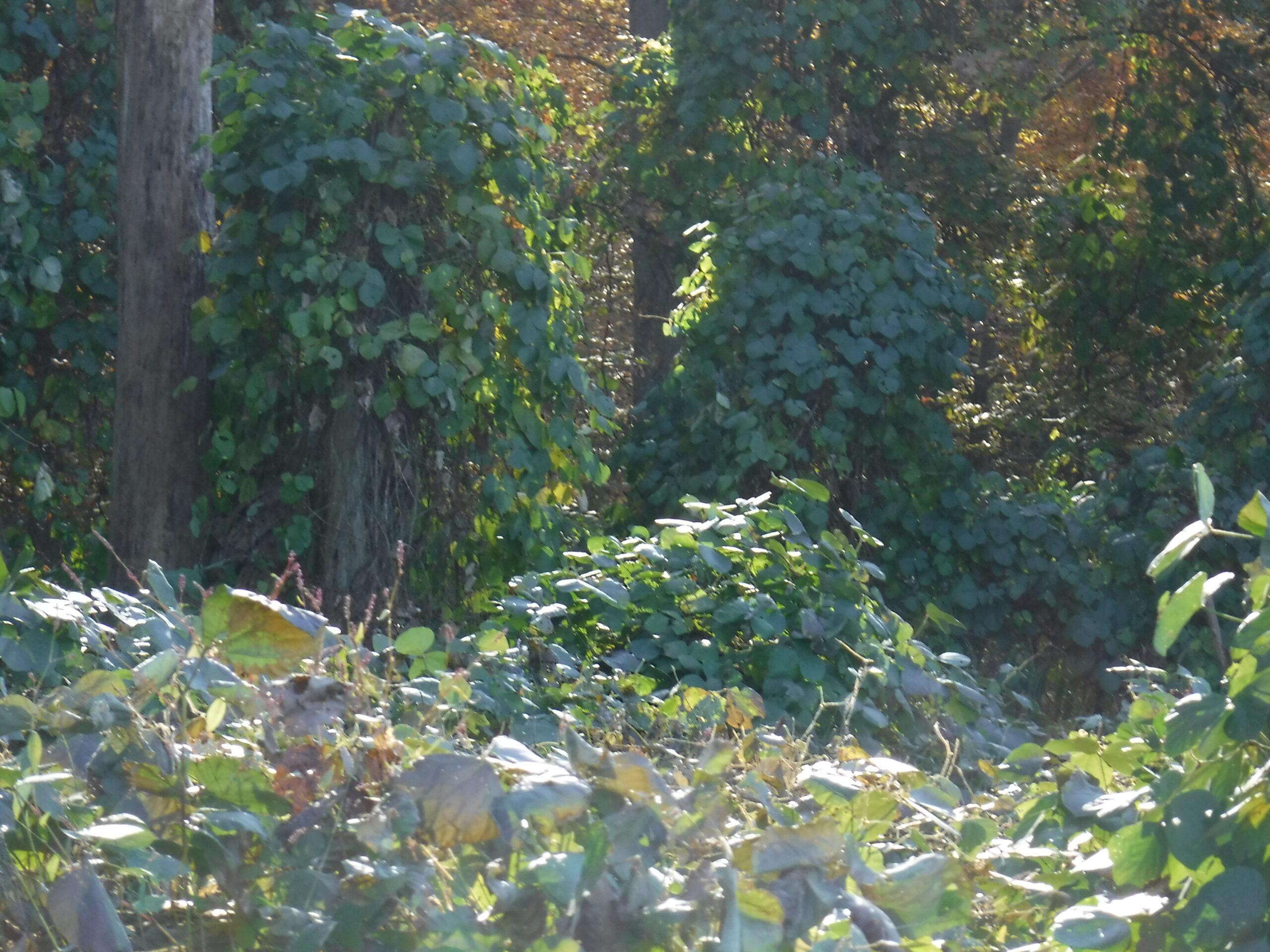
I saw numerous clumps of the notorious invasive plant Miconia calvescens. Dr. Friday told me that conservationists now focus on keeping this plant out of key areas, not trying to eradicate it completely.
area being restored by volunteers; photo by F.T. Campbell
Local people trying to restore disease-damaged forests by planting other native plants and hand-clearing invasive plants. Some of the ohia seedlings infected by Austropuccinia psidii.
ohia seedling with symptoms of ohia rust (Austropuccinia psdii); detected by J.B. Friday; photo by F.T. Campbell
Dr. Friday showed me many areas where ʻōhiʻa trees have been killed by rapid ʻōhiʻa death. Since this mortality occurred a decade or more ago, other plants have grown up. Pic In many if not most cases, this jungle includes dense growths of guava Latin the most widespread invasive tree on the islands (Potter). ‘Ōhi‘a trees continue to thrive in Hawai`i Volcanoes National Park – also on the Big Island – because the NPS makes considerable efforts to protect them from wounding by feral pigs. Demonstrates importance of fencing and mammal eradication in efforts to protect this tree species.
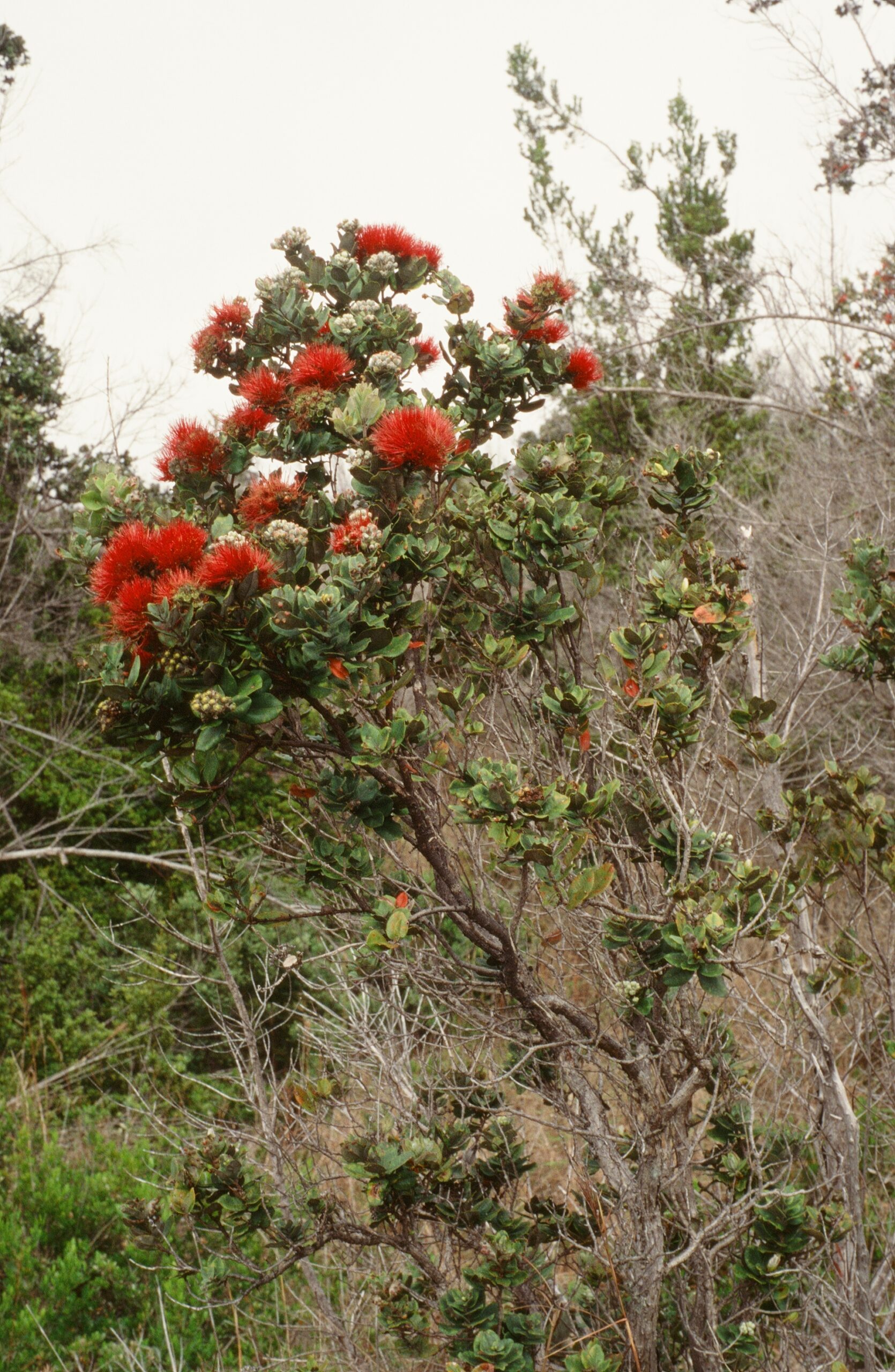
healthy ʻōhiʻa tree on cinder cone created by eruption of Kilauea Iki in 1959; photo by F.T. Campbell
I also saw healthy koa (Acacia koa) in the park, especially at sites along the road to the trail climbing Mauna Loa.
Regarding the wiliwili tree, I was told that it remains extremely scarce on Oahu.
wiliwili tree in flower; photo by Forrest Starr
I heard nothing about the status of naio – another shrub native to the Big Island – but on the dry western side of the island.
I rejoice that scientists are making progress in protecting and restoring Hawaii’s endemic bird species. Specifically, they are at the early stages of controlling mosquitoes that transmit fatal diseases. All 17 species of endemic honeycreepers that have persisted through the 250 years since Europeans first landed on the Islands are now listed as endangered or threatened under the federal Endangered Spp Act. The “Birds, not Mosquitoes” project has developed lab-reared male mosquitoes that, when they mate with wild female, the resulting eggs are sterile. (Male mosquitoes don’t bite, so increasing their number does not affect either animals or people.) Over time, the invasive mosquito population will be reduced, giving vulnerable native bird populations the chance to recover. Scientists began releasing these modified mosquitoes in remote forests on Maui and Kaua‘i in November 2023. In spring 2025, they began testing releases using drones. Use of drones instead of helicopters reduces the danger associated with flying close to complicated mountain rides in regions with variable weather. This project should be able to continue; the Senate Appropriations Committee report for FY26 allocates $5,250,000 for this project.
American Bird Conservancy is sponsoring a webinar about this program. It will be Wednesday, August 27, 2025 4:00 PM – 5:00 PM ET. Sign up for the webinar here
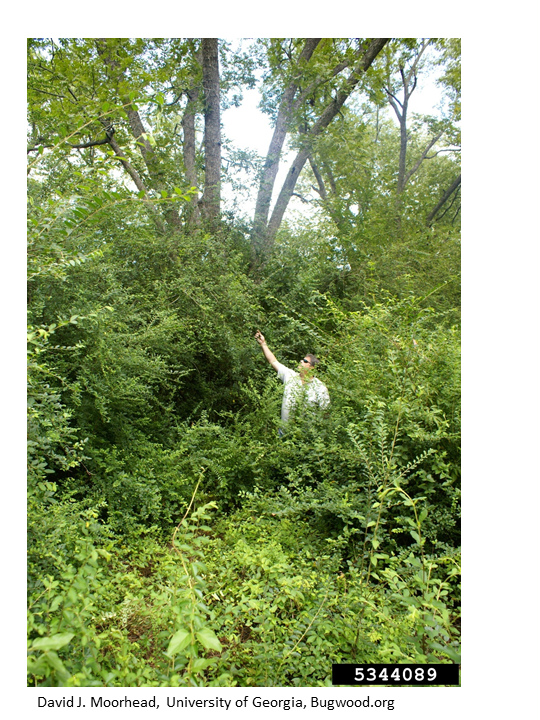
thicket of guava on the Big Island, Hawai`i; photo by F.T. Campbell
Finally, scientists are releasing a biocontrol agent targetting strawberry guava, Psidium cattleyanum, the most widespread invasive tree on the Islands (Potter et al. 2023). Distribution involves an interesting process. A stand of guava is cut down to stimulate rapid growth. The leaf-galling insect Tectococcus ovatus reproduces prolifically on the new foliage. Twigs bearing the eggs of these insects are collected and tied into small bundles. The bundles are then dropped from helicopters into the canopies of dense guava stands, where they establish and feed – damaging the unwanted host.
brown tree snake; photo via Wikimedia
Guam
Guam’s endemic birds have famously been extinguished by the non-native brown tree snake. Dr. Aaron Collins, State Director, Guam and Western Pacific, USDA APHIS Wildlife Services, informed participants at the National Plant Board meeting about the extensive efforts to suppress snake populations in military housing on the island, reduce damage to the electric grid, and prevent snakes from hitchhiking to other environments, especially Hawai`i and the U.S. mainland.
The program began more than 30 years ago, in 1993. The program now employs 80 FTEs and has a budget of $4 million per year. It was initiated because live and dead snakes had been found in shipments and planes that landed in Hawai`i and the U.S. mainland. Avoiding the snake’s establishment on Hawai`i is estimated to save $500 million per year. The program is a coordinated effort by USDA, U.S. Fish and Wildlife Service, and the Department of Defense. Probably this estimate helped advocates reverse a decision by the “Department of Government Efficiency” to defund the program.
The program enjoys some advantages over vertebrate eradication programs on the mainland. For example, since Guam has no native snakes, it can use poison, e.g., in mouse-baited traps that can be dropped from planes. A recent innovation is auto-resetting traps baited with mammals; they can electrocute numerous snakes per night.
SOURCE
Potter, K.M., C. Giardina, R.F. Hughes, S. Cordell, O. Kuegler, A. Koch, E. Yuen. 2023. How invaded are Hawaiian forests? Non‑native understory tree dominance signals potential canopy replacement. Lands. Ecol. https://doi.org/10.1007/s10980-023-01662-6
Posted by Faith Campbell
We welcome comments that supplement or correct factual information, suggest new approaches, or promote thoughtful consideration. We post comments that disagree with us — but not those we judge to be not civil or inflammatory.
For a detailed discussion of the policies and practices that have allowed these pests to enter and spread – and that do not promote effective restoration strategies – review the Fading Forests report at http://treeimprovement.utk.edu/FadingForests.htm
In June I visited Shenandoah National Park (SHNP) (above) for the first time in years. The Park’s forests are mostly mature secondary forests, having recovered over the 90 years since establishment from earlier logging and clearing for small-scale farms and pasture.
While I loved the forest and the vistas, I was aware of which species are missing …
Five years ago I blogged about a study by Anderson-Teixeira et al. (full citation at the end of this blog) that reported on the changes in the forests of SHNP and the neighboring Smithsonian Conservation Biology Institute (SCBI). This is important because, as Fei et al. (2019) (full citation at the end of this blog) documented, nine of the 15 most damaging introduced forest pests grow in eastern forests. In fact, the greatest increase in biomass loss has occurred in Eastern forests. Seven are found specifically in SHNP (Potter et al. 2019; full citation at the end of the blog).
Anderson-Teixeira et al. report that non-native forest pests caused a loss of about a quarter of ecosystem above-ground biomass between 1991 and 2013 across 66 sites. These invasions occurred after the worst impacts of chestnut blight, which entered the country ~120 years ago – before “modern” phytosanitary programs were instituted. Still, total above-ground biomass has largely recovered through germination and growth by trees in other genera. Greatest increases have been by tulip poplar (Liriodendron); oaks (Quercus); ash (Fraxinus) – but see below; birch (Betula); and maples (Acer). And while several taxa were lost from monitoring plots in SHNP and SCBI, a-diversity also remained steady.
So what does that look like on the ground?
American chestnut used to dominate many Eastern forests, composing more than one-third of the pollen assemblage in some stands (Fei et al.) According to Anderson-Teixeira et al., chestnut trees larger than 10 cm DBH disappeared by 1910, killed by chestnut blight. In past decades I frequently saw chestnut root sprouts when hiking. The National Park Service now urges visitors to hike to low elevation sections of the South River Trail to see such sprouts.
In the 1980’s, groves of eastern hemlocks occupied about 9,800 acres in SHNP, primarily in shaded valleys and along streams. Invasion by the hemlock woolly adelgid killed 95% of these hemlocks. Anderson-Teixeira et al. document the species’ disappearance from their study plots by 2007. Park staff treated more than 20,000 hemlocks using injections of imidacloprid. In 2015, the Park began partnering with Virginia Polytechnic Institute and State University in releasing predatory biocontrol beetles (Laricobius spp.) While the beetles have shown promising establishment and spread, it is now recognized that additional biocontrol agents will be needed to suppress the adelgid. The Park plans to allow releases of predatory silver flies (Leucotaraxis spp.) in remaining hemlock sites and will begin to phase out the imidacloprid treatments.
I remember the hemlocks! But this year, at least in the creek valleys where I hiked, I saw almost no remnants – not even fallen logs.
fallen hemlock; all photos by F.T. Campbell in Shenandoah NP in June 2025
And I remember the flowering dogwoods. They are almost gone now from the Appalachian chain, killed by dogwood anthracnose. Their status in SHNP is unclear. Anderson-Teixeira et al. report flowering dogwoods only from the Smithsonian property. There, they declined by almost 90% from the study plots from 2008 to 2019. The Park’s list of tree and shrub species reports that flowering dogwood is still “abundant”; my visit was too late in the season to observe how visible flowering dogwoods still are. Certainly the species survives the disease better in open settings, e.g., meadows and roadsides. I don’t know how the three other native Cornus species were affected.
Dead ash are still visible. Ash trees made up about 5% of the Park’s forest cover. Anderson-Teixeira et al. report that ash aboveground biomass was increasing in SHNP and stable on the SBCI property before arrival of the emerald ash borer (EAB). EAB-caused mortality was first detected in 2016. In just three years — by 2019 – 28% of green, white, and black ash had died; this meant a loss of 30% of ashes’ aboveground biomass. Ninety-five percent of remaining live trees were described as “unhealthy’’. In an effort to retain ash trees for visitor enjoyment, reduce threats to visitors from hazard trees, and to preserve a portion of the park’s ash tree communities until host-specific biological controls become available, SHNP staff – supported by specially trained volunteers and interns, Virginia Department of Forestry and Fairfax County – began treating high-value ash with emamectin benzoate. They began at Loft Mountain Campground, a location (elevation 3,300 feet) where ash trees make up most of the forest. Three hundred forty three trees were treated there — exceeding expectations for what could be accomplished in a single year. The park hopes to treat an additional 200-400 trees. They will target ash trees around campgrounds, picnic areas, overlooks and other areas frequently used by visitors. These efforts were supported by the Shenandoah National Park Trust and here.
I saw many dead oaks – probably the result primarily of repeated attacks by the spongy moth link beginning in 1982. Oak-dominated study plots in SHNP lost on average 25% of individuals and 15% of above-ground biomass. After 1995, when spraying of Bacillus thuringiensis var. curstaki improved control efforts (at the expense of native moths), oak aboveground biomass increased gradually, driven by individual tree growth rather than recruitment. Oak abundance continues to decline due to oak decline and absence of management actions to promote regeneration (Anderson-Teixeira et al.). These authors do not mention oak wilt although a decade-old map shows the disease to be present just to the west of the Blue Ridge (visible here).
Fortunately Shenandoah National Park has relatively few American beech, so it will be less affected by beech leaf disease (BLD). The Blue Ridge is also far from large waterbodies — which promote the disease. However, I did see some beech sprouting in creek valleys – probably in gaps opened when the hemlocks died. These valleys with higher humidity are the type of ecosystem most conducive to the disease! Anderson-Teixeira et al. note that they did not analyze the impact of beech bark disease – which was the disease of concern before arrival of BLD and continues to be present.
They also did not evaluate the impacts of balsam woolly adelgid, described as having decimated high-elevation populations of firs (Abies balsamea); white pine blister rust on eastern white pine; or EAB on fringetree (Chionanthus virginicus) in SCBI. Nor did they document the impact of thousand cankers disease (TCD) on walnuts or butternuts. This concerns me because they report that the disease “appears to be affecting Juglans spp. in our plots.” Furthermore, butternut (J. cinera) had been ‘‘common’’ in 1939, but had disappeared from SHNP by 1987. On the Smithsonian property, the four individuals found originally had declined by half – to two living individuals. Butternut has suffered high levels of mortality throughout its range from butternut canker.
The understory tree redbud (Cercis canadensis) also declined precipitously – by almost76% from 1995 to 2018 in SCBI plots. While Anderson-Teixeira et al. do not speculate why, a few years ago a wider decline was reported.
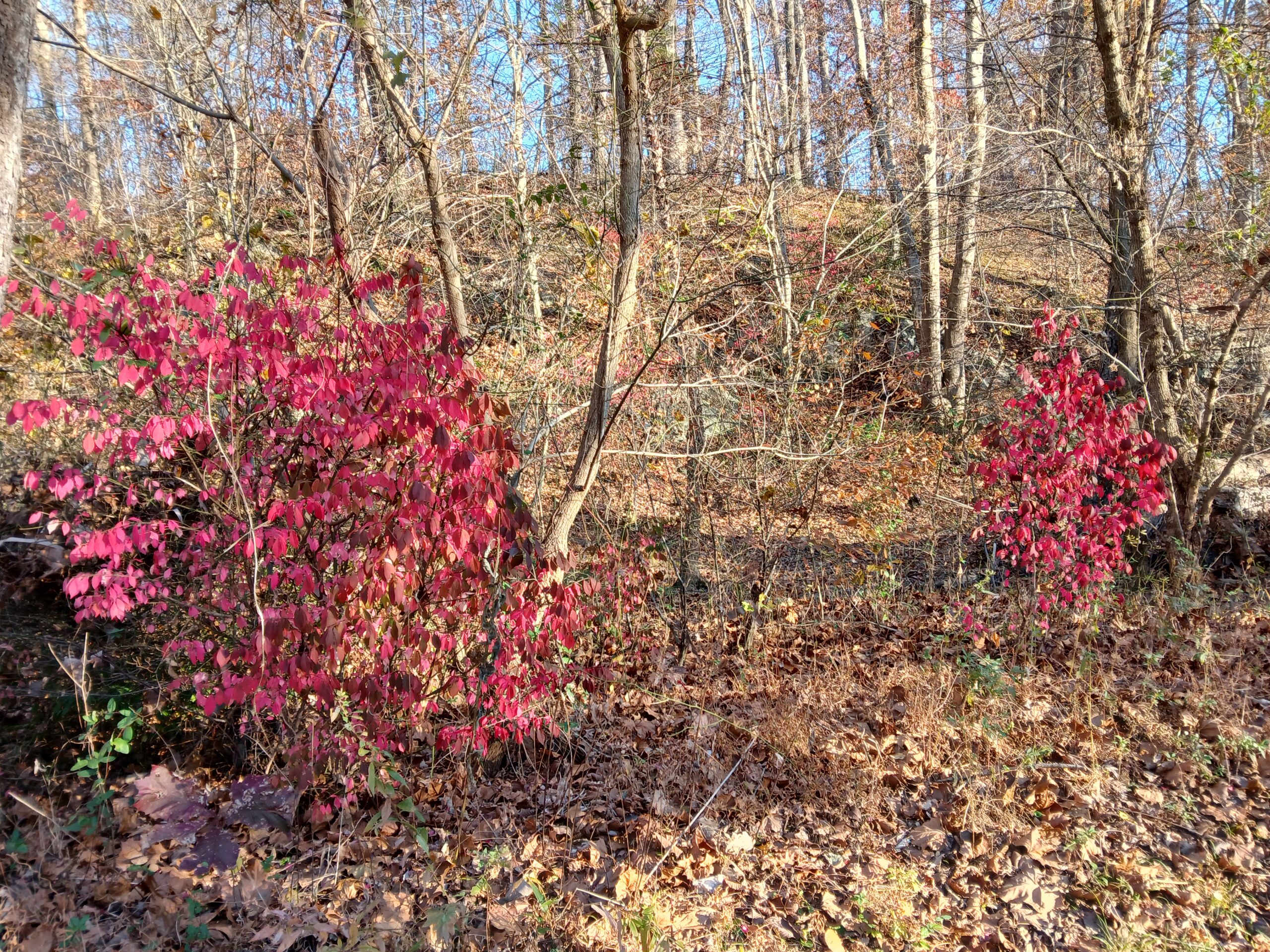
Of course, Shenandoah also has been invaded by non-native plants! So I saw some plants that should not be there. At least the mid- and high-elevations that I visited appear to be much less abundant in the Park than in coastal and piedmont regions of Virgina. Ailanthus is listed as “common” in the Park. I didn’t see Japanese stiltgrass but it is clearly present at lower elevations. I was particularly disturbed to see oriental bittersweet along trails located in all three sections of the Park.
Anderson-Teixeira, K.J., V. Herrmann, W.B. Cass, A.B. Williams, S.J. Paull, E.B. Gonzalez-Akre, R. Helcoski, A.J. Tepley, N.A. Bourg, C.T. Cosma, A.E. Ferson, C. Kittle, V. Meakem, I.R. McGregor, M. N. Prestipino, M.K. Scott, A.R. Terrell, A. Alonso, F. Dallmeier, & W.J. McShea. 2021. Long-Term Impacts of Invasive Insects & Pathogens on Composition, Biomass, & Diversity of Forests in Virginia’s Blue Ridge Mountains. Ecosystems
Fei, S., R.S. Morin, C.M. Oswalt, & A.M. Liebhold. 2019. Biomass losses resulting from insect & disease invasions in United States forests. Proceedings of the National academy of Sciences.
Potter, K.M., M.E. Escanferla, R.M. Jetton, G. Man, & B.S. Crane. 2019. Prioritizing the conservation needs of United States tree spp: Evaluating vulnerability to forest insect & disease threats. Global Ecology & Conservation.
Posted by Faith Campbell
We welcome comments that supplement or correct factual information, suggest new approaches, or promote thoughtful consideration. We post comments that disagree with us — but not those we judge to be not civil or inflammatory.
For a detailed discussion of the policies and practices that have allowed these pests to enter and spread – and that do not promote effective restoration strategies – review the Fading Forests report at http://treeimprovement.utk.edu/FadingForests.htm
ash tree killed by emerald ash borer; photo courtesy of (then) Mayor of Ann Arbor John Hieftje
Since the 1990s, scientists have been trying to the determine costs imposed by invasive species. They hope that measuring monetary costs will motivate political decision-makers to take more assertive actions to counter this ecological treat. As Daigne et al. (2021) point out, too few countries are implementing effective control and mitigation strategies. They say this inaction stems, largely, from undervaluing bioinvasions’ impacts by the general public, stakeholders and decision-makers.
A major step in this effort was creation of the InvaCost database. The goal was to provide a reliable, comprehensive, standardized and easily updatable synthesis of bioinvasions’ monetary costs worldwide.
Several publications based on this database appeared. I have blogged about studies published in 2021 or 2022: a) the costs of bioinvasions generally (Cuthbert et al. 2022); b) the costs imposed by invasive species in protected areas (Moodleyet al. 2022; c) a focus on the “worst” 100 invasives (as determined by the IUCN) (Ahmedet al. 2022); and d) assessing costs associated with various pathways of introduction (Turbelin et al. 2022).
The InvaCost database, as applied in these studies, demonstrated that bioinvasions impose tremendous costs –a minimum of US $1.288 trillion for the period 1970 – 2017. These costs increased on average three times per decade (Daigne et al. 2022).
Still, everyone has recognized that InvaCost data have significant limitations. First, three-quarters of the records in the original database came from North America, Oceania and Europe; and referred to animal taxa, even though plants are a major group of invaders. Also, a large proportion of total invasion costs – for all taxa – probably is undetected. Finally, the many non-market values of species and ecosystems are extremely difficult to calculate (Daigne et al. 2022).
As a result of these deficiencies, the earlier studies discussed in the blogs referenced above substantially underestimated the true costs associated with bioinvasion (Cuthbert et al. 2022).
Now a new study, led by Ismael Soto, finds that the underestimate is huge. Global costs associated with a subset of 162 species (17% of all the species in the InvaCost database) is nearly 17 times higher than reported in the InvaCost database.
Soto et al. (2025) applied species distribution models and macroeconomic data to interpolate these 162 species’ probable impacts in 172 countries
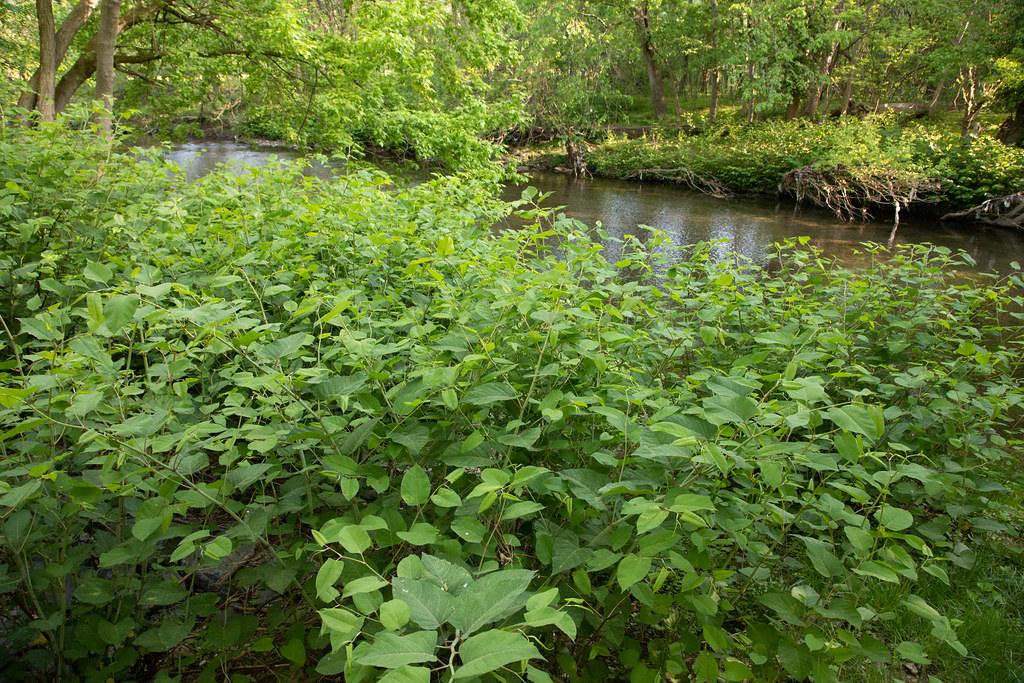
Japanese knotweed – one of the invasive plants proving very costly in Europe, according to I. Soto
The newly identified costs were greatest in Europe; second place fell to North America. This is because both higher damage costs and management expenditures are linked to higher gross domestic product and extent of agricultural area, in addition to environmental suitability. Analysis of monetary costs per unit area revealed that ‘cost hot spots’ are predominantly located in densely populated urban areas and locations hosting key industries. These tend to be in coastal zones, i.e., Europe, the east coast of China, and the east and west coasts of the US.
cypress aphid Cinara cupressi – a threat to both native & plantation trees in Africa; photo by Blackman & Eastop via Wikimedia
The authors found that the greatest increase in estimated costs for countries in Africa and Asia. These countries had not previously recorded any economic costs arising from invasions by these 162 species. I have blogged about forest pest threats in Africa.
The authors also significantly increased estimated costs linked to invasive plants. Daigne et al. found that invasive insects caused ~90% of reported costs in the InvaCost database as of 2022. Vertebrates ranked second, plants third. In contrast, Soto et al. determined that invasive plants had the highest average estimated damage costs (US $42.10 billion) and management expenditures ($0.81 billion).
Substantial total costs were also reported for arthropods, mammals and birds. Reported damage and management costs were much lower for molluscs, fish, reptiles and amphibians. Daigne et al. suggest this might be due to their lower (observable) damage to human infrastructure, research biases leading to fewer studies, or disparities resulting from the filtering process used in their own study.
Williams et al. (2023) focus on insects, which cause damage primarily to agriculture, human health, and forestry. Insects constitute the highest number of species introduced as ‘Contaminants’ (n = 74) and ‘Stowaways’ (n = 43). They also impose the highest costs among species using these two pathways.
Forest insects and pathogens account for less than 1% of the records in the InvaCost database. I believe that this figure reflects significant under-reporting of these invasion events. Even at this paltry level of reported invasions, forest insects and pathogens were responsible for causing 25% of total annual costs ($43.4 billion) (Williams et al. 2023). This discrepancy illustrates the huge economic cost associated with widespread mortality of trees. Yet authorities in most countries continue to provide completely inadequate resources to counter this threat.
The authors of these publications examining economic losses associated with bioinvasion all note that ecological damage is additional. Soto et al. note that bioinvasions contribute to 60% of already recorded global extinctions. Interestingly, the species ranked third using the criterion of monetary damage is the cactus moth Cactoblastis cactorum. This insect threatens flat-padded Opuntia cacti across the United States and in the center of endemism, Mexico.
a flat-padded Opuntia — vulnerable to the cactus moth; photo by F.T. Campbell
Soto et al. found a lag of ~46 years between first (reported) detection of an introduced species and the peak of damage costs. They suggest that the rising monetary cost reflects the species becoming more abundant or occupying a larger area. The authors also say this finding demonstrates the value of implementing mitigation measures as soon as possible. Their finding thus validates others’ advocacy for investing in prevention and rapid response measures (see Cuthbert et al. and Daigne et al.). Soto et al. were cheered by the fact that spending on management measures – when it was reported – often followed soon after a species’ detection – or even before (e.g., prevention).
But Decision-Makers Usually Delay – Why?
Prevention is a hard sell. Decision-makers find it difficult to justify management expenditures before impacts become obvious. By that time, of course, management of the invasion is extremely difficult and expensive – if it is possible at all. Ahmed et al. found particularly effective wording to describe this problem: bioinvasion costs can be deceitfully slow to accrue, so policy makers don’t appreciate the urgency of taking action. Another contributing factor is that when efficient proactive management succeeds in preventing any impact, it paradoxically undermines evidence of the value of this action!
Programs to minimize the economic and ecological consequences of bioinvasion are severely obstructed – if not doomed! – by the following difficulties:
Resources are in short supply. Experts find that demands to address other threats to agriculture or natural systems outcompete appeals to ramp up invasive species efforts.
Prediction is uncertain. Cuthbert et al. found that none of the species with the highest pre-invasion investment was among the top 10 costliest invaders in terms of damages. Cuthbert et al. do not discuss whether this is evidence that the prevention efforts were effective? Or, alternatively, that prevention efforts target the wrong species.
Harm is in the eye of the beholder. Stakeholders’ perceptions of whether an introduced species causes a detrimental impact vary. For example, Moodley et al. point out that species imposing the highest economic costs might not be the ones causing the greatest ecological harm.
Externalities. Those harmed by a bioinvasion often are different from those that decide whether to act. Ahmed et al. argue that this creates a moral dilemma.
These decisions are political — influenced by citizens’ expressed wishes. Changing decision-makers’ perceptions of what is important is up to us!!! Start a parade!!!
SOURCES
Ahmed, D.A., E.J. Hudgins, R.N. Cuthbert, .M. Kourantidou, C. Diagne, P.J. Haubrock, B. Leung, C. Liu, B. Leroy, S. Petrovskii, A. Beidas, F. Courchamp. 2022. Managing biological invasions: the cost of inaction. Biol Invasions (2022) 24:1927–1946 https://doi.org/10.1007/s10530-022-02755-0
Diagne, C., B Leroy, A-C. Vaissière, R.E. Gozlan, D. Roiz, I. Jaric, J-M. Salles, C.A. Bradshaw, and F. Courchamp. 2021. High and rising econ costs of bioinvasions worldwide Published online: 31 March 2021
Moodley, D., E. Angulo, R.N. Cuthbert, B. Leung, A. Turbelin, A. Novoa, M. Kourantidou, G. Heringer, P.J. Haubrock, D. Renault, M. Robuchon, J. Fantle-Lepczyk, F. Courchamp, C. Diagne. 2022. Surprisingly high economic costs of bioinvasions in protected areas. Biol Invasions. https://doi.org/10.1007/s10530-022-02732-7
Soto, I., P. Courtois, A. Pili, E. Tordoni, E. Manfrini, E. Angulo, C. Bellard, E. Briski, M. Buric, R.N. Cuthbert, A. Kouba, M. Kourantidou, R.L. Macêdo, B. Leroy, P.J. Haubrock, F. Courchamp and B. Leung. 2025. Using species ranges and macroeconomic data to fill gap in costs of biological invasions. Nat Ecol Evol doi: 10.1038/s41559-025-02697-5
Turbelin, A.J., C. Diagne, E.J. Hudgins, D. Moodley, M. Kourantidou, A. Novoa, P.J. Haubrock, C. Bernery, R.E. Gozlan, R.A. Francis, F. Courchamp. 2022. Introduction pathways of economically costly invasive alien spp. Biol Invasions (2022) 24:2061–2079 https://doi.org/10.1007/s10530-022-02796-5
Williams, G.M., M.D. Ginzel, Z. Ma, D.C. Adams, F.T. Campbell, G.M. Lovett, M. Belén Pildain, K.F. Raffa, K.J.K. Gandhi, A. Santini, R.A. Sniezko, M.J. Wingfield, and P. Bonello. 2023. The Global Forest Health Crisis: A Public Good Social Dilemma in Need of International Collective Action. Annual Review of Phytopathology Vol. 61, 2023
Posted by Faith Campbell
We welcome comments that supplement or correct factual information, suggest new approaches, or promote thoughtful consideration. We post comments that disagree with us — but not those we judge to be not civil or inflammatory.
For a detailed discussion of the policies and practices that have allowed these pests to enter and spread – and that do not promote effective restoration strategies – review the Fading Forests report at https://treeimprovement.tennessee.edu/
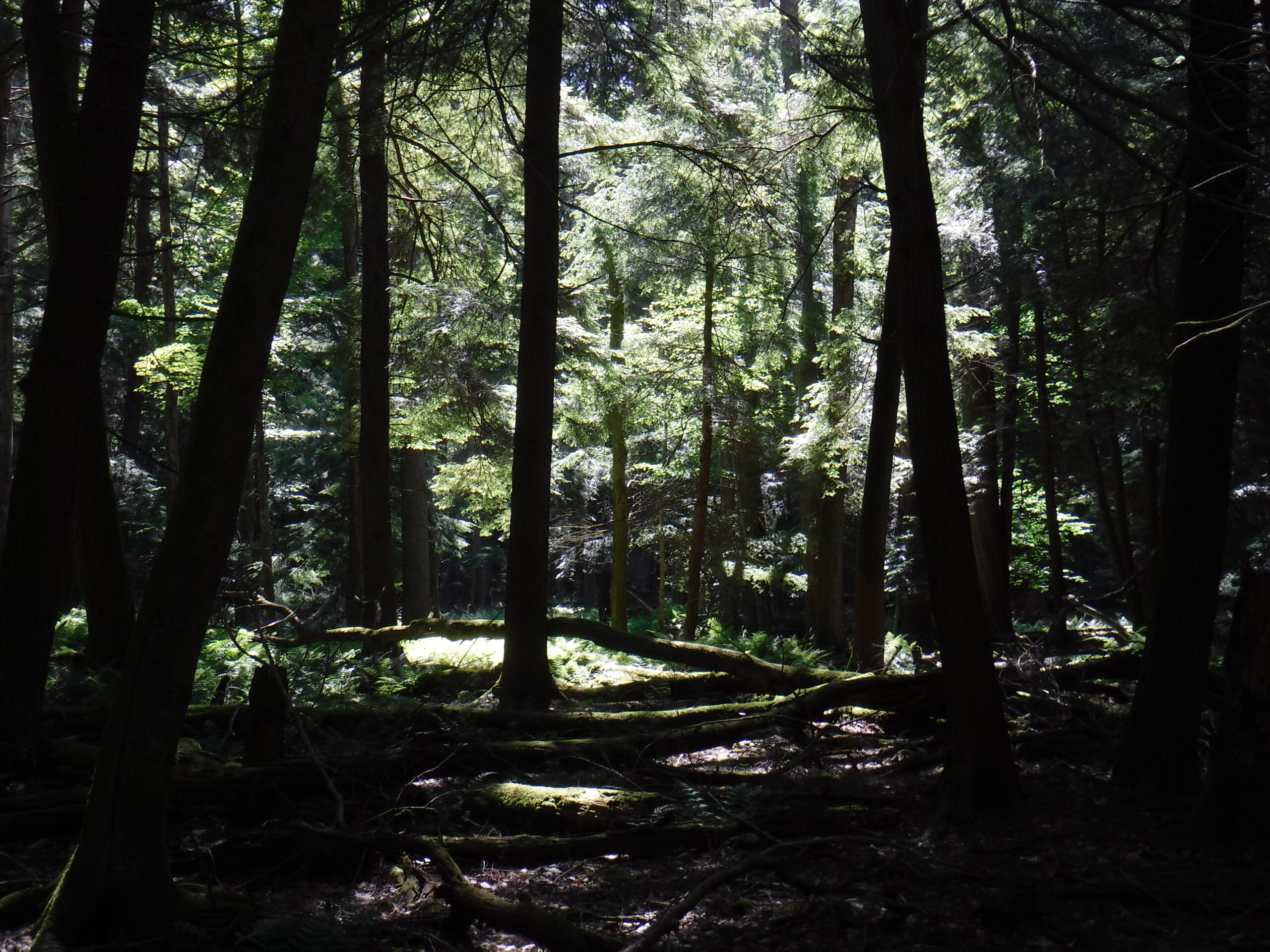
eastern hemlocks in Cook Forest State Forest Pennsylvania; photo by F.T. Campbell
As Eastern hemlock (Tsuga canadensis) suffers high levels of mortality across nearly all its range due to hemlock woolly adelgid (HWA; Adelges tsugae), scientists scramble to determine what the successor forests will look like. The transformation will be stark: from deeply shaded evergreen coniferous forest with a sparse understory to something very different. As this process takes place, most scientists expect cascading effects on not only terrestrial and aquatic wildlife but also onecosystem functions, including soils and nutrient and hydrologic cycles (Dharmadi et al. 2019 Plotkin et al. 2024).
New England
In southern New England, hemlock groves are being replaced by stands of deciduous hardwood forests dominated by black birch (Betula lenta). While birch are expected to continue to dominate, other species comprise at least one third of seedlings in the Harvard Forest experimental sites, primarily eastern white pine (Pinus strobus) and red maple (Acer rubrum). Plotkin et al. (2024) note that conversion of hemlock forests to pine forests would be a less dramatic ecosystem shift since both are evergreen conifers.
symptoms of beech leaf disease; photo by the Ohio State University
In both southern New England and farther north, in Vermont and New Hampshire, maples and American beech have increased in prominence. In the latter case, this is despite the prevalence of beech bark disease and managers’ efforts to suppress beech. I have noted that beech leaf disease now threatens to disrupt this process.
Landowners in the region often seek to get some financial return from their forests before a pest kills the trees. About a quarter of the almost 9,000 ha of hemlock stands in the southern Connecticut River Valley have been harvested as HWA spread into the area. To test the effect of pre-mortality logging of hemlock stands, Plotkin et al. tried to mimic HWA-caused mortality by girdling all the hemlocks in some plots in Harvard Forest. In other plots they harvested most hemlocks and some of the other tree species. The girdled plots had a dramatic increase in standing and downed deadwood and a longer period of elevated understory light levels than the logged plots. They note that standing snags and on-ground dead wood provide critical ecosystem functions. Many wildlife and microbial species depend on dead wood for nutrition and a variety of micro habitats. Plotkin et al. found that the slowly decomposing dead wood also stored a large amount of carbon: girdled plots stored 18% more above-ground carbon than logged sites, even after accounting for carbon stored in harvested wood products.
a beech snag with nesting cavities; photo by F.T. Campbell
The magnitude of these differences might be even larger than demonstrated in this experiment. In New England, hemlocks infested with HWA die over a decade, not the two years seen after girdling. The delayed mortality provides a longer window of opportunity for succeeding vegetation to adapt and preserve higher levels of biodiversity. Plotkin et al. (2024) suggest that logging pest-threatened hemlock forests might remove structural resources that would support forest response to ongoing climate stress and future disturbances.
Considering the disturbed plots’ invasibility by non-native plants, Plotkin et al. (2024) found that more non-native shrubs invaded the girdled plots than the logged plots. They suggest that birds that disperse the shrubs’ fleshy fruits were attracted by perch sites provided by the standing dead trees.
Southern Appalachians
In the Southern Appalachians, post-HWA forests will apparently be quite different. At the USDA Forest Service’ Coweeta Hydrologic Laboratory in the Nantahala Mountain Range of western North Carolina, eastern hemlock died much faster than in New England. Hemlocks comprised more than 40% of the basal area before arrival of HWA (detected in 2003). Within two years all hemlock trees were infested. Half were dead by 2010, 97% by 2014 (Dharmadi et al. 2919).
In some part of the southern Appalachian forests the shrub layer is dominated by Rhododendron maximum (rosebay rhododendron). This dense shrub layer is preventing recruitment of deciduous tree species that had been expected to replace the dead hemlocks. Tree seedlings died rather than grew into saplings. Scientists working in the Coweeta experimental forest attribute the seedlings’ demise to limited access to key resources, e.g., water, nutrients (especially inorganic nitrogen), and light (Dharmadi, Elliott and Miniat 2019).
In the Coweeta Basin, hemlock loss is the most recent of a series of severe disturbances that have apparently led to a cascade of responses in the overstory, midstory, and soil that have promoted expansion of rhododendron. (The earlier disturbances were widespread logging in the 19th Century and the loss of American chestnut to chestnut blight in the first part of the 20th Century. Therefore, the response of future forests to changes in temperature and rainfall might now depend on these novel tree-shrub interactions .
R. maximum hampers succession by forming a dense subcanopy layer that greatly limits light reaching the forest floor and reduces soil moisture and temperature. These changes impede seed germination and seedling survival. In addition, rhododendron leaves that fall to the ground create a thick organic soil layer that decomposes very slowly. This affects soil chemistry, specifically availability of the key nutrient nitrogen.
The rhododendron shrubs in the region are younger than the deciduous trees now making up the canopy above them (Dharmadi, Elliott and Miniat 2019). The dense rhododendron stands resulted from the widespread mortality of American chestnut (Castanea dentata) in the early 20th century and of hemlock in the first years of the 21st Century. What’s more, even the mature deciduous trees appear to be suppressed by dense rhododendron stands. Canopy trees above rhododendrons are on average 6m shorter than those growing on sites without rhododendron thickets (Dharmadi, Elliott and Miniat 2019). In fact, by 2014, 10% of standing trees other than hemlocks had died. The tree suffering the highest level of mortality was flowering dogwood (Cornus florida). The authors do not mention a probable factor, the introduced disease dogwood anthracnose.Other species experiencing high levels of mortality are not, to my knowledge, under attack by non-native pests, so their demise seems more clearly linked to resource competition with rhododendron. These were striped maple (Acer pennsylvanicum), pitch pine (Pinus rigida), witch hazel (Hamamelis virginiana), and that staple of New England aftermath forests, black birch (Betula lenta).
Dharmadi, Elliott and Miniat (2019) suggested that managers should step in to increase recruitment in both understory and overstory layers. They proposed active management: removing rhododendrons and the soil organic layer. USFS scientists are applying these ideas experimentally at the Coweeta research station. I am unclear as to whether there is one study or more. In any case, rhododendronplants have been removed with the goal of restoring vegetation structure and composition – presumably both understory plant diversity and recruitment of tree species capable of growing into the canopy. In at least some cases, the rhododendron removal is followed by prescribed fire. One study is looking also at whether this action increased water yield.
Apparently this lack of tree regeneration is extensive – although published data are not easily accessible. Staff of the North Carolina Hemlock Restoration Initiative report they encounter similar issues (O.W. Hall, Hemlock Restoration Initiative, pers. comm.)
Several experiments have demonstrated that even in the southern Appalachians, where there are abundant moisture and rainfall, the trees and shrubs compete for water and other nutrients. However, Dharmadi et al. (2022) found that removal of the rhododendron shrub layer is unlikely to significantly alter streamflow, atr least during the growing season. In winter, when deciduous trees lack leaves, reduction in interception of precipitation might result in increased streamflow (Dharmadi et al. 2022). I ask whether increasing stream flow in winter is a goal? I thought the concern was stream flow levels in summer.
Nor is removal of the rhododendron shrub layer likely to alter stream chemistry during the growing season.
Removal of living Rhododendron and leaf litter apparently can help restore forest structure through improving tree seedling survival and recruitment as well as increasing growth of established trees.
Removing Privet
However, other management actions might bring about desired changes more effectively or broadly. Specifically Dharmadi and colleagues mentioned removal of privet (Ligustrum) – a very widespread invasive shrub in forests of the Southeast. (Fifteen years ago it was estimated that just one privet species, Chinese privet, occupied more than a million hectares in 12 southeastern states [Hanula 2009].)
Chinese privet
I ask also whether prescribed fire to remove the rhododendron-dominated soil organic layer is useful. Dharmadi and colleagues found that such fires reduced leaf litter temporarily, but annual leaf-fall replaced the litter layer the next year, so this management effort is unlikely to affect plot evapotranspiration rates.
Supporting Pollinators
Another study (Ulyshenet al. 2022) examined whether removing rosebay rhododendron would benefit bees and other pollinators. They found that removal of Rhododendron alone (without fire) did not dramatically improve pollinator habitat in the southern Appalachians. In fact, about a quarter of the bee species studied visited R. maximum flowers and might decline if the shrub’s population is reduced. Ulyshen and colleagues suggest that some factors that correlate with fire severity probably promotes growth of insect-pollinated plants. They suggest specifically the greater presence of downed woody debris, which provides nesting sites and other resources used by insects. They recommended creation of open areas to support wildflowers as a more effective way to benefit bees in this region. Again, rhododendron removal pales in effectiveness compared to eradication of privet.
SOURCES
Dharmadi, S.N., K.J. Elliott, C.F. Miniat. 2019. Lack of forest tree seedling recruitment and enhanced tree and shrub growth characterizes post-Tsuga canadensis mortality forests in the southern Appalachians. Forest Ecology and Management 440 (2019) 122–130.
Dharmadi, S.N., K.J. Elliott, C.F. Miniat. 2022. Larger hardwood trees benefit from removing Rhododendron maximum following Tsuga canadensis mortality. Forest Ecology and Management
Hanula, J.L., S. Horn, and J.W. Taylor. 2009. Chinese Privet (Ligustrum sinense) Removal and its Effect on Native Plant Communities of Riparian Forests. Invasive Plant Science and Management 2009 2:292–300.
Plotkin, A.B., A.M. Ellison, D.A. Orwig, M.G. MacLean. 2024. Logging response alters trajectories of reorganization after loss of a foundation tree species. Ecological Applications. 2024;e2957.
Ulyshen, M., K. Elliott, J. Scott, S. Horn, P. Clinton, N. Liu, C.F. Miniat, P. Caldwell, C. Oishi, J. Knoepp, P. Bolstad. 2022. Effects of Rhododendron removal and prescribed fire on bees and plants in the southern Appalachians. Ecology and Evolution. 2022;12:e8677.
Posted by Faith Campbell
We welcome comments that supplement or correct factual information, suggest new approaches, or promote thoughtful consideration. We post comments that disagree with us — but not those we judge to be not civil or inflammatory.
For a detailed discussion of the policies and practices that have allowed these pests to enter and spread – and that do not promote effective restoration strategies – review the Fading Forests report at https://treeimprovement.tennessee.edu/
emerald ash borer; some of PPA grants are funding evaluation of biocontrol efficacy
USDA APHIS has released information about its most recent annual allocation of funds under the Plant Pest and Disease Management & Disaster Prevention Program under §7721 of the Plant Protection Act. (Also see Fading Forests II and III; links provided at the end of this blog.) These funds support both critical needs and opportunities to strengthen the nation’s infrastructure for pest detection, surveillance, identification, and threat mitigation. Since 2009, this USDA program has provided nearly $940 million to more than 5,890 projects.
For FY25 APHIS allocated $62.725 million to fund 339 projects, about 58% of the proposals submitted. About $10 million has reserved for responding to pest and plant health emergencies throughout the year.
According to APHIS’ press release, the highest amount of funds (almost $16 million) is allocated to the category “Enhanced Plant Pest/Disease Survey.” Projects on “Enhanced Mitigation Capabilities” received $13.6 million. “Targetting Domestic Inspection Efforts to Vulnerable Points” received nearly $6 million. “Improving Pest Identification and Detection Technology” was funded at $5 million. Outreach & education received $4 million. I am not sure why these do not total $63 million.
Funding for States and Specific Pests
Wood-boring insects received about $2.3 million. These included more than $869,800 to assess the efficacy of biocontrol for controlling emerald ash borer (EAB) Agrilus planipennis, $687,410 was provided for various detection projects, and $450,000 for outreach efforts related to various pests. Ohio State received $93,000 to optimize traps for the detection of non-native scolytines (bark beetles).
Biocontrol efficacy will also be assessed for hemlock woolly adelgid, invasive shot hole borers, cactus moth, and several invasive plants (including Brazilian pepper). (Contact me to obtain a copy of CISP’s comments on this biocontrol program.)
Opuntia basilaris in Anza Boreggo; one of flat-padded Opuntia vulnerable to the cactus moth; photo by F.T. Campbell
Funding for other pests exceeded $1 million for spotted lanternfly (nearly $1.4 million), Asian defoliators ($1.2 million) and box tree moth (just over $1 million).
$630,000 was provided for detection surveys and studies of the sudden oak death pathogen Phytophthora ramorum, especially how it infects nursery stock. Nursery surveys are funded in Alabama, Louisiana, North Carolina, Ohio, Oklahoma, Pennsylvania, South Carolina, Tennessee, Virginia, and West Virginia. Most of these states are in regions considered most at risk to SOD infection of wildland plants.
sudden oak mortality of tanoak trees in southern Oregon; photo by Oregon Department of Forestry
Oregon received much-deserved $41,000 to evaluate the threat of the NA2 and EU2 lineages of P. ramorum to nurseries and forests Oregon also received $104,000 to respond to the detection of Phytophthora austrocedri in nurseries in the state. The Oregon outbreak has been traced to Ohio, but I see no record of funds to assist that state in determining how it was introduced.
Asian defoliator (e.g., Lymantrid moths) surveys have been funded for several years. This year’s projects are in Alaska, Arkansas, California, Kentucky, Maryland, Massachusetts, Mississippi, Montana, Nevada, North Carolina, Oregon, Tennessee, Texas, Washington, and West Virginia. While I agree that the introduction risk is not limited to coastal states with maritime ports, I don’t what criteria were applied in choosing the non-coastal states which are funded to search for these insects
Spotted lanternfly surveys (including technological improvements) or related outreach are funded in Alabama, Connecticut, Delaware, Kentucky, New Hampshire, New Jersey, North Carolina, Oregon, Pennsylvania, and Tennessee. California’s project is focused on postharvest treatments.
The Don’t Move Firewood project continues to be funded by APHIS. Several states also direct attention specifically to the firewood pathway: Kentucky, Maine, and Michigan.
I applaud the precautionary funding of the Agriculture Research Service to generate of high-quality genomic resources for managing the causal agent of Japanese oak wilt Dryadomyces quercivorous
Florida Department of Agriculture, North Carolina State University, and West Virginia University each received more than $100,000 to improve detection and management of invasive hornets.
Tennessee State University got $100,000 to continue efforts to detect and understand Vascular Streak Dieback in redbud Cercis canadensis.
Posted by Faith Campbell
We welcome comments that supplement or correct factual information, suggest new approaches, or promote thoughtful consideration. We post comments that disagree with us — but not those we judge to be not civil or inflammatory.
For a detailed discussion of the policies and practices that have allowed these pests to enter and spread – and that do not promote effective restoration strategies – review the Fading Forests report at https://treeimprovement.tennessee.edu/
Yet again, studies focusing on issues of regeneration and mortality failing to consider all aspects.
Two studies focused on persistence of oak forests – a topic of great concern because of economic and ecological importance of oak-dominated forests. Since they dominate forests covering 78.5 million ha (51% of all forestland in the eastern United States) (Dey 2013), oaks shape stand structure and composition; their extensive crowns support many bird and arboreal mammal species; their acorns and leaf litter are the foundation of complex food webs; they live in symbiotic relationships with mycorrhizal fungi that enhance nutrient cycling and uptake within forest ecosystems. Deep roots prevent soil erosion. Oaks play a pivotal role in carbon sequestration (Khadka, Hong, and Bardhan 2024).
Until recently concern has focused on mortality of species in the red oak group (Section Lobatae). Now there is increasing concern about white oak (Quercus alba) mortality. Forest managers reported elevated mortality not just in resource-limited sites,e.g., those characterized by drought conditions, poor drainage, and soil nutrient deficiencies. Deaths are also occurring in higher-quality mesic sites, especially in forests with high stand density and advanced maturity stages. While white oaks go through a self-thinning phase – when dense stands of younger trees compete intensely for limited resources –it appears that some of the concern is focused on this stage (Khadka, Hong, and Bardhan 2024).
I think much of the concern is driven by economic rather than ecological considerations. None of oak species mentioned by Duana et al. (2024) is considered at risk by the authors of the recent conservation gap analysis (Beckman et al. 2019). (This is not surprising since presumably these species are sufficiently numerous to support commercial harvests). Furthermore, complaints about forest regeneration in the East are broader than oaks. A multi-author examination of the future of the northern forest projected decreases for four forest types = aspen-birch, elm-ash-cottonwood, oak-hickory, and spruce-fir. One type –maple-beech-birch – was expected to expand (Shifley and Moser 2016).
Regarding oaks specifically, Khadka, Hong, and Bardhan (2024) found that 30% of FIA plots in ten states composed primarily of white oak met their criteria for considering white oaks to be “declining”. However, higher mortality was limited to scattered areas (see map in Fig. 2B in the article). They suggested that contributing factors included higher elevation and distance from water in the north, intense competition in central regions, and drought stress in oak-hickory forests in the south. They also mentioned mature stands which are not replacing themselves in the southern region. Khadka, Hong, and Bardhan (2024) noted that oak decline complex is a factor in the southern region, and localized non-native insect pests (apparently spongy moth) in the northern region. (I will discuss both regeneration failures and the impacts of non-native pests below.) Still, these authors focus most attention to environmental stresses, e.g., droughts or water logging, poor soils, extreme weather events; and to human management, e.g., fire suppression, logging intensity, edge effects. They suggest strategies for mitigating these factors.
A second study, published by Duana et al. (2024), considered stocking levels of several species of oaks (Q. alba, Q. coccinea, Q. prinus, Q. rubra, and Q. velutina) but limited themselves to a large, temperate hardwood forest landscape in southeastern Ohio. Their purpose was to evaluate the efficacy of two levels of silvicultural intervention in sustaining oaks and restraining maples over the long-term, defined as 150-years (to 2060).
red oak (Quercus rubra); photo by F.T. Campbell
Their model suggested that continuing “business as usual” management would result in oaks shrinking from 22.8% dominance in 2010 to 12% dominance in 2160. Many of the remaining oaks would be large — in the 70 cm DBH class. The undesired maples would rise from 23% of total relative dominance in 2010 to 58% in 2160. The maples grew to almost the same size as the oaks: 50–65 cm DBH. As a result of these developments, the maple basal area increase by more than five times. The basal area of early successional species, e.g., poplars and aspens, decreased from 25% dominance to 11% dominance by 2160. Shade-tolerant species like elms, hickories, beech, and hemlock were suppressed by more competitive maples, occupying 17% of the total dominance.
Under the more manipulative alternative management strategy, oaks’ relative dominance on private land would stay above 20% of total relative dominance; all ages and sizes would be present. Maples would hold steadier at 23% to 33%. Shade-tolerant species would also rise, reaching a quarter of relative dominance on private some site (private public lands).
Duana et al. (2024) explained the outcome of “business as usual” management on maples’ ability to thrive in shaded conditions while oak regeneration requires sunlight to reach the forest floor. Another factor is the prevalence of high-grading harvesting practices. These factors result in a significant absence of oak trees in the sapling and midstory sizes, reflecting challenges to both oak seedlings and saplings. In other words, despite the continued growth of mature overstory oaks, the trees cannot reproduce. As Duana et al. (2024) point out, these results are supported by other field-based studies — including ones I have blogged about. Duana et al. (2024) discuss barriers and incentives to private landowners adopting more active management.
However, as I pointed out above, many tree species are regenerating poorly, not just oaks. Indeed, none of the eastern species fulfilling Potter and Riitters’ (2022) criteria for species threatened by poor regeneration was an oak. See Table 2 in Potter and Riitters (2022).
American sycamore (Platanus occidentalis) – one of the tree species not regenerating adequately; photo by F.T. Campbell
Hanberry et al. (2020) found that actual changes in forest species composition and density do not conform to expectations arising from three factors proposed as drivers: increased precipitation, increased white-tailed deer densities, and functional extinction of American chestnut. They found disappearance of frequent low-intensity fires to be determinative. However, Hanberry et al. (2020) also do not mention invasive plants or non-native pests other than chestnut blight.
Here I review others’ discussion of browsing by overabundant deer and competition from non-native plants as factors widely recognized as impeding regeneration of canopy trees, including oaks.
Deer
There is widespread agreement that browsing by overabundant deer is a major cause of poor regeneration of deciduous forests, especially but not limited to oaks (Quercus species.). Sources cited in my previous blogs include most studies discussed at the 2023 Northern Hardwood research forum (USDA, FS 2023b Proceedings), Spicer et al. (2023), Miller et al., and two studies based in either Ohio (the location of the study by Duana et al. [2024]) or neighboring Pennsylvania: Yaccuci et al. (2023) and Reed et al. 2023. Yacucci et al. reported that stem density of red (Q. rubra) and pin oaks (Q. palustris) was 13 times higher in canopy gaps located in areas with low densities of deer than in gaps in high-deer-density locations. In these gaps, oak saplings were growing into the subcanopy. Reed et al. said deer herbivory might be one of the most important drivers of forest composition and canopy structure over long time-scales.
Deer might be less important in New England. Stern et al. (2023), working in Vermont, focused on the importance of changing precipitation patterns in shifting numbers of red maple (Acer rubrum), sugar maple (Acer saccharum), American beech (Fagus grandifolia), and yellow birch (Betula alleghaniensis). Northern red oak was described as a common co-occurring dominant species in their plots, but was not discussed. In New Hampshire, Ducey et al. reported changing species composition as the forest ages but did not mention deer.
Some of these authors advocated wide-scale efforts to reduce deer populations in order to restore forest ecosystems. Yacucci et al. proposed enlisting those military posts that regularly cull deer into efforts to conserve and regenerate native plants. Otherwise, they say, the prognosis for regeneration is poor. Blossey et al. urged creation of a nation-wide lethal removal program.
Some of these studies indicated that additional biological entities were also important. Miller et al. stressed the role of invasive plants in suppressing forest regeneration in National parks from Virginia to Maine. Reed et al. focused on invading earthworms. One study – again, conducted in Ohio – Hovena et al. (2022), found that interactions between non-native shrubs and soil wetness overshadowed even the impact of deer herbivory on the species richness and abundance of seedlings.
Invasive Plants
FIA data indicate that 46% of forests in the eastern United States are invaded by alien plant species (Oswalt et al. 2016). Across the region, hundreds of non-native plant species are established in forests and woodlands. (See lists compiled by the Southeast Exotic Pest Plant Council, Mid-Atlantic Invasive Plant Council, Midwest Invasive Plants Network). Forests of the northern Midwest are among the most heavily invaded; in Ohio specifically, two studies found that more than 90% of FIA plots harbor at least one invasive plant species (Oswalt et al. [2016] and Kurtz (USDA NRS 311).
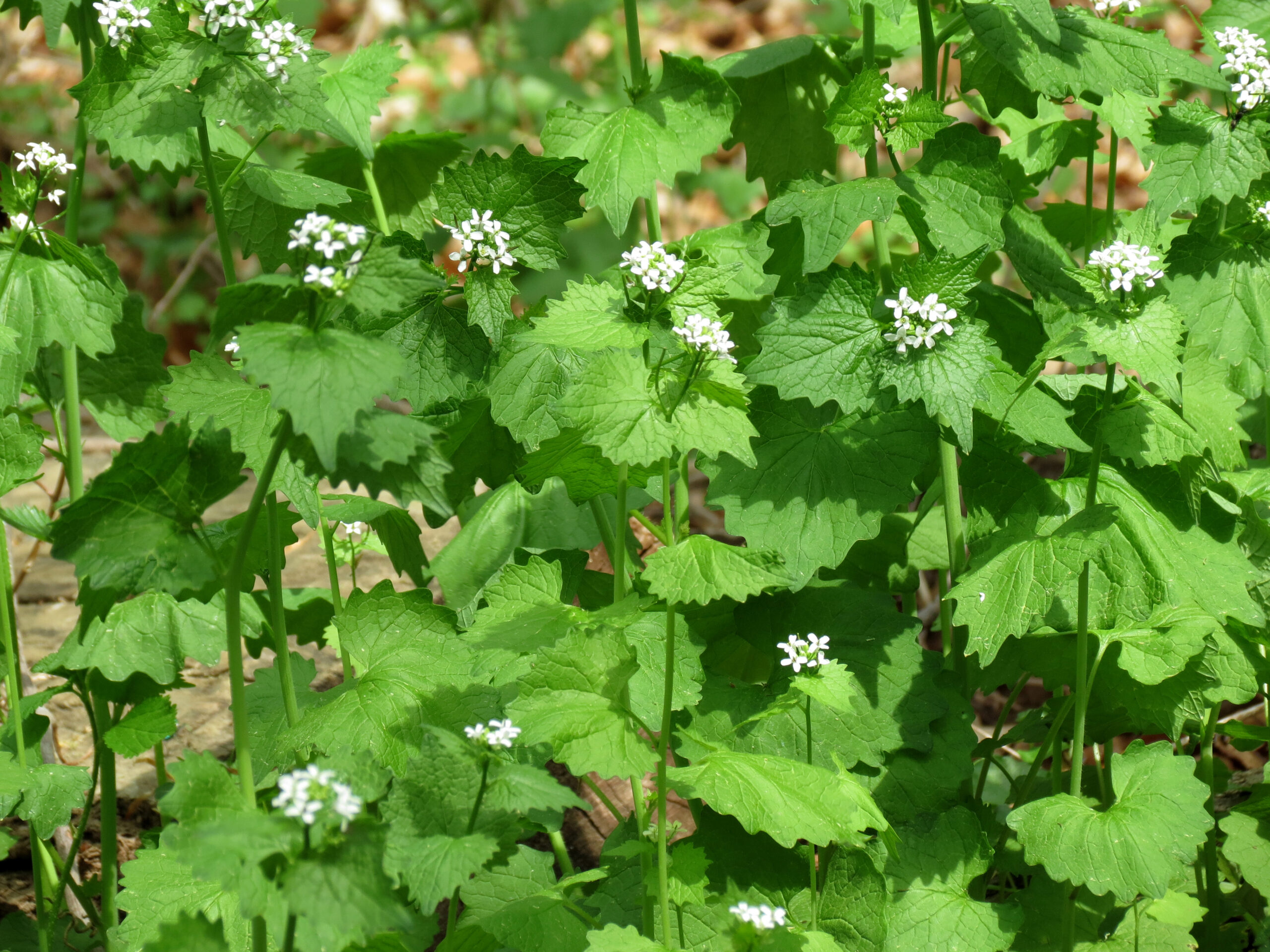
Many of these invaders are herbs, shrubs, or trees which can invade shaded environments. I remind you that a high proportion of these invasive plant species have been deliberately planted either directly in “natural” areas or in yards and gardens throughout the region.
Invasive plants can reduce native diversity, alter forest structure, suppress tree regeneration, alter nutrient cycling, and modify disturbance regimes (Miller et al. 2023).
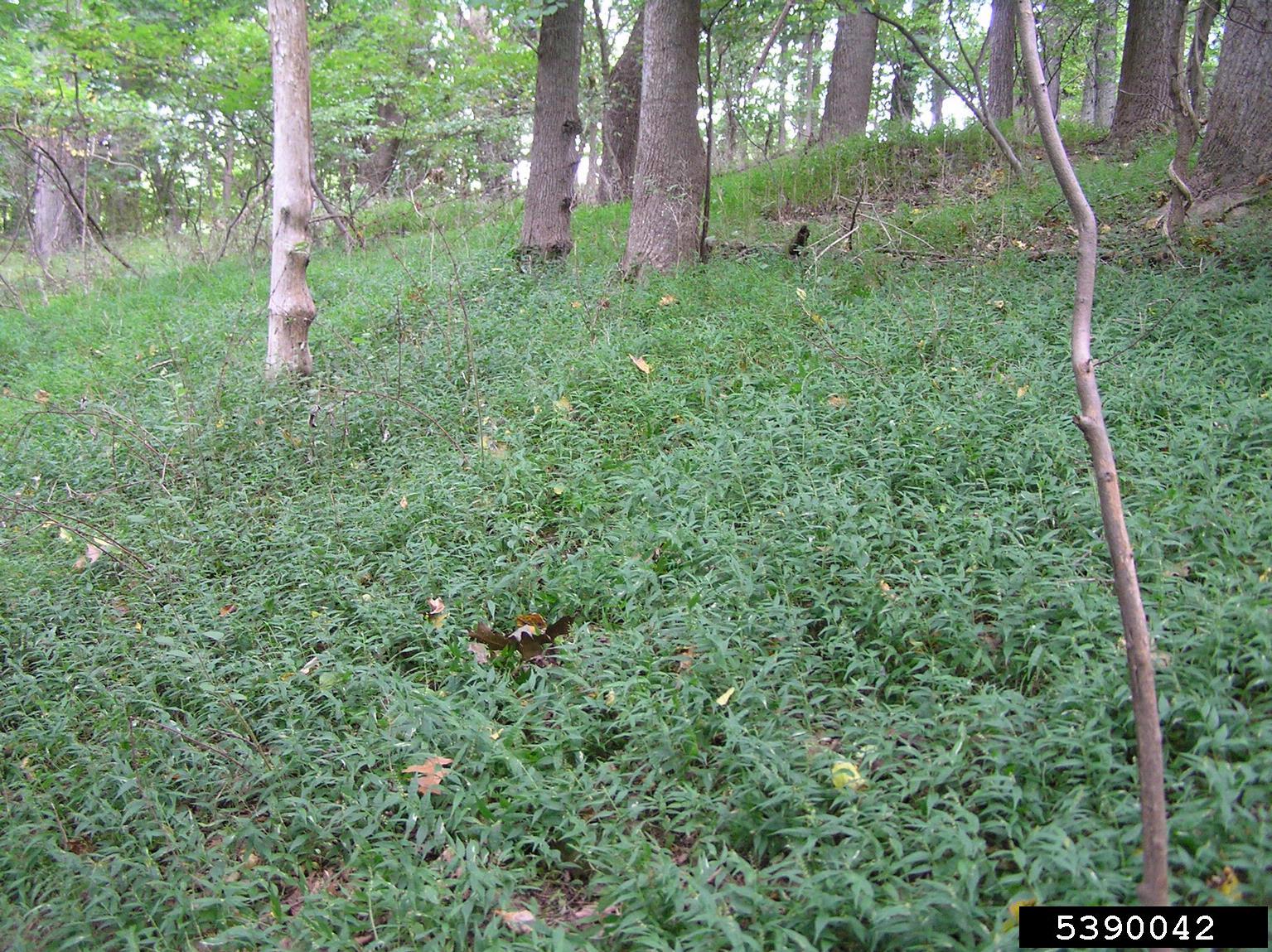
Japanese stiltgrass (Microstegium vimineum) is widespread in forests of both Northeast (Oswalt et al. (2016) and Southeast. Stiltgrass invasions can suppress oak regeneration – at least as part of interactions with herbivore browsing and harvest history (Johnson et al. 2015).
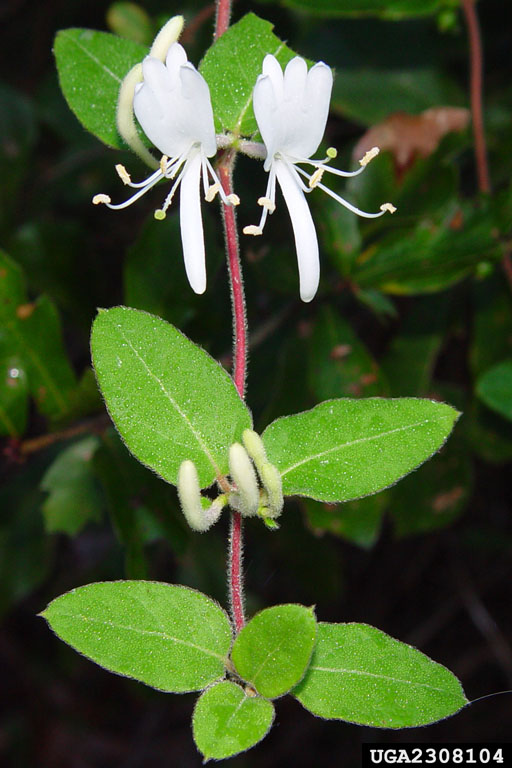
Amur honeysuckle; via Flickr
Several non-native shrub and vine species are also widespread. For example, multiflora rose (Rosa multiflora) is the most frequently recorded invasive plant, present on 16.6% of surveyed plots in 39 states and five Canadian provinces. Again, the state with the highest proportion of plots invaded is Ohio – 85% (USDA Forest Service NRS-109). A study in central Ohio found that the presence of Amur honeysuckle (Lonicera mackii) had a stronger influence on tree species diversity than on the size or number of trees. Removing honeysuckle from heavily invaded areas promoted native tree growth (e.g., the height of tallest trees) and increased the tree canopy’s structural complexity for up to 10 years. Forest recovery began within two years of honeysuckle removal Fotis et al. (2022). (To access earlier blogs, visit www.nivemnic.us; scroll below “archives” to “categories”, click on “invasive plants.)
This impediment to forest regeneration is expected to get worse: non-native plant species are already more widely distributed than native species although the average invasive plant inhabits only about 50% of its expected range (Bradley, Early and Sorte 2015). From Virginia and West Virginia north to Maine, 80% of National Park units have experienced a significant increase in at least one trend measuring abundance of invasive plants in recent decades. In 10 parks (a quarter of all parks studied), total invasives increased significantly in two of three metrics (Miller et al. 2023).
Non-native Pests
Another set of biological factors affecting forest persistence and possibly regeneration is non-native pests that kill North American trees. I have complained that too few of the studies of regeneration discuss implications of these bioinvasions. So Khadka, Hong, and Bardhan (2024), Duana et al. (2024), and Hanberry et al. (2020) continue a tradition that I think is most unfortunate.
American elm in full glory; photo by F.T. Campbell
In Ohio specifically, Hovena et al. and Yacucci et al. did not mention loss of canopy elms, or ash, or the impending threat from beech leaf disease. All these trees are – or used to be – quite common in Ohio. More understandable, perhaps, is lack of attention to laurel wilt disease, which is just now at the state’s southern border. It might decimate an important native shrub, Lindera benzoin. American chestnut was also present in Ohio before its near disappearance following introduction of the chestnut blight fungus early in the 20th Century.
Another possibly damaging pest that has recently turned up in Ohio is the elm zigzag sawflyAproceros leucopoda. This Asian insect was first detected in North America in 2020 in Ontario. It quickly became apparent that it was more widespread. The Ohio detection came in 2023 – too recent to be discussed by Hovena et al. or Yacucci et al. Its impact several elm species is currently unknown.
There are exceptions. Both Stern et al. (2023) and Ducey at al. (2023) reported robust growth rates of American beech (Fagus grandifolia) despite decades-long establishment of beech bark disease. DMF Neither mentioned beech leaf disease – to be fair, this bioinvader is just starting to appear in New England. Stern et al. (2023) did not discuss hemlock woolly adelgid although Eastern hemlock (Tsuga canadensis) is also a common co-occurring dominant species in their plots. Ducey et al. did anticipate pest-driven reversals of increased numbers of eastern hemlock (Tsuga canadensis) and of white ash (Fraxinus americana). Stern et al. (2023) also did not mention oak wilt, despite a vulnerable host — northern red oak — being a common co-dominant species in his study site in Vermont. To be fair, oak wilt is not yet established in New England, although it is in New York and in western Ontario.
The most complete discussion of non-native pests is by Payne and Peet, working in the Piedmont of North Carolina. They state that several “specialist” pathogens have caused loss of important tree species, resulting in drastic and long-lasting shifts in community dynamics. They mention elms and dogwoods plus impending insect-caused widespread mortality of ash.
flowering dogwood (Cornus florida); photo by F.T. Campbell
Miller et al. describe the impact of EAB on ash resources in the National parks and express concern that BLD will cause considerable damage to some units of the system.
I think the failure of scientists to integrate invasive species’ impacts into assessments of changes in forest tree composition will mean that recommendations for management will be – at best – incomplete; at worst – wrong.
SOURCES
Beckman, E., Meyer, A., Denvir, A., Gill, D., Man, G., Pivorunas, D., Shaw, K., and Westwood, M. (2019). Conservation Gap Analysis of Native U.S. Oaks. Lisle, IL: The Morton Arboretum.
Blossey. B., D. Hare, and D.M. Waller, 2024. Where have all the flowers gone? A call for federal leadership in deer management in the US. Front. Conserv. Sci. 5:1382132. doi: 10.3389/fcosc.2024.1382132
Bradley, B.A., R. Early and C. J. B. Sorte. 2015. Space to invade? Comparative range infilling and potential range of invasive and native plants. Global Ecology and Biogeography
Dey, D.C. 2013. Sustaining Oak Forests in Eastern North America: Regeneration and Recruitment, the Pillars of Sustainability. For. Sci. 60(5):926–942 October 2013. http://dx.doi.org/10.5849/forsci.13-114
Duana, S., H.S. He, L.S. Pile Knapp, T.W. Bonnot, J.S. Fraser. 2024. Private land management is more important than public land in sustaining oaks in temperate forests in the eastern U.S. Journal of Environmental Management 352 (2024) 120013
Ducey, M.J, O.L. Fraser, M. Yamasaki, E.P. Belair, W.B. Leak. 2023. Eight decades of compositional change in a managed northern hardwood landscape. Forest Ecosystems 10 (2023) 100121
Fotis, A., Flower, C.E.; Atkins, J.W. Pinchot, C.C., Rodewald, A.D., Matthews, S. 2022. The short-term and long-term effects of honeysuckle removal on canopy structure and implications for urban forest management. Forest Ecology and Management. 517(6): 120251. 10 p. https://doi.org/10.1016/j.foreco.2022.120251
Hanberry, B.B., M.D. Abrams, M.A. Arthur & J.M. Varner. 2020. Reviewing Fire, Climate, Deer, & Foundation Spp as Drivers of Historically Open Oak & Pine Forests & Transition to Closed Forests. Front. For. Glob. Change 3:56. doi: 10.3389/ffgc.2020.00056
Hovena, B.M., K.S. Knight, V.E. Peters, and D.L Gorchov. 2022. Woody seedling community responses to deer herbivory, intro shrubs, and ash mortality depend on canopy competition and site wetness. Forest Ecology and Management. 523 (2022) 120488
Johnson, D.J., S.L. Flory, A. Shelton, C. Huebner and Keith Clay. 2015 Interactive effects of a non-native invasive grass Microstegium vimineum and herbivore exclusion on experimental tree regeneration under differing forest management. Journal of Applied Ecology 2015, 52, 210–219 doi: 10.1111/1365-2664.12356
Khadka, H.S. Hong, S. Bardhan. 2024. Investigating the Spatial Pattern of White Oak (Q. alba L.) Mortality Using Ripley’s K Function across the Ten States of the eastern United States. Forests 2024, 15, 1809. https://doi.org/10.3390/f15101809
Miller, K.M., S.J. Perles, J.P. Schmit, E.R. Matthews, and M.R. Marshall. 2023. Overabundant deer and invasive plants drive widespread regeneration debt in eastern United States national parks. Ecological Applications. 2023;33:e2837. https://onlinelibrary.wiley.com/r/eap Open Access
Oswalt, C.M., S. Fei, Q. Guo, B.V. Iannone III, S.N. Oswalt, B.C. Pijanowski, K.M. Potte. 2916. A subcontinental view of forest plant invasions. NeoBiota. 24: 49-54 http://www.srs.fs.usda.gov/pubs/48489
Payne, C.J. and R.K. Peet. 2023. Revisiting the model system for forest succession: Eighty years of resampling Piedmont forests reveals need for an improved suite of indicators of successional change. Ecological Indicators 154 (2023) 110679
Deer browse susceptibility limits c’nut restoration success in northern hardwood forests PUBLIC
Potter, K.M and Riitters, K. 2022. A National Multi-Scale Assessment of Regeneration Deficit as an Indicator of Potential Risk of Forest Genetic Variation Loss. Forests 2022, 13, 19.
https://doi.org/10.3390/f13010019.
Reed, S.P., D.R. Bronson, J.A. Forrester, L.M. Prudent, A.M. Yang, A.M. Yantes, P.B. Reich, and L.E. Frelich. 2023. Linked disturbance in the temperate forest: Earthworms, deer, and canopy gaps. Ecology. 2023;104:e4040. https://onlinelibrary.wiley.com/r/ecy
Shifley, S.R. and W.K. Moser, editors. 2016. Future Forests of the Northern United States
Simpson, A., and Eyler, M.C., 2018, First comprehensive list of non-native species established in three major regions of the United States: U.S. Geological Survey Open-File Report 2018-1156, 15 p., https://doi.org/10.3133/ofr20181156.
ISSN 2331-1258 (online)
Spicer, M.E., A.A. Royo, J.W. Wenzel, and W.P. Carson. 2023. Understory plant growth forms respond independently to combined natural and anthropogenic disturbances. Forest Ecology and Management 543 (2023) 12077
Growth trends and environmental drivers of major tree species of the northern hardwood forest of eastern North America J. For. Res. (2023) 34:37–50 https://doi.org/10.1007/s11676-022-01553-7
Stout, S.L., A.T. Hille, and A.A. Royo. 2023. Science-Management Collaboration is Essential to Address Current and Future Forestry Challenges. IN United States Department of Agriculture. Forest Service. 2023. Proceedings of the First Biennial Northern Hardwood Conference 2021: Bridging Science and Management for the Future. Northern Research Station General Technical Report NRS-P-211 May 2023
United States Department of Agriculture, Forest Service. 2023a. Proceedings of the First Biennial Northern Hardwood Conference 2021: Bridging Science and Management for the Future. Northern Research Station General Technical Report NRS-P-211 May 2023
USDA Forest Service Northern Research Station Rooted in Research ISSUE 18 | SEPTEMBER 2023
Kurtz, C.M. 2023. An assessment of invasive plant species in northern U.S. forests. Res. Note NRS-311. http://doi.org/10.2737/NRS-RN-311
United States Department of Agriculture Forest Service General Technical Report NRS-109. An Assessment of Invasive Plant Species Monitored by the Northern Research Station
Forest Inventory and Analysis Program, 2005 through 2010.
Yacucci, A.C., W.P. Carson, J.C. Martineau, C.D. Burns, B.P. Riley, A.A. Royo, T.P. Diggins, I.J. Renne. 2023. Native tree species prosper while exotics falter during gap-phase regeneration, but only where deer densities are near historical levels New Forests https://doi.org/10.1007/s11056-023-10022-w
Posted by Faith Campbell
We welcome comments that supplement or correct factual information, suggest new approaches, or promote thoughtful consideration. We post comments that disagree with us — but not those we judge to be not civil or inflammatory.
For a detailed discussion of the policies and practices that have allowed these pests to enter and spread – and that do not promote effective restoration strategies – review the Fading Forests report at https://treeimprovement.tennessee.edu/
ʻŌhiʻa trees killed by ROD; photo by Richard Sniezko, USFS
Several Hawaiian tree species are at risk due to introduced forest pests. Two of the Islands’ most widespread species are among the at-risk taxa. Their continuing loss would expose watersheds on which human life and agriculture depend. Habitats for hundreds of other species – many endemic and already endangered – would lose their foundations. These trees also are of the greatest cultural importance to Native Hawaiians.
I am pleased to report that Hawaiian scientists and conservationists are trying to protect and restore them.
Other tree species enjoy less recognition … and efforts to protect them have struggled to obtain support.
1) koa (Acacia koa)
Koa is both a dominant canopy tree and the second-most abundant native tree species in Hawai`i in terms of areas covered. The species is endemic to the Hawaiian archipelago. Koa forests provide habitat for 30 of the islands’ remaining 35 native bird species, many of which are listed under the U.S. Endangered Species Act. Also dependent on koa forests are native plant and invertebrate species and the Islands’ only native terrestrial mammal, the Hawaiian hoary bat. Finally, koa forests protect watersheds, add nitrogen to degraded soils, and store carbon [Inman-Narahari et al.]
Koa forests once ranged from near sea level to above 7000 ft (2100 m) on both the wet and dry sides of all the large Hawaiian Islands. Conversion of forests to livestock grazing and row-crop agriculture has reduced koa’s range. Significant koa forests are now found on four islands – Hawai’i, Maui, O‘ahu, and Kauaʻi. More than 90% of the remaining koa forests occur on Hawai`i Island (the “Big Island) [Inman-Narahari et al.]
In addition to its fundamental environmental role, koa has immense cultural importance. Koa represents strength and the warrior spirit. The wood was used traditionally to make sea-going canoes. Now Koa is widely used for making musical instruments, especially guitars and ukuleles; furniture, surfboards, ornaments, and art [Inman-Narahari et al.]
Koa timber has the highest monetary value of any wood harvested on the Islands. However, supplies of commercial-quality trees are very limited (Dudley et al. 2020). Harvesting is entirely from old-growth forests on private land. [Inman-Narahari et al.]
Koa forests are under threat by a vascular wilt disease caused by Fusarium oxysporum f. sp. koae (FOXY). This disease can kill up to 90% of young trees and – sometimes — mature trees in native forests. The fungus is a soil-dwelling organism that spreads in soil and infects susceptible plants through the root system (Dudley et al. 2020).
Conservation and commercial considerations have converged to prompt efforts to breed koa resistant to FOXY. Conservationists hope to restore native forests on large areas where agriculture has declined. The forestry industry seeks to enhance supplies of the Islands’ most valuable wood. Finally, science indicated that a breeding program would probably be successful. Field trials in the 1990s demonstrated great differences in wilt-disease mortality among seed sources (the proportion of seedlings surviving inoculation ranged from 4% to 91.6%) [Sniezko 2003; Dudley et al. 2009].
In 2003, Dudley and Sniezko outlined a long-term strategy for exploring and utilizing genetic resistance in koa. Since then, a team of scientists and foresters has implemented different phases of the strategy and refined it further (Dudley et al. 2012, 2015, 2017; Sniezko et al. 2016]
First, scientists determined that the wilt disease is established on the four main islands. Having obtained more than 500 isolates of the pathogen from 386 trees sampled at 46 sites, scientists tested more than 700 koa families from 11 ecoregions for resistance against ten of the most highly virulent isolates (Dudley et al. 2020).
The Hawaiian Agricultural Research Center (HARC), supported by public and private partners, has converted the field-testing facilities on Hawai`i, Maui, and Oahu into seed orchards. The best-performing tree families are being grown to maturity to produce seeds for planting. It is essential that the seedlings be not just resistant to FOXY but also adapted to the ecological conditions of the specific site where they are to be planted [Dudley et al. 2020; Inman-Narahari et al. ] Locally adapted, wilt-resistant seed has been planted on Kauaʻi and Hawai`i. Preparations are being made to plant seed on Maui and O‘ahu also. Scientists are also exploring methods to scale up planting in both restoration and commercial forests [R. Hauff pers. comm.].
koa; photo by David Eickhoff via Flickr
Restoration of koa on the approximately half of lands in the species’ former range that are privately owned will require that the trees provide superior timber. Private landowners might also need financial incentives since the rotation time for a koa plantation is thought to be 30-80 years. [Inman-Narahari et al.]
Plantings on both private and public lands will need to be protected from grazing by feral ungulates and encroachment by competing plants. These management actions are intensive, expensive, and must be maintained for years.
Some additional challenges are scientific: uncertainties about appropriate seed zones, efficacy of silvicultural approaches to managing the disease, and whether koa can be managed for sustainable harvests. Human considerations are also important: Hawai`i lacks sufficient professional tree improvement or silvicultural personnel, a functioning seed distribution and banking network — and supporting resources. Finally, some segments of the public oppose ungulate control programs. Inman-Narahari et al.
Finally, scientists must monitor seed orchards and field plantings for any signs of maladaptation to climate change. (Dudley et al. 2020).
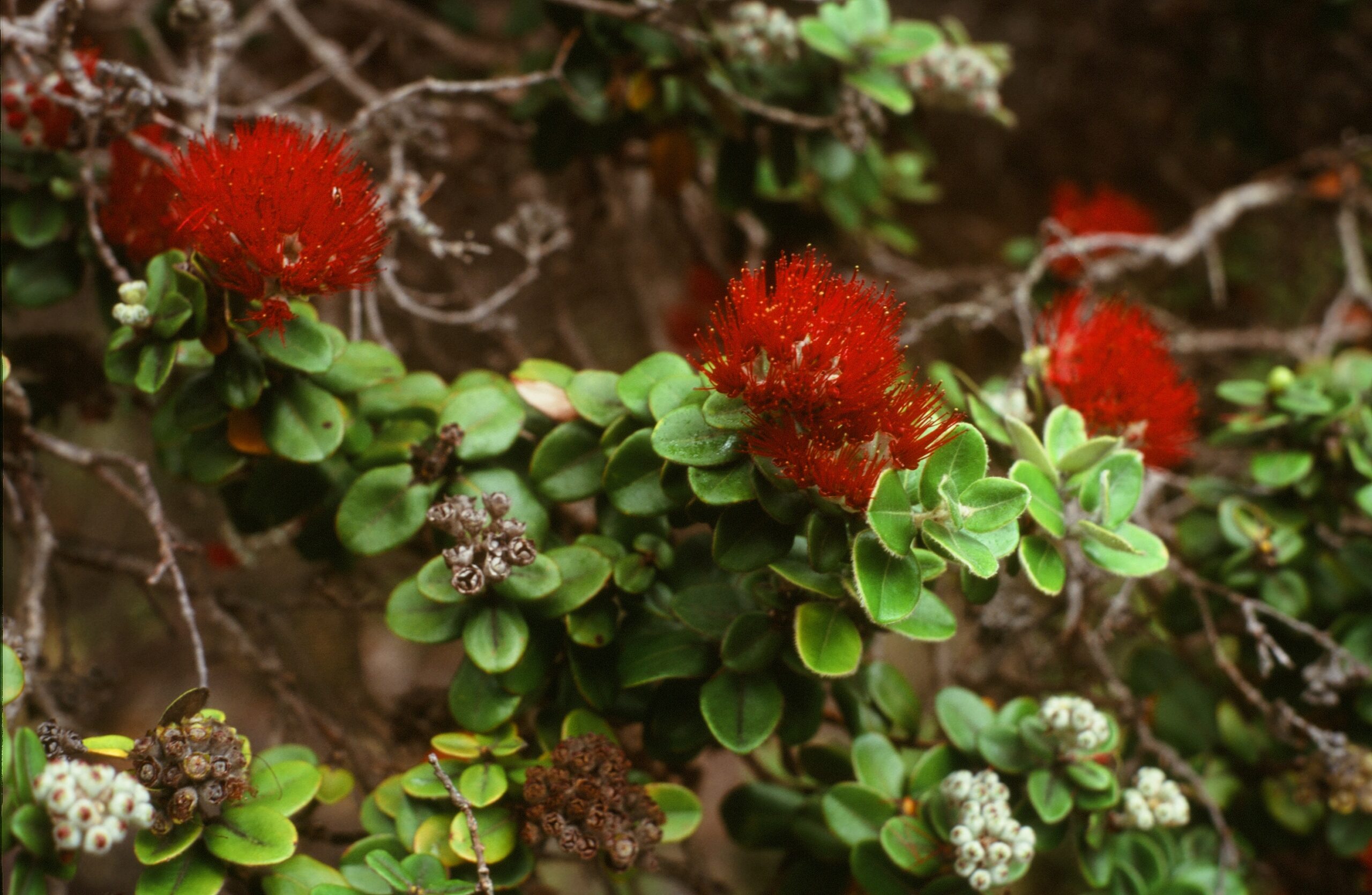
2) ʻŌhiʻa Metrosideros polymorpha)
ʻŌhiʻa lehua is the most widespread tree on the Islands. It dominates approximately 80% the biomass of Hawaii’s remaining native forest, in both wet and dry habitats. ʻŌhiʻa illustrates adaptive radiation and appears to be undergoing incipient speciation. The multitude of ecological niches and their isolation on the separate islands has resulted in five recognized species in the genus Metrosideros. Even the species found throughout the state, Metrosideros polymorpha, has eight recognized varieties (Luiz et al. (2023) (some authorities say there are more).
Loss of this iconic species could result in significant changes to the structure, composition, and potentially, the function, of forests on a landscape level. High elevation ‘ohi‘a forests protect watersheds across the state. ʻŌhiʻa forests shelter the Islands’ one native terrestrial mammal (Hawaiian hoary bat), 30 species of forest birds, and more than 500 endemic arthropod species. Many species in all these taxa are endangered or threatened (Luiz et al. 2023). The increased light penetrating interior forests following canopy dieback facilitates invasion by light-loving non-native plant species, of which Hawai`i has dozens. There is perhaps no other species in the United States that supports more endangered taxa or that plays such a geographical dominant ecological keystone role [Luiz et al. 2023]
For many Native Hawaiians, ‘ōhi‘a is a physical manifestation of multiple Hawaiian deities and the subject of many Hawaiian proverbs, chants, and stories; and foundational to the scared practice of many hula. The wood has numerous uses. Flowers, shoots, and aerial roots are used medicinally and for making lei. The importance of the biocultural link between ‘ōhi‘a and the people of Hawai`i is described by Loope and LaRosa (2008) and Luiz et al. (2023).
In 2010 scientists detected rapid mortality affecting ‘ōhi‘a on Hawai‘i Island. Scientists determined that the disease is caused by two recently-described pathogenic fungi, Ceratocystis lukuohia and Ceratocystis huliohia. The two diseases, Ceratocystis wilt and Ceratocystis canker of ʻōhiʻa, are jointly called “rapid ‘ōhi‘a death”, or ROD. The more virulent species, C. lukuohia, has since spread across Hawai`i Island and been detected on Kaua‘i. The less virulent C. huliohia is established on Hawai`i and Kaua‘i and in about a dozen trees on O‘ahu. One tree on Maui was infected; it was destroyed, and no new infection has been detected [M. Hughes pers. comm.] As of 2023, significant mortality has occurred on more than one third of the vulnerable forest on Hawai`i Island, although mortality is patchy.
[ʻŌhiʻa is also facing a separate disease called myrtle rust caused by the fungus Austropuccinia psidii; to date this rust has caused less virulent infections on ‘ōhi‘a.]
rust-killed ‘ōhi‘a in 2016; photo by J.B. Friday
Because of the ecological importance of ‘ōhi‘a and the rapid spread of these lethal diseases, research into possible resistance to the more virulent pathogen, C. lukiohia began fairly quickly, in 2016. Some ‘ōhi‘a survive in forests on the Big Island in the presence of ROD, raising hopes that some trees might possess natural resistance. Scientists are collecting germplasm from these lightly impacted stands near high-mortality stands (Luiz et al. 2023). Five seedlings representing four varieties of M. polymorpha that survived several years’ exposure to the disease are being used to produce rooted cuttings and seeds for further evaluation of these genotypes.
ʻŌhiʻa flowers
Encouraged by these developments, and recognizing the scope of additional work needed, in 2018 stakeholders created a collaborative partnership that includes state, federal, and non-profit agencies and entities, ʻŌhiʻa Disease Resistance Program (‘ODRP) (Luiz et al. 2023). The partnership seeks to provide baseline information on genetic resistance present in all Hawaiian taxa in the genus Metrosideros. It aims further to develop sources of ROD-resistant germplasm for restoration intended to serve several purposes: cultural plantings, landscaping, and ecological restoration. ‘ODRP is pursuing screenings of seedlings and rooted cuttings sampled from native Metrosideros throughout Hawai`i while trying to improve screening and growing methods. Progress will depend on expanding these efforts to include field trials; research into environmental and genetic drivers of susceptibility and resistance; developing remote sensing and molecular methods to rapidly detect ROD-resistant individuals; and support already ongoing Metrosideros conservation. If levels of resistance in wild populations prove to be insufficient, the program will also undertake breeding (Luiz et al. 2023).
To be successful, ‘ODRP must surmount several challenges (Luiz et al. 2022):
increase capacity to screen seedlings from several hundred plants per year to several thousand;
optimize artificial inoculation methodologies;
determine the effects of temperature and season on infection rates and disease progression;
find ways to speed up seedlings’ attaining sufficient size for testing;
develop improved ways to propagate ʻōhiʻa from seed and rooted cuttings;
establish sites for field testing of putatively resistant trees across a wide range of climatic and edaphic conditions;
establish seed orchard, preferably on several islands;
establish systems for seed collection from the wide variety of subspecies/varieties;
if breeding to enhance resistance is appropriate, it will be useful to develop high-throughput phenotyping of the seed orchard plantings.
Developing ROD-resistant ‘ōhi‘a is only one part of a holistic conservation program. Luiz et al. (2023) reiterate the importance of quarantines and education to curtail movement of infected material and countering activities that injure the trees. Fencing to protect these forests from grazing by feral animals can drastically reduce the amount of disease. Finally, scientists must overcome the factors there caused the almost complete lack of natural regeneration of ‘ōhi‘a in lower elevation forests. Most important are competition by invasive plants, predation by feral ungulates, and the presence of other diseases, e.g., Austropuccinia psidii.
Hawaii’s dryland forests are highly endangered: more than 90% of dry forests are already lost due to habitat destruction and the spread of invasive plant and animal species. Two tree species are the focus of species-specific programs aimed at restoring them to remaining dryland forests. However, support for both programs seems precarious and requires stable long-term funding; disease resistance programs often necessitate decades-long endeavors.
naio in bloom; photo by Forrest & Kim Starr via Creative Commons
1) naio (Myoporum sandwicense)
Naio grows on all of the main Hawaiian Islands at elevations ranging from sea level to 3000 m. While it occurs in the full range of forest types from dry to wet, naio is one of two tree species that dominate upland dry forests. The other species is mamane, Sophora chrysophylla. Naio is a key forage tree for two endangered honeycreepers, palila (Loxioides bailleui) and `akiapola`au (Hemignathus munroi). The tree is also an important host of many species of native yellow-face bees (Hylaeus spp). Finally, loss of a native tree species in priority watersheds might lead to invasions by non-native plants that consume more water or increase runoff.
The invasive non-native Myoporum thrips, Klambothrips myopori, was detected on Hawai‘i Island in December 2008 (L. Kaufman website). In 2018 the thrips was found also on Oahu (work plan). The Myoporum thrips feeds on and causes galls on plants’ terminal growth. This can eventually lead to death of the plant.
Aware of thrips-caused death of plants in the Myoporum genus in California, the Hawaii Department of Lands and Natural Resources Division of Forestry and Wildlife and the University of Hawai‘i began efforts to determine the insect’s distribution and infestation rates, as well as the overall health of naio populations on the Big Island. This initiative began in September 2010, nearly two years after the thrips’ detection. Scientists monitored nine protected natural habitats for four years. This monitoring program was supported by the USFS Forest Health Protection program. This program is described by Kaufman.
naio monitoring sites from L. Kaufman article
The monitoring program determined that by 2013, the thrips has spread across most of Hawi`i Island, on its own and aided by human movement of landscaping plants. More than 60% of trees being monitored had died. Infestation and dieback levels had both increased, especially at medium elevation sites. The authors feared that mortality at high elevations would increase in the future. They found no evidence that natural enemies are effective controlling naio thrips populations on Hawai`i Island.
Kaufman was skeptical that biological control would be effective. She suggested, instead, a breeding program, including hybridizing M. sandwicensis with non-Hawaiian Myoporum species that appear to be resistant to thrips. Kaufman also called for additional programs: active monitoring to prevent thrips from establishing on neighboring islands; and collection and storage of naio seeds.
Ten years later, in February 2024, DLNR Division of Forestry and Wildlife adopted a draft work plan for exploring possible resistance to the Myoporum thrips. Early steps include establishing a database to record data needed to track parent trees, associated propagules, and the results of tests. These data are crucial to keeping track of which trees show the most promise. Other actions will aim to hone methods and processes. Among practical questions to be answered are a) whether scientists can grow even-aged stands of naio seedlings; b) identifying the most efficient resistance screening techniques; and c) whether K. myopori thrips are naturally present in sufficient numbers to be used in tests, or – alternatively – whether they must be augmented. [Plan]
Meanwhile, scientists have begun collecting seed from unaffected or lightly affected naio in hotspots where mortality is high. They have focused on the dry and mesic forests of the western side of Hawai`i (“Big”) Island, where the largest number of naio populations still occur and are at high risk. Unfortunately, these “lingering” trees remain vulnerable to other threats, such as browsing by feral ungulates, competition with invasive plants, drought, and reduced fecundity & regeneration.
Hawai`i DLNR has secured initial funding from the Department of Defense’s REPI program to begin a pest resistance project and is seeking a partnership with University of Hawai`i to carry out tests “challenging” different naio families’ resistance to the thrips [R. Hauff pers. comm.]
wiliwili; photo by Forrest & Kim Starr
2) wiliwili (Erythrina sandwicensis)
Efforts to protect the wiliwili have focused on biological control. The introduced Erythrina gall wasp, Quadrastichus erythrinae (EGW) was detected on the islands in 2005. It immediately caused considerable damage to the native tree and cultivated nonnative coral trees.
A parasitic wasp, Eurytoma erythrinae, was approved for release in November 2008 – only 3 ½ years after EGW was detected on O‘ahu. The parasitic wasp quickly suppressed the gall wasp’s impacts to both wiliwili trees and non-native Erythrina. By 2024, managers are once again planting the tree in restoration projects.
However, both the gall wasp and a second insect pest – a bruchid, Specularius impressithorax – can cause loss of more than 75% of the seed crop. This damage means that the tree cannot regenerate. By 2019, Hawaiian authorities began seeking permission to release a second biocontrol gent, Aprostocitus nites.Unfortunately, the Hawai’i Department of Agriculture still has not approved the release permit despite five years having passed. Once they have this approval, the scientists will then need to ask USDA Animal and Plant Health Inspection Service (APHIS) for its approval [R. Hauff, pers. comm.]
SOURCES
www.RapidOhiaDeath.org
Dudley, N., R. James, R. Sniezko, P. Cannon, A. Yeh, T. Jones, & Michael Kaufmann. 2009? Operational Disease Screening Program for Resistance to Wilt in Acacia koa in Hawai`i. Hawai`i Forestry Association Newsletter August 29 2009
Dudley, N., T. Jones, K. Gerber, A.L. Ross-Davis, R.A. Sniezko, P. Cannon & J. Dobbs. 2020. Establishment of a Genetically Diverse, Disease-Resistant Acacia koa Seed Orchard in Kokee, Kauai: Early Growth, Form, & Survival. Forests 2020, 11, 1276; doi:10.3390/f11121276 www.mdpi.com/journal/forests
Friday, J. B., L. Keith, and F. Hughes. 2015. Rapid ʻŌhiʻa Death (Ceratocystis Wilt of ʻŌhiʻa). PD-107, College of Tropical Agriculture and Human Resources, University of Hawai‘i, Honolulu, HI. URL: https://www.ctahr.HI.edu/oc/freepubs/pdf/PD-107.pdf Accessed April 3, 2018.
Friday, J.B. 2018. Rapid ??hi?a Death Symposium -West Hawai`i (“West Side Symposium”) March 3rd 2018, https://vimeo.com/258704469 Accessed April 4, 2018 (see also full video archive at https://vimeo.com/user10051674)
Inman-Narahari, F., R. Hauff, S.S. Mann, I. Sprecher, & L. Hadway. Koa Action Plan: Management & research priorities for Acacia koa forestry in Hawai`i. State of Hawai`i Department of Land & Natural Resources Division of Forestry & Wildlife no date
Kaufman, L.V, J. Yalemar, M.G. Wright. In press. Classical biological control of the erythrina gall wasp, Quadrastichus erythrinae, in Hawaii: Conserving an endangered habitat. Biological Control. Vol. 142, March 2020
Loope, L. and A.M. LaRosa. 2008. ‘Ohi’a Rust (Eucalyptus Rust) (Puccinia psidii Winter) Risk Assessment for Hawai‘i.
Luiz, B.C. 2017. Understanding Ceratocystis. sp A: Growth, morphology, and host resistance. MS thesis, University of Hawai‘i at Hilo.
Luiz, B.C., C.P. Giardina, L.M. Keith, D.F. Jacobs, R.A. Sniezko, M.A. Hughes, J.B. Friday, P. Cannon, R. Hauff, K. Francisco, M.M. Chau, N. Dudley, A. Yeh, G. Asner, R.E. Martin, R. Perroy, B.J. Tucker, A. Evangelista, V. Fernandez, C. Martins-Keli’iho.omalu, K. Santos, R. Ohara. 2023. A framework for establishlishing a rapid ‘Ohi‘a death resistance program New Forests 54, 637–660. https://doi.org/10.1007/s11056-021-09896-5
Sniezko, R.A., N. Dudley, T. Jones, & P. Cannon. 2016. Koa wilt resistance & koa genetics – key to successful restoration & reforestation of koa (Acacia koa). Acacia koa in Hawai‘i: Facing the Future. Proceedings of the 2016 Symposium, Hilo, HI: www.TropHTIRC.org , www.ctahr.HI.edu/forestry
Posted by Faith Campbell
We welcome comments that supplement or correct factual information, suggest new approaches, or promote thoughtful consideration. We post comments that disagree with us — but not those we judge to be not civil or inflammatory.
For a detailed discussion of the policies and practices that have allowed these pests to enter and spread – and that do not promote effective restoration strategies – review the Fading Forests report at https://treeimprovement.tennessee.edu/
Research scientists in the USFS Northern Region (Region 9) – Maine to Minnesota, south to West Virginia and Missouri – continue to be concerned about regeneration patterns of the forest and the future productivity of northern hardwood forests.
The most recent study of which I am aware is that by Stern et al. (2023) [full citation at the end of this blog]. They sought to determine how four species often dominant in the Northeast (or at least in New England) might cope with climate change. Those four species are red maple (Acer rubrum), sugar maple (Acer saccharum), American beech (Fagus grandifolia), and yellow birch (Betula alleghaniensis). The study involved considerable effort: they examined tree ring data from 690 dominant and co-dominant trees on 45 plots at varying elevations across Vermont. The tree ring data allowed them to analyze each species’ response to several stressors over the 70-year period of 1945 to 2014.
In large part their findings agreed with those of studies carried out earlier, or at other locations. As expected, all four species grew robustly during the early decades, then plateaued – indicative of a maturing forest. All species responded positively to summer and winter moisture and negatively to higher summer temperatures. Stern et al. described the importance of moisture availability in non-growing seasons – i.e., winter – as more notable.
snow in Vermont; Putnypix via Flickr
The American Northeast and adjacent areas in Canada have already experienced an unprecedented increase of precipitation over the last several decades. This pattern is expected to continue or even increase under climate change projections. However, Stern et al. say this development is not as promising for tree growth as it first appears. The first caveat is that winter snow will increasingly be replaced by rain. The authors discuss the importance of the insulation of trees’ roots provided by snow cover. They suggest that this insulation might be particularly necessary for sugar maple.
The second caveat is that precipitation is not expected to increase in the summer; it might even decrease. Their data indicate that summer rainfall – during both the current and preceding years – has a significant impact on tree growth rates.
Stern et al. also found that the rapid rise in winter minimum temperatures was associated with slower growth by sugar maple, beech, and yellow birch, as well as red maple at lower elevations. Still, temperature had less influence than moisture metrics.
Stern et al. discuss specific responses of each species to changes in temperatures, moisture availability, and pollutant deposition. Of course, pollutant levels are decreasing in New England due to implementation of provisions of the Clean Air Act of 1990.
They conclude that red maple will probably continue to outcompete the other species.
In their paper, Stern et al. fill in some missing pieces about forests’ adaptation to the changing climate. I am disappointed, however, that these authors did not discuss the role of biotic stressors, i.e., “pests”.
They do report that growth rates of American beech increased in recent years despite the prevalence of beech bark disease. They note that others’ studies have also found an increase in radial growth for mature beech trees in neighboring New Hampshire, where beech bark disease is also rampant.
For more specific information on pests, we can turn to Ducey at al. – also published in 2023. These authors expected American beech to dominate the Bartlett Experimental Forest (in New Hampshire) despite two considerations that we might expect to suppress this growth. First, 70-90% of beech trees were diseased by 1950. Second, managers have made considerable efforts to suppress beech.
Stern et al. say specifically that their study design did not allow analysis of the impact of beech bark disease. I wonder at that decision since American beech is one of four species studied. More understandable, perhaps, is the absence of any mention of beech leaf disease. In 2014, the cutoff date for their growth analysis, beech leaf disease was known only in northeastern Ohio and perhaps a few counties in far western New York and Pennsylvania. Still, by the date of publication of their study, beech leaf disease was recognized as a serious disease established in southern New England.
counties where beech leaf disease has been confirmed
Eastern hemlock (Tsuga canadensis) and northern red oak (Quercus rubra) are described as common co-occurring dominant species in the plots analyzed by Stern et al. Although hemlock woolly adelgid has been killing trees in southern Vermont for years, Stern et al. did not discuss the possible impact of that pest on the forest’s regeneration trajectory. Nor did they assess the possible effects of oak wilt, which admittedly is farther away (in New York (& here) and in Ontario, Canada, west of Lake Erie).
In contrast, Ducey at al. (2023) did discuss link to blog 344 the probable impact of several non-native insects and diseases. In addition to beech bark disease, they addressed hemlock woolly adelgid, emerald ash borer, and beech leaf disease.
Non-native insects and pathogens are of increasing importance in our forests. To them, we can add overbrowsing by deer, proliferation of non-native plants, and spread of non-native earthworms. There is every reason to think the situation will only become more complex. I hope forest researchers will make a creative leap – incorporate the full range of factors affecting the future of US forests.
I understand that such a more integrated, holistic analysis might be beyond any individual scientist’s expertise or time, funding, and constraints of data availability and analysis. I hope, though, that teams of collaborators will compile an overview based on combining their research approaches. Such an overview would include human management actions, climate variables, established and looming pest infestations, etc. I hope, too, that these experts will extrapolate from their individual, site-specific findings to project region-wide effects.
Some studies have taken a more integrative approach. Reed, Bronson, et al. (2022) studied interactions of earthworm biomass and density with deer. Spicer et al. (2023) examined interactions of deer browsing and various vegetation management actions. Hoven et al. (2022) considered interactions of non-native shrubs, tree basal area, and forest moisture regimes.
Stern, R.L., P.G. Schaberg, S.A. Rayback, C.F. Hansen, P.F. Murakami, G.J. Hawley. 2023. Growth trends and environmental drivers of major tree species of the northern hardwood forest of eastern North America. J. For. Res. (2023) 34:37–50 https://doi.org/10.1007/s11676-022-01553-7
Posted by Faith Campbell
We welcome comments that supplement or correct factual information, suggest new approaches, or promote thoughtful consideration. We post comments that disagree with us — but not those we judge to be not civil or inflammatory.
For a detailed discussion of the policies and practices that have allowed these pests to enter and spread – and that do not promote effective restoration strategies – review the Fading Forests report at https://treeimprovement.tennessee.edu/
Sakhalin knotweed (Fallopia (Reynoutria) sachalinensis) – an invasive plant widespread in Europe; photo by Katrin Schneider [korina.info] via Wikimedia
There is growing evidence that invasive plants – as distinct from invasive species of animals, microbes, etc. – play a significant role in causing the loss of floristic uniqueness at the local or regional level. I provide full citations of all sources at the end of this blog.
Less Diversity. More Similarity
Several studies show that plant invasions have a bigger impact than extinction in the homogenization of Earth’s flora. A major driver is sheer numbers. Daruet al. point out that 10,138 plant species have become naturalized to a region outside their native ranges while only 1,065 species have gone extinct. Even under a scenario in which all species currently included in IUCN Red List as “threatened” become extinct, non-native plant species naturalizations are by far the stronger contributor to biotic reorganization.
Winter et al. report that in Europe since AD 1500, plant invasions have greatly exceeded extinctions, resulting in increased taxonomic diversity (i.e., species richness) on the Continent but increased taxonomic and phylogenetic similarity among European regions. In other words, floras of individual European countries became phylogenetically and taxonomically impoverished. This situation is likely to worsen in the future because introductions continue.
Winter et al. conclude, more broadly, that a focus on species richness can be misleading because it does not capture the important effects of taxonomic or phylogenetic distinctiveness.
Yanget al. (2021) considered the situation globally. They divided most of Earth’s ice-free land surface into 658 regions. They found that introduction of non-native plants has increased the taxonomic similarity between any two of these regions in 90.7% of the time. Introductions increased phylogenetic similarity in 77.2% of those pairs. Australasia illustrates the situation. The region has a large proportion of endemic species, reflecting its unique evolutionary history and exhibiting high floristic diversity. However, the region has also received large numbers of non-native plants from other regions. The result is that the Australasian flora has lost much of its original uniqueness.
rubbervine (Cryptostegia madagascariensis) – one of the worst invasive plants in Australia; photo by Tatters via Flickr
Introduced plant species rarely cause outright extinction of members of the native flora of the receiving ecosystem – at least at the scale of a continent. Winter et al. found that in Europe, extinction usually occurs to plant species with small numbers that are limited to localized habitats. Often, however, the same species continue to thrive elsewhere on the continent. The “losing” country finds its flora becoming more similar to that of other European countries. It loses some uniqueness because it lost one or more components of its flora. However, for Europe as a whole, there is no loss. The homogenization of the “losing” country’s flora is exacerbated by the fact that more than half of plant species listed as invading a particular European country are from other European regions. Winter et al. say a similar pattern has been found in North America.
The picture is more complex for small isolated ecosystems. Carvallo and Castro (2017), writing about isolated volcanic islands in the southeastern Pacific Ocean, introduction of large numbers of non-native plant species has not caused extinction of native plant species. It has, however, resulted in the homogenization of the islands’ floras.
These authors worry that this reduction in phylogenetic diversity could have detrimental impacts for ecosystem function and ecosystem services. (Interestingly, at the level of order or family rather than species or genus, the combined effects of species introductions and extinctions did not change the islands’ taxonomic diversity. They don’t explicitly say whether that fact might mitigate effects on ecosystem function.)
What is the situation in Hawai`i? The Islands are the “capital” of both extinction and invasion. I know the Hawaiian flora has very high levels of endemism and of endangerment. In addition, naturalized non-native plant taxa constitute up to 54% of the archipelago’s flora (Potter et al. 2023). However, it is probably extremely difficult to distinguish the impacts of introduced plants separate from the impacts of the many non-native animals, e.g., feral hogs.
Extinction by Introduction
It has been reported that invasive species have caused the extinction of at least seven species of plants on the Cape of Good Hope and endangered another 14% (Houreld 2024). Unfortunately, the report doesn’t specify whether the non-native species are plants or animals. Either way, this is a tragedy. I remind you that the Cape Floral Kingdom is Earth’s smallest Plant Kingdom in geographic size (78,555 km2), and extremely important in uniqueness. According to the article in The Washington Post, two-thirds of the 20,400 plant species growing in South Africa are endemic – found nowhere else on Earth.
Nearly a decade ago, Downey and Richardson objected to measuring the impact of introduced plant species by considering only total extinction of native plant species. They complain that this approach fails to recognize that plants experience a long decline before reaching extinction. They divide this decline into six “thresholds”. Downey and Richardson say there is abundant evidence of invasive plants driving native plants along this extinction trajectory. For example, increases in non-native plant cover or density that result in decreased native plant species diversity or richness equates, under their hierarchy, to the native species crossing from the first to second threshold. They note there are also examples of species causing “extinction debts”. That is, the extinction occurs long after the invader is introduced and initiates a native species’ decline. They call for conservationists to intervene earlier in that trajectory.
The Global Assessment on Biodiversity and Ecosystem Services was recently published by the Intergovernmental Science-Policy Platform on Biodiversity and Ecosystem Services. This report notes that there are at least 1,061 invasive plants on Earth. In terrestrial systems, invasive plants are the taxonomic group most frequently reported as having negative impacts, especially in cultivated areas, plus temperate and boreal forests. As I have noted above, non-native plant taxa constitute a particularly high proportion of the flora on islands. The assessment found that the number of non-native plants exceeds the total number of native plants on more than one quarter of the Earth’s islands. However, this report does not distinguish the number of species endangered by plant invasions from the number of species endangered by invasive species of all taxonomic groups.
Tiburon mariposa lily (Calochortus tiburnensis) – a federally Threatened species in California; photo by T.J Gehring via Flickr
None of the experts denies the impact of extinction on biodiversity. Extinction represents the loss of phylogenetically and taxonomically unique organisms. This loss is exacerbated if some taxonomic groups are at disproportionately higher risk of extinction. Introduced non-native species compensate for these losses only to a point (Daru et al.). In Europe, Winter et al. found that extinctions usually befall specialized endemic or rare species, often from species-poor families. On the other hand, successful invaders are often ecological generalists with large ranges, often belonging to species-rich families. This results in the pronounced decrease of phylogenetic and taxonomic ß-diversity within and between regions to which the rare species are unique.
All these experts agree that species declines — short of extinction — have severe impacts on ecosystem functions, and even evolution.
Yang et al. emphasize that the rapid and accelerating loss of regional biotic uniqueness changes biotic interactions and species assemblages, with probable impairment of key ecosystem functions. Daru et al. stress that biotic homogenization— declining ß-diversity—reduces trait and phylogenetic differences between regions. Conceding that the consequences of this global biotic reorganization on ecosystems are poorly understood, Daru et al. cite increasing evidence that biotic heterogeneity provides insurance for the maintenance of ecosystem functioning in a time of rapid global change. They assert that declining ß-diversity is a more characteristic feature of the Anthropocene than species loss.
Winter et al. also state that the phylogenetic structure of a species assemblage represents the evolutionary history of its members and reflects the diversity of genetic and thus morphologic, physiologic, and behavioral characteristics. High phylogenetic diversity might enable rapid adaptation to changing environmental conditions.
According to Daru et al., the loss of 14 billion years of evolutionary history has affected some regions particularly. The most disturbed biotas include those of California and Florida; Mesoamerica; the Amazon; the Himalaya-Hengduan region; Southeast Asia; and Southwest Australia. These are regions that experienced spectacular taxonomic radiation over time, and now have both high levels of threat and also species invasion.
Carvallo and Castro, focused on the Pacific islands, call for integrating the two parallel channels of conservation that currently operate separately: those focused on reversing plant extinctions and those focused on reducing invasions. They call for a biogeographical approach that addresses all causes of phylogenetic homogenization.
Tetragonia tetragonoides – the most widespread invasive plant on these Pacific islands; photo by Jake Osborn via Flickr
I believe all these experts, in all their papers, have made the case for such integration world-wide.
Invasive plants’ impact on non-plant species
While I have focused here – and in most of my blogs more broadly — on impacts on wild, native plant communities, it is clear that alterations to floristic communities influence other taxonomic groups. A couple of years ago I summarized findings by Douglas Tallamy and colleagues on what happens to insects – and their predators – when a landscape is dominated by introduced plant species.
In short, domination by non-native plants – whether invasive or just widely planted – suppresses the numbers and diversity of native lepidopteran caterpillars. One study cited in the blog found that 75% of all lepidopteran species were found exclusively on native plant species. Non-native plants in the same genus as native plants often support a similar but depauperate subset of the native lepidopteran community. Tallamy and colleagues conclude that a reduction in the abundance and diversity of insect herbivores will probably cause a concomitant reduction in the insect predators and parasitoids of those herbivores – although few studies have measured this impact beyond spiders, which are generalists. Tallamy focuses on birds.
In the same blog I reviewed publications by Lalk and colleagues, which examined interactions between invasive woody plants and arthropod communities more broadly. They decried the insufficient data about most of these interactions.
A few weeks ago I saw a report of an unexpected impact of invasive plants: roots of beach naupaka [beach cabbage or sea lettuce] (Scaevola sericea) are penetrating sea turtle nests so aggressively that they kill the unhatched turtles. Apparently this is happening at several sites in the Caribbean, where the plant is not native (Houreld 2024). I could find no scientific reports of this phenomenon. One reference noted that a related species (S. taccada) can form large, dense stands that might prevent adult sea turtles’ access to nesting areas (Swensen et al. 2024).
Sources:
Daru, B.H., T.J. Davies, C.G. Willis, E.K. Meineke, A. Ronk, M. Zobel, M. Pärtel, A. Antonelli, and C.C. Davis. 2021. Widespread homogenization of plant communities in the Anthropocene. NATURE COMMUNICATIONS (2021) 12:6983. https://doi.org/10.1038/s41467-021-27186-8
www.nature.com/naturecommunications
Downey, P.O. and D.M. Richardson. 2016. Alien plant invasions and native plant extinctions: a six-threshold framework. AoB Plants, 2016; 8: plw047 DOI: 10.1093/aobpla/plw047; open access, available at http://aobpla.oxfordjournals.org/
Houreld, K. 2024. “Parched Cape Town copes with climate change by cutting down trade.”. The Washington Post. February 29, 2024.
Potter, K.M., C.Giardina, R.F. Hughes, S. Cordell, O. Kuegler, A. Koch, and E. Yuen. 2023. How invaded are Hawaiian forests? Non-native understory tree dominance signals potential canopy replacement. Landsc Ecol https://doi.org/10.1007/s10980-023-01662-6
Yang, Q., P. Weigelt, T.S. Fristoe, Z. Zhang, H. Kreft, A. Stein, H. Seebens, W. Dawson, F. Essl, C. König, B. Lenzner, J. Pergl, R. Pouteau, P. Pyšek, M. Winter, A.L. Ebel, N. Fuentes, E.L.H. Giehl, J. Kartesz, P. Krestov, T. Kukk, M. Nishino, A. Kupriyanov, J.L. Villaseñor, J.J. Wieringa, A. Zeddam, E. Zykova. and M. van Kleunen. 2021. The global loss of floristic uniqueness. NATURE COMMUNICATIONS (2021) 12:7290.
Winter, M., O. Schweiger, S. Klotz, W. Nentwig, P. Andriopoulos, M. Arianoutsou, C. Basnou, P. Delipetrou, V. Didz.iulis, M. Hejdah, P.E. Hulme, P.W. Lambdon, J. Pergl, P. Pys.ek, D.B. Roy, and I. Kuhn. 2009. Plant extinctions and intros lead to phylogenetic and taxonomic homogenization of the European flora PNAS Vol 106 # 51 December 2009
Posted by Faith Campbell
We welcome comments that supplement or correct factual information, suggest new approaches, or promote thoughtful consideration. We post comments that disagree with us — but not those we judge to be not civil or inflammatory.
For a detailed discussion of the policies and practices that have allowed these pests to enter and spread – and that do not promote effective restoration strategies – review the Fading Forests report at http://treeimprovement.utk.edu/FadingForests.htm
I have recently recent blogged several times about threats to regeneration of eastern forests. Most of the underlying studies stress the role of deer browsing as a major driver of suppression of native plant species and proliferation of non-native ones. Most studies discussed at a recent Northern Hardwood research forum (USDA, FS 2023b Proceedings) found that deer browsing overwhelms other disturbances, such as fire and canopy gaps that typically promote seedling diversity. Miller et al. also stressed the importance of the deer-invasive plant complex in interrupting regeneration in National parks. Reed et al. found that, on the Allegheny Plateau of western Pennsylvania, high deer densities at the time stands formed reduced tree species diversity, density, and basal area – changes that were still detectable decades later.
On the other hand, Hovena et al. found that at their study sites in Ohio, interaction between non-native shrubs and soil wetness overshadowed even the impact of deer herbivory on the species richness and abundance of seedlings.
Unlike the others, Ducey et al. don’t mention deer as a factor in their analysis of regeneration in a forest in the northern half of New Hampshire. They focus on the minimal impact of silvicultural management. Its effect is secondary to overall forest development as the forest ages. Is it possible that overabundant deer are not a factor in the Bartlett Experimental forest.
American elm (Ulmus americana); photo by F.T. Campbell
Some of the studies acknowledge the impacts of non-native insects and pathogens. The most thorough discussion is in Payne and Peet. They note that specialist pathogens have caused the loss of important tree species, specifically elms and dogwoods plus the impending widespread mortality of ash. Such mortality is resulting in drastic and long-lasting shifts in community dynamics.
Ducey et al. anticipate pest-driven reversals of increases over the decades of eastern hemlock (Tsuga canadensis) and American beech (Fagus grandifolia). Also, they expect that white ash (Fraxinus americana), which has a minor presence, will disappear.
Miller et al. also stressed the importance of emerald ash borer-induced suppression of ash regeneration in some National parks . The authors also noted the threat to beech trees from beech leaf disease in other parks. Hovena et al. state that the interaction between non-native shrubs and soil wetness was more influential than ash mortality in shaping woody seedling communities.
Reed et al. considered the role of non-native earthworm biomass on plant species’ growth.
But too many of the studies, in my view, make no mention of the probably significant role of non-native insects and pathogens.
It is perhaps understandable that they don’t address emerging pests that either have not yet or have barely reached their study sites. For example, Hovena et al. and Yacucci et al. [see below] noted growth of one native shrub, Lindera benzoin, in the face of the challenges presented by deer and invading plants. Neither acknowledges the approach of laurel wilt disease, which has not yet become established in Ohio (it has been detected on the Kentucky-Indiana border). Similarly, neither mentions beech leaf disease, although some of the plots studied by Hovena et al. are just east of Cleveland – where BLD was first detected. The location of the Yacucci et al. study is less than 50 miles away. The North Carolina forests studied by Payne and Peet are apparently too far east to be affected by beech bark disease and beech leaf disease is not yet established nearby.
Less understandable is the failure to mention loss of elms – which were abundant in riparian areas until killed off by Dutch elm disease – which was first detected in Cleveland!); or to discuss the impact of dogwood anthracnose. Their focus on the deciduous forest might explain why they don’t mention hemlock woolly adelgid – which is just now invading the area discussed by Reed et al. I suppose the demise of American chestnut was so many decades ago that it is truly irrelevant to current forest dynamics.
A new study raises anew these questions about whether inattention to the role of non-native pests has skewed past studies’ results. Yacucci et al. compared regeneration in a military installation (Camp Garfield), to the results in the surrounding second-growth forest. This choice allowed them to overcome one drawback of other studies: using deer exclosures that are small and of short durations. The military facility covers 88 km2. Inside it, deer populations have been controlled for 67 years at a density of 6.6 – 7.5 deer/km2. Outside, deer have been overabundant for decades. Populations have grown to densities estimated (but not measured) to be at least 30 deer/km2 – more than four times as high.
These authors established 21 experimental gaps in the low-deer-density area and 20 gaps outside the installation where deer densities are high. Some of the gaps in both low- and high-deer-density environs were located on wetter, seasonally flooded soils, some on drier sites. None of the forest sites had experience fire in recent decades.
Their findings support the importance of deer browsing as driver of changes to forest regeneration.
northern spicebush (Lindera benzoin); photo by R.A. Nonemacher via Wikimedia
They found that at low deer densities, gaps develop a vigorous and diverse native sapling layer, including oaks. Total stem density of red and pin oaks was 13 times higher in these gaps than in gaps in high-deer-density locations. Oak saplings were growing into the subcanopy – that is, above deer browse heights. Saplings of other species – i.e., tuliptree (Liriodendron tulipifera), red maple, and ash (Fraxinus spp.) were also flourishing. Also present were dogwood (Cornus florida) and two native shrubs — Lindera benzoin and Rubus allegheniensis. One non-native shrub, buckthorn (Rhamnus frangula), also thrived at low deer densities. Other non-native plant species were far fewer; their cover was 80% lower. Overall, abundance, richness, and diversity of native herbaceous and woody species were 37–65% higher at the low-deer-density study sites. On average tree species were more than twice as tall as in high-deer-density plots.
In high-deer-density plots, non-native species were six times more abundant while native species richness was 39% lower. Diversity was 27% lower. Most native tree species were short in stature and in low abundance. The one exception was black cherry (Prunus serotina), which deer avoid feeding on. The cherry was 95% more abundant in these high-deer-density plots.
There were several surprising results. In most cases, neither years since gap formation nor habitat type (wet vs. dry) had a significant impact on plant diversity, richness, or abundance. The exception was that non-native plant species were more abundant in older gaps where deer densities were high. Yacucci et al. warn that this phenomenon is a potential threat to biodiversity since high deer density is now the norm across eastern forests.
The authors also note that fire has probably never been a factor in these forests, which are primarily beech-maple forests. Certainly there have been no fires over the past 70 years, either inside or outside the military installation.
Yacucci et al. did not discuss past or possible future impacts of non-native insects or pathogens. They did not mention emerald ash borer or dogwood anthracnose – both of which had been present in Ohio for at least two decades when they completed their study. Although they said their study forest was a beech-maple forest, they did not discuss whether beech are present and – if so – the impact of beech bark disease or beech leaf disease. Both of these are spreading in Ohio. The latter was originally detected in 2012 near Cleveland, just 50 miles from the location of Camp Garfield (between Youngstown and Cleveland, Ohio). As noted above, they also did they mention that Lindera benzoin is susceptible to laurel wilt disease.
beech seedlings in Virginia; photo by F.T. Campbell
Proposed solutions to deer over-browsing
Given the combined threat from widespread deer overpopulation and invasions by non-native plants, Yacucci et al. propose enlisting those military posts that regularly cull deer into efforts to conserve and regenerate native plants. Otherwise, they say, the prognosis for regeneration is poor.
Bernd Blossey and colleagues propose a more sweeping solution: implementation of a national policy to reduce deer populations on all land ownerships. They point out that overabundant deer:
disrupt the plant communities of affected forests – from spring ephemerals to tree regeneration;
promote disease in wildlife and people; and
lead to miserable deaths of deer on our highways, through winter starvation, and disease.
They call for federal leadership of coordinated deer-reduction programs. I discuss their proposal in detail in a separate blog.
SOURCES
Ducey, M.J, O.L. Fraser, M. Yamasaki, E.P. Belair, W.B. Leak. 2023. Eight decades of compositional change in a managed northern hardwood landscape. Forest Ecosystems 10 (2023) 100121
Hovena, B.M., K.S. Knight, V.E. Peters, and D.L Gorchov. 2022. Woody seedling community responses to deer herbivory, intro shrubs, and ash mortality depend on canopy competition and site wetness. Forest Ecology and Management. 523 (2022) 120488
Payne, C.J. and R.K. Peet. 2023. Revisiting the model system for forest succession: Eighty years of resampling Piedmont forests reveals need for an improved suite of indicators of successional change. Ecological Indicators 154 (2023) 110679
Miller, K.M., S.J. Perles, J.P. Schmit, E.R. Matthews, and M.R. Marshall. 2023. Overabundant deer and invasive plants drive widespread regeneration debt in eastern United States national parks. Ecological Applications. 2023;33:e2837. https://onlinelibrary.wiley.com/r/eap Open Access
Reed, S.P., D.R. Bronson, J.A. Forrester, L.M. Prudent, A.M. Yang, A.M. Yantes, P.B. Reich, and L.E. Frelich. 2023. Linked disturbance in the temperate forest: Earthworms, deer, and canopy gaps. Ecology. 2023;104:e4040. https://onlinelibrary.wiley.com/r/ecy
United States Department of Agriculture, Forest Service. 2023a. Proceedings of the First Biennial Northern Hardwood Conference 2021: Bridging Science and Management for the Future. Northern Research Station General Technical Report NRS-P-211 May 2023
Yacucci, A.C., W.P. Carson, J.C. Martineau, C.D. Burns, B.P. Riley, A.A. Royo, T.P. Diggins, I.J. Renne. 2023. Native tree species prosper while exotics falter during gap-phase regeneration, but only where deer densities are near historical levels New Forests https://doi.org/10.1007/s11056-023-10022-w
Posted by Faith Campbell
We welcome comments that supplement or correct factual information, suggest new approaches, or promote thoughtful consideration. We post comments that disagree with us — but not those we judge to be not civil or inflammatory.
For a detailed discussion of the policies and practices that have allowed these pests to enter and spread – and that do not promote effective restoration strategies – review the Fading Forests report at http://treeimprovement.utk.edu/FadingForests.htm