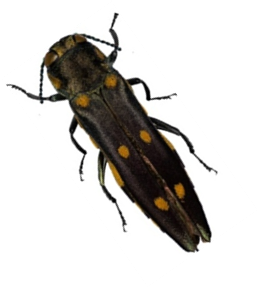
Agrilus genus
Hernández‐Gutiérrez, Nichols, and Kelly (2026) (full citation at the end of the blog) analyzed interactions between this genus of beetles and oaks (Quercus species). In this context, they report that 32 Agrilus species from Africa, Asia, Europe, and North and South America use 51 Quercus species as hosts in their native range. Eighteen (56.25%) use only Quercus hosts.
Oaks that host Agrilus species cluster in several clades, i.e., the entire Section Cerris and one clade of Section Ilex and two clades of section Lobatae. Clades where Agrilus hosts are underrepresented are Sections Cyclobalanopsis and Quercus &, surprisingly, two clades in Section Lobatae.
Their analysis indicated that beetle-oak interactions involving all the 32 Agrilus species and 105 Quercus species in their study had a significant likelihood of being damaging. For example, northern red oak (Q. rubra) is already known to host six Agrilus species. Hernández‐Gutiérrez, Nichols, and Kelly (2026)’s analysis indicated that this tree species might be utilized by all 32 Agrilus species assessed. The tree’s wide distribution (both native and introduced) places it close to other known or probable hosts, which exacerbates the risk of an interaction. Another 26 Quercus species are predicted to host ten or more Agrilus species.
The model was not successful in predicting hosts of A. auroguttatus (goldspotted oakborer) in its introduced range in California.
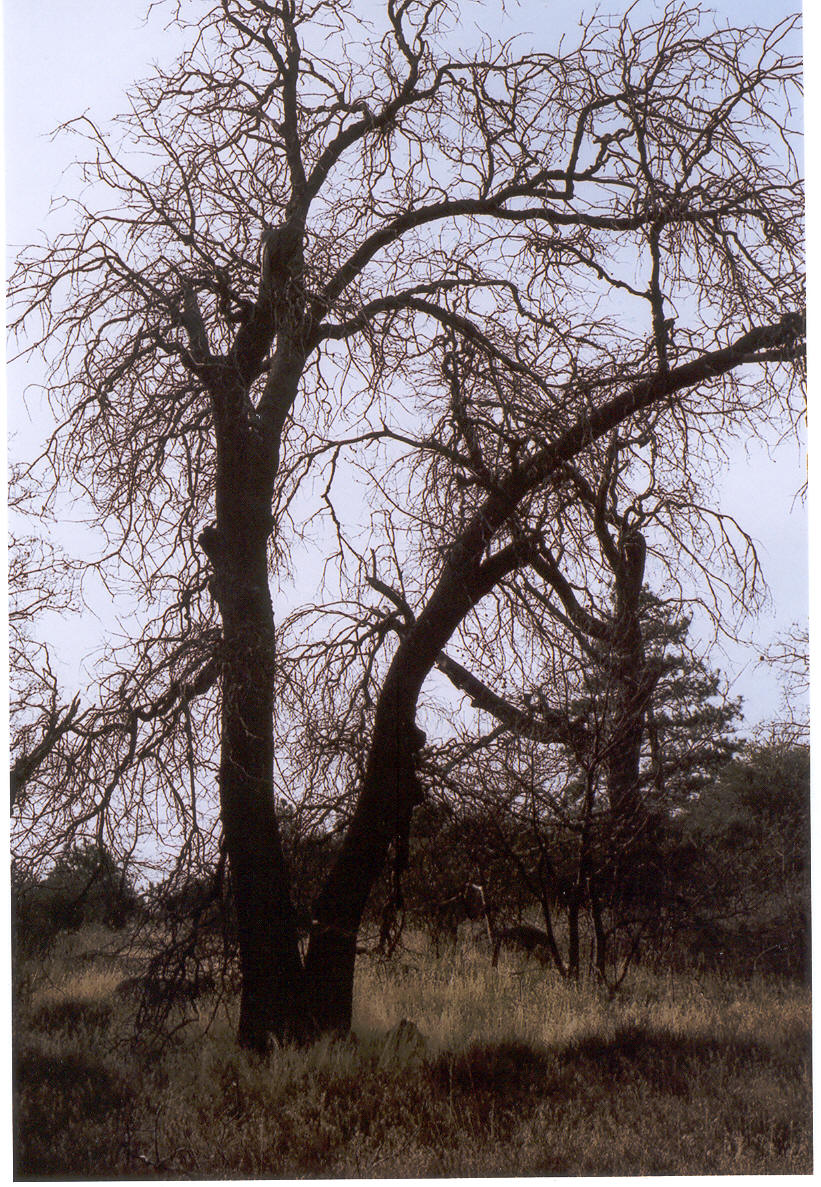
It also predicted that few of China’s oak species might host Agrilus beetles. However, as Dr. Robert Haack notes (pers. comm. June 2026), larval hosts have been identified for only 13% of the nearly 1,200 Asian Agrilus.
Some Agrilus species have a very large number of predicted novel interactions. A. graminis and A. angustulus are predicted to have more than 40 novel oak hosts. Both have numerous known oak hosts; so their “polyphagous” nature is already documented.
Since two-thirds of 666 Agrilus species with known larval hosts exploit only one plant genus as a host in their native range, Hernández‐Gutiérrez, Nichols, and Kelly (2026) assert that they might spread faster if introduced to homogeneous rather than species-rich habitats. Dr. Haack believes that this statement is too broad (pers. comm. June 2026).
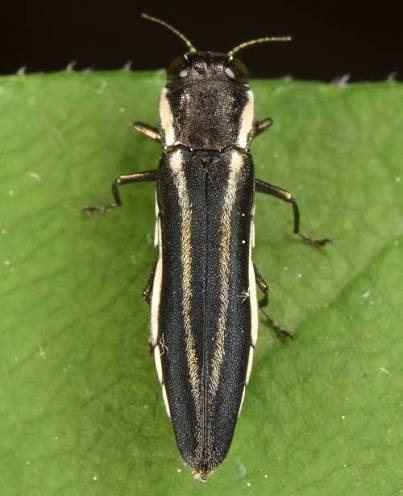
Twolined chestnut borer
Haack and Blank (2024) document that the twolined chestnut borer, Agrilus bilineatus has preferentially infested apparently healthy English oak (Quercus robur) trees over healthy native oak trees in Michigan. In North America, A. bilineatus is a major pest of oaks and American chestnut (Castanea dentata)when they are stressed by drought or other factors. Infestation typically begins in the upper crown and proceeds downward; tree death often occurs within three years.
At several sites in southern Michigan, where English oaks were intermixed with native white oaks (Quercus alba) and close to northern red oaks (Quercus rubra), A. bilineatus preferentially infested Q. robur trees that initially appeared healthy. Further study revealed that many of the English oaks attacked had low or depleted root starch levels.
Although these findings are cause for alarm, English oak is already used by 11 species of Agrilus in Europe. Perhaps the tree and ecosystem might have sufficient defenses in Europe. Meanwhile, A. bilineatus has been reported in Turkey as of 2018; I have found no recent information about the damage whether it is causing any damage there.
Data from Britain and Worldwide
Peyton et al. (2026) reviewed the effectiveness of a “horizon scanning” exercise conducted for Great Britain (England, Scotland and Wales). They report that 3,248 recognized non-native species have been detected in Great Britain, of which 2,016 have established self-sustaining populations. Some 194 (~10%) are considered invasive, that is, have negative impacts on biodiversity and wider ecosystem viability. These consist of 108 terrestrial species, 47 freshwater species, and 39 marine species. These bioinvaders cost the British economy an estimated ~£3.9 billion per year (the bulk of the damage is attributed to ash dieback, caused by the fungus Hymenoscyphus fraxineus).
In the decade between completion of the “horizon scan” and the present, 143 species were recorded as being introduced. The horizon scan predicted 31 of these species, 22%. Peyton et al. (2026) consider this to be success.
Peyton et al. (2026) report that globally, ~ 6% of non-native plant species are ranked as invasive. Among invertebrates, this proportion rises to 22%. Considering vertebrates introduced to Europe or North America, the figure is more than 50%!! I welcome global data that support my call for rethinking the “rule of tens” long relied on for estimating the proportion of non-native species that are invasive.
Discussing bioinvaders’ role in causing extinctions, Peyton et al. (2026) report that 30 predators have been linked to declines and extinctions of 738 vertebrate species.
Peyton et al. (2026) also discuss the difficulty in predicting an introduced species’ impacts when in some cases the time lag between introduction and presence in the wild or between establishment and spread w/in the region can last decades or even a century. They cite as an example Senecio squalidus, which escaped the Oxford Botanic Gardens in the 1700s but started to spread only during mid-1900s.
Australia
More than 300 non-native insect pests, pathogens and nematodes have established on tree or shrub hosts in Australia; 20% have caused moderate to high impacts to commercial plantations, urban forests, or trees in natural ecosystems (Carnegie et al. 2026).The rate at which non-native forest pests and pathogens have been detected in Australia has doubled since 2018 compared to earlier decades: from ~ 1.5 to ~ 3 per year. Carnegie et al. (2026) attribute this rise to greatly expanded official surveillance efforts. Still, three-quarters of the most recent detections came too late for eradication to be attempted.
The Forestwatch program (inaugurated – under a different name – in 2022) includes pathogens. I rejoice!!! Still, the target species threaten primarily tree species not native to Australia but important to commercial forestry or urban forests: Asian longhorned beetle, burnt pine longicorn (Arhopalus ferus), pine pitch canker, pine wilt disease, red turpentine beetle (Dendroctonus valens), Asian spongy moth, red needle cast, and sudden oak death. The exceptions are strains of Austropuccinia psidii not yet intro to Australia, and eucalypt leaf blight (caused by Teratosphaeria destructans) (Carnegie et al. 2026).
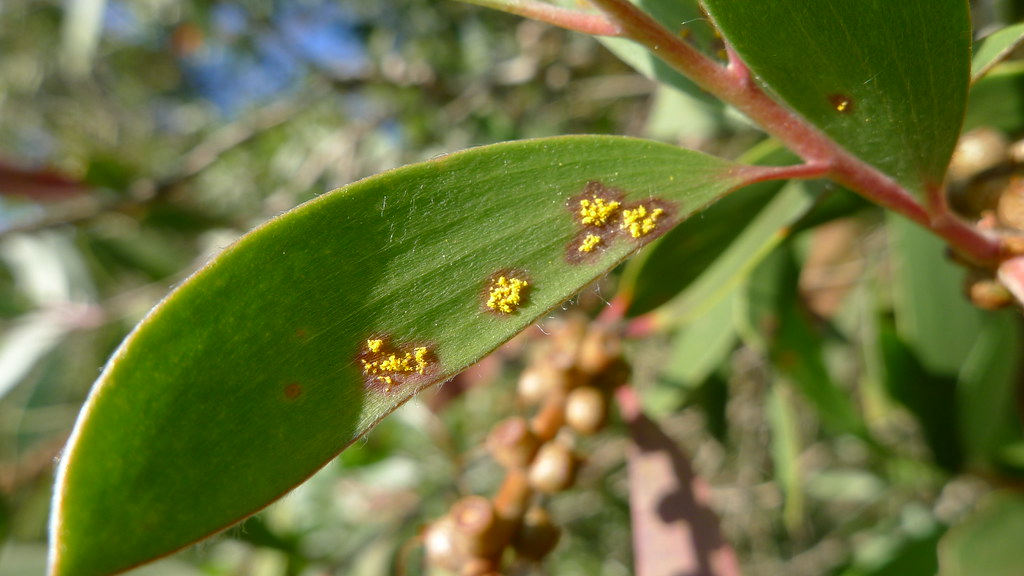
Among the introduced pests causing the greatest damage to native species are
- Phytophthora cinnamomi: this soil fungus can kill 40% of the plant species in the southern portion of Western Australia – which is one of 36 “Biodiversity Hotspots” recognized by the Critical Ecosystem Partnership Fund.
- Austropuccinia psidii (cause of myrtle rust) in natural ecosystems; Members of the host family Myrtaceae occur in 11 of 13 major vegetation formations on Australia. Various authorities have identified 76 species as at risk to the rust.
I hope the Australians are developing strategies for landowners to counter damage by the polyphagous shot hole borer (Euwallacea fornicatus) and its associated fungus (Fusarium euwallaceae). DMF Outbreak detected near Perth, Western Australia, in 2021 – apparently three years after the actual introduction. By June 2025 authorities had determined that it was too widespread to be eradicated, so landowners will be responsible for any management. (Carnegie et al. 2026) Impact is predicted to be greatest in urban landscapes, and cost up to AU$9.7 M per annum to manage.
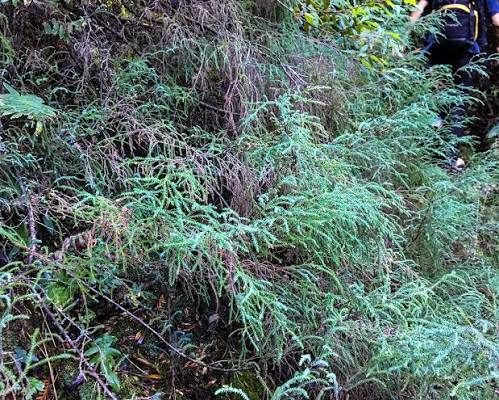
Phytophthora pluvivora was first detected in Australia on an English oak, Quercus robur. However, it has since been recorded on native species in the Blue Mountains, including the critically endangered dwarf mountain pine (Pherosphaera fitzgeraldii) in a National Park.
SOURCES
Carnegie. A.J., B.A. Summerell, C. Trollip, F. Tovar, D.I. Smith, and J. McDonald. 2026. Sentinel trees for early detection of non-native forest pests and pathogens in Australia. Front. For. Glob. Change 9:1801183. doi: 10.3389/ffgc.2026.1801183
Haack, R.A. and R.B. Blank. 2025. Susceptibility of English Oak (Quercus robur) to the Twolined Chestnut Borer, Agrilus bilineatus (Coleoptera: Buprestidae): Observations from Michigan. The Great Lakes Entomologist. 57: 113-125. https://doi.org/10.22543/0090-0222.2492
Hernández‐Gutiérrez, E., R.A. Nichols, and L.J. Kelly. 2026. Combined phylogenetic and geographic data can predict plant–pest interactions with high accuracy. New Phytologist (2026) doi: 10.1111/nph.71306
Peyton, J.M., S. Rorke, D.C. Aldridge, O.L. Pescott, K. Dehnen- Schmutz, D.G. Noble, J. Sewell, A.J.A. Stewart, T. Adriaens, B.C. Beckmann, J. R. Britton, J. Brodie1, P.M.J. Brown, I.C.N. Cavadino, P.F. Clark, A.M. Dunn, J.Foster, C. Harrower, M.C. Harvey, M.C. Jackson, T. Jones, C.A. Maggs, G. Martin, F. Mathews, A.C. Mill, D. Murphy, E. Paganini, R. Payne, W. Rabitsch, T. Renals, K. Schönrogge, R.H. Shaw, G.C. Smith, P.D. Stebbing, P.A. Stroh, H. Tidbury, E. Tricarico, J. Vallet, K.J. Walker, L.E. Wood, C.A. Wood, B. Woodcock, H.E. Roy. 2026. Assessing the success of a horizon scanning approach in predicting invasive non- native species arrival. J Appl Ecol. 2026;63: https://doi.org/10.1111/1365-2664.70217
Posted by Faith Campbell
We welcome comments that supplement or correct factual information, suggest new approaches, or promote thoughtful consideration. We post comments that disagree with us — but not those we judge to be not civil or inflammatory.
For a detailed discussion of the policies and practices that have allowed these pests to enter and spread – and that do not promote effective restoration strategies – review the Fading Forests report at http://treeimprovement.utk.edu/FadingForests.htm
Or