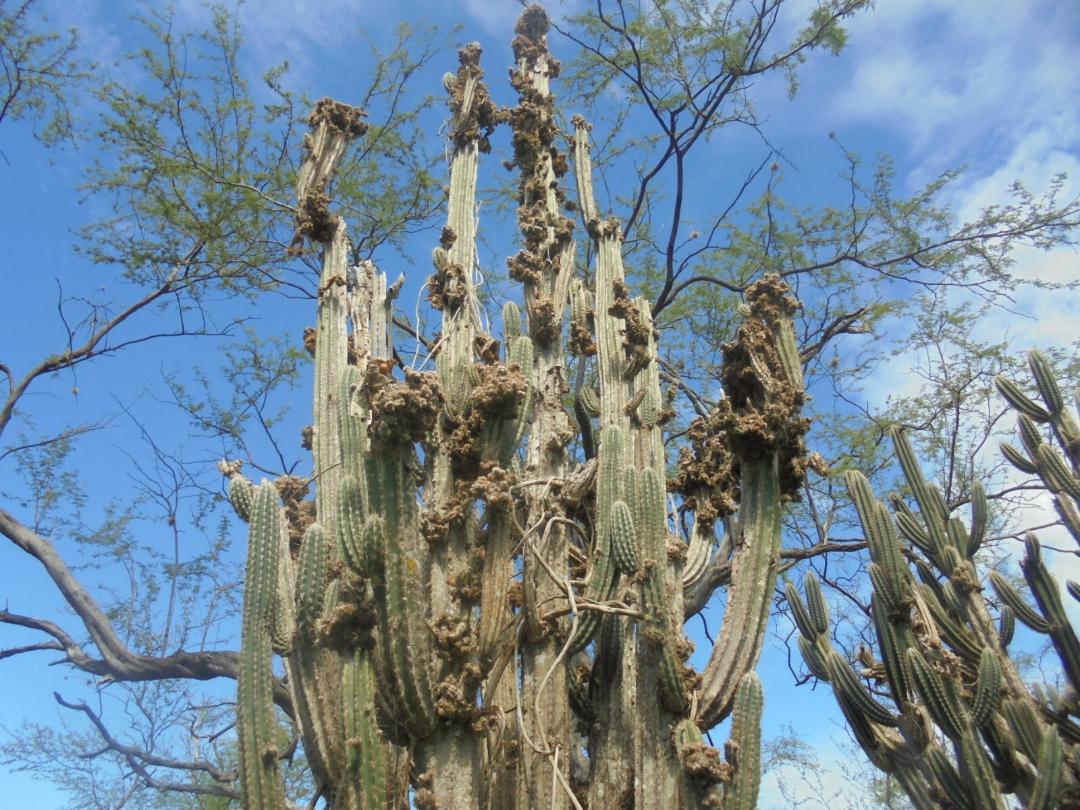
For 15 years I have maintained a profile of the Harrisia cactus mealybug Hypogeococcus pungens because it threatens columnar cacti in the subfamily Cactoideae from the Caribbean basin and possibly in the American Southwest and Mexico. My recent attempts to clarify the current situation have been frustrated by the apparent collapse of funding support for scientists trying to conserve these cactus species.
The dry regions of the Caribbean Islands are home to about 100 native cacti, 75% of which are endemic. According to the Center for Plant Conservation, 20 species are listed as threatened by the IUCN. Puerto Rico specifically is home to 14 cactus species, at least three of which are endemic.
How and when the mealybug first invaded the Caribbean and North America is unknown. The presence of the insect now known as H. pungens Hyp-C on Puerto Rico was detected in the Guánica Commonwealth Forest and Biosphere Reserve on the island’s southern coast in 2005 (Zimmerman et al. 2010). However, the actual introduction probably occurred about ten years earlier, in about 1996 (Poveda-Martinez et al. 2022). See map of locations below.
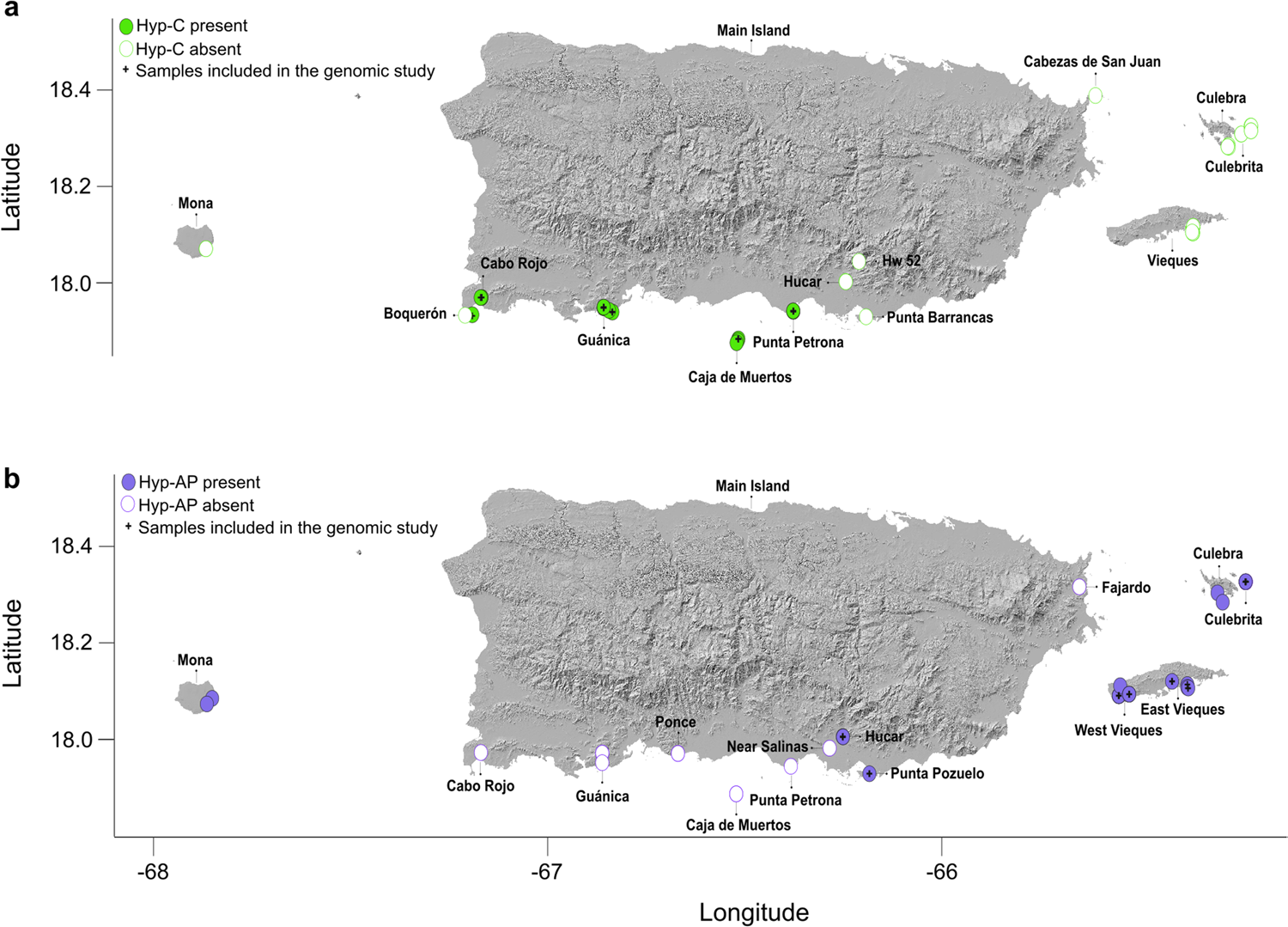
In the 20 years since then, the mealybug has spread across the island’s dry districts. By 2010, it was estimated to be present on about 1,400 km2. By 2014 – nine years after detection — the mealybug had reached the small island of Caja de Muertos. The most recent survey of which I am aware (date unclear) detected the mealybug on 268 out of 445 cactus plants examined (60%) in 12 out of 39 sites examined (Poveda-Martinez et al. 2022). The mealybug is also killing native cacti on the nearby U.S. Virgin Islands (Poland et al. 2019), although I have found no data on this invasion or its impact.
Below – columnar cacti on St. John, US Virgin Islands; photos by F.T. Campbell
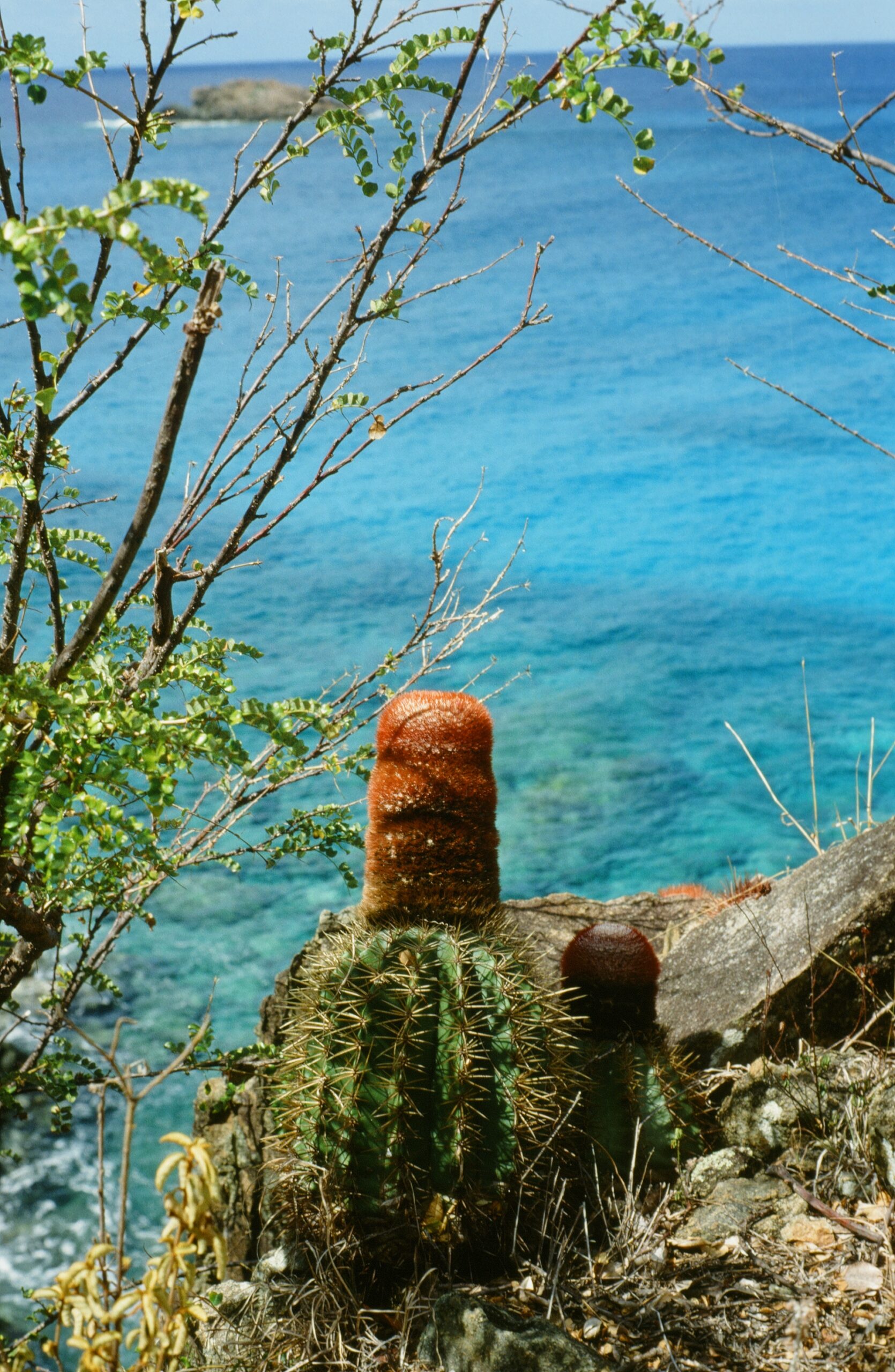
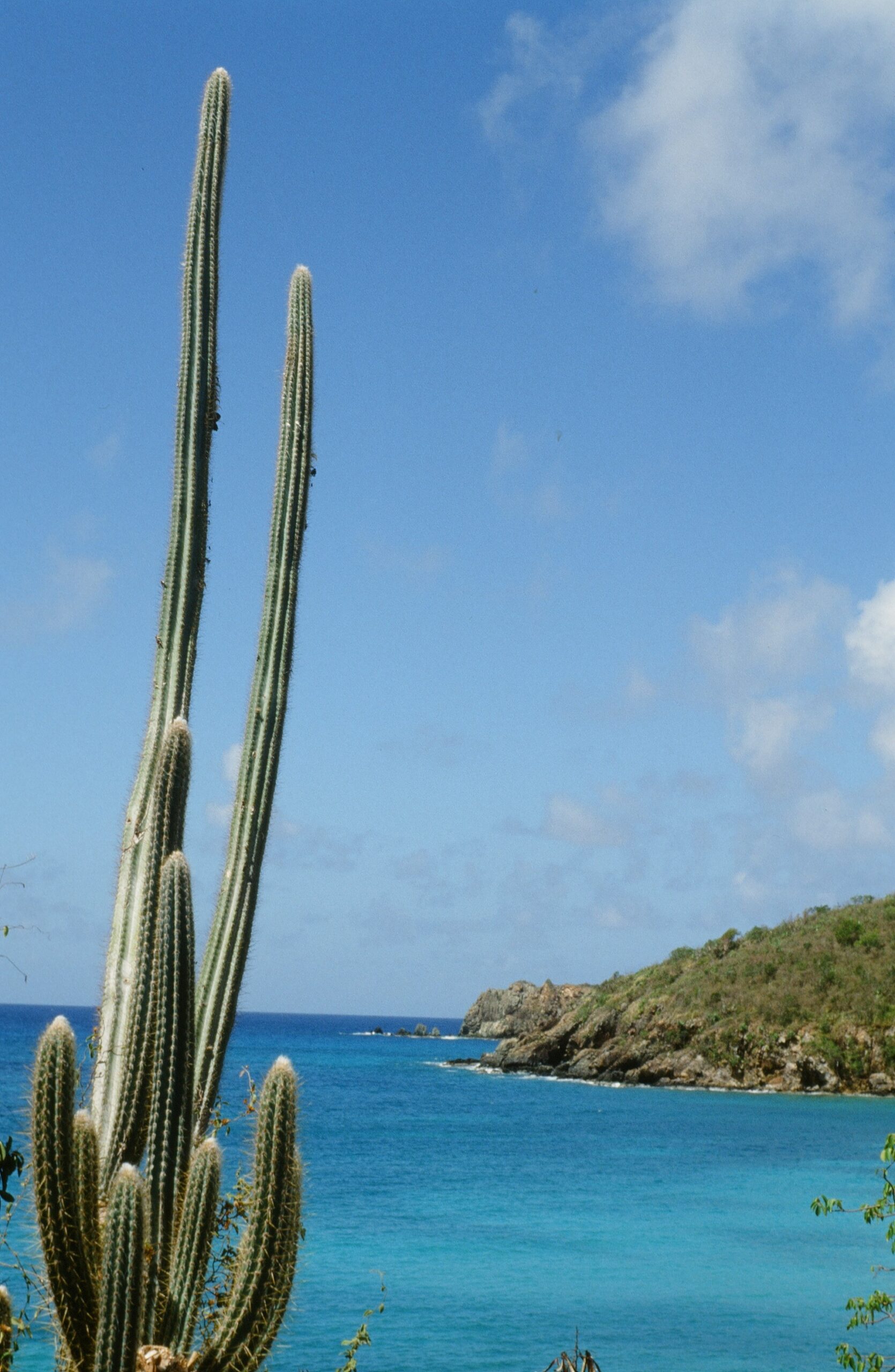
H. pungens Hyp‑C threatens seven of 14 native cactus species in Puerto Rico. Three of the cacti are endemic; two are federally listed as endangered species: Harrisia portoricensis and Leptocereus grantianus (USDA ARS). Since the mealybug’s detection in Puerto Rico, it has caused extensive damage to Pilosocereus royenii (Royen’s tree cactus), Leptocereus qaudricostatus (pitaya), Melocactus intortus (turk’s cap), and an introduced cultivar, Cereus hexagonus. It has caused minor damage to Stenocereus fimbriatus (Zimmerman et al. 2010). These cacti provide food or shelter for endemic bats, birds, moths and other pollinators (Segarra and Ramirez; USDA ARS).
The insect’s attack promotes abnormal gall-like growth on the stem and deformed flowers. These deformations severely affect infested plants’ reproduction and eventually survival (Poveda-Martinez et al. 2022).
Biological Control
When the mealybug was first detected Commonwealth and federal agencies tried to counter it. A search for possible biocontrol agents in the insect’s native range in Argentina began the 2010. While no funds have ever been appropriated for this activity, for several years the U.S. Department of Agriculture supported the work by allocating funds to the Agriculture Research Service Insect Behavior and Biocontrol laboratory in Gainesville, Florida, from broader programs. Dr. Stephen Hight took the lead, working with colleagues in South America. According to Dr. Hilda Diaz-Soltero, then a USDA official, these funds came primarily from the USDA Invasive Species Coordination Program and APHIS Eastern Region. In fiscal years 2017 and 2019, an additional ~$550,000 came in the form of grants under APHIS’ Plant Pest and Disease Management and Disaster Prevention Program. Link Scientists at the Center for Excellence in Quarantine and Invasive Species at the University of Puerto Rico devoted at least a decade to the search.
Scientists focused on two parasitoid wasps, Anagyrus cachamai and A. lapachosus (Hymenoptera: Encyrtidae). A third candidate, the predator Hyperaspis conclusa, was also assessed (Aguire et al.).
Research on the mealybug-wasps interaction uncovered troubling patterns. First, it has long been known that some mealybugs believed to be belong to the species Hypogeococcus pungens feed on columnar cacti while others feed on plants in two unrelated families, Amaranthaceae and Portulacaceae (USDA ARS; Zimmerman et al. 2010). Would the introduced wasps attack the cactus-feeding mealybug in sufficient numbers?
The confusion over how many mealybug species have been introduced – and where – severely hampered development of a program. (The mealybug has been introduced to control invasive cactus in Australia and South Africa. Most sources say it has been highly effective – prompting the initial concern when it appeared on Puerto Rico.) I have been unable to find any information about the status of the candidate biocontrol agents more recent than 2022.
Genetic Conservation
The USDA also partnered with the Naples (Florida) Botanical Garden to collect fruits and vegetative material for ex situ conservation. Rigorous phytosanitary procedures were followed to ensure the absence of the mealybug. Collections of fruits and vegetative material provided 1,298 cacti samples from 13 species, representing 1,173 maternal lines from 91 sites throughout Puerto Rico. A total of 90,720 seeds representing 8 species are banked at the NBG for long-term storage. Propagation of the vegetative material has 56% success, and plants are incorporated into the NBG’s living collections. (These figures include Opuntia cacti that are hosts of a second invasive insect, Cactoblastis cactorum.)
Genetic Concerns
Scientists now consider Hypogeococcus pungens (Hemiptera: Pseudococcidae) to be a species complex composed of at least five putative species. The species are separated in part by the plants they use as hosts. Two of the complex have apparently been introduced to Puerto Rico: H. pungens Hyp‑C feeds on cacti; H. pungens Hyp‑AP feeds on hosts in the Portulacaceae & Amaranthaceae. Both evolved from putative source populations in Brazil (Poveda-Martinez et al. 2022).
The two species H. pungens Hyp-C and Hyp-AP are currently separated on Puerto Rico by host preferences and climatic niches. They also occupy different geographic areas. Scientists fear that ongoing climate change could allow H. pungens Hyp-C to establish farther into the island’s interior and in a large area in the north. Such range expansion would end the geographic separation. Overlapping of the two species is likely to exacerbate the threat to Puerto Rico’s cacti. Most directly, it would complicate implementation of management strategies, especially biological control. Intermixing of the two species could also facilitate hybridization which might result in more vigorous attacks or a broadened host range. Hybridization is frequent in closely related species (Poveda-Martinez et al. 2022).
The Mealybug is Frequently Introduced
Mealybugs that feed on cacti and believed to be in the species Hypogeococcus pungens made multiple appearances in southern California between 2000 and 2018 – in gardens and in nurseries. Confusingly, CDFA reports interception of the mealybug on alternanthera and ludwigia plants shipped from Florida (CDFA 2018). I have no more recent data. The population in Florida was reported to be present in 16 counties in 2009); it might be the species that feeds on plants other than cacti (Poveda-Martinez et al. 2022). Other populations has been reported in the Dominican Republic (no date) (CDFA 2018); and in Hawai`i in 2005 (Hawaii Department of Agriculture new pest report). A mealybug that feeds on Amaranthaceae and Portulacaceae was detected in 2000 in San Juan, Puerto Rico (Poveda-Martinez et al. 2022).
In the absence of control measures, scientists expect H. pungens Hyp-C to continue decimating Puerto Rican cactus diversity and threaten other cactus rich ecosystems across the Caribbean islands, Central America and, potentially, North America (Poveda-Martinez et al. 2022).
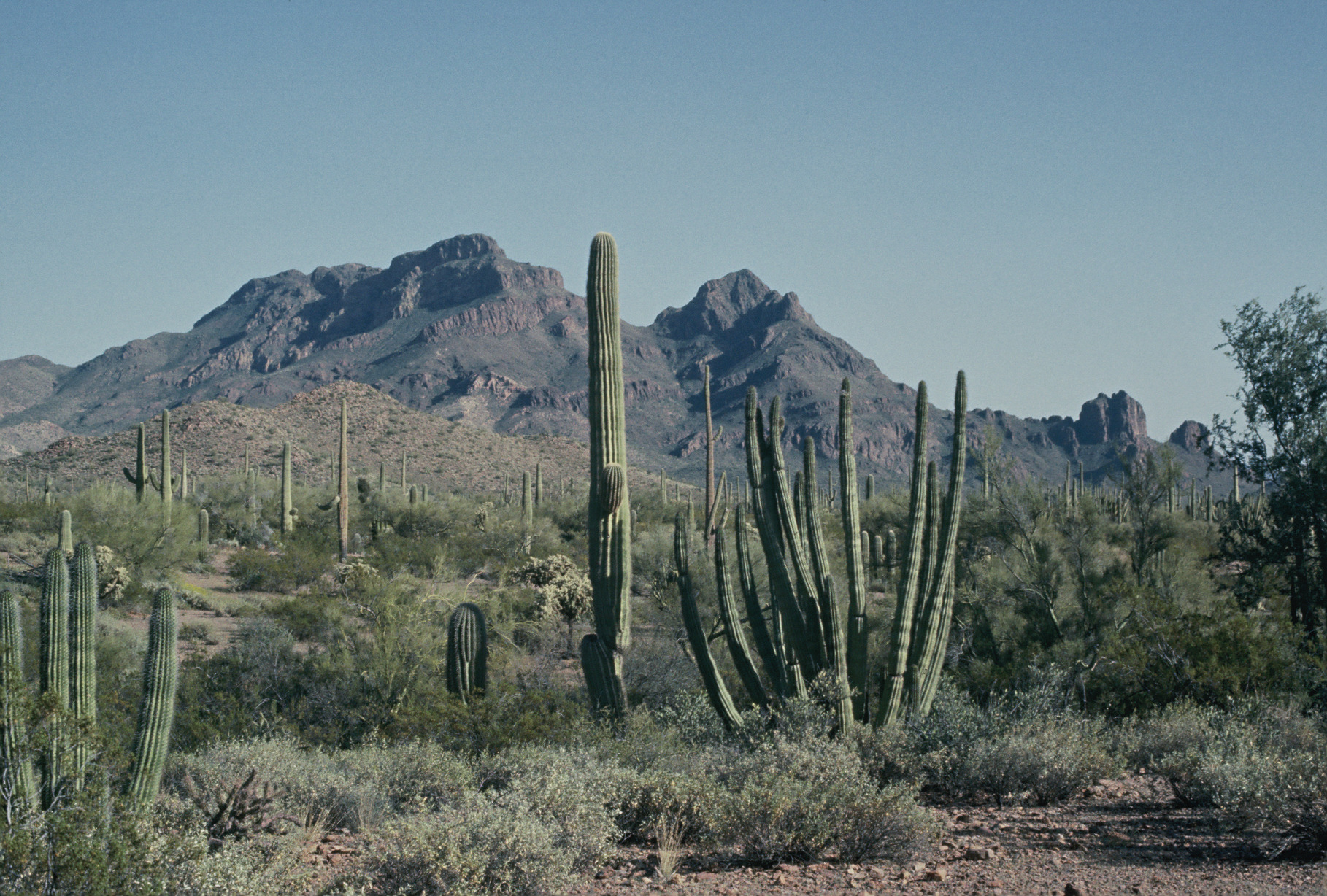
North America has more than 500 columnar cactus species in the Cactoideae (Zimmerman et al. 2010). Some of these cacti are already endangered, e.g., several Pediocactus. Others are totems of the desert, e.g., the saguaro (Carnegiea gigantea) and organ pipe (Stenocereus thurberi) cacti. Picture The larger ones, particularly, play important ecological roles. It is not known how vulnerable individual species are to the mealybug (Golubov pers. comm. January 2011). In Mexico several mealybugs in the same genus are already present. The natural enemies of these mealybugs might be able to attack H. pungens Hyp-C if it invades the country (Zimmerman et al. 2010). Despite the well-founded concern, apparently no funds have been allocated by governments or conservation organizations to studying the vulnerability of these cacti to one or more mealybugs in the Hypogeococcus genus.
The most likely pathway by which the mealybug is spread is the trade in plants for planting (the horticultural trade) (Zimmerman et al. 2010). A decade ago APHIS reported intercepting mealybugs on cactus (primarily on roots) imported from Germany, Peru, and Puerto Rico. APHIS has also intercepted several other mealybugs in the same genus – on plants (including orchids and bromeliads as well as cacti) from Belize, Costa Rica, Ecuador, Guatemala, Honduras, Mexico, Panama, Peru, and Venezuela (USDA APHIS alert).
A decade ago NatureServe and IUCN found that 31% of Earth’s cactus species were threatened with extinction. They named overharvesting (often for the illegal horticultural trade) and destruction of habitat by smallholder livestock ranching and farming. Did not mention predation by introduced insects – although that is now manifest not only in the cactus mealybug but also the cactus moth.
Sources
Aguirre, M. G. Logarzo, S. Triapitsyn, H. Diaz-Soltero, S. Hight, O. Bruzzone. 2023? Effect of egg production dynamics on the functional response of parasitoids
California Plant Pest and Disease Report. 2005. Vol. 22 No. 1. Covering Period from July 2002 through July 2005.California Department of Food and Agriculture. 2018.California Pest Rating for Hypogeococcus pungens Granara de Willink | Harrisia cactus mealybug Hemiptera: Pseudococcidae Pest Rating: A California Pest Rating for Hypogeococcus pungens Granara de Willink | Harrisia cactus mealybug Hemiptera: Pseudococcidae Pest Rating: A
Hawaii Department of Agriculture. 2006. https://hawaii.gov/hdoa/pi/ppc/2006-annual-report/new-pest-detections (accessed 11/1/10)
Poland, T.M., Patel-Weynand, T., Finch, D., Miniat, C. F., and Lopez, V. (Eds) (2019), Invasive Species in Forests and Grasslands of the United States: A Comprehensive Science Synthesis for the United States Forest Sector. Springer Verlag.
Poveda-Martinez, D. N.A. Salinas, M. Belen Aguirre, A.F. Sanchez-Restrepo, S. Hight, H. Diaz-Soltero, G. Logarzo, and E. Hasson. 2022 Geonomic & ecol evidence shed light on the recent demographic history of two related invasive insects. Scientific Reports.
Segarra-Carmona, A.E., A. Ramirez-Lluch. No date. Hypogeococcus pungens (Hemiptera: Pseudococcidae): A new threat to biodiversity in fragile dry tropical forests.
Segarra-Carmona, A.E., A. Ramírez-Lluch, I. Cabrera-Asencio and A.N. Jiménez-López. 2010. First Report of a New Invasive Mealybug, the Harrisia Cactus mealybug Hypogeococcus pungens (Hemiptera: Pseudococcidae). J. Agrie. Univ. RR. 94(1-2):183-187 (2010)
Srivastava, M., P. Srivastava, R. Karan, A. Jeyaprakash, L. Whilby, E. Rohrig, A.C. Howe, S.D. Hight, and L. Varone. 2019. Molecular detection method developed to track the koinobiont larval parasitoid Apanteles opuntiarum (Hymenoptera: Braconidae) imported from Argentina to control Cactoblastis cactorum (Lepidoptera: Pyralidae). Florida Entomologist 102(2): 329-335.
Triapitsyn, Aguirre, Logarzo, Hight, Ciomperlik, Rugman-Jones, Rodriguez. 2018. Complex of primary and secondary parasitoids (Hymenoptera: Encyrtidae and Signiphoridae) of Hypogeococcus species. mealybugs (Hemiptera: Pseudococcidae) in the New World. Florida Entomologist Volume 101, No. 3 411
USDA Agriculture Research Service, Research Project: Biological Control of the Harrisia Cactus Mealybug, Hypogeococcus pungens (Hemiptera:pseudococcidae) in Puerto Rico Project Number: 0211-22000-006-10 Project Type: Reimbursable
Zimmermann, H.G., M.P.S. Cuen, M.C. Mandujano, and J. Golubov. 2010. The South American mealybug that threatens North American cacti. Cactus and Succulent Journal. 2010 Volume 82 Number 3