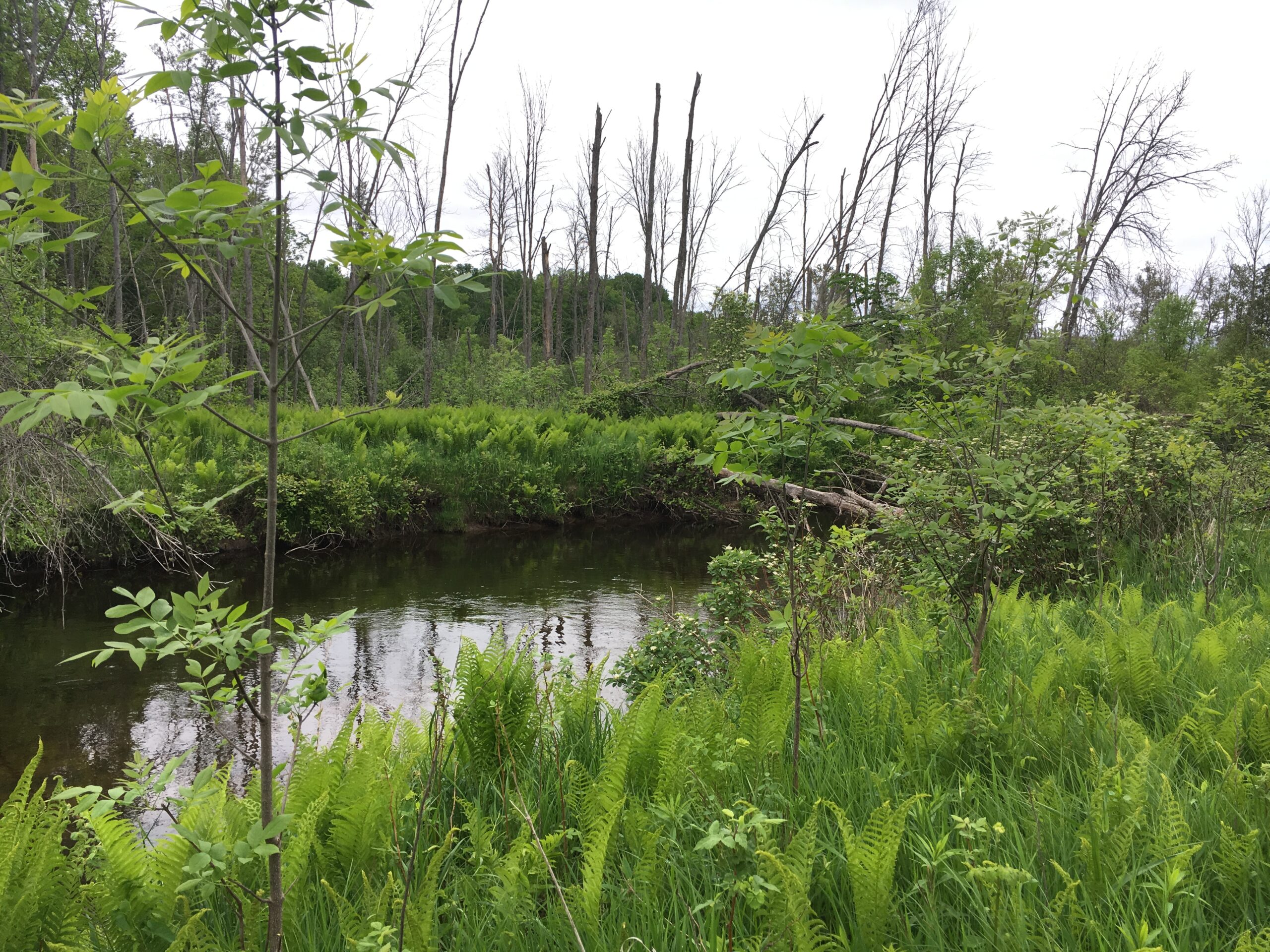
The 20th anniversary of detection of the emerald ash borer (EAB; Agrilus planipennis) in southeast Michigan has prompted reviews of the current situation. Tayal and Perry (2026) analyzed data from invasion-spanning research sites to investigate the extent of ash regeneration. Mortality of black ash (Fraxinus nigra), green ash (Fraxinus pennsylvanica), and white ash (Fraxinus americana) had exceeded 99% in these forests, with a concurrent precipitous decline of viable seed production.
They found that regenerating ash are abundant in the understory of post-outbreak forests. Among the 638 understory trees in the survey, basal area was highest for ash, followed by elm (Ulmus species.), maple (Acer species.), and musclewood (Carpinus caroliniana). On upland (xeric) and riparian (mesic) sites, ash are primarily in seedling and sapling size classes. Larger ash are more plentiful in wetland forests; the seven canopy ash trees were all in wetland forests.
The emerald ash borer is present in low numbers in all study sites.
Many ash of susceptible size (≥2.5 cm dbh) have symptoms of EAB infestation. Several of these symptoms (e.g., woodpecker damage, presence of epicormic sprouts, and canopy decline) grow more established as the trees grow. Still, 57% trees ≥5 cm dbh have healthy canopies. D-shaped adult beetle exit holes were detected on only 2% of the ash.
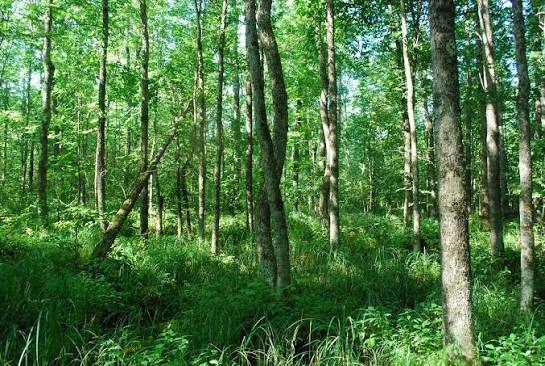
Tayal and Perry (2026) concluded that the black and green ash in wetland forests are able to respond quickly to the multi-tree gaps produced by EAB-induced death of their dominant predecessors in these systems. These gaps result in more light availability and growing space than the single-tree gaps created by mortality of individual ash in mixed-species riparian or upland systems.
Other tree species that also flourished in the aftermath forests were maples, esp silver maple (Acer saccharinum), have become dominant in the overstories of wetland forests in northern US and Canada. In late successional floodplain forest systems, the maples are joined by other species with a tolerance for cold, flooding, and shade including elm (e.g., Ulmus americana); tamarack (Larix laricina) and yellow birch (Betula alleghaniensis).
Of course, American elm is threatened by a separate invasive species, the pathogens Ophiostoma ulmi and O. novo-ulmi.
Tayal and Perry (2026) state several times that the future survival of this “orphaned” cohort of seedlings and saplings too small to have been colonized by EAB during the initial outbreak is uncertain. As they grow to susceptible size will they be attacked and killed by a growing population of beetles? Or will the biocontrol agents – assisted by woodpeckers – be effective in keeping EAB populations sufficiently low to allow the immature ash to reach reproductive size? Tayal and Perry (2026) cite Duan et al. (2023) as reporting that there is some evidence that the biocontrol agents can suppress EAB densities in immature ash. [Three agents – Oobius agrili, Spathius galinae, and Tetrastichus planipennisi – are established – in low numbers – in the forest sites studied.] So while the extent to which BC agents have protected regenerating ash in these long-term plots is still unknown, they express the hope that the parasitoids might be most effective in aftermath forests after EAB populations have peaked and then declined.
SOURCE
Tayal, A. and K.I. Perry. 2026. Status of ash (Fraxinus species.) in mixed hardwood post-outbreak forests near the epicentre of the emerald ash borer invasion. Agricultural and Forest Entomology, 1–12. Available from: https://doi.org/10.1111/afe.70067
Posted by Faith Campbell
We welcome comments that supplement or correct factual information, suggest new approaches, or promote thoughtful consideration. We post comments that disagree with us — but not those we judge to be not civil or inflammatory.
For a detailed discussion of the policies and practices that have allowed these pests to enter and spread – and that do not promote effective restoration strategies – review the Fading Forests report at http://treeimprovement.utk.edu/FadingForests.htm
Or