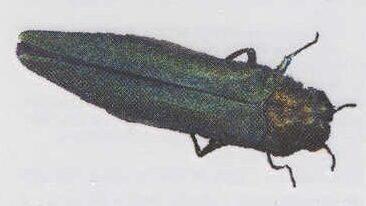
A newsletter issued by the Oregon Department of Forestry reports lots of action in Oregon and Washington in response to the presence of emerald ash borer (EAB; Agrilus planipennis). (To subscribe to the newsletter, email Jim Gersbach at jim.gersbach@odf.oregon.gov)
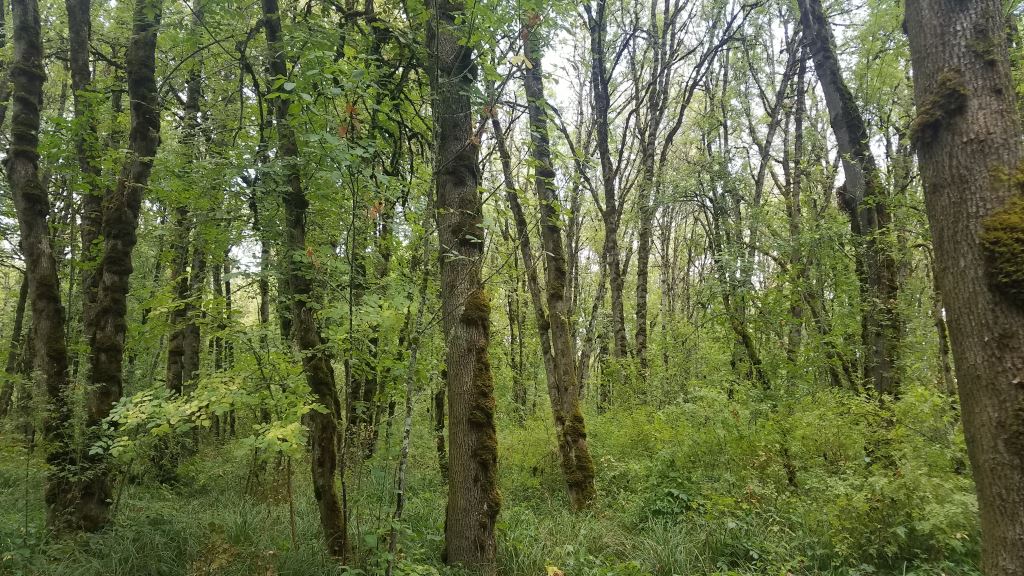
In Oregon, where EAB was detected in 2022, cities are taking protective actions. In Portland EAB was officially detected inside city limits in late summer 2025 east of the I-205 freeway. So far the beetle has not been reported from elsewhere inside city limits. To better establish where EAB is present, officials plan to girdle 4 ash trees in spring 2027 in hopes that female EAB will be attracted to them and oviposit. Those trees will be cut down in the fall, then examined to determine if any larvae are inside. This method has been used to help pinpoint where EAB is spreading before obvious signs of tree dieback are apparent. Oregon Department of Forestry will demonstrate the techniques for staff from the City of Portland, Oregon Dept. of Agriculture, U.S. Forest Service, Washington Dept. of Natural Resources, and Clackamas Soil & Water Conservation District.
EAB was confirmed within the city limits of Beaverton during summer 2026. The Beaverton City Council has adopted legislation expanding pesticide protection to1,400 ash street treesabove the 600 already treated in 2025. Treatment – injection of emamectin benzoate – is scheduled to begin in spring 2027 and be completed by September 2027. Last year city workers also protected 22 significant native Oregon ash trees (Fraxinus latifolia) over 20” dbh in a city-maintained natural grove that is predominantly ash.
EAB was detected in Silverton by a local tree care professional in summer 2016. The nearby Oregon Garden responded by treating eight ash trees on its grounds – all exotic to the region (seven white ash [eastern North America] & one narrow-leaved ash [Europe]). The Garden receives ~100,000 visitors a year. The treatments were supervised by Oregon Dept. of Forestry & Oregon Forestry Resource Institute staff.
In Washington State, where EAB was detected in August 2026, near Vancouver, the state has regulated firewood imported from sources outside the state. The quarantine on untreated firewood from outside the state was adopted in February by the state Legislature. It took effect on August 18. The rule prohibits importation into WA of untreated firewood from outside the state. Firewood imported into WA must be heat-treated to a minimum woodcore temperature of 160o F (71o C) for at least 60 minutes or receive an equivalent WSDA-approved treatment. The wood must also be labeled to show its source & display the statement “Approved Pest Free”. Firewood harvested within Washington State is exempt as are processed wood products, such as compressed wood bricks, wood pellets, logs, or wood products transported for industrial uses, such as to sawmills, pulp & paper mills, & biomass or wood composite facilities. Civil penalties up to $5,000 per violation can be imposed.
The newsletter provides updates on Europe’s double threat: EAB & ash dieback pathogen.
Europe is home to three species of ash: common ash (Fraxinus excelsior), manna ash (F. ornus), & narrow-leaved ash (F. angustifolia).
Hungary is the first European Union country with a confirmed EAB infestation (summer 2026). Neighboring Slovakia has also reported EAB presence but this is still unconfirmed.
While the EAB is native to the Russian Far East & other parts of East Asia, it was not seen west of the Ural Mountains before 2007, when it was reported in western Russia. By 2019 the pest had been recorded in Ukraine & Belarus. Researchers at Ohio State University have found that F. excelsior has at least moderate resistance to EAB.
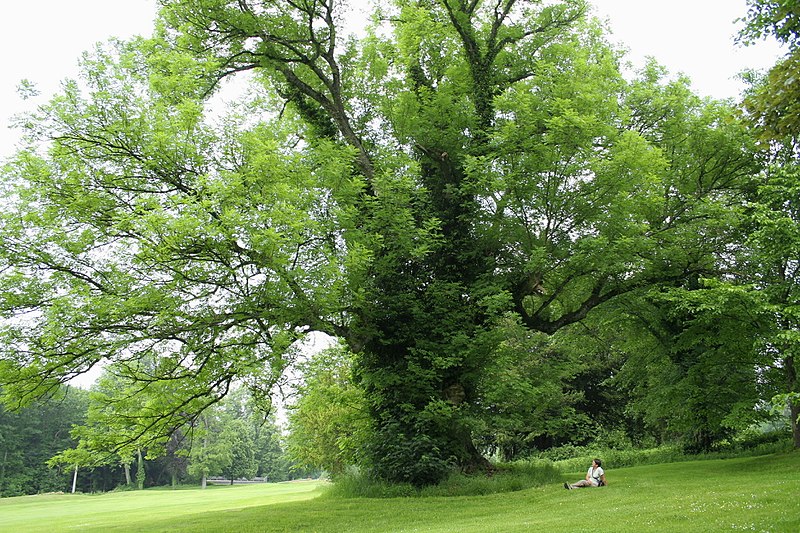
The ash decline pathogen (Hymenoscyphus fraxineus) is also from East Asia. It was first described in Poland in 1992 [although probably present much earlier, perhaps the 1990s (Tolio et al., 2025)]. It is now widespread in Europe. Where present, it has killed the vast majority of ash trees. To ascertain whether Oregon ash (Fraxinus latifolia) might be attacked, USDA Forest Geneticist Richard Sniezko of the Dorena Genetic Resource Center has sent seed to European colleagues so that they can plant them and track the results.
Some good news: British scientists report ~5% of F. excelsior trees appear to exhibit resistance to the parthogen and in some ash groves in northern England ~90% of young seedlings appear to be resistant.
The USDA Forest Service will hold a webinar on Oct. 6th to discuss EAB resistance ash breeding
Mary Mason, a geneticist w/ USFS Northern Research Station, will present. The webinar starts at 1 PM Eastern Daylight Time on Tuesday, Oct. 6.
Publications named by the Oregon newsletter that are particularly related to the situation in Oregon):
• Hull, C. 2024. A Valley Without Ash: Exploring Strategies for Forested Wetland Restoration Post Emerald Ash Borer Invasion in the Willamette Valley, Oregon. Oregon State University. https://ir.library.ORstate.edu/concern/graduate_projects/3j333b36w
• Melton, A.E., Faske, T.M., Sniezko, R.A., Thibault, T., Williams, W., Parchman, T. & Hamilton, J.A. 2025. Genomics-Driven Monitoring of Fraxinus latifolia (Oregon Ash) to Inform Conservation & emerald ash borer Resistance Breeding. Molecular Ecology e17640. https://doi.org/10.1111/mec.17640
• Monitoring Oregon ash forests in the face of the emerald ash borer: A guide for small woodland owners & managers https://extension.ORstate.edu/catalog/pub/em-9451-monitoring-OR-ash-forests-face-emerald-ashborer
• Larval development & parasitism of emerald ash borer (Agrilus planipennis) in Oregon ash (Fraxinus latifolia) & European olive (Olea europaea): implications for the West Coast invasion Journal of Economic Entomology | Oxford Academic
• Maze, D., Bond, J. & Mattsson, M. 2024. Modelling impacts to water quality in salmonid-bearing waterways following the introduction of emerald ash borer in the Pacific Northwest, USA. Biol Invasions (2024). https://doi.org/10.1007/s10530-024-03340-3
• Kral, G. & D.C. Shaw. 2023. Alternatives to Ash in Western Oregon: With a Critical Tree Under Threat, These Options Can Help Fill Habitat Niche. Oregon State University Extension EM 9396. https://catalog.extension.ORstate.edu/em9396
• Oregon Ash: Insects, Pathogens & Tree Health by Oregon State University Extension (also available in Spanish) https://extension.ORstate.edu/pub/em-9380
Useful links for more information
Map to find where EAB is currently confirmed in Oregon: https://experience.arcgis.com/experience/9f29b1860cb04d36ad71b122148277f3
EAB monitoring guidance https://www.OR.gov/odf/forestbenefits/Documents/eab-monitoring-guidance.pdf
Oregon Department of Agriculture https://www.oda.direct/EAB
Oregon Department of Forestry https://www.OR.gov/odf/forestbenefits/pages/foresthealth.aspx
Oregon State University Extension https://extension.ORstate.edu/collection/emerald-ash-borer-resources
Emerald Ash Borer Information Network, a collaborative effort by the USDA Forest Service & Michigan State University www.emeraldashborer.info
SOURCE
Tolio, B., P. Sherwood, D. Marčiulynienė, C. Crocoll, M. Cleary, M. Liziniewicz. 2026. Constitutive Metabolite Profiling of European & Asian Fraxinus with Varying Susceptibility to Ash Dieback. Journal of Chemical Ecology 52:8 https://doi.org/10.1007/s10886-025-01678-z
Posted by Faith Campbell
We welcome comments that supplement or correct factual information, suggest new approaches, or promote thoughtful consideration. We post comments that disagree with us — but not those we judge to be not civil or inflammatory.
For a detailed discussion of the policies and practices that have allowed these pests to enter and spread – and that do not promote effective restoration strategies – review the Fading Forests report at http://treeimprovement.utk.edu/FadingForests.htm
Or