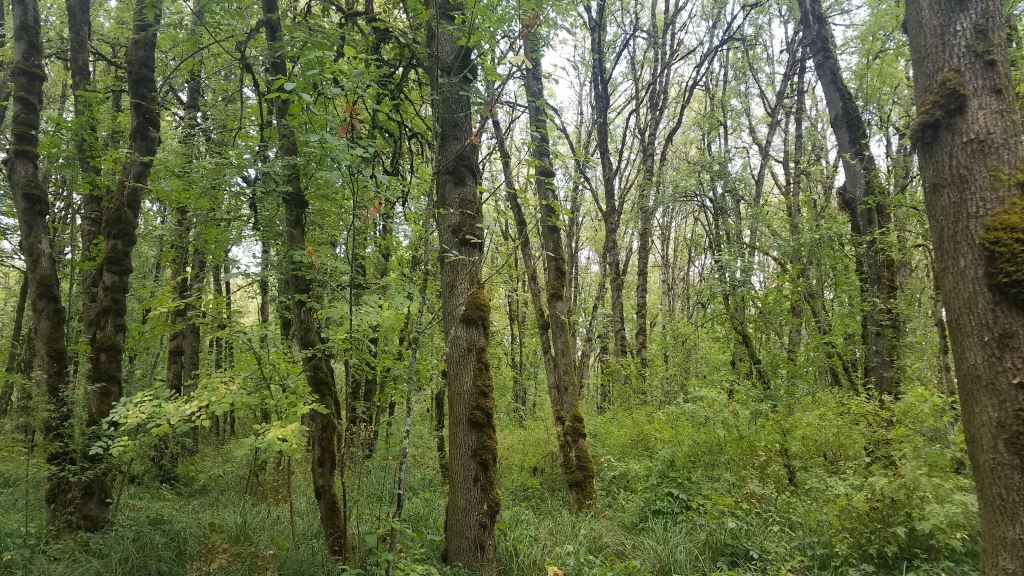
Research scientists in the USFS Northern Region (Region 9) – Maine to Minnesota, south to West Virginia and Missouri – continue to be concerned about regeneration patterns of the forest and the future productivity of northern hardwood forests.
The most recent study of which I am aware is that by Stern et al. (2023) [full citation at the end of this blog]. They sought to determine how four species often dominant in the Northeast (or at least in New England) might cope with climate change. Those four species are red maple (Acer rubrum), sugar maple (Acer saccharum), American beech (Fagus grandifolia), and yellow birch (Betula alleghaniensis). The study involved considerable effort: they examined tree ring data from 690 dominant and co-dominant trees on 45 plots at varying elevations across Vermont. The tree ring data allowed them to analyze each species’ response to several stressors over the 70-year period of 1945 to 2014.
In large part their findings agreed with those of studies carried out earlier, or at other locations. As expected, all four species grew robustly during the early decades, then plateaued – indicative of a maturing forest. All species responded positively to summer and winter moisture and negatively to higher summer temperatures. Stern et al. described the importance of moisture availability in non-growing seasons – i.e., winter – as more notable.
snow in Vermont; Putnypix via Flickr
The American Northeast and adjacent areas in Canada have already experienced an unprecedented increase of precipitation over the last several decades. This pattern is expected to continue or even increase under climate change projections. However, Stern et al. say this development is not as promising for tree growth as it first appears. The first caveat is that winter snow will increasingly be replaced by rain. The authors discuss the importance of the insulation of trees’ roots provided by snow cover. They suggest that this insulation might be particularly necessary for sugar maple.
The second caveat is that precipitation is not expected to increase in the summer; it might even decrease. Their data indicate that summer rainfall – during both the current and preceding years – has a significant impact on tree growth rates.
Stern et al. also found that the rapid rise in winter minimum temperatures was associated with slower growth by sugar maple, beech, and yellow birch, as well as red maple at lower elevations. Still, temperature had less influence than moisture metrics.
Stern et al. discuss specific responses of each species to changes in temperatures, moisture availability, and pollutant deposition. Of course, pollutant levels are decreasing in New England due to implementation of provisions of the Clean Air Act of 1990.
They conclude that red maple will probably continue to outcompete the other species.
In their paper, Stern et al. fill in some missing pieces about forests’ adaptation to the changing climate. I am disappointed, however, that these authors did not discuss the role of biotic stressors, i.e., “pests”.
They do report that growth rates of American beech increased in recent years despite the prevalence of beech bark disease. They note that others’ studies have also found an increase in radial growth for mature beech trees in neighboring New Hampshire, where beech bark disease is also rampant.
For more specific information on pests, we can turn to Ducey at al. – also published in 2023. These authors expected American beech to dominate the Bartlett Experimental Forest (in New Hampshire) despite two considerations that we might expect to suppress this growth. First, 70-90% of beech trees were diseased by 1950. Second, managers have made considerable efforts to suppress beech.
Stern et al. say specifically that their study design did not allow analysis of the impact of beech bark disease. I wonder at that decision since American beech is one of four species studied. More understandable, perhaps, is the absence of any mention of beech leaf disease. In 2014, the cutoff date for their growth analysis, beech leaf disease was known only in northeastern Ohio and perhaps a few counties in far western New York and Pennsylvania. Still, by the date of publication of their study, beech leaf disease was recognized as a serious disease established in southern New England.
counties where beech leaf disease has been confirmed
Eastern hemlock (Tsuga canadensis) and northern red oak (Quercus rubra) are described as common co-occurring dominant species in the plots analyzed by Stern et al. Although hemlock woolly adelgid has been killing trees in southern Vermont for years, Stern et al. did not discuss the possible impact of that pest on the forest’s regeneration trajectory. Nor did they assess the possible effects of oak wilt, which admittedly is farther away (in New York (& here) and in Ontario, Canada, west of Lake Erie).
In contrast, Ducey at al. (2023) did discuss link to blog 344 the probable impact of several non-native insects and diseases. In addition to beech bark disease, they addressed hemlock woolly adelgid, emerald ash borer, and beech leaf disease.
Non-native insects and pathogens are of increasing importance in our forests. To them, we can add overbrowsing by deer, proliferation of non-native plants, and spread of non-native earthworms. There is every reason to think the situation will only become more complex. I hope forest researchers will make a creative leap – incorporate the full range of factors affecting the future of US forests.
I understand that such a more integrated, holistic analysis might be beyond any individual scientist’s expertise or time, funding, and constraints of data availability and analysis. I hope, though, that teams of collaborators will compile an overview based on combining their research approaches. Such an overview would include human management actions, climate variables, established and looming pest infestations, etc. I hope, too, that these experts will extrapolate from their individual, site-specific findings to project region-wide effects.
Some studies have taken a more integrative approach. Reed, Bronson, et al. (2022) studied interactions of earthworm biomass and density with deer. Spicer et al. (2023) examined interactions of deer browsing and various vegetation management actions. Hoven et al. (2022) considered interactions of non-native shrubs, tree basal area, and forest moisture regimes.
Stern, R.L., P.G. Schaberg, S.A. Rayback, C.F. Hansen, P.F. Murakami, G.J. Hawley. 2023. Growth trends and environmental drivers of major tree species of the northern hardwood forest of eastern North America. J. For. Res. (2023) 34:37–50 https://doi.org/10.1007/s11676-022-01553-7
Posted by Faith Campbell
We welcome comments that supplement or correct factual information, suggest new approaches, or promote thoughtful consideration. We post comments that disagree with us — but not those we judge to be not civil or inflammatory.
For a detailed discussion of the policies and practices that have allowed these pests to enter and spread – and that do not promote effective restoration strategies – review the Fading Forests report at https://treeimprovement.tennessee.edu/
tanoak killed by P. ramorum; photo by F.T. Campbell
I am belatedly catching up on the situation with regard to Phytophthora ramorum – sudden oak death – in the US and other countries.
For a general factsheet on this plant disease, see profile here. Here, I’m summarizing more detailed information contained in the February, May, and August 2024 newsletters of the California Oak Mortality Task Force (COMTF) (Newsletters for earlier months are posted here.)
To obtain the most recent information, you can attend the Fall 2024 virtual meeting of the Task Force on Tuesday, October 29, 2024, from 1 pm to 3 pm PDT. Speakers will focus on the status of P. ramorum in California and Oregon wildlands.
On the next day, Wednesday, October 30, the Phytophthoras in Native Habitats Work Group will discuss “Threats to California Native Plants” including from viruses and excessive heat, along with other concerns.
Participation is free, but registration is required. Complete agendas and more information will be available soon here. Sessions will be recorded and posted to the same site. Questions? Contact Janice Alexander.
More in-depth information à Matteo Garbelotto’s UC Berkeley class, “Ecology and Impacts of Emergent Forest Diseases in California,” is now available free and online. Recommended reading, lecture recordings, slides, even essay topic suggestions are posted. Subjects covered include several high impact forest diseases, molecular diagnostics, disease control, and prevention.
I note that the recent detections of new outbreaks in forests and nurseries support the importance of weather in promoting or hindering establishment and spread of Phytophthora ramorum.
Phytophthora ramorum in North American Forests
In Oregon, P. ramorum continued to spread in 2023 and the first half of 2024.
These outbreaks were detected through extensive surveillance. Aerial monitoring (in cooperation with the USDA Forest Service) and high-resolution imagery covered more than half a million acres in Curry County — the region between the California border and the Coos County line. Ground surveys covered 860 acres. Sampling included 518 trees; 117 tested were positive for the fungus. Stream baits were deployed to 63 sites; 26 tested positive at least once (COMTF newsletter, February 2024; includes maps).
By summer 2024, 23 new P. ramorum infestations had been detected at or beyond the Generally Infested Area (GIA; the area where the pathogen is most commonly found) since 2021. Some of these involve one of the newly detected clonal lineages. Oregon officials are expecting to expand the state’s quarantine area to 901 square miles – 45% of Curry County. The designated GIA would also be enlarged to 178 square miles(COMTF newsletter, August 2024; contains maps).
Oregon continues trying to treat high-priority infestations. In 2023, the state treated 165 acres infested by one of the newly detected clonal lineages, NA2, in the Humbug Mountain area and 347 acres in the Port Orford infestation. Since 2001, Oregon’s Department of Forestry has completed eradication treatments on more than 9,000 acres at an estimated cost of over $37 million. Federal lands comprised 28% of treated acres; the remainder were private and state lands. Still, more than 1,000 high-priority acres have not been treated because neither state nor federal agencies could provide sufficient funds (COMTF newsletter, February 2024).
The stream baiting program in 64 stream drainages has – so far – detected six positive streams. Ground surveys are planned for the new positive drainages along the north bank of the Rogue River and a stream that drains into the Elk River east of Port Orford (COMTF newsletter, August 2024).
In California, recent wet winters have prompted several new detections. The first was in Del Norte County near previously detected sites. The UC Berkeley-coordinated “SOD Blitz” plans intensive surveys in this region in coming months (COMTF newsletter May 2024; contains map).
Somewhat later, new infestations were detected farther south, in Humboldt Redwoods State Park. The new sites were outside the formerly detected sites, on the north side of the creek and up to the top of the ridge (COMTF newsletter, August 2024).
Scientists have realized another concern: several other pathogens cause symptoms on bay laurel, tanoak, and madrone that are almost indistinguishable from SOD. This development will complicate monitoring (COMTF newsletter for August 2024; see below for more details).
Meanwhile, scientists determined that sites where the P. ramorum epidemic is driven by higher bay laurel (Umbellularia californica) densities sustained a higher genotypic diversity of P. ramorum. While tanoak (Notholithocarpus densiflorus) doesn’t contribute much to infection of true oaks (Quercus spp.) it can infect bay laurel, thus perpetuating the infection. Infected oaks and tanoaks maintain host-specific pathogen genotypes (Kozanitas et al. 2024)
The USDA Forest Service program that monitors streams in the East to detect P. ramorum placed baits in 63 streams in 10 eastern states: Alabama, Florida, Georgia, Illinois, Maryland, Mississippi, North Carolina, Pennsylvania, South Carolina, and Texas. In 2023, positive findings for P. ramorum were detected from two streams in Alabama, and one each in Mississippi and North Carolina. All sites are associated with nurseries that had previously tested positive for P. ramorum. Over the last five years – since 2019 – eight streams in four states have tested positive at least once: five in Alabama, and one each in Mississippi, North Carolina, and South Carolina. The detection in South Carolina is new. Vegetation in the watershed has been sampled multiple times; all samples collected so far — plant, soil, and run-off water – have been negative. The pathogen belongs to the NA1 lineage – the one established in forests in West Coast states. [COMTF newsletter February 2024]
from D.J. Haller & M.C. Wimberly. 2020
Situation in Europe
The February 2024, the COMTF newsletter summarized the situation in Great Britain. In England, aerial surveillance covered more than 31,000 ha of larch (Larix kaempferi)plantations. Follow-up investigations detected considerably fewer infested sites than the approximately 200 detected in 2022. Most remain in the southwest and northwest of the country. Weather conditions in 2023 were less conducive for sporulation in 2021 and 2022, which seemed to lead to a reduced level of disease in 2022 and 2023.
In Scotland, widespread aerial and ground surveillance detected a number of sites similar to those found since 2018. Scottish authorities note that where positive findings are not quickly followed by tree removal, localized spread occurred.
In Wales, four helicopter surveillance flights identified around 150 sites deserving further investigation. About 60 of these sites held infected trees, mainly larch, but some noble fir (Abies procera). The COMTF newsletter contains a map showing infested locations. This year’s infection level might be less than in previous years, but this might reflect the fact that the infections are in smaller forest blocks. However, the wet and mild weather in autumn/winter 2023 provided optimal conditions for sporulation, so the scientist expected higher infection rates in 2024. The Welsh Government is working on a new strategy for managing P. ramorum.
In Northern Ireland, P. ramorum was described as still active and spreading. Only two surveys were flown. They identified 49 locations for follow-up, many in forests where the pathogen had been found previously. At two locations, follow-up inspections and sampling of larch confirmed infection by a different pathogen, Phytophthora pseudosyringae. So in 2024, larch samples will be tested for both P. ramorum and P. pseudosyringae.
Other Phytopthoras in Europe
English scientists are trying to determine how damaging P. pseudosyringae is on larch. Infections have been observed at several locations in the north of England, as well as in Northern Ireland (COMTF newsletter February 2024).
Mullet et al. (2024) report that P. pseudosyringae is a self-fertile pathogen of woody plants, especially tree species in the genera Fagus, Notholithocarpus, Nothofagus and Quercus. It is found across Europe and in parts of North America and Chile. Genetic studies show that the North American population originated from Europe. P. pseudosyringae can infect roots; the stem collar region; bark; twigs and stems; as well as leaves. They report it is causing particular damage in Great Britain and western North America. Mullet et al. call for investigation of differences in life history traits between the two main population clusters, including their virulence and host ranges.
Nothofagus obliqua; photo by Line1 via Wikimedia
Chile (COMTF newsletter May 2024)
Concerned about decades of mortality of Nothofagus trees in native forests in Chile, González et al. 2024 sought to understand which other native plants might be reservoirs of inoculum of the pathogen Phytophthora pseudosyringae — which is a documented causal agent of partial defoliation and bleeding cankers on two native tree species,Nothofagus obliqua and N. alpina. P. pseudosyringae can sporulate on lesions on Cryptocarya alba, Nothofagus dombeyi and N. obliqua leaves. On Sophora macrocarpa, sporulation occurs on both asymptomatic tissues and on lesions. S. macrocarpa is a common understory species in Nothofagus forests, so it might be an inoculum reservoir for epidemic events in them.
Look-alikes on California Bay Laurel (COMTF newsletter May 2024)
Similar symptoms from a wide variety of pathogenic organisms were detected on bay laurels after last year’s wet winter. Among the pathogens — the list is not exhaustive — includes P. cinnamomi, Neofusicoccum nonquaesitum, Ganoderma brownie, P. pseudosyringae, P. nemorosa, Botryosphaeria dothidea, Armillaria gallica, Diplodia corticola, and others.
Foliar symptoms tend to look identical on bay laurel leaves. Two foliar pathogens cause particular concern. The first is an “anthracnose” disease of bay laurel caused by a species of Kabatiella. Although known to be present for ~80 years, this organism did not seem to cause problems until 2023. In multiple locations around the San Francisco Bay area, it has caused extensive browning defoliation of bay laurel crowns. Whether the trees will die is uncertain.
The second focus is on a recently named species, Calonectria californiensis. This organism produces P. ramorum-like similar symptoms on a wide variety of native plants, including bay laurel, tanoak, salal, mock-orange, Oregon-grape, and rhododendron. On most of these plants this fungus causes black spots that can grow to kill entire leaves, but apparently C. californiensis is not a pathogen of woody plant parts. Initial symptoms of infection on bay laurel appear identical to those caused by the SOD pathogen (Phytopthora ramorum). C. californiensis does not appear (yet) to lead to lasting debilitating disease or tree mortality.
Nurseries and Managed Landscapes
In administering APHIS’ cooperative program aimed at minimizing spread of P. ramorum via interstate trade in plants, California’s Department of Agriculture (CDFA) relies – at least in part – on funds from USDA. CDFA received $1,308,771 from APHIS in 2023. More than 300 establishments in California are regulated under the program. They submitted ~ 7,400 P. ramorum regulatory samples to the CDFA in 2023. Seventy-eight of the samples were positive (COMTF newsletter February 2024).
At the end of 2023, seven California nurseries that had tested positive for the presence of P. ramorum were operating under the APHIS regulation governing positive nurseries. This was an increase over previous years; zero in 2022, three in 2021 (COMTF newsletter February 2024 Table 4). During 2024 five nurseries were confirmed as positive. Three of these had tested positive in previous years. Two retail nurseries were newly positive; one of these was apparently infected when it brought in plants from another nursery (COMTF newsletter August 2024). I wonder whether the very wet winters California has experienced lately have enhanced the pathogen’s ability to grow – and be detected.
In Oregon, in 2023 the Department of Agriculture regulated five interstate shippers under federal compliance agreements and a sixth intrastate shipper regulated under state requirements (COMTF newsletter February 2024). Spring compliance surveys tested 1,228 foliar samples; ten were positive. After this nursery incinerated all nearby plants, none of the 1,664 foliar samples tested in the fall was positive.
In 2023, the Washington State Department of Agriculture processed more than 300 plant, soil, and water samples; all were negative. Washington also inspected five of the nine nurseries that had ‘opted-out’ of the Federal program so they can no longer ship interstate. Host material appeared free of symptoms so no samples were collected (COMTF newsletter February 2024).
Washington nurseries and regulators frequently encounter the problem of infected plants being shipped into the state from outside. (P. ramorum has been found in 33 Washington nurseries since 2003.) During 2023, the Washington State Department of Agriculture conducted three trace-forward investigations. Fortunately no infestations were detected (COMTF newsletter February 2024). In March 2024, Washington faced another trace-forward involving plants sold to homeowners (COMTF newsletter May 2024). Thirteen tissue samples and two soil samples all tested negative (COMTF newsletter August 2024)
Finally, Washington conducted stream baiting. In 2023, none of the 66 samples was positive (COMTF newsletter February 2024)
Infested Plants
Most of the plant species on which P. ramorum was detected during these years are the usual ones: Rhododendron, Viburnum, Pieris, Arbutus, Prunus, Camellia, Loropetalum. I think the several Cornus species might be somewhat unusual. Disease was confirmed on a new Cornus species, C. capitata (evergreen dogwood). One taxon — Arbutus x ‘Marina’ — is not yet listed by APHIS as a host because Koch’s postulates have not been completed (COMTF newsletters for February 2024 and August 2024).
Research (summarized in the February 2024 newsletter)
Two studies found evidence of seasonal and weather factors influenced establishment of P. ramorum. One study found a clear seasonal pattern of pathogen incidence in the western US, plus a link to the El Niño-Southern Oscillation (ENSO) (Xuechung et al. 2024. The second study looked at a Japanese larch plantation in Scotland (Dun et al. 2024).
In both Scotland (above) and France (Beltran et al. 2024 2024), scientists demonstrated that prompt action helps to suppress P. ramorum establishment.
APHIS Updates its Regulations
In March 2024, APHIS revised the P. ramorum “Domestic Regulatory Program Manual.” The agency said it updated figures and definitions, clarified operational steps, and revised the Retail Nursery Dealer Protocol (COMTF newsletter for May 2024).
Funding
In Fiscal Year 2024, under the Plant Protection Act Section 7721 program, APHIS funded $1 million worth of projects focused on P. ramorum and related species. This was out of a total $62 million in funds dispersed for pest survey, research, mitigation, and outreach programs. This money funded nursery surveys in 11 states. Also, it paid for a project to evaluate the threat of the NA2 & EU2 lineages to nurseries and forests (COMTF newsletter May 2024).
SOURCES
Beltran, A.; Laubray, S.; Ioos, R.; Husson, C.; Marçais, B. 2024. Low persistence of Phytophthora ramorum in western France after implementation of eradication measures. Annals of Forest Science. 81: 7. https://doi.org/10.1186/s13595-024-01222-1
Dun, H.F.; MacKay, J.J. & Green, S. 2024. Expansion of natural infection of Japanese larch by Phytophthora ramorum shows trends associated with seasonality & climate. Plant Pathology. 73(2): 419-430).
González, M.P.; Mizubuti, E.S.G.; Gonzalez, G.; Sanfuentes, E. 2024. Uncovering the hidden hosts: Identifying inoculum reservoirs for Phytophthora pseudosyringae in Nothofagus forests in Chile. Plant Pathology. 73(4): 937-947. https://doi.org/10.1111/ppa.13855. (Summarized in COMTF newsletter February 2024.)
Kozanitas, M.; Knaus, B.J.; Tabima, J.F.; Grünwald, N.J.; Garbelotto, M. 2024. Climatic variability, spatial heterogeneity & the presence of multiple hosts drive the population structure of the pathogen P ram & the epidemiology of Sudden Oak Death. Ecogeography. https://doi.org/10.1111/ecog.07012. (Summarized in COMTF newsletter May 2024.)
Mullet, M.S.; Harris, A.R.; Scanu, B. [and others]. 2024. Phylogeography, origin & population structure of the self-fertile emerging plant pathogen Phytophthora pseudosyringae. Molecular Plant Pathology. https://doi.org/10.1111/mpp.13450. (Summarized in COMTF newsletter for May 2024.)
Xuechung, K.; Wei, C.; Siliang, L.; Tiejun, W.; Le, Y. & Singh, R. 2024. Spatiotemporal distribution of sudden oak death in the US & Europe. Agricultural & Forest Meteorology. 346: 109891)
beech leaf disease symptoms; photo by Matthew Borden via Flickr
Beech leaf disease (BLD) came to attention in 2012 near Cleveland. It has since spread to the Atlantic – Maine to New Jersey and northern Delaware; south into Virginia; north in Ontario; and west to eastern Michigan.
Scientists have scrambled to understand the disease – how it hijacks the tree’s metabolism; & here its impacts on seedlings, saplings, and mature trees; how it spreads, locations at greatest risk.
Now Bartlett Tree Research Laboratories – the research arm of Bartlett Tree Experts – has announced development of Integrated Pest Management (IPM) strategies to treat individual trees – sadly not yet beech in the forest. The project is led by Dr. Andrew Loyd and Dr. Matthew Borden.
Seeing the disease’s impacts on a tree species with aesthetic and ecological values not easily replaced, and its rapid spread, scientists at Bartlett Tree Research Laboratories began testing fungicides and nematicides registered under the Federal Insecticide, Fungicide and Rodenticide Act (FIFRA) by the U.S. Environmental Protection Agency (EPA) to see whether they might be effective against the causal nematode Litylenchus crenatae ssp mccannii.
As Drs. Loyd and Borden note, managing BLD presents numerous challenges:
1. The disease was discovered recently, so there were many unknowns, including how it spreads and the causal organism’s novel life cycle.
2. The damage occurs in leaf buds during winter dormancy. There has been little previous research on such a system. It is difficult for chemicals to reach the tissues.
3. Mature trees are large, so reaching the vulnerable leaves in the canopy is difficult.
4. Treatment efficacy cannot be evaluated until nearly a year after application.
5. Few chemicals are registered for use against foliar nematodes or for trees in forest, nursery, or landscape settings.
6. Obtaining funding is difficult because protecting beech is a low priority among many of the usual sources.
Fortunately, the leadership at Bartlett – the company’s research department, the New England Division leadership, and especially Robert A. Bartlett, Jr. (head of the family-owned company) – saw the importance of protecting beech and have supported this research. The USDA Forest Service has also funded some of studies exploring soil drenches. Cameron McIntire reports that these studies do not yet have results.
Furthermore, Bartlett has chosen to make the science easily available to all interested parties. Three posters explaining experiments to date are available at ResearchGate. They have also published a study on the early tests of Fuopyram as a foliar spray. It is open-access. Additional publications presenting data on experiments with both spray (Fluopyram) and injection (Thiabendazole/Arbotect) are in preparation.
I summarize briefly here their findings as of August 2024.
In all the trials, the scientists judged efficacy of treatments by counting the number of viable nematodes in leaves, viable nematodes in overwintering buds, and BLD symptom severity at appropriate times before and after treatment (spray or injection).
Tests of foliar sprays on small to medium sized trees
The first tests of foliar applications that resulted in BLD suppression were carried out in Ohio starting in 2021, then expanded to other field sites in Ohio and several states in New England in 2022 and 2023 seasons. In early trials, trees were sprayed four times starting in mid to late July at 21-day intervals. The scientists say that recent trials focus on application timing and rate. They hope that optimizing these factors will help generate new recommendations that are more sustainable while maintaining efficacy.
At the annual meeting of the American Phytopathological Society in July 2023, Bartlett announced that Fluopyram is an effective management tool to combat BLD – on smaller trees that can be treated using foliar application. There are several EPA-registered products, though only one, Broadform, has been so far been granted a section 2(EE) recommendation “For Control of Beech Leaf Disease on Beech Trees.”
Treatments are less effective in situations where the inoculum load is very high (for example, a very dense stand of infected trees); or where mature, untreated canopies hang over treated understory beech.
They suggest that managers focus treatments on high-value specimen beech, collection preservation, and potentially uncrowded mixed natural stands.
Treatments should be made by certified pesticide applicators who are familiar with the disease and treatment specifications. For the injection treatment, technical training and specialized equipment is needed. Bartlett arborists and plant health care specialists in locations affected by BLD have all been trained to perform the treatments, and some other arborists are doing BLD treatments as well using the same products.
Soil drench
Matt Borden said that they tested drenches with three different chemicals. The approach did not reduce nemtatode numbers sufficiently. However, as noted above, the Forest Service is funding additional tests exploring possible combinations of drenches with other actions, such as thinning. Discovering management options across a range of application methods (e.g., foliar, injection, drench) and modes of action is vital for a disease that covers such a broad range of locations and tree sizes and forms.
a macroinjection demonstration; photo by Matthew Borden via Flickr
Injections
Scientists injected Thiabendazole (TBZ) into beech on private land in three locations in Ohio and New Jersey. They tested two application rates and three application timings. They have two years of follow-up data for one site, one year for the others.
Key findings:
nematode numbers in buds in late winter consistently reflected foliar symptoms when the leaves opened.
Injections made before mid-July provided the greatest reduction in nemtatode numbers and best canopy improvement. Trees injected late in the season (30 August), after the nematode has begun dispersing from leaves to buds, exhibited some BLD symptoms the next year, but suffered less canopy dieback than controls.
Margery Daughtrey of Cornell said during a discussion of these finding that the trees’ persistence suggests that trees can tolerate some level of symptoms. Among other things, it might be possible to treat the trees less frequently than annually.
TBZ appears to provide at least two seasons of nematode suppression
Bartlett continues to monitor these trees to see how long the injected chemical suppresses nematode numbers and how long the tree remains healthy. They are also establishing new field sites to further optimize rate and timing.
TBZ – in a product called Arbotect 20-S – has been used to manage Dutch elm disease and sycamore anthracnose since the 1970s. However, it is also a well-known nematicide, previously used as an anti-parasitic drug in human and veterinary medicine. Once injected, TBZ protects the tree for more than one season. The injection technology (MACRO-Injection) has also been used for decades. It infuses the chemical directly into the tree’s vascular system; it does not rely on root uptake. Matt says injection does require take technical skill and the right equipment. To minimize the risk of the wound cracking and weeping, the injection should be done low on the side of the root flare, not on top.
While Arbotect 20-S has been registered for use in 48 states for many years, new labeling is required for its use in beech trees and against BLD. Special Local Needs labels, 24(C)s, have been granted by eight states – Connecticut, Massachusetts, Maine, New Jersey, New York, Pennsylvania, and Virginia. Registration in a ninth – Maryland – is in progress and Bartlett scientists are prepared to apply for several more. The problem is that only a limited number of these “special needs” labels may be issued, and BLD has expanded so far, and so rapidly, that it is already infesting beech in more states than may be covered by 24(C)s. Furthermore, 24(C) labels expire if not renewed. Most current 24(C)s will be active through 2028 – not ideal for a disease that will likely be with us long into the future. The product manufacturer (Syngenta) and distributor (Rainbow Ecoscience) are drafting a change to the main Arbotect 20-S label to add beech and the new nematode pest, but warn that EPA review and approval of amendments can take a very long time. Until then, we must resort to limited special local needs labels, and some states will miss out.
contrasting canopy transparency in beech treated with TBZ v. untreated controls; photo by Matthew Borden
One of the key scientists who developed these treatments for Dutch elm disease, R. Jay Stipes, professor emeritus at Virginia Tech, is quoted by Bartlett rejoicing that his work might help protect another tree species.
Matt believes the treatments will be effective if applied every 2-3 years. This approach would also spread out the cost – which will depend on the arborist but Dave Anderson of Rainbow Ecoscience estimated to be about $25 / inch of dbh.
It is always best to obtain an accurate diagnosis before treatment. The next step is talking through your options with a certified arborist or tree disease specialist. The “good” thing about BLD is that it is a progressive disease and will not kill a tree in a single year. Therefore, waiting until you know the disease is present or active locally is generally recommended.
Tree injection is better than foliar application where the latter is impractical (e.g., the tree is tall) or to reduce runoff, particularly near streams. Bartlett recommends treating any beech larger than 10 cm dbh by injection; smaller trees by foliar spray.
Treated trees should be sound, without serious decay, girdling roots, or other conditions that curtail uptake. Based on research results to date, they recommend treating the tree before mid-July. Bartlett is testing the results of injecting the shortly after full leaf expansion – early to mid-June. Bartlett scientists are testing several application rates to determine how long a single injection will suppress BLD. So far they have had good results from both low and moderate label rates (0.4-1.6 fl oz/inch DBH).
All the technical information re: research into treatments and recommendations for applying either the foliar or injection treatments has been provided by Dr. Matthew Borden of Bartlett Tree Research Laboratories. He can be reached at
Dr. Borden says he is immensely grateful for the support that allows him and Dr. Loyd to travel widely to establish the BLD research sites and spend weeks collecting data each year with their team. Company founder Francis A. Bartlett established the Bartlett Tree Research Laboratories as a separate entity within the company, where capital is reinvested directly into stable, long-term support of scientific tree research and preservation. The model is well-suited to provide the flexibility and freedom needed to rapidly respond to emerging invasive species issues.
Posted by Faith Campbell
We welcome comments that supplement or correct factual information, suggest new approaches, or promote thoughtful consideration. We post comments that disagree with us — but not those we judge to be not civil or inflammatory.
For a detailed discussion of the policies and practices that have allowed these pests to enter and spread – and that do not promote effective restoration strategies – review the Fading Forests report at https://treeimprovement.tennessee.edu/
The National Plant Board’s members are the lead plant health officials of the states and territories. Many federal officials also attend – from APHIS and DHS Bureau of Customs and Border Protection. Representatives of other North American phytosanitary entities participate – i.e., Canada, Mexico, and the North American Plant Protection Organization (NAPPO). Some stakeholder groups participate, especially the nursery industry. I have attended these meetings for over a decade because they provide an overview of pest issues and programs plus an unparalleled opportunity to network. The Nature Conservancy’s Leigh Greenwood also attends. We are the only representatives of the species conservation community to attend – others are missing great opportunities.
Here, I’ve listed 10 items that are among the most important the group discussed.
1) The funding situation for APHIS is worse than I realized
APHIS Administrator Mike Watson and Deputy Administrator (for plants) Mark Davidson both spoke about the need to cut programs to stay within the limits set by congressional appropriations. Funding for APHIS, as a whole, was cut only 1% for the current year (Fiscal Year 2024), cost-of-living salary increases mean less money for programs. (I believe Dr. Watson said $41 million less for FY24). If FY25 funding is the same, Congressionally mandated additional payraises will mean an another $20 million decrease in program funding.
Dr. Davidson said that the plant programs (Plant Protection and Quarantine) had been cut by 5% in FY24. However, Congress did not finalize the funding levels until about half-way through the fiscal year – so staying within the limits required even more severe cuts to programs in the remainder of FY24. To stay within these limits, APHIS cut several programs, among them a $3.6 million cut from the “tree and wood pest” program. This meant loss of funds to manage the polyphagous and Kuroshio shot hole borers, smaller cuts for programs managing Asian longhorned beetle and emerald ash borer, and perhaps the Asian flighted spongy moth. They anticipate additional cuts in these programs in FY25. The one bright light is the Section 7721 Plant Pest & Disease Management & Disaster Prevention Program. It provides steady funding for a range of plant health programs. The House version of the still-pending Farm Bill calls for increasing funding for this program by $15 million each year.
Nearly 100% ash trees in Oregon wetland — exposed to spreading EAB. Photo by Wyatt Williams, Oregon Department of Forestry
Remember this when I ask you to lobby for appropriations! If we don’t advocate for funding the programs dealing with “our” pests, they will shrink.
Watkins and Davidson also worry that whoever is the next secretary of USDA might not support the agency when it seeks to withdraw funds to cover emergencies from the Commodity Credit Corporation – as Secretary Vilsack has.
APHIS and the DHS Customs and Border Protection (CBP) both praised a recent regulatory action that increases user fees for importers having goods cleared at ports. Kevin Harriger, CPB official in charge of agriculture programs, said the new funds would allow CBP to hire 700 new agricultural inspectors (currently there are 2,800 agricultural officials). That sounds great, but … when trade and passenger volumes crashed early in the COVID pandemic, things looked dicey for a while. Plus – as I have argued repeatedly – real protection against pest introductions will come from stronger policies, not ramped-up inspections.
Pathologist Bruce Moltzan reported on the USFS Forest Health Protection program. He pointed out that the USFS has a very limited toolbox. In this fiscal year, the program has about $48 million, after salaries, to support its activities. Projects targetting insects receive 70% of the funding; those targetting pathogens 15%.
2) Invasive hornets
Washington State has not found any new nests of the Northern (formerly Asian) giant hornet (Vespa mandarinia). Miraculous!
However, Georgia detected another species, the yellow-legged hornet (Vespa velutina), near Savannah in August 2023. The Georgia Department of Agriculture, APHIS, and the University of Georgia are working to find nests – which are located at the top of tall pine trees in residential areas. Five nests were found in 2023; another four so far in 2024. Georgia hopes to place traps 100 miles out from each detection site. Like the northern hornet, V. velutina preys on honey bees. It was probably transported by ship or with its cargo.
A third species, V. tropica, has been introduced on Guam.
3) Better Federal-State Cooperation — Sometimes
APHIS and the state phytosanitary officials have set up structures – e.g., Strategic Alliance/Strategic Initiative, or SASI – to work together more closely. CBP joins the coordinating meetings. One program described at the meeting is the effort to contain spread of the box tree moth (Cydalima perspectalis). This effort came out of discussions at last year’s Plant Board meeting, with follow-up gatherings of APHIS, the states, and the nursery industry. The moth is known to be present in New York, Massachusetts, Michigan, Ohio, and now Delaware – plus several Canadian provinces.
A second project concerns how much data to share about state detections of pests – which are recorded in the National Plant diagnostic Network database. These data have accrued over 20 years … and are sought by both other states and academic researchers. States are often reluctant to allow public review of detection data because they fear it will cause other states or private parties to avoid buying plants or other goods from the infested area. While the project team has not yet decided how to deal with these conflicts, they said they were more inclined to share “nonconsequential data” – meaning data on a pest everyone already knows is present, not a pest under regulation or a new detection. In other words, “consequential” seems to pertain to industry profits, not damage to agricultural or natural resources.
EAB-killed ash along Mattawoman Creek, Maryland. Photo by Leslie A. Brice
Craig Kellogg, APHIS’ chief plant health representative in Michigan, reviewed 20 years of dealing with the emerald ash borer (EAB). He is optimistic about the impact of the biocontrol agents that have now been released in 32 states and four provinces. The larval parasitoids are dispersing and EAB densities are coming down. He conceded that over-story and mature ash are still dying, but says ash in long-infested areas are regenerating well. Scientists agree (see Wilson et al. 2024; full citation at end of the blog). Woodpeckers are still the most effective biocontrol agent of EAB for over-story ash, especially in locations where introduced parasitoids are not established. So far, the growing numbers of biocontrol agents are still parasitizing too few EAB larvae to prevent decline of over-story ash trees.
APHIS reported on recent detections of flighted spongy moth from Asia on ships coming to U.S. ports. The program covers four closely related species of Lymantria. All have much broader host ranges than Lymantria dispar, plus the females are capable of sustained flight, so they spread more rapidly.
The principal strategy to prevent their introduction is to require ships that call at ports along the Pacific coast in Russia, China, Japan, and North and South Korea to ensure that the ships’ superstructures and cargo are clean. Before arriving at U.S. ports, the ship’s captain must inform CBP where it has called over the last 24 months. Then, CBP conducts an inspection. If CBP inspectors find a small number of egg masses, they remove the eggs and spray pesticide. If the inspectors detect a large number of egg masses, the ship is ordered to leave port, clean itself, and undergo re-inspection before it can return.
Four countries in the Americas – the U.S., Canada, Chile, and Argentina – and also New Zealand have very similar programs.
Detections follow natural changes in population levels in the exporting regions. APHIS’ program leader, Ingrid Asmundsson, reported on an unfortunate coincidence in 2014. A huge moth population outbreak occurred simultaneously with very low fuel prices in Russia. The latter attracted many ships to call there. An even bigger population surge occurred in 2019. Asmundsson expects another high-moth period this year.
flighted spongy moths infesting a ship superstructure
APHIS is working on putting this program on a regulatory foundation; this would allow the agency to be more specific in its requirements and to impose penalties (other than expulsions from ports). I’ll let you know when the proposed rule is published for comment.
6) Regional Reports: Old Pests, New Pests
Representatives of the regional plant boards informed us of their “new pest” or other concerns.
Gary Fish, president of the Eastern Plant Board, mentioned
awareness that laurel wilt is moving into Virginia and maybe farther north.
elm zig-zag sawfly; photo by Gyorgy Csoka via Bugwood
There was a more general discussion of beech leaf disease. What can be done, given that the disease is so widespread that no one is regulating movement of beech. Gary Fish advised outreach and efforts to reach agreement on management approaches. Chris Benemann, of Oregon, suggested informing other states so that they can decide whether to take regulatory action. A representative of CBP urged engaging stakeholders by asking for their help.
Chris Benemann, President of the Western Plant Board, expressed concern about APHIS’ reduced funding for spongy moth detection and control efforts. She also worries about the recently detected population of Phytophthora austrocedriiin an Oregon nursery. The western states are also focused on several longstanding pest problems – grasshoppers, Japanese beetle; and a new beetle from Australia that is attacking almonds, pistachios, and walnuts.
tree infested by hemlock woolly adelgid; photo by F.T. Campbell
Megan Abraham of Indiana reported that members of the Central Plant Board are concerned about
funding decrease for APHIS and USFS efforts to slow the spread of spongy moth and manage Asian longhorned beetle and emerald ash borer;
She noted that nursery stock is increasingly coming from more distant – and cheaper – producers, raising the risk of new pests being introduced.
Finally, Abraham expressed concern about decreased funding at the same time as the need is growing – and asked with whom states should collaborate in order to reverse this trend.
Kenny Naylor of Oklahoma, Vice President of the Southern Plant Board, concurred that funding levels are a major concern. He mentioned specifically the spongy moth Slow the Spread program and eradication of the Asian longhorned beetle outbreak in South Carolina. Another concern is the Georgia hornet outbreak.
7) Phasing Out Post-Entry Quarantine
APHIS and the NPB have agreed to phase out the post-entry quarantine (PEQ) program. A program review revealed several problems, some of which astound me. When examining plants in quarantine the scientists still relying on visual inspection! And they are looking for pests identified 45 years ago (1980)! While I think PEQ programs can be valuable in preventing introduction of disease agents, as implemented in recent decades it does not. Twenty years ago, citrus longhorned beetles escaped from a “quarantine” area in a commercial nursery in Washington state. These Cerambycids are more than an inch long!
citrus longhorned beetle; photo by Art Wagner, USDA via Bugwood
Part of this phase-out is to transfer plant species harboring pests of concern to the Not Authorized for Importation Pending Pest Risk Assessment (NAPPRA). While the APHIS speaker said that NAPPRA allows the agency to act quickly when it detects evidence of pest risk, I have found lengthy delays. The third round of proposals was published in December 2019! The fourth round of species proposed for NAPPRA listing should be published soon; a fifth round is now in draft inside the agency.
8) Christmas Greens – Spreading Pests
Officials from Oregon, Maine, and Illinois described their concerns about pests being spread by shipments of various forest or plant products, especially Christmas greens. Mentioned were spongy moths, link hemlock woolly adelgid, link elongate hemlock scale, balsam woolly adelgid, link and box wood moth. Part of the challenge is that the vectoring items are often sold by unregulated outlets – multiple stores, Christmas tree lots – and through on-line or catalog outlets. There are also extreme demands on the regulatory enforcement staff during the brief holiday sales season. Several states are unsure whether they have authority over decorative products – although others pointed out that they are regulating the pest, regardless of the object for sale or type of store.
9) Pests in Firewood
Leigh Greenwood of The Nature Conservancy noted that the state agencies that issue firewood regulations – often the plant protection organization (state department of agriculture) — do a good job alerting the public about the risks and rules. However, the public looks first to state parks agencies for information about camping – and those agencies have less robust educational efforts. It is important to put the message where the public can find it when they don’t know it exists – before they include firewood from home in their camping gear.
10) Projects of the North American Plant Protection Organization
The North American Plant Protection Organization (NAPPO) is working on several projects of interest to those of us concerned about tree-killing pests. One project is evaluating risks associated with wood products, especially how well one international regulation, ISPM#15 is working for dunnage. Another projects is testing the efficacy of the heat treatment specified by ISPM#15 (50o C for 30 minutes). A third project — almost completed – is evaluating fumigants that can be alternatives to methyl bromide.
In conclusion, each annual meeting of the National Plant Board is packed with new information, updates on current pests, and comments on by the state agencies who suggest new approached to APHIS and hold the agency to account. It is well worth attending. Information about upcoming meetings of both the national and four regional plant boards is posted on the NPB website, https://www.nationalplantboard.org/
Signatories to the APHIS-NPB strategic alliance
SOURCE
Wilson, C.J., T.R. Petrice, T.M. Poland, and D.G. McCullough. 2024. Tree species richness and ash density have variable effects on emerald ash borer biological control by woodpeckers & parasitoid wasps in post-invasion white ash stands. Environmental Entomology.
Posted by Faith Campbell
We welcome comments that supplement or correct factual information, suggest new approaches, or promote thoughtful consideration. We post comments that disagree with us — but not those we judge to be not civil or inflammatory.
For a detailed discussion of the policies and practices that have allowed these pests to enter and spread – and that do not promote effective restoration strategies – review the Fading Forests report at https://treeimprovement.tennessee.edu/
Flighted spongy moths infesting a ship’s superstructure
USDA’s Animal and Plant Health Inspection Service (APHIS) has issued its annual report for Fiscal Year 2023. The report is part of an enhanced outreach effort that I believe is an effort to persuade the Congress to provide additional funds. However, as I describe below, at this summer’s annual meeting of the National Plant Board, link APHIS’ leadership stated that funding shortfalls are forcing them to curtail many programs. These include ones important to those of us concerned about threats to North American trees. I applaud this action and hope it succeeds!
The report contains some good news but I consider the overall approach depressing. Tree-killing pests continue to receive little attention. The report also emphasizes APHIS’ efforts to facilitate export of agricultural products – an understandable stance given American politics.
The opening summarizes the agency’s activities includes:
Examples of programs targetting pests abroad, before they can reach the U.S. All are fresh fruits and vegetables;
APHIS or staff at U.S. borders:
Approved (cleared) 27,235 shipmentscontaining over 1.87 billion plant units (e.g., a single plant or cutting, or vial of tissue culture plantlets) and 670,811 kilograms of seeds. They intercepted 2,176 quarantine pests. (APHIS carry out these inspections at Plant Inspection Stations – separate from the port environment where DHS Customs and Border Protection (CBP) staff inspects other cargo.)
Identified approximately 92,000 pestsfound during CBP inspections of cargo, mail, and express carrier shipments and took quick action to prevent those of concern from entering the U.S.
Facilitated entry of regulated agricultural cargo by monitoring more than 62,000 treatments of various kinds, that is, fumigations, cold or heat treatments, and irradiation.
Examples of APHIS’ efforts to slow pests’ spread within the country cited plant pest surveys — with coordinated responses — for approximately 45 pests. Also APHIS described funding to help citrus growers combat citrus greening.
The report has separate subreports on the following programs: risk analysis, pest detection, “specialty crop” pests, and tree and wood pests. The last two contain information specific to our interests.
Tree and Wood Pests
This program protects forests, private working lands, and natural resources. It targets specific pests: the Asian longhorned beetle, emerald ash borer, spongy moth, and most recently the invasive shot hole borers. The report notes that numerous native, widespread hardwood tree species are vulnerable to these pests. APHIS asserts an economic justification for the program: conserving forests enhances rural communities’ economic vitality, supports forest-related industries, and maintains the ecosystem services provided by urban trees.
Unfortunately, at this summer’s annual meeting of the National Plant Board APHIS leadership said funding shortfalls forced them to pull back on all these programs.
ALB eradication aims to protect the 30% of U.S. trees that are ALB hosts. These trees support multi-billion-dollar maple syrup, timber, tree nursery, trade, and tourism industries. After reviewing the history of ALB detections, starting in Brooklyn in August 1996, the report describes APHIS’ eradication strategy as comprising surveys, regulatory inspections and quarantine restrictions, removal of infested and high-risk trees, and chemical treatment applications. In FY 2023, the program surveyed more than 763,000 trees across the four regulated areas: New York, Massachusetts, Ohio, and South Carolina. Each program is summarized.
Good news at two locations. On Long Island: only 11 new infested trees were found after a survey of 43,480 trees. In Worcester County, Massachusetts, no new infested trees were found after surveying nearly 360,000 trees. However, in Tate Township, Ohio, surveys detected 163 new infested trees. And in
South Carolina, the program is at an earlier stage — surveying a portion of the quarantine area. The program surveyed nearly 140,000 trees and removed 1,700 in FY 2023.
At the National Plant Board Meeting, Deputy Administrator Mark Davidson explained that the FY2024 appropriation cut $3.6 million from the “tree and wood pests” account. This required the agency to reduce funding for the ALB eradication program.
The report summarizes the spread of EAB since its first detection in 2002 in Michigan to 37 states and the District of Columbia (APHIS does not mention EAB’s presence in five Canadian provinces.)
Saying that EAB has spread beyond what a regulatory program can control, the report notes that APHIS ended the regulatory program in FY 2021. In FY 2023 the agency continued the transition to a program relying primarily on biocontrol. In FY2023, APHIS provided parasitoids to 155 release sites – three in Canada, the rest in 122 counties in 25 states. APHIS and cooperators continue to assess their impacts on EAB populations and tree health at release sites and nearby areas. Field evaluations indicate the EAB parasitoid wasps and other EAB natural enemies (woodpeckers) are protecting regenerating sapling ash from EAB.
At the National Plant Board Meeting, Deputy Administrator Mark Davidson explained that the FY2024 appropriation cut $3.6 million from the “tree and wood pests” account. This required the agency to reduce funding for the EAB containment program – probably the biocontrol component.
Spongy moths (the species formerly called European gypsy moths) are established in all or parts of 20 eastern and midwestern states, plus the District of Columbia. APHIS and state cooperators regulate activities in the quarantine area to prevent the moths’ human-assisted spread to non-quarantine (non-infested) areas – primarily West coast states. To address the moths’ natural spread, APHIS PPQ monitors the 1,200-mile-long border of the quarantine area and adds newly infested areas to the regulated area. The USDA Forest Service – APHIS – Slow-the-Spread Foundation program has greatly reduced the moth’s rate of spread and has eradicated isolated populations.
Another component of the program aims to prevent introduction of members of the flighted spongy moth complex link from Asia. The Asian species have broader host ranges and the females can fly, so they could spread faster. A multi-nation cooperative program is designed to prevent the moths’ hitchhike on vessels coming from Asia. link APHIS supports this program through negotiations and support of CBP’s offshore vessel inspection, certification, and cleaning requirements. Canada participates in the same program.
In FY 2023, APHIS and state cooperators continued efforts to delimit possibly introductions in Washington State (no additional moths detected); and California and Oregon (initial detections in FY 2020).
At the National Plant Board Meeting, Deputy Administrator Mark Davidson explained that the FY2024 appropriation cut $3.6 million from the “tree and wood pests” account. This required the agency to reduce funding for the flighted spongy moth program.
California sycamore infested by polyphagous shot hole borer; photo by Beatriz Nobua-Behrmann UC Cooperative Extension
The report notes that various non-native shot hole borers have been detected in several states. Their hosts include trees in forests and urban landscapes, tea plantations, and avocado orchards. The program’s focus was apparently on the polyphagous and Kuroshio shot hole borers devastating riparian habitats in southern California and urban areas in other parts of California. At California’s request, APHIS and the USDA Forest Service helped establish a working group, led by USFS, with the goal of strategically addressing both shot hole borers in California. In FY 2023, APHIS’ helped with foreign explorations for possible biocontrol agents, as well as host specificity testing.
APHIS leadership told the National Plant Board in July 2024 that it had dropped this entire program due to funding shortfalls.
Specialty Crop Pests
While much of this report concerns pests of agricultural crops (e.g., grapes, citrus, potatoes), it also summarized efforts re: Phytophthora ramorum (sudden oak death) and spotted lanternfly. APHIS says its efforts protected nursery stock production worth approximately $1.3 billion as of 2019, and tree fruit production worth approximately $1.7 billion in 2021.
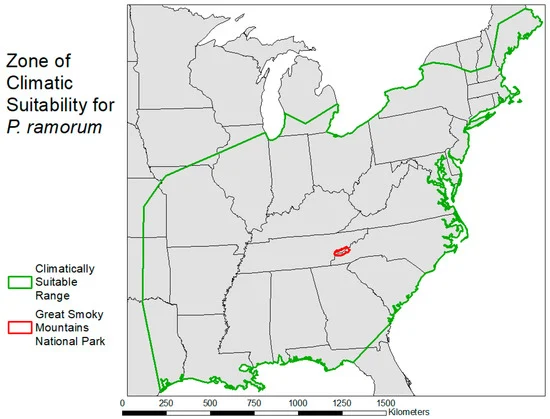
map showing areas of the Eastern United States at risk to P. ramorum – developed by Gilligan of Cambridge University
The report states that APHIS seeks to limit P. ramorum’s spread from affected nurseries. The agency does this via regulatory strategies. During FY 2023, 16 nurseries were governed by more stringent rules under the federal program which are imposed on nurseries that have been determined in past years to harbor P. ramorum-infected plants.
In addition, Oregon officials continued surveys of an area outside its quarantine zone because of a detection the previous year. APHIS will adjust the federal quarantine depending on the state’s findings.
The APHIS report does not discuss several pertinent events that occurred in FY2023. [For more details, read the California Oak Mortality Task Force newsletters for 2023 – posted here.
First, APHIS does not mention or discuss the implications of detection of two new strains of P. ramorum — EU1 & NA2 — in west coast forests. The presence of EU1 in a new California county (Del Norte) was confirmed in Feb 2023.
Second, the report said that Oregon is trying to determine the extent of the P. ramorum infection detected outside the state’s quarantine zone. However, it does not mention that this outbreak involves the new NA2 lineage – and that NA2 was known to be present in nurseries in the region since 2005.
The report also does not clarify that three nurseries to added to the more stringent program were so treated because SOD-infected plants were found on their premises.
Nor does the report note that at least two new naturally-infected hosts of P. ramorum were identified: Western sword fern (Polystichum munitum) and Arbutus x ‘Marina’.Koch’s postulates need to be completed on the latter so it has not yet been added to APHIS’ official host list.
Spotted Lanternfly (SLF) was found in 16 states in FY 2023. APHIS’ program enjoyed funding provided through Specialty Crop Pests and from the Plant Protection Act’s Section 7721 link ($6 million from the latter).
The report notes that APHIS still does not have enough data to determine SLF’s impacts on agriculture. Thus far, vineyards have been the most adversely affected agricultural segment, mostly due to SLF acting as a stressor to vines. Also, the sticky, sugary “honeydew” produced by SLF attracts other insects and promotes sooty mold growth. These can ruin the fruit and further damage the plant.
SLF populations are strongly linked to major transportation pathways, such as railroads and interstate highways. APHIS targets treatments and, in some areas, removes SLF’s preferred host plant (tree of heaven [Ailanthus]), from transportation hubs. The aim is to reduce the risk of SLF’ spread to new areas and to eradicate isolated infestations. In FY 2023, APHIS and cooperators treated 4,637 properties covering 6,455 acres in affected areas. However, during the National Plant Board meeting both state and APHIS officials complained to me that managers of these transportation hubs raise many barriers to their access, sharply limiting the program’s chance of success.
Ailanthus altissima – drive of spotted lanternfly invasion
The program was expanded after National Environmental Policy Act-mandated environmental review. This allowed APHIS to conduct treatments in four additional states—Indiana, Massachusetts, Michigan, and Rhode Island. In addition, program cooperators identified three potential biological control organisms, one that targets the tree of heaven and two that target SLF. APHIS will continue to evaluate them and develop methods to rear them in the laboratory.
Finally, in fiscal year 2023, APHIS joined the National Association of State Departments of Agriculture and the National Plant Board to develop a national strategic plan outlining the future direction of the SLF program. With the strategic plan, PPQ aims to harmonize the approach across states to slow SLF’s spread, develop consistent outreach messaging for a nationwide audience, and more effectively use existing state and Federal resources. Continued spread of SLF despite the huge effort, rising costs of the program, and new scientific findings spurred reconsideration of the strategy.
To summarize, I hope that APHIS’ annual report will – in the future – help members of Congress and their staff understand the agency’s programs’ purpose and past successes. This increased understanding might make it easier to advocate for more funding. I am troubled, however, by the agency’s glossing over significant problems.
Posted by Faith Campbell
We welcome comments that supplement or correct factual information, suggest new approaches, or promote thoughtful consideration. We post comments that disagree with us — but not those we judge to be not civil or inflammatory.
For a detailed discussion of the policies and practices that have allowed these pests to enter and spread – and that do not promote effective restoration strategies – review the Fading Forests report at https://treeimprovement.tennessee.edu/
Breeding Port-Orford cedar for resistance to Phytophthora lateralis; photo by Richard Sniezko, USDA Forest Service
At the annual meeting of the National Plant Board in July, I learned that two new Phytophthora species have been detected in the United States. Questions remain about how each arrived.
Phytophthora austrocedrii
This species was detected in a nursery in Oregon, then traced back to a supplier in Ohio. Officials are trying to determine how it entered the country – and then spread.
junipers in Great Britain killed by P. austrocedri; Forestry Research
In the United Kingdom, P. austrocedri has killed trees in the Juniperus and Cupressus genera. Damage is particularly significant at two sites in northern Scotland and in England’s Lake District. The principal host, Juniperus communis, is an important native species. It is already considered vulnerable. P. austrocedri has also been detected in Argentina, where it is killing the native Chilean or Patagonian cedar (Austrocedrus chilendris). The cedar species is the only one in the genus. Evidence indicates the pathogen was introduced to both Britain and Argentina; but its origin is unknown. Indeed, the species was first isolated by scientists as an unknown Phytopthora taxon on a juniper in an import/export nursery in Germany. All reported hosts are members of the Cupressaceae family (UK forest research website).
Of greater concern to Americans, P. austrocedri has also infected individual trees of Port-Orford cedar (Chamaecyparis lawsoniana). (UK forest research website).
Port-Orford cedar is a species endemic to a small range in southwestern Oregon and Northwestern California.
POC populations have been severely reduced over the past century by a different non-native Phytophthora, P. lawsonii. US Forest Service scientists recently announced that they have bred trees resistant to this pathogen – and offered seedlings for widespread planting.
Possible hosts in the Pacific Northwest – other than Port Orford cedar – include Juniperus californica, Juniperus grandis, Juniperus occidentalis, and Juniperus maritima – although the junipers might be limited to arid environments, where they would presumably be less vulnerable. https://plants.usda.gov/home/classification/15147
Research in Great Britain shows that P. austrocedri spreads in water and by movement of infected plants and contaminated soil. Footwear, camping equipment, and vehicle tires can all carry the pathogen. This makes the pathogen particularly difficult to control (this is another similarity with P. lawsonii).
Phytophthora abietivora
P. abietivora was originally found on a diseased Christmas tree (Fraser fir, Abies fraseri) in Connecticut in 2019. It has since been reported in Pennsylvania and Virginia; and in forest nurseries and Christmas tree plantations in Quebec and Ontario. The Canadians report that it has not caused disease (Canadian website). However, the Canadian representative at the National Plant Board meeting expressed concern and asked USDA APHIS to clarify what actions it is taking regarding this species.
(Natural populations of Fraser fir have been severely reduced over the past century by the balsam woolly adelgid.)
Fraser fir killed by balsam woolly adelgid; Clingman’s Dome, Great Smoky Mountains National Park
Several additional hosts have been identified, including balsam fir (Abies balsamea) and eastern hemlock (Tsuga canadensis); and deciduous or hardwood species: hickory (Carya sp.), flowering dogwood (Cornus florida), American witch hazel (Hamamelis virginiana), mountain holly (Ilex montana), red maple (Acer rubrum), silver birch (Betula lenta), American beech (Fagus grandifolia); and several oaks: white (Quercus alba), chestnut (Q. montana) and northern red oak (Q. rubra) (Canadian fact sheet).
According to the Canadian website, P. abietivora causes root rot and subsequent foliar chlorosis, discoloration, stem cankers, and sometimes tree decline and death. Determining which Phytophthora species is the causal agent of a tree’s symptoms requires laboratory testing. The Canadian fact sheet reports that wet, cool conditions provide ideal environments for P. abietivora. Like other Phytophthora species, P. abietivora can be spread through soil and water, as well as via infected plant material or pots or trays (particularly if soil remains on the equipment). The Canadian fact sheet has several photographs illustrating symptoms and additional sources.
Liriodendron tulipifera; photo by Evelyn Simak via Geograph
Phytophthora kernoviae
P. kernoviae was first detected in southwestern England in 2003. link In England, this pathogen has caused significant diseases in native Fagus sylvatica (European beech) and lesions on trunks of a European oak, Quercus robur. More worrying are the trunk lesions on the North American native yellow or tulip poplar (Liriodendron tulipifera) and lesions on foliage of Monterey pine (Pinus radiate), giant sequoia(Sequoiadendron giganteum), and several North American native shrubs, Rhododendron macrophyllum (Pacific rhododendron), R. occidentale (western rhododendron), R. catawbiense(Catawba rosebay) and Umbellularia californica (California bay laurel).
The infestation in Cornwall is sustained by heavy sporulation on the non-native shrub Rhododendron ponticum, which is invasive in woodlands. Worrying for Americans is the fact that P. kernoviae sporulates on three plant species native to West coast forests — Rhododendron macrophyllum, R. occidentale, and Umbellularia californica – as well as on R. catawbiense, which is native to the southern Appalachians.
USDA APHIS requested adoption of a “response plan” targetting P. kernoviae under the National Plant Disease Recovery System (NPDRS). This plan was adopted in 2008 and updated in 2015.
The recovery plans found the areas at highest risk are eastern slopes of the Appalachian Mountains because this area combines a native sporulating host and residential landscaping choices that are likely to include hosts that could transport the pathogen. A lower risk was identified for West Coast forests.
Because of this status, P. kernoviae is also a “priority” pest for surveys under the Cooperative Agricultural Pest Survey (CAPS) program. According to Purdue University’s “pest tracker” website four states have reported carrying out surveys for P. kernoviae in one or more years since 2016: Oregon, Tennessee, Pennsylvania, and Virginia. Surveys in Oregon were carried out in 2018 – 2020. In 2020 the counties surveyed included Curry County, where three strains of P. ramorum link have become established. The Purdue list is not certified as accurate or complete. To date, no surveys have detected P. kernoviae in the United States or – I believe – in Canada.
For details on existence of two clonal lineages of Phytophthora austrocedrii, see Henricot, B. A. Perez-Sierra, A.C. Armstrong, P.M. Sharp, and S. Green. Phytopathology 2017. 107:12, 1532-1540.
Posted by Faith Campbell
We welcome comments that supplement or correct factual information, suggest new approaches, or promote thoughtful consideration. We post comments that disagree with us — but not those we judge to be not civil or inflammatory.
For a detailed discussion of the policies and practices that have allowed these pests to enter and spread – and that do not promote effective restoration strategies – review the Fading Forests report at https://treeimprovement.tennessee.edu/
The House and Senate Agriculture committees are edging toward adopting the next Farm Bill, which is a year past due. Farm bills set policy, funding levels, and more, for 5 years. Each covers a wide range of subjects, including crop subsidies and insurance; food stamps; rural development (including wifi access); forestry policy; and research.
As you might remember, CISP aims to improve USDA’s programs — not only to prevent introductions of non-native tree killing pests and pathogens but also to better respond to those that enter the US and become established. I summarize here what the Senate and House bills have in common and how they differ on these issues.
I understand that the minorities, that is, House Democrats and Senate Republicans, have not accepted all aspects of the majorities’ drafts. So let’s take the opportunity to ask for better bills.
Both the House and Senate bills would “simplify” the USDA Forest Service’s obligations to prepare environmental assessments under the National Environmental Policy Act (NEPA). I have not analyzed which bill weakens NEPA more.
The Senate Bill: The Rural Prosperity and Food Security Act of 2024
The Senate bill addresses forest pest species in several places: Title II — Conservation, Title VII — Research, and Title VIII — Forestry. Here, I describe relevant sections, beginning with the section that partially addresses CISP’s proposal.
Title VIII — Forestry. Section 8214 requires the USDA Secretary to establish a national policy to counter threats posed by invasive species to tree species and forest ecosystems and identify areas for interagency cooperation.
This mandate falls far short of what we sought in a previous bill (S. 1238). However, depending on the exact wording of the bill and accompanying report, perhaps we can succeed in building a stronger program.
It is most important to obtain funding for applied, directed research into resistance breeding strategies, “bulking up,” and planting seedlings that show promise. Please contact your senators and ask them to work with the sponsors – Peter Welch [D-VT], Maggie Hassan [D-NH], and Mike Braun [R-IN] – to try to incorporate more of S. 1238 in the final bill.
The Senate bill contains other provisions that might be helpful for invasive species management – although not part of what CISP and our partners asked for.
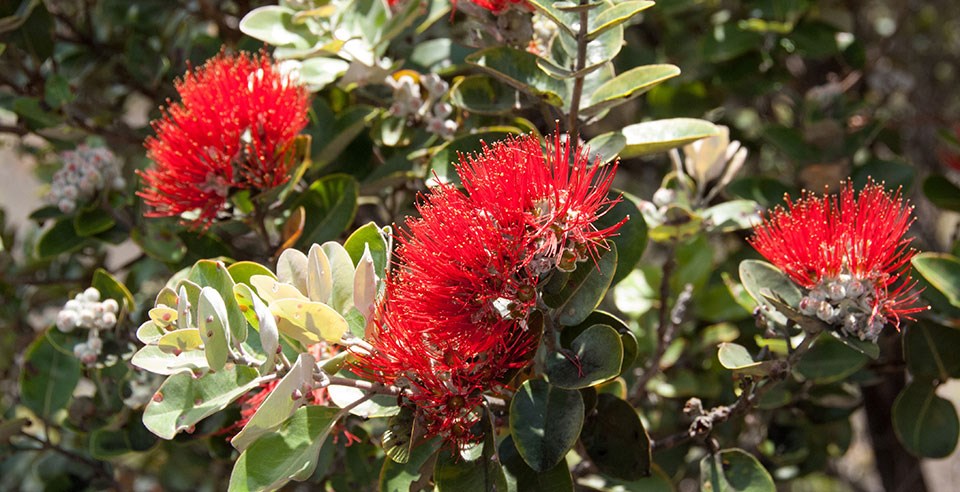
‘ōhi‘a trees killed by rapid ‘ōhi‘a death; photo by Richard sniezko, USFS
Title VIII — Forestry. In Section 8506, the Senate bill would require that the US Departments of Agriculture and Interior continue working with Hawai`i to address the pathogen that causes rapid ‘ōhi‘a death. The section authorizes $5 million for each of the coming five fiscal years to do this work. Unfortunately, authorization does not equal funding. Only the Senate and House Appropriations Committees can make this funding available. Hawai`i’s endemic ‘ōhi‘a trees certainly face a dire threat. CISP is already advocating for funding to support resistance breeding and other necessary work.
Title VIII — Forestry. Sections 8247 and 8248 support USDA Forest Service’s nursery and tree establishment programs. My hesitation in fully supporting these provisions is that I fear the urge to plant lots of trees in a hurry will divert attention for the need to learn how to propagate many of the hardwood tree species that have been decimated by non-native pests. However, I agree that the U.S. lacks sufficient nursery capacity to provide anything close to the number of seedlings sought. Perhaps this program can be adjusted to assist the “planting out” component of our request.
Title VII — Research. Section 7208 designates several high-priority research initiatives. On this list are spotted lanternfly, and “invasive species”. A number of forest corporations have been urging Members of Congress to upgrade research on this broad category, which I believe might focus more on invasive plants than the insects and pathogens on which CISP focuses. How the two ideas are integrated will be very important.
Another high-priority initiative concerns the perceived crisis in failed white oak regeneration.
Title VII — Research.Section 7213 mandates creation of four new Centers of Excellence at 1890 Institutions. These are historically Black universities that are also land-grant institutions]. These centers will focus on: 1) climate change, 2) forestry resilience and conservation; 3) food safety, bioprocessing, and value-added agriculture; and, 3) food and agricultural sciences and the social sciences.
Title II — Conservation. Section 2407 provides mandatory funding (which is not subject to annual appropriations) of $75 million per year to the national feral swine eradication/control program (run by USDA APHIS’ Wildlife Service Division). I discuss this program in a separate blog.
The Senate bill also mandates use of several conservation and other programs to address the causes and impacts of climate change. This requirement is directly countered by the House Agriculture Committee’s bill (see below).
Title VIII — Forestry. This section contains none of the provisions CISP’ sought to USDA’s management of tree-killing non-native insects and diseases.
Instead, the House bill calls on the USFS to establish a comprehensive approach to addressing the demise of the giant sequoia trees.
Title VII — Research The House bill, like the Senate’s, lists the invasive species and white oak research initiatives as high priority. The House, unlike the Senate, does not include spotted lanternfly.
Title II — Conservation. As I noted above, the House bill explicitly rescinds all unobligated conservation funding from the Inflation Reduction Act. It reallocates these funds to the traditional conservation programs, e.g., the Environmental Quality Incentive Program and Watershed Protection and Flood Prevention. The bill would use these funds to support “orphan” programs – naming specifically the national feral swine eradication/control program. The House bill provides $150 million – apparently across the five years covered by the Farm Bill, so $30 million per year. Finally, the House allocates 60% of the hog management funds to APHIS, 40% to the Natural Resources Conservation Service.
spotted lanternfly – target of at least 11 projects funded through APHIS’ the Plant Pest and Disease Management and Disaster Prevention Program in FY24. Photo by Holly Raguza, Pennsylvania Department of Agriuculture
Title X —Horticulture, Marketing, and Regulatory Reform. The House’s summary says it is taking steps to protect plant health. It does this by increasing funding for the grant program under the Plant Pest and Disease Management and Disaster Prevention Program – §7721 of the last (2018) Farm Bill. The increase would raise the amount of money available each year from the current level of $70 million to $90 million. These funds are mandatory; they are not subject to annual appropriations. Research, development, and outreach projects funded by this program have certainly added to our understanding of plant pests, hence to their effective management. However, they are usually short-term projects. Therefore they are not suitable for the long-term commitment required for resistance breeding programs. See here and here.
Title III — Trade. Here, the House bill exacerbates the current imbalance between trade promotion and phytosanitary protection. The bill doubles the authorized funding for USDA’s Market Access and Foreign Market Development programs. I concede that this measure probably does reflect a bipartisan consensus in the Congress to support robust programs for promoting agricultural exports.
Also under this Title, the House bill requires the USDA Secretary to conduct regular assessments to identify risks to critical infrastructure that supports food and agriculture sector. This might be helpful – although it is not clear that this assessment would include to threats to forest or urban trees not used commercially (e.g., for timber).
At a recent forum on biological control sponsored by the National Association of State Foresters (NASF), it was reported that participants noted several problems: insufficient funding, significant delays in refilling positions, inadequate research capacity, lack of brick-and-mortar infrastructure, and declining college enrollments in biocontrol-related studies. The NASF Forest Science Health Committee is developing a “Statement of Needs” document that NASF and others can use to lobby for funding to fill these gaps. I hope you will join them in doing so!
salt cedar (Tamarix sp.) attacked by biocontrol agent; photo by J.N. Stuart via Flickr
However, as I note above, empowering resistance breeding programs requires a long-term commitment, that is, a comprehensive alteration of policies and infrastructure – beyond annual appropriations.
Posted by Faith Campbell
We welcome comments that supplement or correct factual information, suggest new approaches, or promote thoughtful consideration. We post comments that disagree with us — but not those we judge to be not civil or inflammatory.
For a detailed discussion of the policies and practices that have allowed these pests to enter and spread – and that do not promote effective restoration strategies – review the Fading Forests report at http://treeimprovement.utk.edu/FadingForests.htm
I have recently recent blogged several times about threats to regeneration of eastern forests. Most of the underlying studies stress the role of deer browsing as a major driver of suppression of native plant species and proliferation of non-native ones. Most studies discussed at a recent Northern Hardwood research forum (USDA, FS 2023b Proceedings) found that deer browsing overwhelms other disturbances, such as fire and canopy gaps that typically promote seedling diversity. Miller et al. also stressed the importance of the deer-invasive plant complex in interrupting regeneration in National parks. Reed et al. found that, on the Allegheny Plateau of western Pennsylvania, high deer densities at the time stands formed reduced tree species diversity, density, and basal area – changes that were still detectable decades later.
On the other hand, Hovena et al. found that at their study sites in Ohio, interaction between non-native shrubs and soil wetness overshadowed even the impact of deer herbivory on the species richness and abundance of seedlings.
Unlike the others, Ducey et al. don’t mention deer as a factor in their analysis of regeneration in a forest in the northern half of New Hampshire. They focus on the minimal impact of silvicultural management. Its effect is secondary to overall forest development as the forest ages. Is it possible that overabundant deer are not a factor in the Bartlett Experimental forest.
American elm (Ulmus americana); photo by F.T. Campbell
Some of the studies acknowledge the impacts of non-native insects and pathogens. The most thorough discussion is in Payne and Peet. They note that specialist pathogens have caused the loss of important tree species, specifically elms and dogwoods plus the impending widespread mortality of ash. Such mortality is resulting in drastic and long-lasting shifts in community dynamics.
Ducey et al. anticipate pest-driven reversals of increases over the decades of eastern hemlock (Tsuga canadensis) and American beech (Fagus grandifolia). Also, they expect that white ash (Fraxinus americana), which has a minor presence, will disappear.
Miller et al. also stressed the importance of emerald ash borer-induced suppression of ash regeneration in some National parks . The authors also noted the threat to beech trees from beech leaf disease in other parks. Hovena et al. state that the interaction between non-native shrubs and soil wetness was more influential than ash mortality in shaping woody seedling communities.
Reed et al. considered the role of non-native earthworm biomass on plant species’ growth.
But too many of the studies, in my view, make no mention of the probably significant role of non-native insects and pathogens.
It is perhaps understandable that they don’t address emerging pests that either have not yet or have barely reached their study sites. For example, Hovena et al. and Yacucci et al. [see below] noted growth of one native shrub, Lindera benzoin, in the face of the challenges presented by deer and invading plants. Neither acknowledges the approach of laurel wilt disease, which has not yet become established in Ohio (it has been detected on the Kentucky-Indiana border). Similarly, neither mentions beech leaf disease, although some of the plots studied by Hovena et al. are just east of Cleveland – where BLD was first detected. The location of the Yacucci et al. study is less than 50 miles away. The North Carolina forests studied by Payne and Peet are apparently too far east to be affected by beech bark disease and beech leaf disease is not yet established nearby.
Less understandable is the failure to mention loss of elms – which were abundant in riparian areas until killed off by Dutch elm disease – which was first detected in Cleveland!); or to discuss the impact of dogwood anthracnose. Their focus on the deciduous forest might explain why they don’t mention hemlock woolly adelgid – which is just now invading the area discussed by Reed et al. I suppose the demise of American chestnut was so many decades ago that it is truly irrelevant to current forest dynamics.
A new study raises anew these questions about whether inattention to the role of non-native pests has skewed past studies’ results. Yacucci et al. compared regeneration in a military installation (Camp Garfield), to the results in the surrounding second-growth forest. This choice allowed them to overcome one drawback of other studies: using deer exclosures that are small and of short durations. The military facility covers 88 km2. Inside it, deer populations have been controlled for 67 years at a density of 6.6 – 7.5 deer/km2. Outside, deer have been overabundant for decades. Populations have grown to densities estimated (but not measured) to be at least 30 deer/km2 – more than four times as high.
These authors established 21 experimental gaps in the low-deer-density area and 20 gaps outside the installation where deer densities are high. Some of the gaps in both low- and high-deer-density environs were located on wetter, seasonally flooded soils, some on drier sites. None of the forest sites had experience fire in recent decades.
Their findings support the importance of deer browsing as driver of changes to forest regeneration.
northern spicebush (Lindera benzoin); photo by R.A. Nonemacher via Wikimedia
They found that at low deer densities, gaps develop a vigorous and diverse native sapling layer, including oaks. Total stem density of red and pin oaks was 13 times higher in these gaps than in gaps in high-deer-density locations. Oak saplings were growing into the subcanopy – that is, above deer browse heights. Saplings of other species – i.e., tuliptree (Liriodendron tulipifera), red maple, and ash (Fraxinus spp.) were also flourishing. Also present were dogwood (Cornus florida) and two native shrubs — Lindera benzoin and Rubus allegheniensis. One non-native shrub, buckthorn (Rhamnus frangula), also thrived at low deer densities. Other non-native plant species were far fewer; their cover was 80% lower. Overall, abundance, richness, and diversity of native herbaceous and woody species were 37–65% higher at the low-deer-density study sites. On average tree species were more than twice as tall as in high-deer-density plots.
In high-deer-density plots, non-native species were six times more abundant while native species richness was 39% lower. Diversity was 27% lower. Most native tree species were short in stature and in low abundance. The one exception was black cherry (Prunus serotina), which deer avoid feeding on. The cherry was 95% more abundant in these high-deer-density plots.
There were several surprising results. In most cases, neither years since gap formation nor habitat type (wet vs. dry) had a significant impact on plant diversity, richness, or abundance. The exception was that non-native plant species were more abundant in older gaps where deer densities were high. Yacucci et al. warn that this phenomenon is a potential threat to biodiversity since high deer density is now the norm across eastern forests.
The authors also note that fire has probably never been a factor in these forests, which are primarily beech-maple forests. Certainly there have been no fires over the past 70 years, either inside or outside the military installation.
Yacucci et al. did not discuss past or possible future impacts of non-native insects or pathogens. They did not mention emerald ash borer or dogwood anthracnose – both of which had been present in Ohio for at least two decades when they completed their study. Although they said their study forest was a beech-maple forest, they did not discuss whether beech are present and – if so – the impact of beech bark disease or beech leaf disease. Both of these are spreading in Ohio. The latter was originally detected in 2012 near Cleveland, just 50 miles from the location of Camp Garfield (between Youngstown and Cleveland, Ohio). As noted above, they also did they mention that Lindera benzoin is susceptible to laurel wilt disease.
beech seedlings in Virginia; photo by F.T. Campbell
Proposed solutions to deer over-browsing
Given the combined threat from widespread deer overpopulation and invasions by non-native plants, Yacucci et al. propose enlisting those military posts that regularly cull deer into efforts to conserve and regenerate native plants. Otherwise, they say, the prognosis for regeneration is poor.
Bernd Blossey and colleagues propose a more sweeping solution: implementation of a national policy to reduce deer populations on all land ownerships. They point out that overabundant deer:
disrupt the plant communities of affected forests – from spring ephemerals to tree regeneration;
promote disease in wildlife and people; and
lead to miserable deaths of deer on our highways, through winter starvation, and disease.
They call for federal leadership of coordinated deer-reduction programs. I discuss their proposal in detail in a separate blog.
SOURCES
Ducey, M.J, O.L. Fraser, M. Yamasaki, E.P. Belair, W.B. Leak. 2023. Eight decades of compositional change in a managed northern hardwood landscape. Forest Ecosystems 10 (2023) 100121
Hovena, B.M., K.S. Knight, V.E. Peters, and D.L Gorchov. 2022. Woody seedling community responses to deer herbivory, intro shrubs, and ash mortality depend on canopy competition and site wetness. Forest Ecology and Management. 523 (2022) 120488
Payne, C.J. and R.K. Peet. 2023. Revisiting the model system for forest succession: Eighty years of resampling Piedmont forests reveals need for an improved suite of indicators of successional change. Ecological Indicators 154 (2023) 110679
Miller, K.M., S.J. Perles, J.P. Schmit, E.R. Matthews, and M.R. Marshall. 2023. Overabundant deer and invasive plants drive widespread regeneration debt in eastern United States national parks. Ecological Applications. 2023;33:e2837. https://onlinelibrary.wiley.com/r/eap Open Access
Reed, S.P., D.R. Bronson, J.A. Forrester, L.M. Prudent, A.M. Yang, A.M. Yantes, P.B. Reich, and L.E. Frelich. 2023. Linked disturbance in the temperate forest: Earthworms, deer, and canopy gaps. Ecology. 2023;104:e4040. https://onlinelibrary.wiley.com/r/ecy
United States Department of Agriculture, Forest Service. 2023a. Proceedings of the First Biennial Northern Hardwood Conference 2021: Bridging Science and Management for the Future. Northern Research Station General Technical Report NRS-P-211 May 2023
Yacucci, A.C., W.P. Carson, J.C. Martineau, C.D. Burns, B.P. Riley, A.A. Royo, T.P. Diggins, I.J. Renne. 2023. Native tree species prosper while exotics falter during gap-phase regeneration, but only where deer densities are near historical levels New Forests https://doi.org/10.1007/s11056-023-10022-w
Posted by Faith Campbell
We welcome comments that supplement or correct factual information, suggest new approaches, or promote thoughtful consideration. We post comments that disagree with us — but not those we judge to be not civil or inflammatory.
For a detailed discussion of the policies and practices that have allowed these pests to enter and spread – and that do not promote effective restoration strategies – review the Fading Forests report at http://treeimprovement.utk.edu/FadingForests.htm
spotted lanternfly – target of many projects funded by USDA’s Plant Pest & Disease Management & Disaster Prevention Program; photo by Holly Raguza of Pennsylvania Department of Agriculture
I am belatedly reporting on the forest-pest projects funded by annual grants under the Plant Pest & Disease Management & Disaster Prevention Program ( of the Plant Protection Act). As usual, APHIS funded projects totaling $62.975 million in FY24. In total, 353 projects were funded. These projects represented 70% of the 504 project proposals submitted (the total funding sought was $106 M).
APHIS reserved $11 million for responding to P&P emergencies. I applaud this choice since the agency’s annual appropriation provides only a completely inadequate $1 million (or less) to cover emergencies.
APHIS notes that since initiation of the Plant Pest & Disease Management & Disaster Prevention Program in 2009, it has funded more than 5,500 projects with a total of nearly $870 million.
In FY24 the program funded 30 more projects than the 322 projects funded in FY23. blog 320 The FY24 allocation provides more than $1 million more for goal area 1S — Enhance Plant Pest/Disease Survey (from $14.4 million to $15.7 million). This was balanced by small decreases for the other goal areas: enhancing mitigation capabilities received $13.6 million; inspections at domestic sites important in invasive species’ spread received $6.3 million; pest identification and detection received $5.3 million; and outreach and education received $4.1 million. Projects safeguarding nursery production and those improving pest and disease analysis each received about $2 million.
By my calculation – subject to error! – about $7.5 million went to projects clearly dealing with forest pests [12% of total funding]. This is a welcome increase from FY23 – when funding of such projects reached about $6.5 million (a little over 10%). blog 320 Funding for tree pest projects might be higher. Some $1.9 million is allocated to surveys of grapevines and orchards — hosts of the spotted lanternfly (SLF). However, it is not clear whether these projects are focused on detecting and managing SLF; they might have a much broader goal. If we do include these projects, the total for tree-killing pests rises to $9.4 million — nearly 15% of the total.
Over both FY23 and FY24, the majority of funds went to similar topics: survey and management of sudden oak death in nurseries; surveys for bark beetles, Asian defoliators, and forest pests generally; and outreach programs targetting the spotted lanternfly. In FY24, just under $100,000 paid for efforts to develop tools for rapid detection of laurel wilt link to DMF in avocados – that is, in a crop rather than the natural environment.
No projects addressing tree or forest pests were funded in seven states or territories: Guam, Idaho, Nebraska, New Mexico, Rhode Island, South Dakota, and Utah. This was three fewer states than in FY23. In neither year do I know whether these states submitted proposals in this category that ended up not being funded.
In FY24, spotted lanternfly is by far the pest addressed by the most projects. As noted above, I can’t be precise about the number because of the lack of information about the 23 projects that fund pest surveys of grapes and/or tree crops that are SLF hosts. Eleven projects named SLF specifically. A final project (not included in above) is one funding registration of Verticillium nonalfalfae as a biocontrol for Ailanthus altissima – an invasive tree that is the preferred host of SLF.
The District of Columbia, Kansas, Missouri, and Oklahoma each had one tree pest project funded. In the cases of Kansas and Missouri, the single project was surveys for thousand cankers disease of walnut. Three other states — Iowa, Maryland, and Pennsylvania — also obtained funding to survey for TCD.
The single Oklahoma project concerned efforts to ensure that the sudden oak death pathogen(Phytopthora ramorum) is not present in nurseries. (An Oklahoma wholesaler was one of the hubs of this pathogen’s spread to 18 states in 2019). Eleven other states were also funded to survey their nurseries for P. ramorum: Alabama, Kentucky, Louisiana, Nevada, North Carolina, Ohio, Pennsylvania, South Carolina, Virginia, and West Virginia. P. ramorum is a “program pest” in 2024. That is, APHIS had designated it as a regulated pest for which the agency wished to fill knowledge gaps about its distribution. I note that last year APHIS published a risk assessment that downplayed the likelihood that P. ramorum would establish in the eastern states. Is APHIS seeking more information to test this conclusion?
In a separate case, Oregon received $76,000 to evaluating the threat to nurseries and forests arising from the presence in the state’s forests of two strains or lineages of P. ramorum that previously had not been extant in the environment of North America.
Another approximately 53 projects fund surveys for tree pests other than spotted lanternfly; these are often fairly general surveys, such as for woodborers or “Asian defoliators”. About ten projects fund management efforts – including evaluation of the efficacy of emerald ash borer biocontrol programs.
Last year I noted that two states – Mississippi and Nevada — had projects to survey the “palm commodity”. Hawai`i joined this group in FY24. The project descriptions don’t specify which pests are the targets. The South American palm weevil (Rhynchophorus palmarum) seems most probable; it is established in far southern California and neighboring Mexico. APHIS prepared a risk assessment on the species in 2012. link? In Hawa`ii, concern probably focuses on the coconut rhinoceros beetle (Oryctes rhinoceros). link? There are other threats to palms, e.g., the red palm weevil (Rhynochophorus ferrugineus), link? and a deadly Fusarium wilt. link?
native palms in the desert at Anza-Borrego, California; photo by F.T. Campbell
California has native palms (Washingtonia filifera); southern states from Texas to at least South Carolina have native palmettos. Of course, many species of palms are important ornamental plants in these states, and dates are raised commercially.
Another “program pest” that I have blogged about in the past is box tree moth. link to blog 287 In FY24 five projects addressed this pest, including surveys and efforts to develop better control tools.
beavertail cactus (Opuntia basilaris) in Anza-Borrego, California; photo by F.T. Campbell
I am pleased by continued funding of projects trying to utilize biocontrol agents to protect two groups of cactus severely threatened by non-native insects: lepidoptera that attack flat-padded prickly pear cacti (Opuntia spp.) link to DMF and the mealybug that attacks columnar cacti of Puerto Rico and the Virgin Islands. link to DMF
vulnerable cactus on St. John, US Virgin Islands; photo by F.T. Campbell
I applaud the decision to fund projects focused on determining the efficacy of biocontrol projects. As noted above, three projects are asking these questions in the case of the emerald ash borer. link to DMF Another project funds production, release, and efficacy evaluation of biocontrol agents targetting Brazilian peppertree in Florida & Texas.
I am also pleased that three projects assist Washington State in its efforts to eradicate the invasion by giant hornets from Asia. link to blogs & Hornet Herald – no detections in 2023 … A company in California also received funding to developing hornet detection tools.
Nineteen projects funded outreach efforts, including continued funding for the “Don’t Move Firewood” program. In addition to those focused on spotted lanternfly, such projects also included other firewood programs, Asian longhorned beetle awareness, and the nursery industry.
I note that while California received funding for 27 projects, none dealt with any of several deadly tree pests extant in the state – goldspotted oak borer, polyphagous and Kuroshio shot hole borers, Mediterranean oak borer, and the palm weevils. Nor did Hawai`i obtain funding to address rapid ohia death. Did no one submit proposals to address any of the many issues impeding management of these killers?
South American palm weevil; photo by Allan Hopkins via Flickr
Posted by Faith Campbell
We welcome comments that supplement or correct factual information, suggest new approaches, or promote thoughtful consideration. We post comments that disagree with us — but not those we judge to be not civil or inflammatory.
For a detailed discussion of the policies and practices that have allowed these pests to enter and spread – and that do not promote effective restoration strategies – review the Fading Forests report at http://treeimprovement.utk.edu/FadingForests.htm
invasion of wild/black mustard Brassica nigra; photo by carlbegge via Flickr
A California state legislator has proposed a bill to expand state efforts to counter invasive species. Should we support it – and others like it in other states?
The bill is Assembly Bill 2827 introduced by Assembly Member (and former Majority Leader) Eloise Reyes of the 50th Assembly District. She represents urban parts of southwestern San Bernardino County, including the cities of Rialto, Colton, and Fontana.
According to media reports, Reyes was prompted to act by the current outbreak of exotic fruit flies, which as of some months ago resulted in detections in 15 California counties.
The bill is much broader than agricultural pests, however. It would find and declare that it is a primary goal of the state to prevent the introduction, and suppress the spread, of invasive species within its borders. I applaud the language of the “findings” section:
(a) Invasive species have the potential to cause extensive damage to California’s natural and working landscapes, native species, agriculture, the public, and economy.
(b) Invasive species can threaten native flora and fauna, disrupt ecosystems, damage critical infrastructure, and result in further loss of biodiversity.
Paragraph (c) cites rising threats associated with increased movement of goods, international travel, and climate change — all said to create conditions that may enhance the survival, reproduction, and spread of these invasive species, posing additional threats to the state.
(d) It is in the best interest of the state to adopt a proactive and coordinated approach to prevent the introduction and spread of invasive species.
California sycamore attacked by invasive shot hole borer; photo by Beatriz Nobua-Behrmann
The bill calls for
The state agencies, in collaboration with relevant stakeholders, to develop and implement pertinent strategies to protect the state’s agriculture, environment, and natural resources.
The state to invest in research, outreach, and education programs to raise awareness and promote responsible practices among residents, industries, and visitors.
State agencies to coordinate efforts with federal, local, and tribal authorities.
However, the bill falls short when it comes to action. Having declared that countering bioinvasion is “a primary goal of the state”, and mandated the above efforts, the bill says only that the California Department of Food and Agriculture (which has responsibility for plant pests) is to allocate funds, if available, to implement and enforce this article. Under this provision, significant action is likely to depend on holding agencies accountable and providing increased funding.
removing coast live oak killed by goldspotted oak borer; photo by F.T. Campbell
Would this proposed legislation make a practical difference? I have often complained that CDFA has not taken action to protect the state’s wonderful flora. For example, CDFA does not regulate firewood to prevent movement of pests within the State. It has not regulated numerous invasive plants or several wood-boring insects. These include the goldspotted oak borer; the polyphagous and Kuroshio shothole borers; and the Mediterranean oak borer.
On the other hand, CDFA is quick to act against pests that might enter the state from elsewhere in the country, e.g., spongy moth (European or Asian), emerald ash borer and spotted lanternfly.
I hope Californians and the several non-governmental organizations focused on invasive species will lobby the legislature to adopt Assembly Bill 2827. I hope further that they will try to identify and secure a source of funds to support the mandated action by CDFA and other agencies responsible for managing the fauna, flora, and other taxa to which invasive species belong.
I applaud Ms. Reyes’ initiative. I hope legislators in other states will consider proposing similar bills.
Posted by Faith Campbell
We welcome comments that supplement or correct factual information, suggest new approaches, or promote thoughtful consideration. We post comments that disagree with us — but not those we judge to be not civil or inflammatory.
For a detailed discussion of the policies and practices that have allowed these pests to enter and spread – and that do not promote effective restoration strategies – review the Fading Forests report at http://treeimprovement.utk.edu/FadingForests.htm