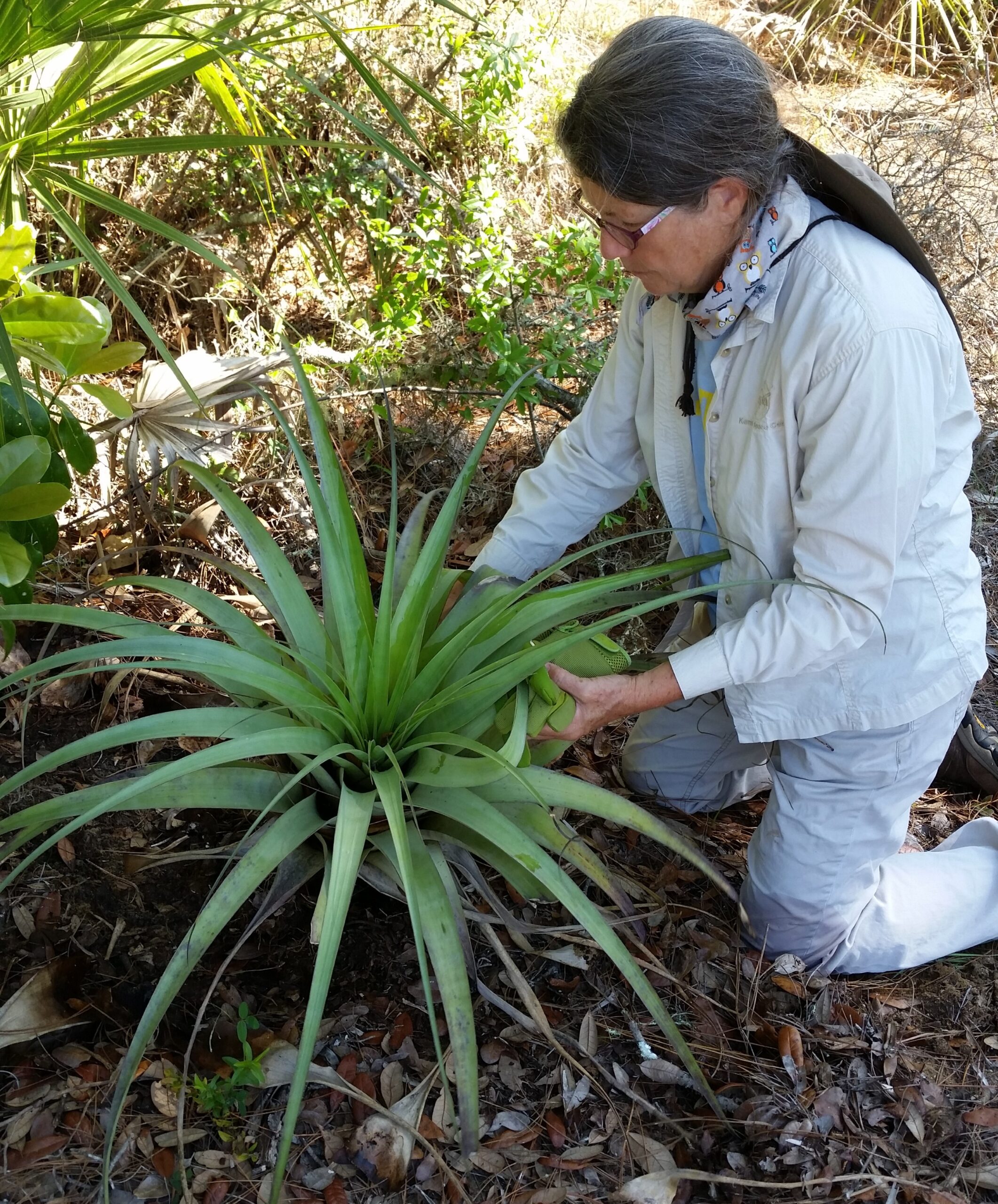
Florida has 16 native species of bromeliads. Up to 15 invertebrates depend on bromeliads, especially the water that collects at the bases of the leaves. See Frank (1983) and Frank and Fish (2008) for more information about bromeliads’ ecological importance.
Eight species had been listed as threatened or endangered in the state (visit here) (Frank and Cave 2005) before arrival of the Mexican bromeliad weevil. The Florida Endangered Plant Advisory Council added two of its hosts – Tillandsia utriculata and Tillandsia fasciculata. The website now lists 12 species as threatened by the weevil.
Twelve species are believed to be vulnerable to the weevil. T. utriculata is at most immediate risk. Before arrival of the Mexican bromeliad weevil, some populations of this species were described by Teresa Cooper as “giant” and dense, containing very large mature plants and producing huge volumes of of seed.
One such population — in the Enchanted Forest Sanctuary in Brevard County – succumbed to the weevil quickly: 87% died in six months. At 27 months after arrival of the weevil, less than 3% of the original population remained. It is now rare to see large T. utriculata plants. Medium-sized plants put out inflorescences. The weevil persists at low levels, so is able to feed on and reproduce on medium and small plants. Several endemic wildlife species that inhabit the water pooled in T. utriculata’s base face global extinction (T.M. Cooper pers. comm. 2026).
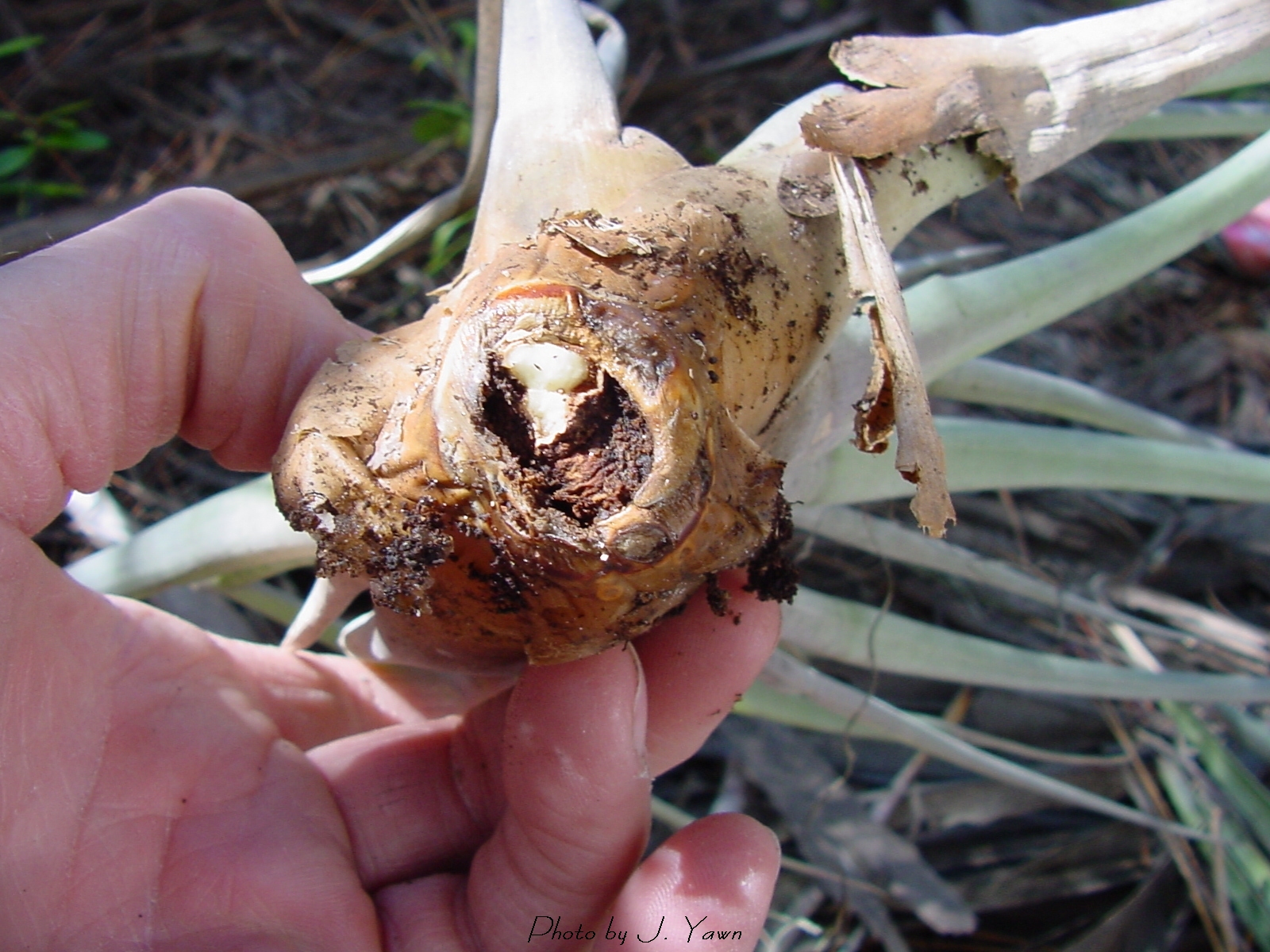
The first reason T. utriculata is at higher risk is that each plant can support many weevil larvae. Its leaves are softer (so more easily consumed) and its large stems contain lots of nutrients — for a bromeliad). More important is the plant’s very slow reproduction in contrast to the weevil’s rapid attack. T. utriculata plants do not produce seed until after they have grown for up to 20 years. Furthermore, an extremely small fraction of the ~ 10,000 seeds released by a mature plant make it to reproductive age. A plant that after 18 years begins growing an inflorescence — which then takes ~ a year to flower and produce seed – can be killed by a weevil within a few months. In addition, T. utriculata is monocarpic – it doesn’t produce offshoots. T.M. Cooper asserts that if the bromeliad weevil extirpates T. utriculata from Florida, it will not be because the weevil ate the very last plant, it will be because T. utriculata seed output has fallen below a sustainable level.
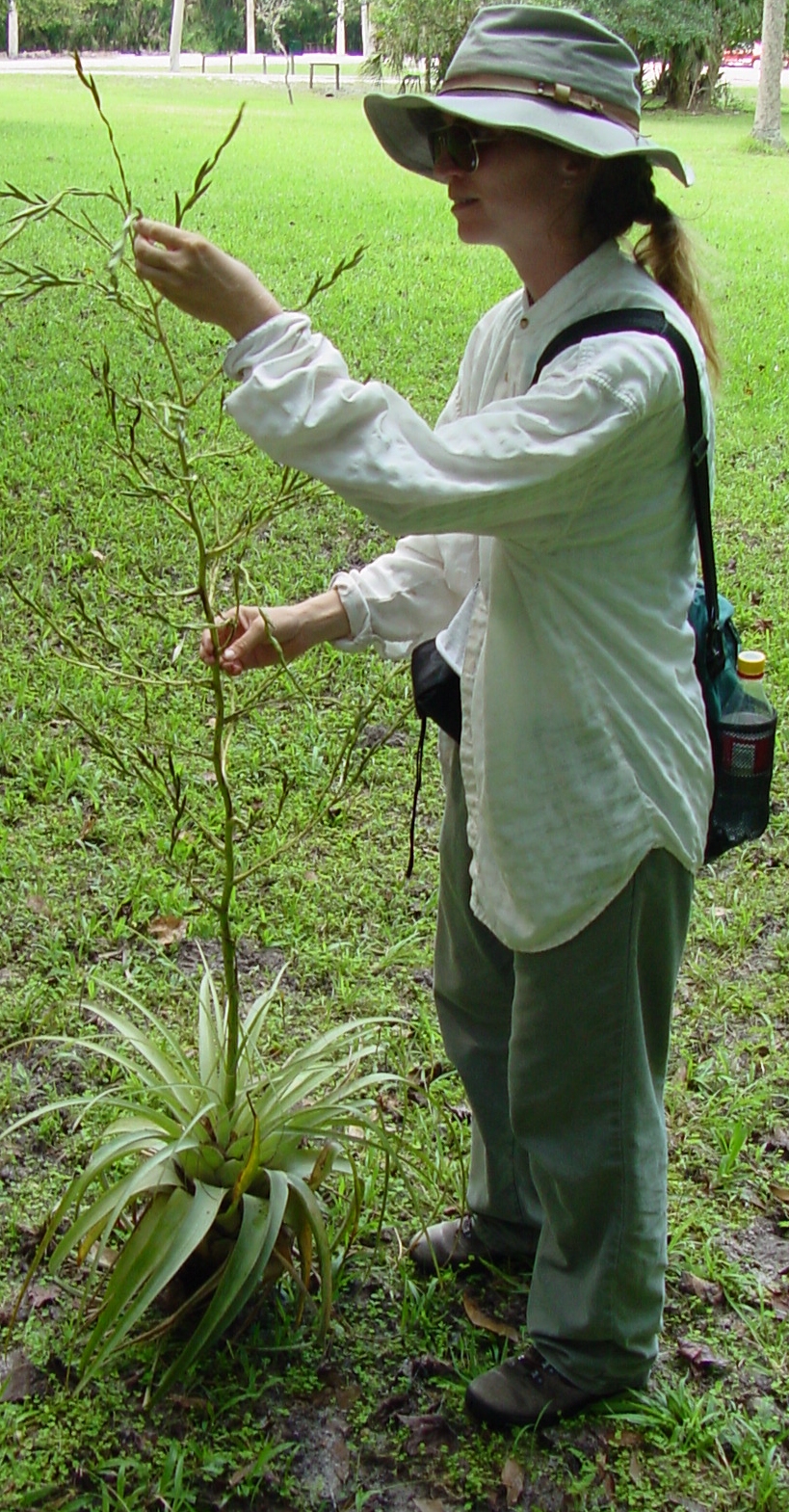
A second host, Tillandsia fasciculata, had large and dense population in Loxahatchee National Wildlife Refuge (Palm Beach County) in 2002 to 2005. Almost every tree had multiple T. fasciculata plants; many were huge with multiple pups. When Teresa Cooper revisited about 10 years later, T. fasciculata plants were very sparse, large plants very rare; none was really large (T.M. Cooper pers. comm. 2026).
T. fasciculata is expected to decline more slowly than T. utriculata. First among several advantages is that its leaves are tougher and stems smaller, so they provide less nutrition to the weevil. Probably more important, T. fasciculata is polycarpic (it produces both seed and offshoots). A large T. fasciculata plant can sprout up to a dozen blooming rametes at a time. If the weevil kills one, other rametes will bloom and seed. At the same time, the plant might produce numerous up to 20 offshoots which come detatched from the “mother” plant and start a new individual. Still, as the weevil kills these rametes year after year the plant shrinks in size and eventually dies (T.M. Cooper pers. comm. 2026).
Teresa Cooper has documented damage on Tillandsia paucifolia, T. simulate, and T. variabilis (T.M. Cooper pers. comm. 2026). She has no funding to continue studying these species. I have been unable to find any more recent information about the status of the Tillandsia species. The Florida Department of Agriculture and Consumer Services does not have an active program addressing the weevil (Patrick Gordon, FDACS, pers. comm. June 2026).
There is considerably more information about another endangered bromeliad, Guzmania monostachia. This species has the broadest distribution of any species in the genus, stretching across northern South America, Central America, the Caribbean, as well as southern Florida. As the northernmost population, the Florida population might harbor unique genetics important for the species’ adaptation to climate change (Krupar et al. 2023).
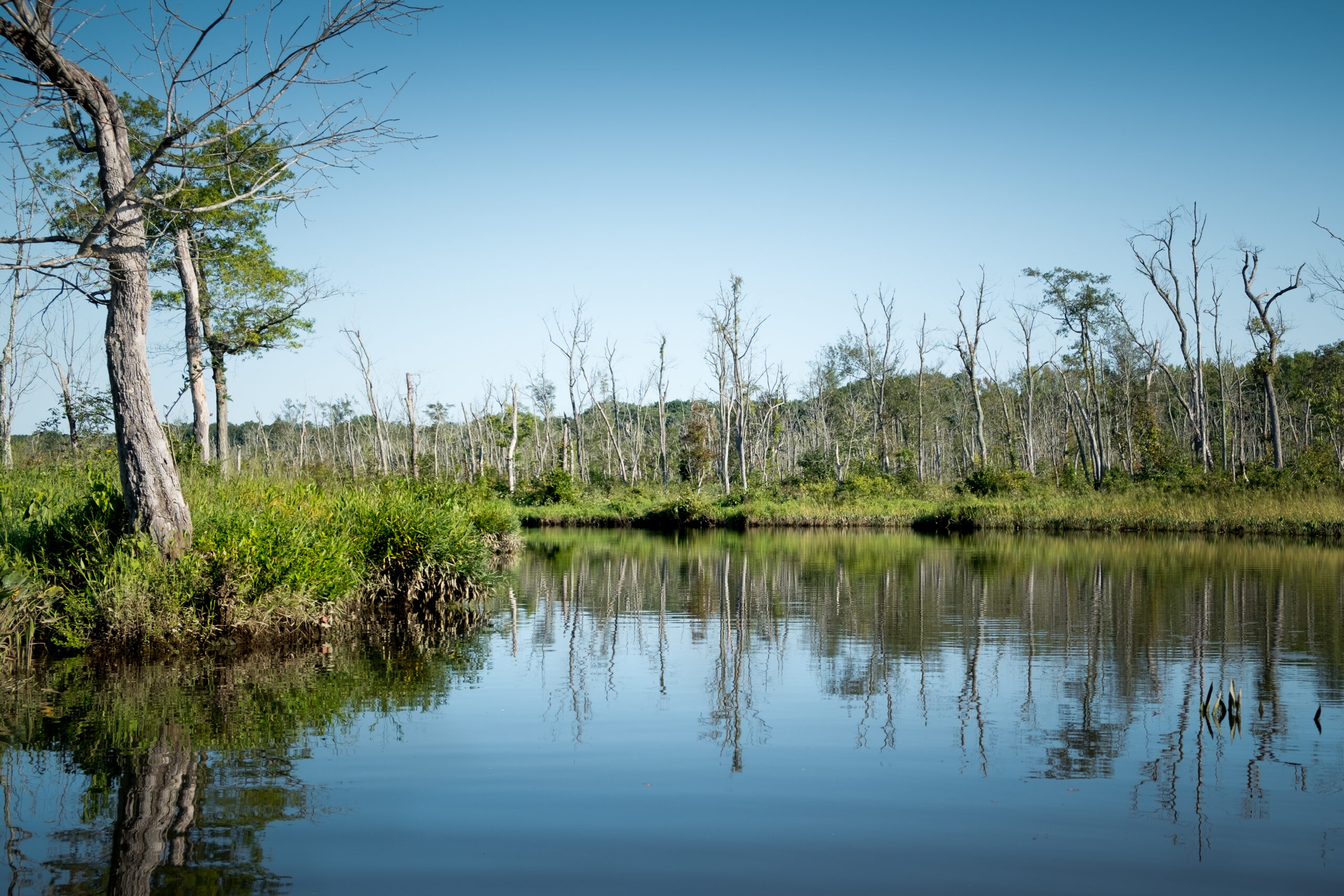
Formerly more common, G. monostachia is now found in six fragmented and disjunct populations in five areas in Florida. The species has apparently been extirpated from four other sites by habitat loss, not depredations by the weevil. One set of habitats is in wetland sloughs on the peninsula’s west coast on the peninsula’s west coast. These forests comprise pond apple (Annona glabra) and Florida ash (Fraxinus caroliniana); Kupar et al. (2023) don’t mention whether this species is vulnerable to the emerald ash borer, which has not yet been detected in Florida. The largest of the bromeliad populations is in Fakahatchee Strand State Preserve, in Collier County in Southwest Florida. Fakahatchee Strand Preserve is Florida’ oldest and largest state park. The bromeliad’s population was previously estimated to exceed two million individuals. Their number has been halved by weevil attack. Also, since M. callizona prefers larger plants, the proportion of reproductively mature individuals had been reduced from roughly 50% to only 10–20% by 2021. T.M. Cooper reports (pers. comm. 2026) fears this species might also be extirpated eventually.
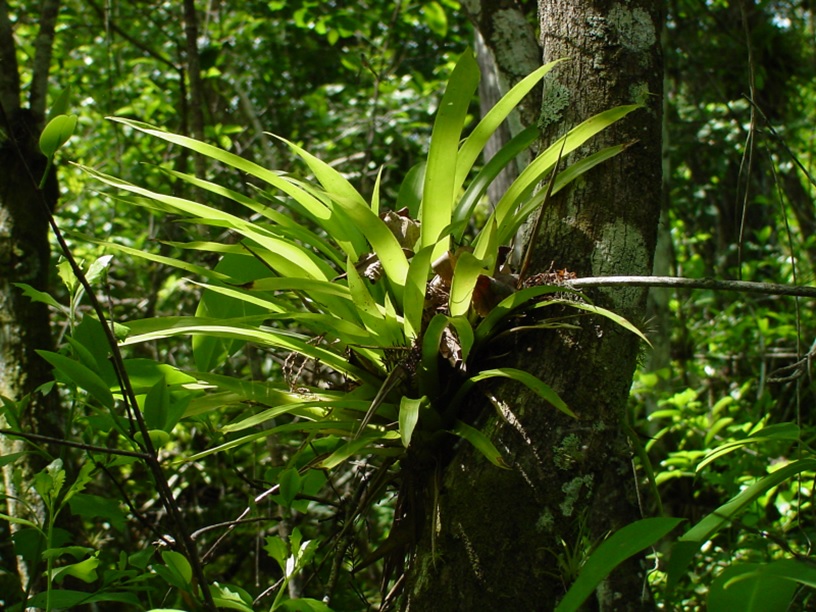
The adjacent Big Cypress National Preserve is home to two populations of G. monostachia; they are separated by ~2,900 km2 so there is no interaction between them. The southern population consists of ~ 1000 individuals, the northern population comprises only~ 200 individuals.
Guzmania monostachia is in an even more precarious situation on the eastern side of the peninsula: tiny populations of two or three plants are found in three locations: Everglades National Park, Fuchs (formerly Sykes) Hammock Preserve, and Meissner Hammock Preserve.
The Mexican bromeliad weevil Metamasius callizona (Chevrolat) is native to southern Mexico, Guatamala, (Frank and Thomas 1994; Frank and Cave 2005) and Belize (Cooper, Cave and Frank 2023). Its presence in Florida was detected in a nursery in Ft. Lauderdale, Broward County, in 1989. Probably introduced on a shipment of ornamental bromeliads from Mexico. The nursery treated the infested plants, but the weevil had already established on native bromeliad species in the natural environment. By 1991, it was detected in four counties in southern Florida; by 1999, it was found in 12 more. It is now in most counties of peninsular Florida from Daytona (Volusa County) south to Miami-Dade (Patrick Gordon, Florida Department of Agriculture and Consumer Services, pers. comm. June 2026).
While chemical control is feasible in nurseries and display plantings, it can’t be used in natural areas, where the epiphytes are not accessible from the ground and stakeholders fear likely non-target effects.
Therefore, scientists initially focused on classical biocontrol. They made 16 expeditions to Mexico and Central and South America from 1992 to 2010 searching for natural enemies of the weevil. The chose parasitoid tachinid fly, Lixadmontia franki. A colony was established in the University of Florida’s quarantine laboratory and research on fly-weevil interactions was conducted for several years. Releases into the environment were begun under Federal and State permits in 2007. Although more than 3,100 flies were released, the species failed to establish. So this approach is no longer being pursued (Cooper, Cave, and Frank (2024); T.M. Cooper pers. comm. June 2026).
Meanwhile, in 2010, Dr. Frank and D. Giardina of the Florida Fish and Wildlife Conservation Commission observed that in one location in Belize the weevils had no apparent detrimental effect on bromeliads identified as Tillandsia utriculata (although there is some disagreement on this classification). Cooper, Cave, and Frank (2024) undertook a study to determine how the bromeliad could coexist with Metamasius callizona in Belize while being so vulnerable in Florida. They compared life cycle parameters (oviposition and pupation rates, egg hatch rate, adult emergence and size, and developmental time) of weevils from Florida and Belize. They also observed how populations of the weevil from Florida fared on three hosts: pineapple (Ananas comosus), T. utriculata collected from Florida, and T. utriculata collected from Belize. Finally, they quantified the hosts’ nutritional content using two measures (percent soluble solids and leaf toughness).
Their most important finding is that weevil larva from Florida could not develop past the third instar on leaves of the T. utriculata from Belize. The weevil larvae starved because the Belize bromeliad’s leaves had fewer nutrients and were tougher than the leaves from T. utriculata collected in Florida.
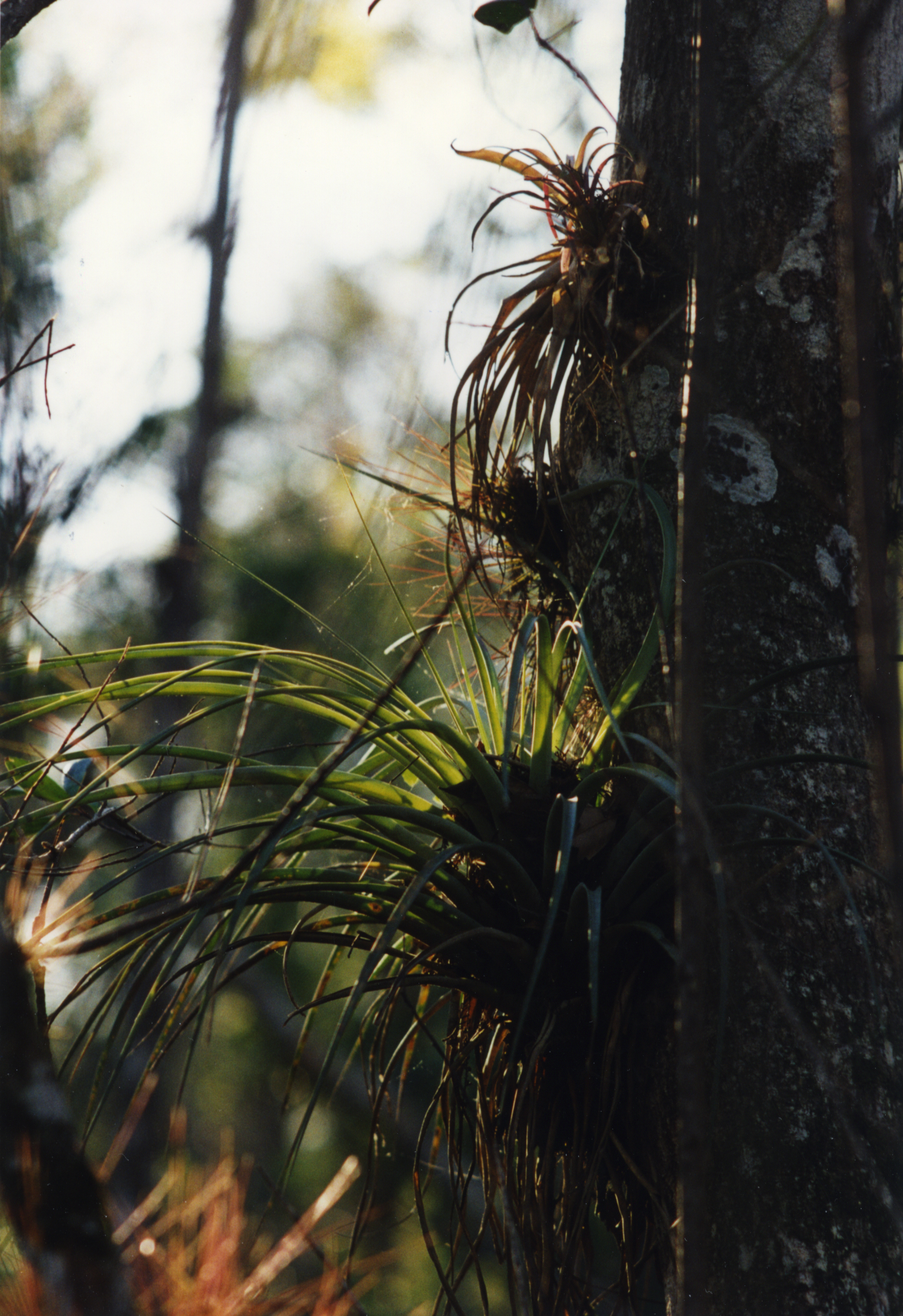
Based on this finding, Cooper, Cave, and Frank (2024) recommend that authorities introduce T. utriculata plants from Belize into Florida’s forests and allow them to colonize and/or hybridize naturally with Florida’s remaining plants. An alternative would be to breed hybrid Tillandsia in the lab and release them into Florida’s forests. I note that the American Chestnut Foundation pursued a similar strategy for decades to develop American chestnuts (Castanea dentata) able to tolerate the chestnut blight fungus (Cryphonectria parasitica).
Sources
Cave, R.D. 1997. Admontia sp., a potential biological control agent of Metamasius callizona. J Brom Soc. 47:244-249.
Cave, R.D. 2008. Biological control of the MEXICO bromeliad weevil. Biocontrol News and Information 29(1):1N-2N.
Cooper T.M. 2006. Ecological and demographic trends and patterns of Metamasius callizona (Chevrolat), an invasive bromeliad-eating weevil, and FLORIDA’s native bromeliads [Master’s thesis]. [Gainesville (FLORIDA)]: University of FLORIDA. 69 p.
Cooper, T.M., R.D. Cave, and J.H. Frank. 2023. Potential bottom-up control of Metamasius callizona in Florida, USA. Entomologia Experimentales et Applicata. 2024. 172;4090421
Frank, JH. 1983. Bromeliad phytotelmata and their biota, especially mosquitoes. In: Frank J.H., Lounibos, L.P., editors. Phytotelmata: terrestrial plants as hosts for aquatic insect communities. Medford (NJ): Plexus. p. 101-128.
Frank, J.H. 1996. Bromeliad biota: history of Metamasius callizona FLORIDA [online]. Gainesville (FLORIDA): University of FLORIDA [cited 2010 Feb 1]. Available from https://www.entnemdept.uFlorida.edu/frank/bromeliadbiota/wvbrom6.htm
Frank, J.H. and R.D. Cave. 2005. Metamasius callizona is destroying FLORIDA’s native bromeliads. In: Hoddle MS, editor. USDA Forest Service Publication FHTET-2005-08. Vol 1. Second International Symposium on Biological
Control of Arthropods; 2005 Sep 12-16; Davos, Switzerland. Washington D.C.: USDA Forest Service. p. 91-101.
Frank, J.H. and D. Fish. 2008. Potential biodiversity loss in Florida bromeliad phytotelmata due to Metamasius callizona (Coleoptera: Dryophthoridae), an invasive species. Florida Entomol. 91(1):1-8.
Frank, J.H. and M.C. Thomas. 1994. Metamasius callizona (Chevrolat) (Coleoptera:Curculionidae), an immigrant pest, destroys bromeliads in FLORIDA. Can Entomol.126(1):673-682.
Krupar, S., A.A. Naranjo, G. Godden, N. Cellinese. The Fate of Guzmania monostachia in Florida Rests with Humans. Diversity 2023, 15, 525. https://doi.org/10.3390/d15040525
Potter, K.M., Escanferla, M.E., Jetton, R.M., Man, G., Crane, B.S., Prioritizing the conservation needs of US tree species: Evaluating vulnerability to forest insect and disease threats, Global Ecology and Conservation (2019), doi: https://doi.org/10.1016/
Salas, J. and J.H. Frank. 2001. Development of Metamasius callizona (Coleoptera:Curculionidae) on pineapple stems. Florida Entomol. 84(1):123-126.
Wood, D.M. and R.D. Cave. 2006. Description of a new genus and species of weevil parasitoid from Honduras (Diptera: Tachinidae). Florida Entomol. 89(2):239-24.
Posted by Faith Campbell
We welcome comments that supplement or correct factual information, suggest new approaches, or promote thoughtful consideration. We post comments that disagree with us — but not those we judge to be not civil or inflammatory.
For a detailed discussion of the policies and practices that have allowed these pests to enter and spread – and that do not promote effective restoration strategies – review the Fading Forests report at http://treeimprovement.utk.edu/FadingForests.htm
Or